

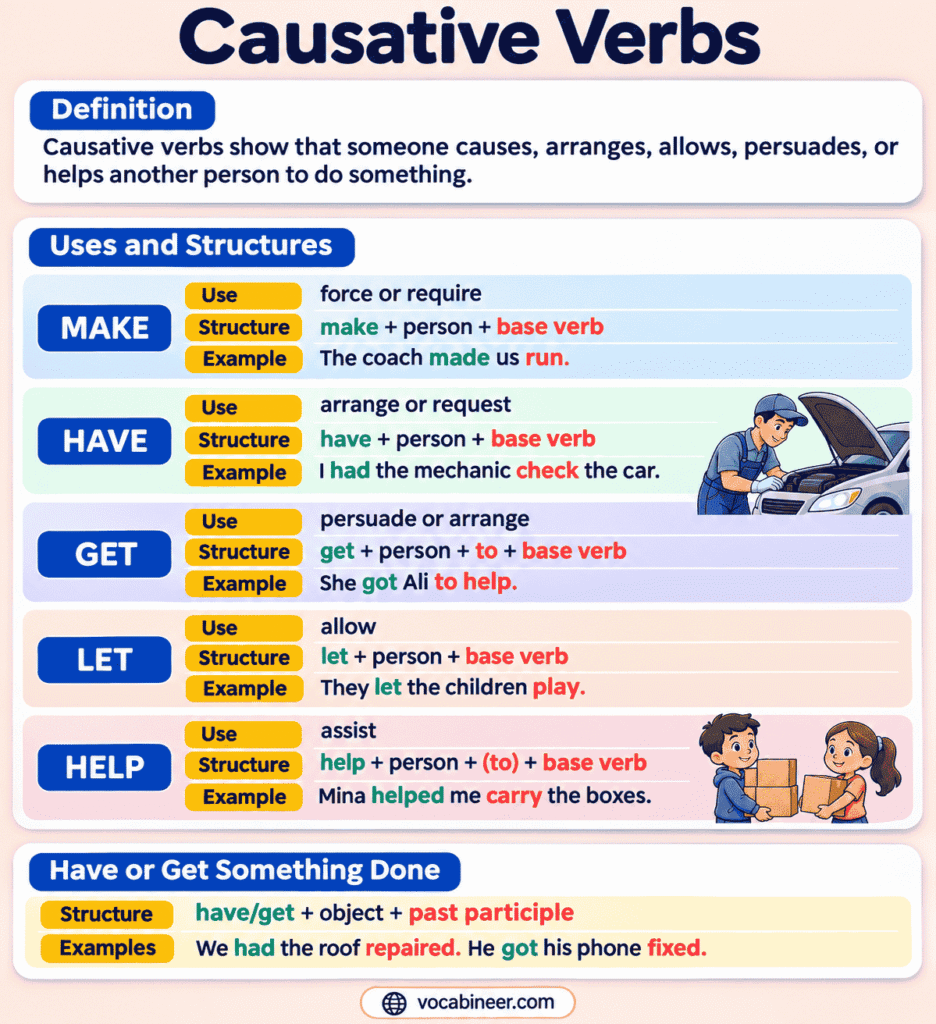
Causative verbs show that a person or thing causes, arranges, allows, persuades, or helps an action happen. In “The manager had Leo print the report,” the manager did not print it. Instead, the manager arranged for Leo to perform the action.
The most common causative verbs in English are make, have, get, let, and help. Although they share the idea of causation, they express different meanings and require different verb forms. Understanding these patterns helps you describe instructions, permission, persuasion, assistance, paid services, and unwanted experiences accurately.
In This Page
What Are Causative Verbs?
A causative verb indicates that the subject causes another person or thing to perform an action or enter a particular condition. The subject may force, request, arrange, permit, persuade, or assist rather than complete the action personally.
Consider these sentences:
- Maya repaired the computer. Maya performed the action herself.
- Maya had the technician repair the computer. Maya arranged the action, but the technician performed it.
- The joke made Maya laugh. The joke caused Maya to perform the action.
Therefore, causation does not always involve force. It can also involve permission, organization, encouragement, or help.
Causative Verbs and Causative Constructions
A causative verb carries a causative meaning, whereas a causative construction is the complete grammatical pattern built around that verb.
| Term | Meaning | Example |
|---|---|---|
| Causative verb | A verb that expresses cause, arrangement, permission, persuasion, or assistance | made in “The news made her smile.” |
| Causative construction | The complete structure containing the causative verb, an object, and another verb form | “The news made her smile.” |
The construction determines whether the next verb appears as a base verb, a to-infinitive, or a past participle.
How Causative Constructions Work
Most causative sentences contain four basic parts:
| Part | Function | Example |
|---|---|---|
| Subject | Causes or arranges the action | The manager |
| Causative verb | Shows the kind of causation | had |
| Agent or affected object | Performs or receives the action | Leo |
| Action verb | Describes the resulting action |
In “The manager had Leo print the report,” Leo is the agent because he performs the printing. In “The manager had the report printed,” the report is the affected object, while the person who printed it remains unnamed.
Ordinary and Causative Uses of the Same Verbs
The verbs make, have, get, let, and help do not always function causatively. Their role depends on their meaning and the structure that follows them.
| Verb | Ordinary use | Causative use |
|---|---|---|
| Make | She made a cake. | She made me apologize. |
| Have | We have a new printer. | We had the assistant test it. |
| Get | He got a message. | He got the team to cooperate. |
| Let | They let the dog outside. | They let us leave early. |
| Help | Your advice helped. | Your advice helped me decide. |
In each causative example, the verb connects the cause to another action.
Main Causative Verbs and Their Structures
The five principal causative verbs differ in meaning and grammatical pattern.
| Verb | Basic structure | Main meaning | Example |
|---|---|---|---|
| Make | make + object + base verb | Force or strongly cause | The coach made us run. |
| Have | have + object + base verb | Arrange, request, or instruct | I had Leo check the figures. |
| Get | get + object + to-infinitive | Persuade or arrange | I got Leo to check the figures. |
| Let | let + object + base verb | Allow or permit | They let us enter. |
| Help | help + object + base verb/to-infinitive | Assist | She helped me carry the boxes. |
Make: Forcing or Strongly Causing an Action
Use make + object + base verb when someone forces another person to act or when something strongly causes a result.
Structure: subject + make + object + base verb
- The teacher made the students rewrite their work.
- The loud noise made the baby cry.
- That film always makes me laugh.
The object can refer to a person or a thing. For example, “The heat made the ice melt” describes an inanimate cause acting on a thing.
Have: Arranging, Requesting, or Instructing
Use have + object + base verb when the subject gives someone responsibility for an action or arranges for that person to perform it.
Structure: subject + have + person + base verb
- I had the receptionist confirm the appointment.
- The director had the actors repeat the scene.
- We will have the technician inspect the system.
This structure often sounds neutral and suggests an arrangement, instruction, or professional responsibility rather than persuasion.
Get: Persuading or Arranging
Use get + object + to-infinitive when the subject persuades, encourages, or manages to make someone act.
Structure: subject + get + person + to-infinitive
- She got her brother to drive her home.
- We finally got the children to tidy their room.
- How did you get them to agree?
Compared with have, get often suggests that the subject made an effort to secure the other person’s cooperation.
Let: Giving Permission
Use let + object + base verb when someone allows another person or thing to act.
Structure: subject + let + object + base verb
- Her parents let her attend the concert.
- Please let me explain.
- He let the engine run for a few minutes.
Do not place to before the action verb after causative let.
Help: Assisting an Action
Use help + object + base verb or help + object + to-infinitive. Both patterns are correct, although the form without to is especially common.
Structures:
- subject + help + object + base verb
- subject + help + object + to-infinitive
Examples:
- The guide helped us find the station.
- The guide helped us to find the station.
- Regular practice helps learners improve their fluency.
Unlike make, help expresses assistance rather than force.
Direct Actions and Caused Actions
The key difference is who performs the main action.
| Direct action | Caused action | Difference |
|---|---|---|
| I cleaned the windows. | I had the cleaner clean the windows. | I did it myself in the first sentence. |
| Sara repaired her laptop. | Sara got a technician to repair her laptop. | A technician performed the second action. |
| Tom left the room. | The teacher made Tom leave the room. | The teacher caused the second action. |
This distinction prevents misleading statements. For example, “I cut my hair” normally means that I used the scissors myself, while “I had my hair cut” means that another person cut it for me.
Causatives with People and Things
A causative object can be a person, an animal, or a thing.
| Type of object | Example | Explanation |
|---|---|---|
| Person | The manager made him wait. | A person performs the resulting action. |
| Animal | She let the dog run outside. | An animal receives permission to act. |
| Thing | The cold made the pipes freeze. | A condition causes a physical result. |
When a pronoun follows a causative verb, use an object pronoun: me, you, him, her, it, us, or them.
- Correct: She helped me finish the task.
- Incorrect: She helped I finish the task.
- Correct: They made him apologize.
- Incorrect: They made he apologize.
Active Causative Structures
An active causative identifies the person or thing that performs the resulting action.
| Structure | Example | Meaning |
|---|---|---|
| have + person + base verb | I had Nina send the email. | I arranged or instructed Nina to send it. |
| get + person + to-infinitive | I got Nina to send the email. | I persuaded or managed to get Nina to send it. |
| make + person + base verb | I made Nina send the email. | I forced Nina to send it. |
| let + person + base verb | I let Nina send the email. | I allowed Nina to send it. |
| help + person + base verb/to-infinitive | I helped Nina send the email. | I assisted Nina. |
Although these sentences describe the same general action, they communicate very different relationships between the subject and the agent.
Passive Causative Structures
The passive causative focuses on the affected object or completed action rather than the person performing it. English commonly uses have and get in this pattern.
Structures:
- subject + have + object + past participle
- subject + get + object + past participle
Examples:
- We had the roof repaired.
- She gets her eyes tested every year.
- I am getting my laptop fixed.
- They will have the documents translated.
The past participle is essential because the object receives the action. Therefore, say “I had my car repaired,” not “I had my car repair.”
Using Passive Causatives for Services
Passive causatives frequently describe services that someone arranges or pays another person to perform.
- He had his suit cleaned.
- We are getting the kitchen painted.
- She has her hair trimmed every six weeks.
- They will get the air conditioner serviced tomorrow.
The agent usually remains unstated because the service matters more than the person providing it.
Naming the Agent with By
When the performer is relevant, add by + agent after the past participle.
- We had the roof inspected by an engineer.
- She got the document translated by a certified translator.
However, omit the agent when it is unknown, obvious, or unimportant.
Describing Unwanted Experiences
The pattern have + object + past participle can also describe an event that the subject did not arrange and did not want.
- She had her phone stolen.
- We had our windows broken during the storm.
- He had his application rejected.
Context reveals whether the subject arranged the action or merely experienced it.
| Arranged action | Unwanted experience |
|---|---|
| She had her portrait painted. | She had her handbag stolen. |
| We had the trees trimmed. | We had two trees damaged in the storm. |
| He had his teeth checked. | He had a tooth knocked out. |
Active and Passive Causatives Compared
| Feature | Active causative | Passive causative |
|---|---|---|
| Focus | Person performing the action | Object receiving the action |
| Agent | Usually stated | Usually omitted |
| Following verb | Base verb or to-infinitive | Past participle |
| Example | We had Mia clean the office. | We had the office cleaned. |
| Main purpose | Emphasize who acts | Emphasize the service or result |
The active form answers “Who did it?” while the passive form emphasizes “What was done?”
Have and Get in Causative Structures
Both have and get can describe arrangements, but they differ in structure and tone.
| Feature | Have | Get |
|---|---|---|
| Active structure | have + person + base verb | get + person + to-infinitive |
| Active example | I had Sam call the supplier. | I got Sam to call the supplier. |
| Typical implication | Neutral arrangement or instruction | Persuasion, effort, or successful arrangement |
| Passive structure | have + object + past participle | get + object + past participle |
| Passive example | I had the printer repaired. | I got the printer repaired. |
| Tone | Neutral or slightly more formal | More conversational |
In many passive causatives, have and get communicate nearly the same idea. Nevertheless, get often sounds more informal or emphasizes achieving the result.
Causative Structures and the Ordinary Passive Voice
A passive causative and an ordinary passive sentence may describe the same event, but their emphasis differs.
| Structure | Example | Meaning |
|---|---|---|
| Active sentence | A mechanic repaired the car. | Identifies the performer. |
| Ordinary passive | The car was repaired. | Reports what happened to the car. |
| Passive causative | I had the car repaired. | Shows that I arranged or experienced the action. |
Therefore, the word passive in “passive causative” describes the relationship between the object and the past participle. It does not mean that the entire sentence is simply an ordinary passive construction.
Causative Verbs in Different Tenses
The causative verb changes according to tense, while the required form of the following action verb remains the same.
| Tense or form | Active causative | Passive causative |
|---|---|---|
| Present simple | I have Leo check the system. | I have the system checked. |
| Past simple | I had Leo check the system. | I had the system checked. |
| Future simple | I will have Leo check the system. | I will have the system checked. |
| Present continuous | I am having Leo check the system. | I am having the system checked. |
| Present perfect | I have had Leo check the system. | I have had the system checked. |
| Past perfect | I had had Leo check the system. | I had had the system checked. |
| Modal verb | I may have Leo check the system. | I may have the system checked. |
The form had had is grammatically correct: the first had marks the past perfect, while the second is the causative verb.
Negative Causative Sentences
Form negatives by placing not with the appropriate auxiliary verb. The causative pattern after it does not change.
- The teacher did not make us stay.
- She did not let him use the car.
- I could not get them to respond.
- We have not had the heating repaired yet.
- He will not have the assistant contact you.
Be careful with meaning. “She did not make him leave” means she did not force him, while “She made him not leave” means she forced him to remain. The position of not changes the message.
Questions with Causative Verbs
Use the auxiliary required by the tense or verb phrase.
- Did the manager make you rewrite the report?
- Why did they let him enter?
- How did you get the baby to sleep?
- Have you had your eyes tested recently?
- When will you get the roof repaired?
- Can you help me carry these boxes?
In each question, retain the usual causative structure after the subject.
Causative Verbs with Modal Verbs
Place the modal before the causative verb, and keep the causative verb in its base form.
Structure: subject + modal + causative verb + object + required verb form
- You should have a mechanic inspect the brakes.
- We may get the designer to revise the logo.
- They must let the children rest.
- This tool can help you organize the data.
- The delay might make us miss the train.
In passive causatives, the past participle still follows the object: “You should have the brakes inspected.”
The Passive Form of Make
Active causative make takes a base verb, but passive make requires a to-infinitive.
| Voice | Structure | Example |
|---|---|---|
| Active | make + object + base verb | The coach made us run. |
| Passive | be made + to-infinitive | We were made to run. |
Additional examples include:
- The teacher made him apologize. → He was made to apologize.
- The company made them work late. → They were made to work late.
This change is a special rule, so “We were made run” is incorrect.
Using Let in Passive Sentences
English does not normally use causative let in a passive pattern followed directly by another verb. Instead, replace it with be allowed to.
| Active with let | Natural passive equivalent |
|---|---|
| They let us leave early. | We were allowed to leave early. |
| Her parents let her travel alone. | She was allowed to travel alone. |
| The guard let him enter. | He was allowed to enter. |
Forms such as “We were let leave” are incorrect. However, let can appear passively before an adverb or particle in expressions such as “The dog was let out.”
Other Verbs That Express Causation
English also uses several verbs with meanings related to force, permission, encouragement, and enablement. Unlike make, have, and let, most of these verbs take a to-infinitive.
| Verb | Common structure | Example |
|---|---|---|
| Cause | cause + object + to-infinitive | The fault caused the machine to stop. |
| Force | force + object + to-infinitive | They forced him to resign. |
| Compel | compel + object + to-infinitive | The evidence compelled her to respond. |
| Allow | allow + object + to-infinitive | They allowed us to enter. |
| Permit | permit + object + to-infinitive | The rules permit visitors to take photos. |
| Enable | enable + object + to-infinitive | The grant enabled them to continue. |
| Persuade | persuade + object + to-infinitive | She persuaded him to apply. |
| Encourage | encourage + object + to-infinitive | We encouraged them to participate. |
| Require | require + object + to-infinitive | The policy requires staff to register. |
These verbs express causation broadly, but their meanings and patterns differ from the five core causative verbs.
Common Mistakes with Causative Verbs
| Incorrect | Correct | Explanation |
|---|---|---|
| She made me to wait. | She made me wait. | Active make takes a base verb. |
| They let us to enter. | They let us enter. | Let takes a base verb. |
| I had him to call me. | I had him call me. | Active causative have takes a base verb. |
| We got her join us. | We got her to join us. | Get takes a to-infinitive. |
| I had my car repair. | I had my car repaired. | A passive causative requires a past participle. |
| We were made wait. | We were made to wait. | Passive make takes a to-infinitive. |
| He was let to leave. | He was allowed to leave. | Use be allowed to as the passive equivalent of causative let. |
| She helped I finish. | She helped me finish. | Use an object pronoun after help. |
Another common error involves confusing the performer with the affected object. Compare “I had the mechanic repair the car” with “I had the car repaired.” The first names the agent and therefore uses a base verb; the second places the affected object before a past participle.
Quick Reference to Causative Verb Patterns
| Meaning | Pattern | Example |
|---|---|---|
| Force or strongly cause | make + object + base verb | The news made her cry. |
| Arrange or instruct | have + person + base verb | I had Dan deliver the parcel. |
| Persuade or manage | get + person + to-infinitive | I got Dan to deliver the parcel. |
| Give permission | let + object + base verb | They let us stay. |
| Assist | help + object + base verb/to-infinitive | She helped me prepare. |
| Arrange a service | have/get + object + past participle | We had the lock changed. |
| Report an unwanted experience | have + object + past participle | He had his bicycle stolen. |
| Form passive make | be made + to-infinitive | He was made to apologize. |
| Express passive permission | be allowed + to-infinitive | We were allowed to enter. |
FAQs
A causative verb shows that someone or something causes, arranges, permits, persuades, or helps an action happen. The subject does not necessarily perform the main action.
The five main causative verbs are make, have, get, let, and help. Each expresses a different relationship and follows a particular grammatical structure.
Have usually describes a neutral arrangement or instruction, while get often suggests persuasion or effort. Compare “I had Sam call the supplier” with “I got Sam to call the supplier.”
An active causative identifies the person performing the action: “I had Sam clean the room.” A passive causative focuses on the affected object: “I had the room cleaned.”
The structure is subject + have/get + object + past participle. For example, “She had her hair cut” and “He got his car repaired” describe actions performed by someone else.
Read More
- Parts of Speech in English
- Nouns in English with Examples
- Common and Proper Nouns
- Countable and uncountable nouns
- Collective nouns
- Abstract and concrete nouns
- Gender nouns
- Compound nouns
- Possessive nouns
- Singular and plural nouns
- Plural noun rules