

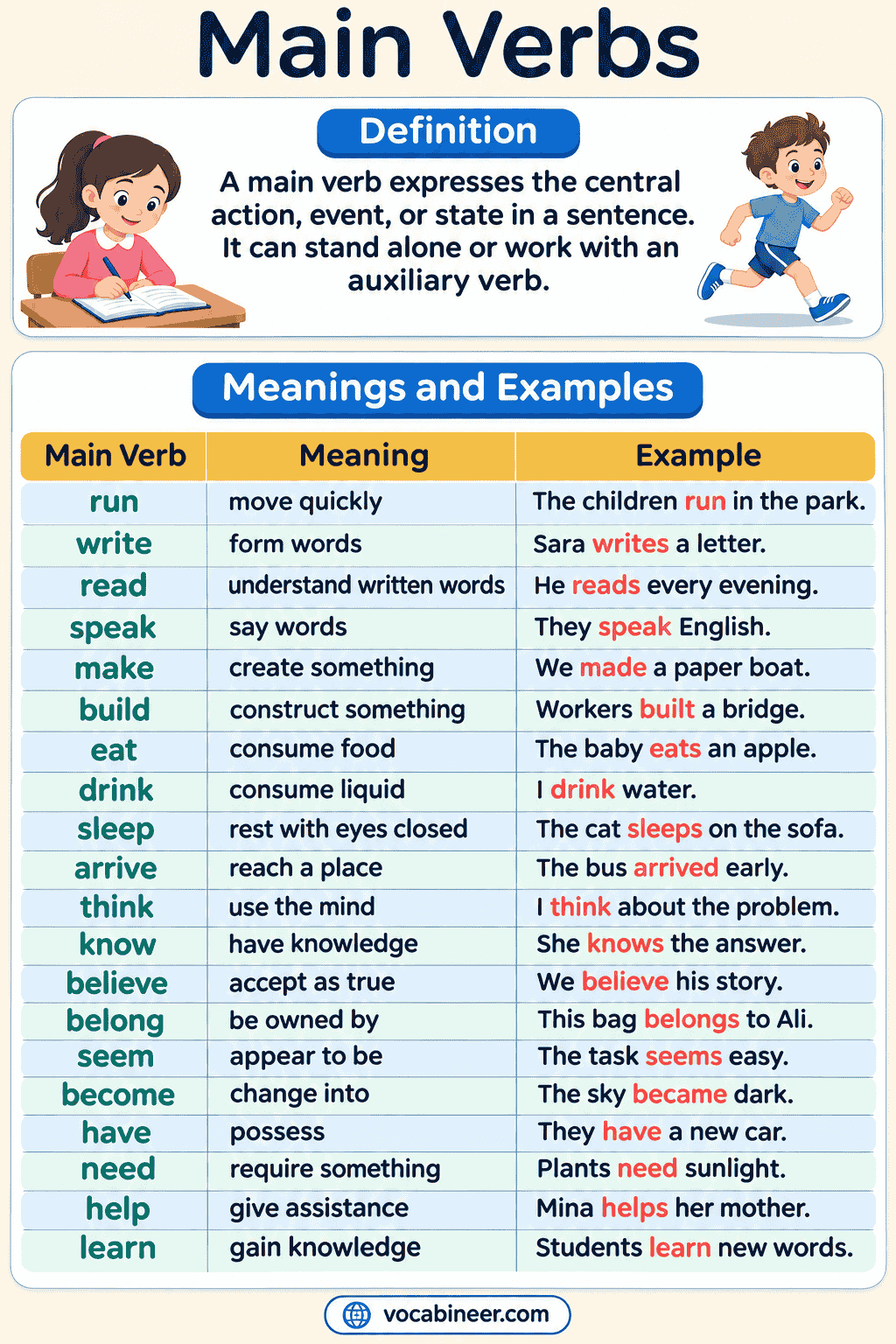
Every complete English clause needs a verb, and the main verb carries its central action, event, state, or linking meaning. In “The children laughed,” laughed is the main verb. In “The children were laughing,” were helps form the tense and aspect, while laughing remains the meaning-carrying verb.
Main verbs may appear alone or as part of longer verb phrases. They can be action, event, stative, or linking verbs; regular or irregular; finite or non-finite; and transitive or intransitive. This guide explains these overlapping classifications and shows how to identify and use main verbs correctly in statements, questions, negatives, commands, passive sentences, and complex structures.
In This Page
What Is a Main Verb?
A main verb carries the central verbal meaning in a clause or verb phrase. It tells us what the subject does, what happens, what state exists, or how the subject is described or identified.
- Mia opened the window. The verb expresses an action.
- The accident happened yesterday. The verb expresses an event.
- I understand the problem. The verb expresses a mental state.
- The soup tastes delicious. The verb links the subject to a description.
A main verb can form a complete verb phrase by itself, as in “Mia opened the window.” It can also follow one or more auxiliary verbs, as in “Mia might have opened the window.”
Main Verbs and Lexical Verbs
Learner grammars often use main verb, lexical verb, and full verb for the meaning-carrying verb in a clause. However, terminology can vary between grammar systems.
| Term | Main emphasis |
|---|---|
| Main verb | The verb’s central role in a clause or verb phrase |
| Lexical verb | The dictionary meaning contributed by the verb |
| Full verb | Another term sometimes used for a lexical verb |
| Auxiliary verb | A verb that adds grammatical meaning to another verb |
In this article, main verb refers to the verb that contributes the central action, event, state, or link.
Main Verb and Predicate Compared
The main verb forms part of the predicate, but it is not always the entire predicate.
| Term | Meaning | Example from “Sara opened the window quietly” |
|---|---|---|
| Subject | The person or thing the clause is about | Sara |
| Main verb | Carries the central verbal meaning | opened |
| Predicate | Says something about the subject | opened the window quietly |
Therefore, opened is the main verb, while opened the window quietly is the complete predicate in a traditional analysis.
Main Verbs and Complete Verb Phrases
A verb phrase contains a main verb alone or a main verb with one or more auxiliaries. The auxiliaries add grammatical information, while the main verb supplies the central meaning.
| Complete verb phrase | Auxiliary verbs | Main verb |
|---|---|---|
| works | — | works |
| is working | is | working |
| has worked | has | worked |
| has been working | has, been | working |
| might work | might | work |
| might have worked | might, have | worked |
| might have been working | might, have, been | working |
| was repaired | was | repaired |
In “She might have been working,” the complete verb phrase is might have been working. The words might, have, and been are auxiliaries, while working is the main verb.
Main, Auxiliary, and Modal Verbs
Main verbs, primary auxiliaries, and modal auxiliaries perform different jobs.
| Verb type | Function | Example |
|---|---|---|
| Main verb | Carries the central meaning | She writes clearly. |
| Primary auxiliary | Forms aspect, voice, questions, negatives, or emphasis | She is writing. |
| Modal auxiliary | Expresses ability, possibility, permission, necessity, or prediction | She might write. |
The primary auxiliaries are be, do, and have. Common modal verbs include can, could, may, might, must, shall, should, will, and would.
Consider this sentence:
She might have been writing all morning.
- Might expresses possibility.
- Have helps form the perfect aspect.
- Been helps form the continuous aspect.
- Writing provides the central meaning.
The Order of Verbs in a Verb Phrase
When several auxiliaries appear, they usually follow this order:
modal + perfect have + continuous be + passive be + main verb
| Verb phrase | Modal | Perfect auxiliary | Continuous auxiliary | Passive auxiliary | Main verb |
|---|---|---|---|---|---|
| may work | may | — | — | — | work |
| may have worked | may | have | — | — | worked |
| may have been working | may | have | been | — | working |
| may have been repaired | may | have | — | been | repaired |
| may have been being repaired | may | have | been | being | repaired |
The final example is grammatically possible but uncommon because its long chain sounds heavy. Nevertheless, it clearly shows the fixed auxiliary order.
Be, Do, and Have as Main and Auxiliary Verbs
The verbs be, do, and have can function as main verbs or auxiliaries. Their role depends on the structure and meaning of the sentence.
| Verb | As a main verb | As an auxiliary |
|---|---|---|
| Be | She is a teacher. | She is working. |
| Do | I did my homework. | Did you finish? |
| Have | They have a car. | They have finished. |
As main verbs, these words carry the central meaning:
- She is happy.
- We did the work.
- He has two brothers.
As auxiliaries, they support another verb:
- She is studying.
- Do you understand?
- He has completed the course.
Main Types of Main Verbs
Main verbs can be grouped by the kind of meaning they express.
| Type | Function | Example |
|---|---|---|
| Action verb | Expresses physical or mental activity | She opened the door. |
| Event verb | Describes something that happens | The accident occurred yesterday. |
| Stative verb | Expresses a condition, thought, possession, feeling, or relationship | He knows the answer. |
| Linking verb | Connects the subject to a description or identity | She became a doctor. |
Action Main Verbs
Action verbs express physical or mental activities.
- The children ran across the field.
- She wrote a letter.
- We calculated the total.
- He considered the proposal.
Mental actions such as analyze, calculate, investigate, and consider can function as action verbs even though the action is not physically visible.
Event Main Verbs
Event verbs describe occurrences, developments, and changes.
- The meeting began at nine.
- The accident happened suddenly.
- Prices fell during the month.
- The situation changed quickly.
The subject may not deliberately cause the event.
Stative Main Verbs
Stative verbs express conditions, possession, knowledge, beliefs, emotions, preferences, or relationships.
- I know the answer.
- She owns the building.
- They prefer tea.
- This bag belongs to me.
Stative meanings usually appear in simple rather than continuous forms. However, some verbs become dynamic when their meaning changes.
Linking Main Verbs
Linking verbs connect the subject to a subject complement that describes or identifies it.
- The soup tastes delicious.
- She became a doctor.
- He seems tired.
- The children remained quiet.
The words delicious, a doctor, tired, and quiet describe or identify the subjects. They are not direct objects.
One Verb with Different Functions
A verb’s classification depends on its use in a particular sentence.
| Verb | First function | Second function |
|---|---|---|
| Feel | She felt the fabric. Action and transitive | The fabric felt soft. Linking |
| Grow | They grow tomatoes. Transitive | The tomatoes grow quickly. Intransitive |
| Look | She looked at me. Action | She looked tired. Linking |
| Taste | The chef tasted the soup. Action | The soup tasted salty. Linking |
| Have | They have a car. Main verb | They have finished. Auxiliary |
Therefore, labels such as action, stative, linking, and transitive describe a verb’s function in context rather than a permanent property of the word.
The Five Forms of Main Verbs
English main verbs commonly have five forms.
| Form | Example with write | Common use |
|---|---|---|
| Base form | write | Modals, infinitives, commands, and most present forms |
| Third-person singular | writes | Present simple with he, she, or it |
| Past form | wrote | Past simple |
| Present participle | writing | Continuous forms and non-finite clauses |
| Past participle | written | Perfect forms, passive voice, and non-finite clauses |
Examples include:
- I write every day.
- She writes every day.
- They wrote yesterday.
- He is writing now.
- We have written the report.
The verb be is unusually variable, with forms such as am, is, are, was, were, being, and been.
Regular and Irregular Main Verbs
Regular verbs form the past and past participle with -ed or -d. Irregular verbs use other patterns.
| Regular verb | Irregular verb |
|---|---|
| walk–walked–walked | go–went–gone |
| play–played–played | sing–sang–sung |
| open–opened–opened | take–took–taken |
| study–studied–studied | write–wrote–written |
| stop–stopped–stopped | break–broke–broken |
Regularity concerns verb formation. Both regular and irregular verbs can function as main verbs.
Finite and Non-Finite Main Verbs
A meaning-carrying verb can be finite or non-finite.
| Form | Example | Function |
|---|---|---|
| Finite | She works here. | Shows tense and agrees with the subject |
| To-infinitive | She wants to work here. | Heads a non-finite infinitive clause |
| Bare infinitive | She can work here. | Follows a modal auxiliary |
| Present participle | Working late made her tired. | Heads a non-finite -ing clause |
| Past participle | The documents sent yesterday arrived. | Heads a reduced participial clause |
A finite verb shows tense or modality and can serve as the grammatical center of an independent clause. A non-finite verb does not independently show tense or subject agreement.
Therefore, main verb and finite verb are not identical terms. A lexical verb can carry meaning inside either a finite or non-finite clause.
Main Verbs and Their Sentence Patterns
The main verb determines which objects, complements, or clauses may follow it. This property is sometimes called the verb’s valency or complementation pattern.
Intransitive Main Verbs
An intransitive verb does not take a direct object.
Structure: subject + main verb
- The baby slept.
- Everyone laughed.
- The accident happened.
Additional information may follow, but it is not a direct object: “The baby slept peacefully.”
Transitive Main Verbs
A transitive verb takes a direct object.
Structure: subject + main verb + object
- She opened the window.
- I understand the question.
- They built a shelter.
The object answers what? or whom? after the verb.
Ditransitive Main Verbs
A ditransitive verb can take an indirect object and a direct object.
Structure: subject + main verb + indirect object + direct object
- He sent me a message.
- She gave the child a gift.
- They taught us English.
Many ditransitive sentences have an alternative prepositional pattern: “He sent a message to me.”
Linking Main Verbs
A linking verb takes a subject complement rather than a direct object.
Structure: subject + linking verb + subject complement
- She became a doctor.
- The soup tastes delicious.
- He seems tired.
The complement describes or identifies the subject.
Complex Transitive Main Verbs
A complex transitive verb takes an object followed by an object complement.
Structure: subject + main verb + object + object complement
- They painted the wall blue.
- We elected Sara captain.
- The news made him happy.
The complement describes or identifies the object rather than the subject.
Ergative Main Verbs
Some verbs alternate between transitive and intransitive patterns. The object in the transitive sentence corresponds to the subject in the intransitive sentence.
| Transitive | Intransitive |
|---|---|
| Sara opened the door. | The door opened. |
| He boiled the water. | The water boiled. |
| They broke the glass. | The glass broke. |
| We changed the plan. | The plan changed. |
These are often called ergative verbs in grammar descriptions.
Main Verbs and Their Complements
Main verbs can select many structures beyond ordinary noun objects.
| Pattern | Example |
|---|---|
| verb + to-infinitive | She wants to leave. |
| verb + bare infinitive | They made us wait. |
| verb + -ing form | He enjoys reading. |
| verb + that-clause | I believe that she is right. |
| verb + wh-clause | She explained what happened. |
| verb + if/whether clause | They asked whether we agreed. |
| verb + object + to-infinitive | We encouraged him to apply. |
| verb + object + bare infinitive | She let us leave. |
| verb + object + object complement | They painted the wall blue. |
Different main verbs require different complements. For example, English uses “enjoy reading,” not “enjoy to read,” but it uses “want to read,” not normally “want reading.”
Main Verbs in Tense, Aspect, and Voice
The main verb changes form according to the tense, aspect, or voice expressed by the complete verb phrase.
| Grammatical meaning | Structure | Example |
|---|---|---|
| Present simple | main verb | She writes. |
| Past simple | past-form main verb | She wrote. |
| Present continuous | be + present participle | She is writing. |
| Present perfect | have + past participle | She has written. |
| Perfect continuous | have + been + present participle | She has been writing. |
| Passive voice | be + past participle | The letter was written. |
| Modal meaning | modal + base form | She may write. |
| Modal perfect | modal + have + past participle | She may have written. |
The auxiliaries carry much of the grammatical information, while the main verb contributes the central meaning.
Main Verbs in Questions and Negative Sentences
When a present or past simple statement contains no auxiliary, English generally introduces do, does, or did to form questions and negatives.
| Statement | Question | Negative |
|---|---|---|
| She works here. | Does she work here? | She does not work here. |
| They like coffee. | Do they like coffee? | They do not like coffee. |
| He left early. | Did he leave early? | He did not leave early. |
After do, does, or did, use the base form of the main verb:
- Correct: Does she work here?
- Incorrect: Does she works here?
- Correct: Did he go home?
- Incorrect: Did he went home?
The main verb be does not normally use do-support:
- She is ready.
- Is she ready?
- She is not ready.
Emphatic Do
Do, does, and did can also emphasize a positive statement.
- I do understand.
- She does work hard.
- They did finish the project.
The main verb remains in the base form after emphatic do.
Main-Verb Ellipsis in Short Answers
An auxiliary may appear without an expressed main verb when the missing meaning is clear from context.
- “Does she work here?” “Yes, she does.”
- “Have they finished?” “Yes, they have.”
- “Can he swim?” “Yes, he can.”
In these answers, the auxiliary represents an understood verb phrase. It does not become the main verb.
Main Verbs and Subject–Verb Agreement
In the present simple, the main verb usually adds -s or -es with a third-person singular subject.
| Subject | Verb form |
|---|---|
| I/you/we/they | work |
| he/she/it | works |
| singular noun | works |
| plural noun | work |
Examples include:
- The student writes carefully.
- The students write carefully.
- My brother has a car.
- My brothers have a car.
In longer verb phrases, the first auxiliary normally carries agreement:
- She is working.
- They are working.
- He has finished.
- They have finished.
Main Verbs in Imperatives
Commands use the base form of the main verb with an understood subject, usually you.
- Open the door.
- Please sit down.
- Be careful.
- Bring your notebook.
Negative commands use do not or don’t before the base-form main verb:
- Do not touch the glass.
- Don’t open the window.
- Don’t be late.
Although the subject is not normally written, the imperative still contains a main verb.
Phrasal Verbs as Main Verbs
A phrasal verb combines a verb with one or more particles and can function as the central lexical unit of a clause.
- The plane took off.
- She turned down the offer.
- We have run out of milk.
- He looked after the children.
The complete combination carries the meaning, but only the verb element changes form:
| Base | Past | Past participle |
|---|---|---|
| take off | took off | taken off |
| give up | gave up | given up |
| run out | ran out | run out |
Therefore, identifying the main verb may require recognizing the complete phrasal expression.
How to Identify the Main Verb in a Sentence
Use the following method:
- Locate every verb or verb phrase.
- Identify modal verbs and the auxiliaries be, do, and have.
- Find the verb that carries the main action, event, state, or linking meaning.
- Check whether it forms part of a phrasal verb.
- Examine each clause separately when the sentence contains more than one clause.
| Sentence | Complete verb phrase | Main verb |
|---|---|---|
| She sings beautifully. | sings | sings |
| She is singing. | is singing | singing |
| She has been singing. | has been singing | singing |
| She might have been singing. | might have been singing | singing |
| The song was recorded. | was recorded | recorded |
| The meeting was called off. | was called off | called off |
In passive constructions, the past participle supplies the main lexical meaning, while be acts as the auxiliary.
Verb Forms That Are Not Main Verbs
A word that looks like a verb may function as a noun, adjective, or modifier instead of serving as the clause’s main verb.
| Sentence | Form | Function |
|---|---|---|
| Swimming is enjoyable. | swimming | -ing form functioning as the subject |
| The broken window needs repair. | broken | Participial adjective modifying window |
| The children are swimming. | swimming | Main verb within are swimming |
| The window was broken by the ball. | broken | Main verb within the passive phrase |
| Tired workers need rest. | tired | Adjective modifying workers |
The form alone does not determine the function. You must examine the complete sentence structure.
Main Verbs in Complex Sentences
A sentence may contain several main or lexical verbs because it contains multiple clauses, coordinated verbs, or non-finite structures.
Coordinated Main Verbs
A single subject may have two coordinated main verbs:
- Sara opened the window and looked outside.
- The children laughed and shouted.
Both verbs belong to the same coordinated predicate.
Main Verbs in Different Clauses
Each clause may contain its own main verb.
| Sentence | Main or lexical verbs |
|---|---|
| I think that she knows the answer. | think, knows |
| When the bell rang, the students left. | rang, left |
| She promised that she would call. | promised, call |
| We stayed because it was raining. | stayed, raining |
Main Verbs in Non-Finite Clauses
Non-finite clauses can contain meaning-carrying verbs that do not independently show tense.
- He wants to leave.
- She enjoys reading.
- Working late made him tired.
In “He wants to leave,” wants is the finite main verb of the main clause, while leave is the lexical verb of the non-finite infinitive clause.
Therefore, “Every sentence has only one main verb” is not a reliable rule. A simple clause normally centers on one main verb, but a complete sentence may contain several clauses or coordinated verbs.
Common Mistakes with Main Verbs
| Incorrect | Correct | Explanation |
|---|---|---|
| She does works here. | She does work here. | Use the base form after does. |
| Did he went home? | Did he go home? | Use the base form after did. |
| She is know the answer. | She knows the answer. | Do not add be to a simple stative verb. |
| He have finished. | He has finished. | Make the auxiliary agree with the subject. |
| They was working. | They were working. | Use the correct form of be. |
| The letter was wrote. | The letter was written. | Passive voice requires the past participle. |
| She became happily. | She became happy. | A linking verb takes a subject complement. |
| The students writes well. | The students write well. | A plural subject takes the base present form. |
| He enjoys to read. | He enjoys reading. | Enjoy takes an -ing complement. |
| She wants leaving. | She wants to leave. | Want normally takes a to-infinitive. |
Another common error is confusing the complete verb phrase with the main verb. In “She has been working,” the complete verb phrase is has been working, but working carries the central lexical meaning.
Quick Reference to Main Verb Patterns
| Feature | Rule | Example |
|---|---|---|
| Main verb alone | Can form a complete verb phrase | She works. |
| Main verb after auxiliaries | Usually appears at the end of the verb chain | She has been working. |
| After a modal | Use the base form | She can work. |
| After do, does, or did | Use the base form | Did she work? |
| Continuous aspect | Use be + present participle | She is working. |
| Perfect aspect | Use have + past participle | She has worked. |
| Passive voice | Use be + past participle | The work was completed. |
| Linking pattern | Follow with a subject complement | She became tired. |
| Transitive pattern | Follow with an object | She opened the door. |
| Intransitive pattern | Do not use a direct object | The baby slept. |
| Imperative | Use the base form | Open the door. |
| Phrasal main verb | Include the particle in the meaning | The plane took off. |
FAQs
A main verb carries the central action, event, state, or linking meaning in a clause or verb phrase. It may appear alone, as in “She works,” or after auxiliaries, as in “She has been working.”
A main verb contributes the central meaning, while a helping or auxiliary verb adds grammatical information such as aspect, voice, questions, negation, or modality. In “She has finished,” has is the helping verb and finished is the main verb.
Yes. They are main verbs in sentences such as “She is a doctor,” “I did my work,” and “They have a car.” They are auxiliaries in “She is working,” “Do you agree?” and “They have finished.”
Find the complete verb phrase, separate any modal or auxiliary verbs, and identify the verb that carries the central meaning. In “They might have been waiting,” waiting is the main verb.
Yes. A sentence may contain coordinated verbs or several clauses. In “Sara opened the door and looked outside,” both opened and looked are main verbs. In “I think that she knows,” think and knows belong to different clauses.
Read More
- Parts of Speech in English
- Nouns in English with Examples
- Common and Proper Nouns
- Countable and uncountable nouns
- Collective nouns
- Abstract and concrete nouns
- Gender nouns
- Compound nouns
- Possessive nouns
- Singular and plural nouns
- Plural noun rules