

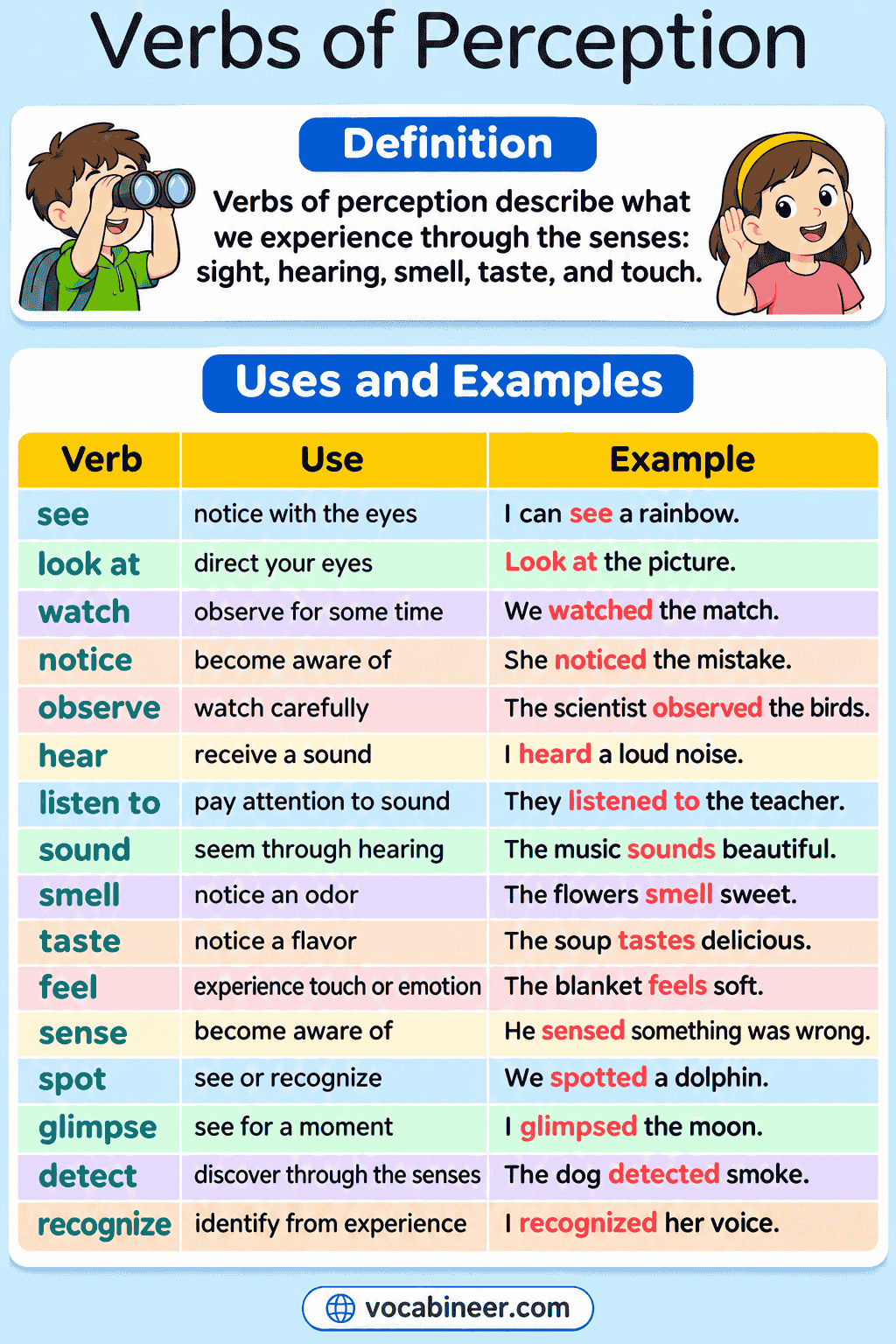
Verbs of perception describe what people and animals experience through sight, hearing, smell, taste, and touch. Common examples include see, hear, watch, notice, smell, taste, and feel. These verbs help us report both the sensory experience and any action that we perceive.
However, perception verbs do not all follow the same grammar. Some describe automatic perception, while others express deliberate attention. They can also take a direct object, a bare infinitive, an -ing form, a past participle, an adjective, or a complete clause. Understanding these patterns makes descriptions clearer and prevents common mistakes such as “I saw him to leave.”
In This Page
What Are Verbs of Perception?
Verbs of perception express how someone receives, notices, or deliberately seeks information through the senses. They connect a perceiver—the person or animal experiencing something—with a stimulus, such as a sight, sound, smell, taste, texture, or physical action.
Consider these examples:
- I saw a flash of light.
- We heard someone knocking.
- She smelled smoke.
- He tasted the sauce.
- They felt the building shake.
Some perception verbs also express mental interpretation rather than a literal sensory experience. For example, “I see what you mean” refers to understanding, while “I feel that this is unfair” expresses an opinion.
How Perception Verbs Work
A perception sentence may contain the following elements:
| Element | Function | Example |
|---|---|---|
| Perceiver | Experiences the perception | I |
| Perception verb | Describes the sensory process | saw |
| Perceived object | Identifies the person or thing perceived | him |
| Perceived action | Describes what that person or thing did | crossing the road |
In “I saw him crossing the road,” I am the perceiver, him is the perceived person, and crossing describes the action in progress.
Common Verbs of Perception by Sense
English contains both everyday and more precise perception verbs.
| Sense or function | Common verbs | Typical purpose |
|---|---|---|
| Sight | see, look at, watch, notice, observe, spot, glimpse | Receive or seek visual information |
| Hearing | hear, listen to, overhear | Receive or attend to sounds |
| Smell | smell, sniff | Notice or investigate an odor |
| Taste | taste | Experience or test flavor |
| Touch and physical sensation | feel, touch | Experience texture, pressure, temperature, or movement |
| General detection | sense, detect, perceive | Become aware through the senses or mind |
The verbs observe, detect, and perceive often sound more formal than see, notice, or sense.
Precise Verbs of Sight and Hearing
| Verb | Meaning | Example |
|---|---|---|
| Notice | Become aware of something | I noticed a crack in the wall. |
| Observe | Watch or study something carefully | The scientists observed the birds. |
| Spot | Notice something that may be difficult to see | She spotted a mistake in the report. |
| Glimpse | See something briefly | I glimpsed him through the window. |
| Overhear | Hear something not intended for you | We overheard their conversation. |
| Detect | Discover something difficult to notice | The device detected a faint sound. |
| Perceive | Become aware through the senses or mind | She perceived a change in his tone. |
These verbs differ in attention, duration, intention, and formality. Therefore, they are not always interchangeable.
Automatic Perception and Deliberate Attention
Some verbs describe information that reaches the senses naturally. Others describe an intentional effort to look, listen, smell, taste, or touch.
| Automatic perception | Deliberate attention |
|---|---|
| see | look at, watch |
| hear | listen to |
| smell | smell, sniff |
| taste | taste |
| feel | feel, touch |
Compare these examples:
- I heard music from the next room. The sound reached me naturally.
- I listened to the music carefully. I deliberately gave it my attention.
- I smelled smoke. I became aware of the odor.
- She sniffed the milk. She deliberately checked its smell.
The same verb can sometimes express automatic perception or deliberate action. Context reveals the intended meaning.
See, Look At, and Watch
These three verbs relate to sight, but they describe different experiences.
| Verb | Main use | Example |
|---|---|---|
| See | Notice something naturally with the eyes | I can see the mountains. |
| Look at | Direct the eyes toward something | Look at this photograph. |
| Watch | Observe something moving, changing, or continuing | We watched the match. |
Use see when something enters your visual awareness, look at when you direct your eyes toward a target, and watch when you observe an activity or development over time.
See a Film and Watch a Film
Both expressions are possible, but their emphasis can differ.
- We saw a film last night. This presents the film as a complete event or outing.
- We watched a film at home. This emphasizes the activity of viewing it.
Similarly, people normally watch television because television presents continuing visual content. However, they may see a show when referring to attending or experiencing the complete event.
Hear and Listen To
Hear describes receiving a sound, while listen to describes intentional attention.
| Verb | Main use | Example |
|---|---|---|
| Hear | Receive a sound naturally | I heard a loud noise. |
| Listen to | Give deliberate attention to a sound | She listened to the announcement. |
| Overhear | Hear something not intended for you | I overheard them discussing the plan. |
Use to before the object of listen:
- Correct: She listened to the music.
- Incorrect: She listened the music.
However, listen can appear without an object: “Please listen carefully.”
Smell, Sniff, Taste, Feel, and Touch
These verbs can describe a sensory state or a deliberate action.
| Verb | Sensory meaning | Deliberate action |
|---|---|---|
| Smell | I smell smoke. | She is smelling the flowers. |
| Sniff | — | The dog sniffed the bag. |
| Taste | The soup tastes salty. | The chef is tasting the soup. |
| Feel | The fabric feels soft. | He is feeling the fabric. |
| Touch | — | Please do not touch the glass. |
Sniff and touch mainly describe deliberate physical actions. By contrast, smell, taste, and feel can describe either an experienced quality or an intentional test.
Stative and Dynamic Uses of Perception Verbs
Perception verbs often function as stative verbs when they describe a sensory condition. Therefore, they usually appear in simple rather than continuous forms. When they express a deliberate, temporary, or extended activity, they can become dynamic.
| Stative use | Dynamic use |
|---|---|
| I see a bird. | I am seeing the doctor tomorrow. |
| I hear music. | The judge is hearing the case. |
| I smell smoke. | She is smelling the perfume. |
| The soup tastes salty. | The chef is tasting the soup. |
| The material feels smooth. | He is feeling the material. |
In “I am seeing the doctor,” see means meet. In “The judge is hearing the case,” hear refers to formally considering legal evidence. These are dynamic meanings rather than ordinary visual or auditory perception.
Avoid continuous forms when the verb simply reports a current sensory state:
- Natural: I see a bird in the garden.
- Usually unnatural: I am seeing a bird in the garden.
Perception Verbs as Linking Verbs
The verbs look, sound, smell, taste, and feel can function as linking verbs. In this role, they connect the subject to a description.
Structure: subject + sensory linking verb + adjective
| Linking verb | Example | Description |
|---|---|---|
| Look | You look tired. | Tired describes you. |
| Sound | The plan sounds reasonable. | Reasonable describes the plan. |
| Smell | The flowers smell fresh. | Fresh describes the flowers. |
| Taste | The soup tastes delicious. | Delicious describes the soup. |
| Feel | The blanket feels soft. | Soft describes the blanket. |
Because the complement describes the subject, use an adjective rather than an adverb. Therefore, “The soup tastes delicious” is correct. “The soup tastes deliciously” would suggest that the soup itself performs the action of tasting in a delicious manner.
Adjective and Like Structures
Sensory linking verbs can also take like + noun or as if/as though + clause.
| Structure | Purpose | Example |
|---|---|---|
| perception verb + adjective | Describes a quality | The material feels soft. |
| perception verb + like + noun | Compares with a person or thing | The material feels like silk. |
| perception verb + as if/as though + clause | Expresses an impression | It sounds as if someone is outside. |
Additional examples include:
- You look like your mother.
- That sounds like a sensible plan.
- The perfume smells like roses.
- This drink tastes like lemon.
- The sky looks as though it might rain.
Smell Of and Smell Like
Both forms describe resemblance or association, but usage varies by context and region.
- The room smells of smoke. Smoke is the identifiable odor in the room.
- The candle smells like vanilla. Its scent resembles vanilla.
In many contexts, either form may communicate a similar idea. However, smell of often identifies the source or dominant odor, while smell like emphasizes resemblance.
Feel Like with Nouns and Gerunds
The pattern feel like has several uses.
| Structure | Meaning | Example |
|---|---|---|
| feel + adjective | Experience a condition | I feel tired. |
| feel like + noun | Want something | I feel like coffee. |
| feel like + gerund | Want to perform an action | I feel like resting. |
| feel like + noun phrase | Resemble something by touch | The fabric feels like silk. |
Therefore, “I feel like resting” expresses desire rather than physical touch.
Main Sentence Patterns with Perception Verbs
Perception verbs can take several kinds of complements. However, not every perception verb accepts every pattern naturally.
Perception Verb Followed by a Direct Object
The simplest pattern identifies what someone perceives.
Structure: subject + perception verb + object
- I saw a bright light.
- She heard a strange sound.
- We smelled smoke.
- He felt a sharp pain.
- They noticed the open window.
Object Followed by a Bare Infinitive
Use a bare infinitive—the base verb without to—to present a perceived action as a complete event or unified whole.
Structure: perception verb + object + base verb
- I saw him cross the road.
- We heard the door slam.
- She watched the bird fly away.
- They felt the building shake.
- He noticed her enter the room.
Do not place to before the action verb in this active structure.
Object Followed by an -ing Form
Use an -ing form to present an action in progress, incomplete, or repeated.
Structure: perception verb + object + -ing form
- I saw him crossing the road.
- We heard the children laughing.
- She watched the birds flying over the lake.
- They felt the ground shaking.
- He noticed someone following him.
Object Followed by a Past Participle
A past participle gives the perceived object a passive or completed meaning.
Structure: perception verb + object + past participle
- I heard my name called.
- She saw the man arrested.
- We found the door locked.
- He felt his arm pulled.
- They noticed the window broken.
The object receives the action: someone called my name, arrested the man, locked the door, and pulled his arm.
Perception Verb Followed by a That-Clause
A complete clause can report information, realization, or interpretation.
Structure: perception verb + that-clause
- I noticed that the window was open.
- She could see that he was worried.
- We heard that the road had closed.
- He sensed that something was wrong.
- They perceived that the situation had changed.
In informal English, speakers often omit that: “I noticed the window was open.”
Which Perception Verbs Take Each Pattern?
The most productive patterns occur with see, hear, watch, notice, observe, and feel. Other verbs have more limited complement choices.
| Verb | Direct object | Object + bare infinitive | Object + -ing | Object + past participle |
|---|---|---|---|---|
| See | Common | Common | Common | Common |
| Hear | Common | Common | Common | Common |
| Watch | Common | Common | Common | Usually expressed with being + past participle |
| Notice | Common | Common | Common | Possible |
| Observe | Common | Common, formal | Common | Possible, formal |
| Feel | Common | Common | Common | Possible |
| Smell | Common | Limited | Common | Possible in suitable contexts |
| Taste | Common | Not normally used | Limited | Uncommon |
| Listen to | Common | Possible | Possible | Uncommon |
For example, “We watched the building being demolished” sounds more natural than “We watched the building demolished.” Because usage varies by verb and meaning, learners should check uncertain patterns in a reliable dictionary.
Bare Infinitive and -ing Forms Compared
The choice between a bare infinitive and an -ing form changes how the speaker presents the perceived action.
| Bare infinitive | -ing form |
|---|---|
| Presents the event as a whole | Presents the event in progress |
| Often suggests a complete or single event | Often suggests an incomplete, continuing, or repeated action |
| I saw her cross the road. | I saw her crossing the road. |
| We heard him shout. | We heard him shouting. |
| She watched the bird fly away. | She watched the birds flying around. |
The bare infinitive provides a whole-event viewpoint, but it does not always prove that the event objectively finished. The distinction concerns how the speaker chooses to present the perception.
Compare:
- I heard her sing a song. I perceived the song as a complete event.
- I heard her singing a song. I heard the activity while it was happening.
Object Pronouns After Perception Verbs
Use object pronouns—me, you, him, her, it, us, and them—after perception verbs.
- I saw him leave.
- We heard them arguing.
- She noticed me waiting.
- They watched us perform.
Do not use subject pronouns in this position:
- Incorrect: I saw he leave.
- Correct: I saw him leave.
The pronoun functions as the object of the perception verb and, at the same time, as the understood performer of the following action.
Active and Passive Perception Structures
When an active perception sentence with a bare infinitive becomes passive, the infinitive normally gains to.
| Active | Passive |
|---|---|
| They saw him leave. | He was seen to leave. |
| We heard her sing. | She was heard to sing. |
| Someone noticed him enter. | He was noticed to enter. |
| They observed the car stop. | The car was observed to stop. |
By contrast, the -ing form remains unchanged:
| Active | Passive |
|---|---|
| They saw him running away. | He was seen running away. |
| We heard her singing. | She was heard singing. |
| Someone noticed him entering. | He was noticed entering. |
Therefore, “He was seen leave” is incorrect, but both “He was seen to leave” and “He was seen leaving” are correct with different viewpoints.
Perception Verbs in Different Tenses
Perception verbs can appear in various tenses when their meaning permits the chosen form.
| Tense or form | Example |
|---|---|
| Present simple | I hear someone outside. |
| Past simple | I heard someone knock. |
| Present perfect | I have seen her perform before. |
| Past perfect | We had noticed the light flashing. |
| Future simple | You will see the birds return in spring. |
| Present continuous | She is watching the children play. |
| Modal construction | We might hear the bell ring. |
Stative meanings generally favor simple forms, whereas deliberate activities such as watching, listening, and tasting work naturally in continuous tenses.
Perception Verbs with Can and Could
English frequently uses can and could with see, hear, smell, and feel to describe current or past perception.
- I can see the mountains from here.
- Can you hear the music?
- We could smell smoke downstairs.
- She could feel the floor moving.
In these sentences, can often reports present perception rather than a learned ability. “I can hear you” usually means that your voice is reaching me now.
An -ing form commonly follows an object when the speaker describes an ongoing perception:
- I can hear people talking.
- We could see smoke rising.
- She could feel her hands shaking.
Negative Sentences and Questions
Use the auxiliary required by the tense or modal construction.
Negative examples:
- I cannot see the screen.
- She did not hear him enter.
- We did not notice anyone following us.
- They have not seen the machine working.
Question examples:
- Can you smell smoke?
- Did you see him leave?
- Have you ever heard her sing?
- Why were they watching us work?
- Did she notice the lights flashing?
The complement pattern remains the same after the subject.
Physical and Extended Meanings
Perception verbs often extend beyond literal sensory experiences.
| Physical perception | Extended meaning |
|---|---|
| I see a light. | I see what you mean. |
| I hear music. | I hear that you are moving. |
| The material feels rough. | I feel that the decision is unfair. |
| She tasted the soup. | He finally tasted success. |
| I sensed movement behind me. | I sensed that something was wrong. |
Extended meanings may express understanding, reported information, opinion, social meetings, or intuition. Therefore, their tense behavior may differ from that of literal sensory meanings.
Common Mistakes with Verbs of Perception
| Incorrect | Correct | Explanation |
|---|---|---|
| I saw him to cross the road. | I saw him cross the road. | Use a bare infinitive in the active pattern. |
| We heard her sang. | We heard her sing. | Do not use a finite past form after the object. |
| She listened the music. | She listened to the music. | Listen requires to before an object. |
| I am seeing a bird. | I see a bird. | Ordinary visual perception is usually stative. |
| The soup tastes deliciously. | The soup tastes delicious. | A sensory linking verb takes an adjective. |
| He was seen leave. | He was seen to leave. | Passive perception requires a to-infinitive. |
| I watched the photograph. | I looked at the photograph. | Watch normally involves continuing or changing content. |
| I saw he leave. | I saw him leave. | Use an object pronoun after the perception verb. |
| I feel like to rest. | I feel like resting. | Feel like takes a noun or gerund. |
Another common mistake is applying the same complement pattern to every perception verb. For example, taste readily takes a direct object in “She tasted the sauce,” but it does not normally take the same object + bare infinitive pattern as see or hear.
Quick Reference to Perception Verb Patterns
| Pattern | Main use | Example |
|---|---|---|
| perception verb + object | Identifies what is perceived | I heard a noise. |
| perception verb + object + base verb | Presents an action as a whole | I saw him cross the road. |
| perception verb + object + -ing | Presents an action in progress | I saw him crossing the road. |
| perception verb + object + past participle | Gives the object a passive meaning | I heard my name called. |
| perception verb + that-clause | Reports information or interpretation | I noticed that he was worried. |
| sensory linking verb + adjective | Describes the subject | The soup tastes delicious. |
| sensory linking verb + like + noun | Expresses resemblance | The fabric feels like silk. |
| sensory linking verb + as if/as though | Expresses an impression | It sounds as if someone is outside. |
| passive + to-infinitive | Reports a whole perceived action | He was seen to leave. |
| passive + -ing | Reports an action in progress | He was seen leaving. |
FAQs
Verbs of perception describe what someone receives, notices, or deliberately investigates through sight, hearing, smell, taste, and touch. Common examples include see, hear, watch, notice, smell, taste, and feel.
See describes natural visual perception, look at describes directing the eyes toward something, and watch describes observing an activity, movement, or change over time.
Hear describes receiving a sound naturally, while listen to describes deliberately paying attention to it. Therefore, you may hear music without choosing to listen to it.
Use a bare infinitive to present a perceived action as a complete unit and an -ing form to show it in progress, incomplete, or repeated. Compare “I saw her cross the road” with “I saw her crossing the road.”
Yes, when they describe deliberate or temporary activities, as in “She is tasting the soup.” However, ordinary sensory states usually use simple forms, as in “The soup tastes salty.”
Read More
- Parts of Speech in English
- Nouns in English with Examples
- Common and Proper Nouns
- Countable and uncountable nouns
- Collective nouns
- Abstract and concrete nouns
- Gender nouns
- Compound nouns
- Possessive nouns
- Singular and plural nouns
- Plural noun rules