

Modal verbs help speakers express more than a simple action or state. They show ability, possibility, certainty, permission, obligation, advice, willingness, prediction, and other attitudes toward what happens. For example, She swims states a fact, while She can swim, She may swim, and She should swim express different meanings.
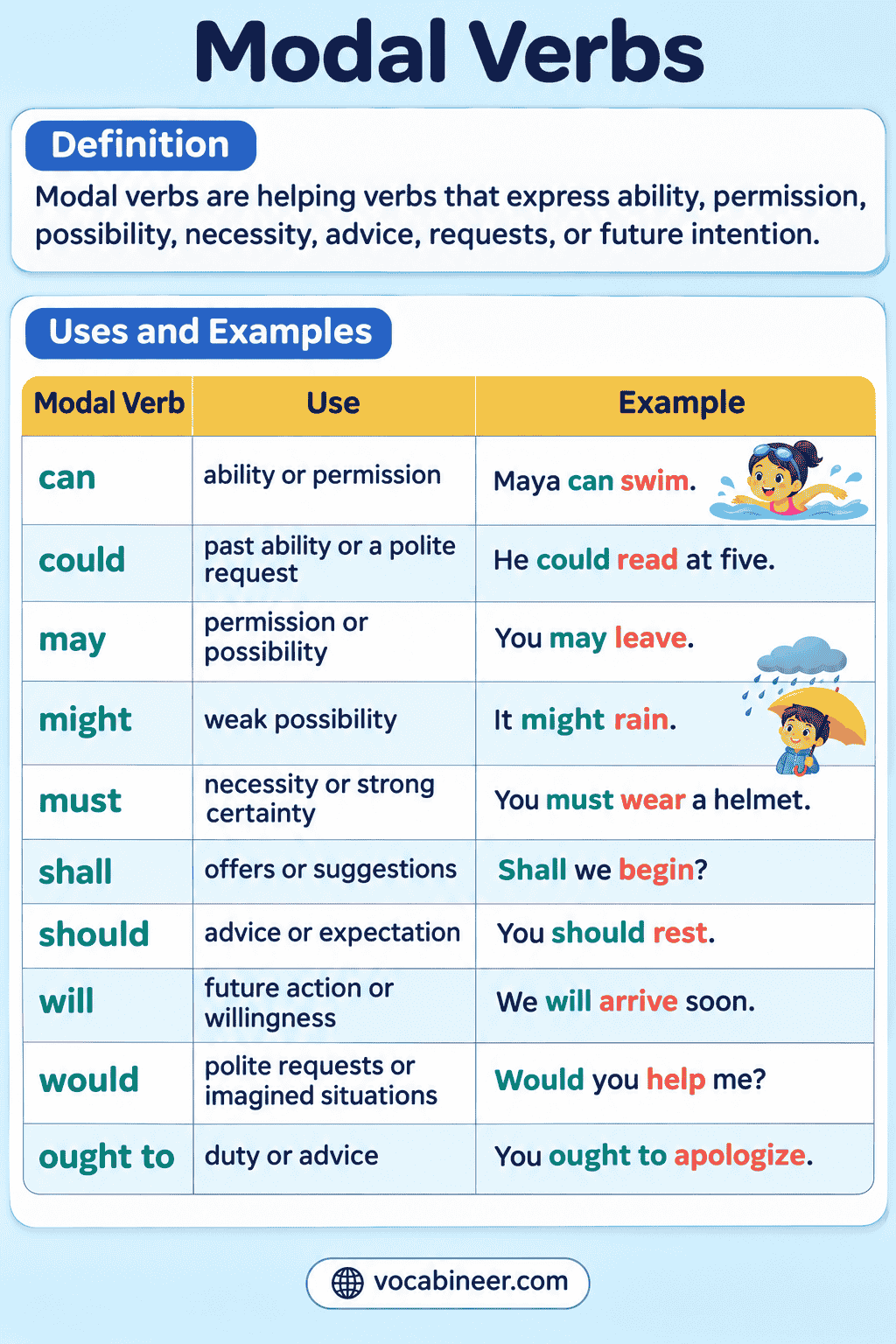
The nine central modal verbs are can, could, may, might, must, shall, should, will, and would. Although these verbs follow a small set of grammatical rules, each one can communicate several ideas depending on context. This guide explains their forms, functions, time references, related expressions, comparisons, and common mistakes with clear examples.
In This Page
What Are Modal Verbs?
A modal verb is an auxiliary verb that expresses a speaker’s or writer’s attitude toward an action, event, or situation. This grammatical meaning is called modality.
Modal verbs commonly express:
- Ability
- Possibility and probability
- Certainty and deduction
- Permission and prohibition
- Obligation and necessity
- Advice and suggestions
- Requests, offers, and invitations
- Prediction, intention, and willingness
- Hypothetical meaning
The basic structure is:
subject + modal verb + base verb
- She can swim.
- They might arrive soon.
- You should rest.
- I will help.
The modal carries the grammatical meaning, while the main verb identifies the action or state.
List of Modal Verbs in English
English has nine widely recognized central modal verbs.
| Modal Verb | Common Functions | Example |
|---|---|---|
| can | Ability, permission, general possibility | She can swim. |
| could | Past ability, possibility, polite requests | Could you help? |
| may | Possibility, formal permission | It may rain. |
| might | Tentative possibility | They might come. |
| must | Necessity, obligation, deduction | You must stop. |
| shall | Offers, suggestions, formal future meaning | Shall we begin? |
| should | Advice, duty, expectation | You should rest. |
| will | Prediction, intention, willingness | I will help. |
| would | Hypothetical meaning, politeness, past habit | I would agree. |
The same modal may have several meanings. For example, can expresses ability in She can swim, permission in You can leave, and general possibility in Mistakes can happen.
Rules for Using Modal Verbs
Central modal verbs follow several important rules.
Use a Base Verb After a Modal
A central modal takes the base form of the following verb without to.
- She can drive.
- You should wait.
- They might arrive.
Do Not Add -s for Third-Person Subjects
Modal verbs remain unchanged with every subject.
- I can swim.
- She can swim.
- They can swim.
Form Questions Without Do
Move the modal before the subject:
- Can she drive?
- Should we leave?
- Will they attend?
Place Not After the Modal
- She cannot swim.
- You should not worry.
- They might not attend.
Do Not Combine Two Central Modals
Standard English does not normally place two central modals together. Use a modal-like expression when another form is needed.
| Incorrect | Correct |
|---|---|
| She will can attend. | She will be able to attend. |
| He may must leave. | He may have to leave. |
Central Modals Have No Ordinary Non-Finite Forms
Central modals do not normally have infinitive, -ing, or participle forms. English therefore uses expressions such as be able to and have to:
- I want to be able to swim.
- She has had to work late.
- Being able to communicate helps.
The main rules can be summarized in this table:
| Incorrect | Correct |
|---|---|
| She can swims. | She can swim. |
| He must to leave. | He must leave. |
| Does she can drive? | Can she drive? |
| He cans speak English. | He can speak English. |
| She will can attend. | She will be able to attend. |
Types of Modal Meaning
Grammarians commonly group modal meanings into three broad categories.
| Type of Modality | Meaning | Example |
|---|---|---|
| Dynamic modality | Ability or willingness | She can swim. |
| Deontic modality | Permission, obligation, or duty | You must leave. |
| Epistemic modality | Possibility, probability, or deduction | She must be home. |
One modal can belong to different categories depending on its meaning. In You must leave, must expresses obligation. In She must be home, it expresses a logical conclusion.
Modal Verbs for Ability
Use can for present ability and could for general ability in the past.
- I can speak Urdu and English.
- Sara can solve difficult problems.
- He could read before he started school.
- We could swim for hours when we were younger.
Use be able to when a grammatical form of can is unavailable:
- She will be able to attend tomorrow.
- I want to be able to drive.
- They have been able to reduce costs.
Could vs Was Able To
Use could for general past ability. For a successful action on one particular occasion, was/were able to or managed to is often clearer.
| Could | Was/Were Able To or Managed To |
|---|---|
| Describes general past ability | Often describes one successfully completed action |
| I could swim at five. | I was able to rescue the child. |
| She could read before school. | She managed to solve the problem. |
However, couldn’t can describe failure in a specific situation:
- We couldn’t open the door.
- They couldn’t find the address.
Modal Verbs for Permission
Use can, could, may, and occasionally might when asking for permission. The level of formality and directness changes.
| Modal | Typical Use | Example |
|---|---|---|
| can | Ordinary or informal request | Can I leave now? |
| could | Polite request | Could I leave early? |
| may | Formal request or permission | May I enter? |
| might | Very formal or tentative request | Might I ask a question? |
Use can or may to grant permission:
- You can use my phone.
- You may begin the test.
Although could commonly asks for permission, it does not normally grant present permission. Say Yes, you can or Yes, you may, rather than Yes, you could, unless you mean that something is one possible option.
General Past Permission vs Permission on One Occasion
| General Past Permission | Permission on One Occasion |
|---|---|
| We could stay up late on weekends. | We were allowed to leave early yesterday. |
| Describes a repeated arrangement | Describes permission granted in one situation |
For one specific past occasion, was/were allowed to usually communicates the meaning more clearly than could.
Modal Verbs for Possibility
Use can for general possibility. Use could, may, or might for a particular present or future possibility.
| General Possibility | Particular Possibility |
|---|---|
| Roads can become dangerous in winter. | This road might be closed tonight. |
| Anyone can make a mistake. | Sara may arrive late today. |
| Exercise can improve sleep. | The treatment could improve his sleep. |
May vs Might
| May | Might |
|---|---|
| Expresses a real possibility | Often sounds more tentative or distant |
| She may attend. | She might attend. |
| Common in neutral and formal contexts | Common when the speaker feels less certain |
The difference is not a fixed percentage. Context, tone, and the speaker’s judgment determine the strength of each form.
The Two Meanings of May Not
The expression may not can communicate different meanings.
| Meaning | Example and Interpretation |
|---|---|
| Negative possibility | She may not attend. = It is possible that she will not attend. |
| Formal prohibition | You may not enter. = You are not permitted to enter. |
Context normally reveals which meaning the speaker intends.
Modal Verbs for Certainty and Deduction
Modal verbs allow speakers to express different degrees of confidence.
| Degree of Certainty | Modal | Example |
|---|---|---|
| Strong conclusion | must | She must be home. |
| Confident prediction | will | That will be the delivery driver. |
| Expected result | should | The train should arrive soon. |
| Possibility | may, might, could | She might be home. |
| Strong impossibility | can’t | She can’t be home. |
In She must be home, the speaker does not impose an obligation. Instead, the speaker draws a strong conclusion from available evidence.
Modal Verbs for Obligation and Necessity
Use must, have to, and need to to express obligation or necessity.
- You must wear a seat belt.
- Employees have to follow the safety rules.
- We need to finish this report.
Must vs Have To
| Must | Have To |
|---|---|
| Often reflects the speaker’s authority or judgment | Often reflects an external rule or circumstance |
| Has no ordinary past form for obligation | Changes to had to for past obligation |
| Forms questions through inversion | Usually requires do-support |
| Must you leave? | Do you have to leave? |
| You must leave. | You have to leave. |
The distinction is useful but not absolute. In many contexts, must and have to overlap.
Use had to for past obligation and will have to for future necessity:
- We had to cancel the meeting.
- She will have to apply again.
Had To vs Must Have
These structures express completely different meanings.
| Had To + Base Verb | Must Have + Past Participle |
|---|---|
| Expresses past obligation | Expresses a strong conclusion about the past |
| She had to leave. | She must have left. |
| Leaving was necessary | The speaker concludes that she left |
Prohibition and Absence of Obligation
Must not and do not have to are not interchangeable.
| Must Not | Do Not Have To |
|---|---|
| Expresses prohibition | Expresses absence of necessity |
| You must not enter. | You do not have to attend. |
| Entering is forbidden. | Attending is optional. |
Use needn’t or don’t need to to express that something is unnecessary:
- You needn’t wait.
- You don’t need to wait.
Modal Verbs for Advice and Suggestions
Use should and ought to for advice, recommendations, expectations, and mild duties.
- You should speak to your doctor.
- We ought to leave soon.
- Students should check their work.
Use could to offer an option rather than strong advice:
- You could take an earlier train.
- We could meet online.
Use had better for strong advice, especially when ignoring it may cause a problem:
- You had better leave now.
- We had better not wait any longer.
Should vs Ought To
| Should | Ought To |
|---|---|
| More common in everyday English | Slightly more formal or less common |
| Takes a base verb | Takes to + base verb |
| You should apologize. | You ought to apologize. |
Modal Verbs for Requests, Offers, and Invitations
Several modals help speakers communicate politely.
| Function | Common Modals | Example |
|---|---|---|
| Direct request | can, will | Can you help me? |
| Polite request | could, would | Could you close the window? |
| Offer | shall, will | Shall I carry that? |
| Invitation | would | Would you like some tea? |
| Suggestion | shall | Shall we begin? |
Past-looking forms such as could and would often make a request less direct. In these uses, they do not refer to past time.
Prediction, Intention, and Willingness
Use will for predictions, spontaneous decisions, promises, and willingness.
- The weather will improve tomorrow.
- I will answer the phone.
- We will support you.
- She will help if you ask.
Use won’t to express a negative prediction or refusal:
- The car won’t start.
- He won’t listen to advice.
Use would for willingness in hypothetical situations:
- I would help if I had time.
- She would accept the offer under different conditions.
Would vs Used To
Both forms can describe repeated past actions, but only used to normally introduces past states.
| Would | Used To |
|---|---|
| Describes repeated past actions | Describes repeated past actions or past states |
| Usually needs an established past-time context | Can introduce the past situation directly |
| Every summer, we would visit the coast. | We used to visit the coast. |
| Not normally used to introduce past states | We used to live near the coast. |
For a past state, use used to:
- Correct: We used to live near the coast.
- Not normally correct for this meaning: We would live near the coast.
Modal Verbs in Conditional Sentences
Use would, could, and might to express different hypothetical results.
| Modal | Meaning in a Conditional | Example |
|---|---|---|
| would | Expected hypothetical result | I would travel if I had time. |
| could | Possible ability or opportunity | I could help if you asked. |
| might | Less certain result | She might attend if she finishes early. |
In ordinary conditionals, do not normally use will or would in the if-clause.
| Incorrect | Correct |
|---|---|
| If it will rain, we will stay home. | If it rains, we will stay home. |
| If I would know, I would tell you. | If I knew, I would tell you. |
However, will or would may follow if when it expresses willingness, insistence, or a polite request:
- If you will wait here, the manager will see you.
- If you would sign here, please.
Forming Questions with Modal Verbs
Move the modal before the subject to form a question.
modal + subject + base verb
| Statement | Question |
|---|---|
| She can swim. | Can she swim? |
| They might come. | Might they come? |
| You should leave. | Should you leave? |
| He will help. | Will he help? |
Do not add do, does, or did when a central modal is already present.
Wh-Questions with Modals
Most wh-questions follow this structure:
question word + modal + subject + base verb
- Where should we meet?
- Why would she leave?
- When can you begin?
- How could they know?
Subject Questions vs Object Questions
| Subject Question | Object Question |
|---|---|
| Who can help you? | Who can you help? |
| What might cause the problem? | What might they change? |
| Which student should lead? | Which student should we choose? |
In a subject question, the question word itself acts as the subject. Therefore, no additional subject appears between the modal and the main verb.
Making Modal Verbs Negative
Place not immediately after the modal.
modal + not + base verb
| Positive | Negative |
|---|---|
| She can swim. | She cannot swim. |
| They may attend. | They may not attend. |
| You should leave. | You should not leave. |
| He will agree. | He will not agree. |
The form cannot normally appears as one word. The two-word form can not occurs only in special structures, such as You can not only read it but also explain it.
Modal Verb Contractions
Contractions are common in conversation and informal writing.
| Full Form | Contraction |
|---|---|
| cannot | can’t |
| could not | couldn’t |
| will not | won’t |
| would not | wouldn’t |
| should not | shouldn’t |
| must not | mustn’t |
| shall not | shan’t |
| might not | mightn’t |
Forms such as shan’t, mightn’t, mustn’t, and needn’t vary in frequency across regions. For example, shan’t and needn’t occur more often in British English than in American English.
The First-Modal Rule
When a modal appears in a verb phrase, it normally acts as the first or finite auxiliary.
Consider this sentence:
She may have been waiting.
The modal may:
- Appears before the other auxiliaries
- Moves before the subject in questions
- Takes not in negative sentences
- Carries contrastive emphasis
- Can replace an understood verb phrase
| Function | Example |
|---|---|
| Statement | She may have been waiting. |
| Question | May she have been waiting? |
| Negative | She may not have been waiting. |
| Emphasis | She may have been waiting. |
| Ellipsis | Sara may attend, and Omar may too. |
Because combinations such as mayn’t she? sound uncommon to many speakers, people often restructure modal question tags when necessary.
Order of Verbs After a Modal
When a modal combines with primary auxiliaries, the verbs follow this order:
modal + perfect have + continuous be + passive be + main verb
| Structure | Example |
|---|---|
| modal + main verb | She may leave. |
| modal + be + present participle | She may be working. |
| modal + have + past participle | She may have left. |
| modal + be + past participle | It must be completed. |
| modal + have been + present participle | She may have been waiting. |
| modal + have been + past participle | It may have been damaged. |
Each auxiliary determines the form immediately after it.
Modal Verbs and Time
Modal verbs do not create a regular tense system. A past-looking form may express politeness, distance, possibility, or hypothetical meaning rather than past time.
| Modal Form | Possible Functions |
|---|---|
| could | Past ability, present possibility, or polite request |
| would | Reported future, hypothetical result, past habit, or politeness |
| might | Present or future possibility, reported may, or tentativeness |
| should | Advice, expectation, duty, or reported shall |
Compare these uses of could:
- She could swim at five. — Past ability
- It could rain tonight. — Future possibility
- Could you help me? — Polite present request
Context establishes the time and meaning.
Perfect Modal Verbs
Perfect modals usually refer to a past situation.
The structure is:
modal + have + past participle
| Structure | Common Meaning | Example |
|---|---|---|
| must have | Strong past deduction | She must have left. |
| may have | Past possibility | She may have forgotten. |
| might have | Tentative past possibility | He might have missed the bus. |
| could have | Past possibility or unrealized opportunity | We could have won. |
| should have | Unfulfilled advice, criticism, or expectation | You should have called. |
| would have | Hypothetical past result | I would have helped. |
| can’t have | Strong past impossibility | She can’t have known. |
| needn’t have | Unnecessary completed action | You needn’t have waited. |
Different Meanings of Could Have
The surrounding context changes the meaning:
- She could have taken the earlier train. — A past option was available.
- The noise could have caused an accident. — A past possibility existed.
- You could have warned me. — The speaker criticizes a missed action.
Different Meanings of Should Have
- You should have called. — Unfulfilled advice or criticism
- The package should have arrived. — Expected past result
- I should have checked. — Regret about a past action
Needn’t Have vs Didn’t Need To
| Needn’t Have + Past Participle | Didn’t Need To + Base Verb |
|---|---|
| The action happened but was unnecessary | The action was unnecessary; context shows whether it happened |
| You needn’t have bought milk. | You didn’t need to buy milk. |
In You needn’t have bought milk, the person bought the milk. In You didn’t need to buy milk, the sentence alone does not always confirm whether the purchase happened.
Continuous and Passive Modal Forms
Modal verbs combine with be and have to express ongoing and passive meanings.
| Structure | Meaning | Example |
|---|---|---|
| modal + be + present participle | Ongoing present or future situation | She may be working. |
| modal + have been + present participle | Possible past ongoing situation | She may have been waiting. |
| modal + be + past participle | Present or future modal passive | The work must be completed. |
| modal + have been + past participle | Past modal passive | The door may have been damaged. |
These patterns allow speakers to combine modality with time, aspect, and voice.
Short Answers and Modal Ellipsis
A modal can stand alone when listeners or readers understand the missing verb phrase.
| Question or Statement | Response or Continuation |
|---|---|
| Can you swim? | Yes, I can. |
| Should we leave? | Yes, we should. |
| Will she attend? | No, she won’t. |
| Mina can drive. | Sara can too. |
| Omar may attend. | Ali might not. |
Do not contract a positive modal when it stands alone.
| Incorrect | Correct |
|---|---|
| Yes, I’ll. | Yes, I will. |
| Yes, she’d. | Yes, she would. |
Modal Verbs in Question Tags
A question tag normally repeats the modal from the main statement.
| Statement | Question Tag |
|---|---|
| She can swim, | can’t she? |
| They should leave, | shouldn’t they? |
| He won’t object, | will he? |
| You would help, | wouldn’t you? |
| We must wait, | mustn’t we? |
Some modal tags sound more natural than others. When a tag sounds awkward or overly formal, speakers often restate the question in another way.
Adverb Placement with Modal Verbs
Adverbs of frequency and probability commonly appear between the modal and the following verb.
- She may already know.
- They will probably arrive soon.
- He can never remember the address.
- You should definitely apply.
When not appears, adverb placement depends on meaning and emphasis:
- She may not always agree.
- They probably will not attend.
Modal Verbs in Reported Speech
Some modals commonly change when reporting earlier speech.
| Direct Form | Common Reported Form |
|---|---|
| will | would |
| can | could |
| may | might |
| shall | should or would, depending on meaning |
- Direct: She said, “I will help.”
- Reported: She said that she would help.
- Direct: He said, “I can swim.”
- Reported: He said that he could swim.
The modal does not always change. Meaning, time reference, and whether the situation remains true all influence the final form.
Marginal Modal Verbs Need and Dare
Need and dare can behave like modal auxiliaries or main verbs, especially in British English.
| Modal-Like Use | Main-Verb Use |
|---|---|
| You needn’t wait. | You don’t need to wait. |
| Need we continue? | Do we need to continue? |
| He dare not speak. | He doesn’t dare to speak. |
Modal-like need and dare form questions and negatives without do. Their main-verb equivalents use do-support.
Questions and Negatives with Used To
Use did + use to in questions and negatives because did already marks past time.
- Did you use to live here?
- She didn’t use to drink coffee.
- We used to visit every summer.
Edited English generally prefers use to after did and didn’t, although used to sometimes appears in informal writing because the forms sound similar in speech.
Semi-Modal Verbs and Related Expressions
Semi-modals express meanings similar to central modals but behave partly like main verbs.
| Semi-Modal or Related Form | Common Meaning | Example |
|---|---|---|
| have to | Necessity | I have to leave. |
| ought to | Advice or duty | You ought to apologize. |
| need to | Necessity | We need to talk. |
| used to | Past habit or state | He used to live here. |
| be able to | Ability | She is able to swim. |
| be going to | Plan or prediction | They are going to travel. |
| be supposed to | Expectation or obligation | You are supposed to wait. |
| had better | Strong advice | You had better leave. |
Other modal-like expressions include:
- be likely to — probability
- be meant to — intention or expectation
- be bound to — strong likelihood
- be permitted to — permission
Central Modals vs Semi-Modals
| Central Modal Verbs | Semi-Modal Expressions |
|---|---|
| Usually have one fixed form | Often change for tense or subject |
| Usually take a base verb without to | Many take to + base verb |
| Form questions through inversion | Many require do-support |
| She can swim. | She is able to swim. |
| Must you leave? | Do you have to leave? |
Semi-modals supply many forms that central modal verbs lack.
Modal Verbs vs Primary Auxiliary Verbs
| Modal Auxiliary Verbs | Primary Auxiliary Verbs |
|---|---|
| Include can, may, must, will, and others | Include be, have, and do |
| Express attitude, judgment, or stance | Form aspect, voice, questions, and negatives |
| Usually remain unchanged | Change according to tense or subject |
| Take a base verb | May take a base verb or a participle |
The two groups can appear in the same verb phrase:
The work may have been completed.
Here, may is the modal auxiliary, while have and been are primary auxiliaries.
Modal Verbs in Academic Writing
Modal verbs help writers make appropriately cautious claims rather than presenting every conclusion as an absolute fact.
| Strong Claim | Hedged Claim |
|---|---|
| This method causes errors. | This method may cause errors. |
| The results prove the theory. | The results could support the theory. |
| The change improves performance. | The change might improve performance. |
However, excessive hedging can make writing vague. Writers should choose a modal that accurately reflects the strength of their evidence.
Dialect and Register Differences
Modal usage varies across English varieties and levels of formality.
- Shall remains more common in British English and formal contexts.
- Shan’t is uncommon in American English.
- Needn’t occurs more frequently in British English.
- Oughtn’t and mightn’t sound uncommon or formal to many speakers.
- May often sounds more formal than can when asking permission.
- Must may sound forceful in direct instructions.
These differences rarely change the core grammar, but they affect naturalness, tone, and frequency.
Modal Verbs in Spoken English
Speakers often reduce unstressed modals in natural conversation. For example, affirmative can may sound weak, while negative can’t normally receives clearer stress.
The modals will and would commonly contract after pronouns:
- I’ll = I will
- she’ll = she will
- I’d = I would
- they’d = they would
Speakers use full, stressed forms for correction or contrast:
- I can help.
- She will attend.
- You should apologize.
How to Identify a Modal Verb
Use this process:
- Find the complete verb phrase.
- Look for a central modal before another verb.
- Check whether the following verb appears in its base form.
- Identify the meaning expressed by the modal.
- Check whether the modal forms its own question or negative.
- Distinguish central modals from semi-modal expressions.
- Examine any following forms of have or be to identify perfect, continuous, or passive meaning.
Consider this sentence:
The documents might have been damaged.
- Might expresses possibility.
- Have creates a perfect structure.
- Been helps form passive voice.
- Damaged is the main verb’s past participle.
Common Mistakes with Modal Verbs
Adding -s After a Modal
Incorrect: She can swims.
Correct: She can swim.
Adding To After a Central Modal
Incorrect: You must to leave.
Correct: You must leave.
Using Do-Support with a Modal
Incorrect: Does she can drive?
Correct: Can she drive?
Combining Two Central Modals
Incorrect: She will can attend.
Correct: She will be able to attend.
Confusing Prohibition with No Obligation
Incorrect for prohibition: You don’t have to enter.
Correct: You must not enter.
Writing Could Of Instead of Could Have
Incorrect: She could of won.
Correct: She could have won.
The contraction could’ve sounds similar to could of, but it represents could have.
Using the Wrong Participle After Have
Incorrect: He must have went home.
Correct: He must have gone home.
Using the Wrong Form After Did
Incorrect: Did you used to live here?
Correct: Did you use to live here?
Using Must Have for Past Obligation
Incorrect for past obligation: She must have leave early.
Correct: She had to leave early.
Use must have left only for a strong conclusion about the past.
Using Could for Every Specific Past Success
Less clear: She could escape from the burning building yesterday.
Better: She was able to escape from the burning building yesterday.
Using Will in an Ordinary If-Clause
Incorrect: If it will rain, we will stay home.
Correct: If it rains, we will stay home.
Treating Every Past-Looking Modal as Past Time
In Could you help me?, could expresses politeness, not past time. Similarly, might and would often communicate distance, uncertainty, or hypothetical meaning.
FAQs
Modal verbs are auxiliary verbs that express meanings such as ability, possibility, certainty, permission, obligation, advice, willingness, and prediction. They work with a main verb in its base form.
The nine central modal verbs are can, could, may, might, must, shall, should, will, and would.
The modal already performs the finite grammatical role in the verb phrase. Therefore, the following main verb remains in its base form, as in She can swim and He should leave.
Central modals usually have one fixed form, form their own questions and negatives, and take a base verb without to. Semi-modals often change for tense or subject and may require to or do-support.
Some modals refer directly to past situations, as could does with general past ability. Many past meanings use modal + have + past participle, as in might have left, should have called, and must have forgotten.
Final Thoughts
Modal verbs allow English speakers to express fine differences in ability, possibility, certainty, permission, obligation, advice, willingness, prediction, and hypothetical meaning. Although their meanings vary, the central grammatical pattern remains simple: modal + base verb.
To use modal verbs accurately, consider both structure and context. Check whether the modal expresses a fact, judgment, request, rule, possibility, or imagined result. Then choose the form that matches the intended time, strength, and level of formality. With these principles in place, even perfect, continuous, passive, and conditional modal constructions become much easier to understand.
Read More
- Parts of Speech in English
- Nouns in English with Examples
- Common and Proper Nouns
- Countable and uncountable nouns
- Collective nouns
- Abstract and concrete nouns
- Gender nouns
- Compound nouns
- Possessive nouns
- Singular and plural nouns
- Plural noun rules