

English verbs change form to show time, agreement, aspect, voice, and grammatical function. For example, write, wrote, written, writing, and writes belong to the same verb, yet each form performs a different job. Learning these forms helps you build accurate sentences, choose the right auxiliary verbs, and avoid errors such as “She has wrote” or “Did he went?”
This guide explains the five forms of verbs—commonly called V1, V2, V3, V4, and V5—with clear examples. It also covers regular and irregular verbs, spelling and pronunciation rules, infinitives and participles, finite and non-finite forms, regional variations, and common verb-form mistakes.
In This Page
What Are Verb Forms?
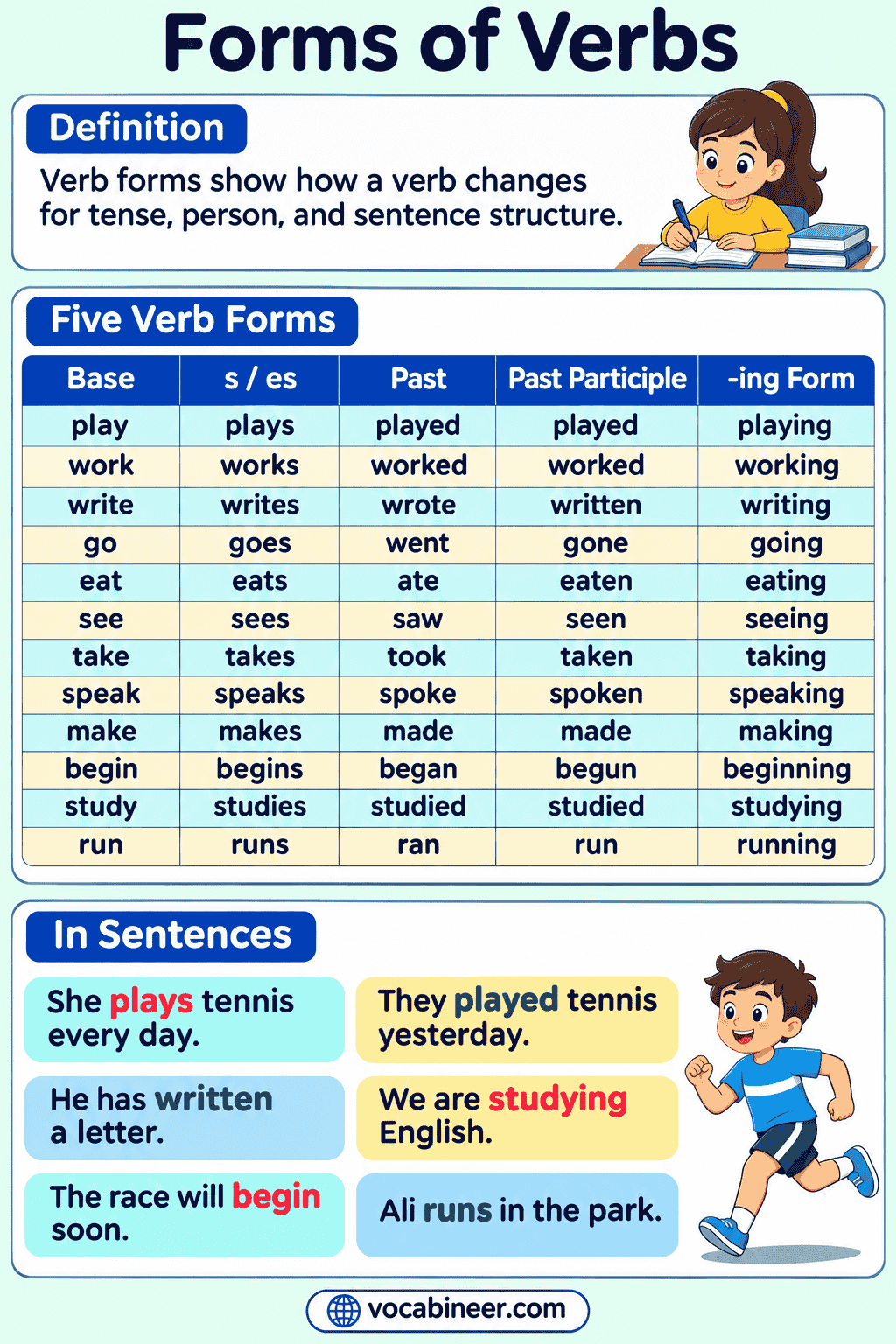
Verb forms are the different shapes a verb takes according to its grammatical role. The verb work, for instance, appears as work, worked, worked, working, and works. These forms combine with subjects and auxiliary verbs to create different tense, aspect, and voice constructions.
The labels V1, V2, V3, V4, and V5 commonly appear in English-learning materials. However, they are classroom labels rather than universal grammatical terms. Therefore, learners should also know the standard names: base form, past form, past participle, -ing form, and third-person singular form.
The Five Main Forms of a Verb
| Label | Grammatical name | Write | Work | Main use |
|---|---|---|---|---|
| V1 | Base form | write | work | Simple present, infinitives, imperatives, and use after modals or do |
| V2 | Past form | wrote | worked | Simple past and some unreal constructions |
| V3 | Past participle | written | worked | Perfect constructions, passive voice, and modifiers |
| V4 | -ing form | writing | working | Continuous constructions, gerunds, participles, and non-finite clauses |
| V5 | Third-person singular form | writes | works | Simple present with he, she, it, or another singular subject |
Why Some Sources Count Four Verb Forms
Some grammar references identify four basic forms because they treat the third-person singular as a variation of the present form. In contrast, many school systems list it separately and teach five forms.
| Four-form system | Five-form system |
|---|---|
| Base form | V1: base form |
| Past form | V2: past form |
| Past participle | V3: past participle |
| -ing form | V4: -ing form |
| Third-person singular treated as a present-form variation | V5: third-person singular form |
Both systems describe the same verb patterns. In addition, some textbooks reverse the V4 and V5 labels. One may call writing V4 and writes V5, while another does the opposite. Consequently, grammatical names are more reliable than numbers alone.
The Principal Parts of a Verb
The base form, past form, and past participle are often called the principal parts of a verb. They reveal the most important changes, especially for irregular verbs:
- write–wrote–written
- take–took–taken
- work–worked–worked
Once learners know these principal parts, they can combine them with auxiliaries and endings to create complete verb phrases.
V1, V2, V3, V4, and V5 at a Glance
The following table shows all five forms of several common verbs.
| Meaning | V1: base | V2: past | V3: past participle | V4: -ing | V5: third-person singular |
|---|---|---|---|---|---|
| to be | be | was/were | been | being | is |
| to begin | begin | began | begun | beginning | begins |
| to bring | bring | brought | brought | bringing | brings |
| to build | build | built | built | building | builds |
| to choose | choose | chose | chosen | choosing | chooses |
| to do | do | did | done | doing | does |
| to eat | eat | ate | eaten | eating | eats |
| to go | go | went | gone | going | goes |
| to have | have | had | had | having | has |
| to know | know | knew | known | knowing | knows |
| to make | make | made | made | making | makes |
| to read | read | read | read | reading | reads |
| to run | run | ran | run | running | runs |
| to see | see | saw | seen | seeing | sees |
| to speak | speak | spoke | spoken | speaking | speaks |
| to study | study | studied | studied | studying | studies |
| to take | take | took | taken | taking | takes |
| to travel | travel | travelled/traveled | travelled/traveled | travelling/traveling | travels |
| to work | work | worked | worked | working | works |
| to write | write | wrote | written | writing | writes |
V1: The Base Form
The base form is the simplest form of a verb. Dictionaries usually list verbs in this form, although dictionary entries often place to before them for convenience.
The Base Form in the Simple Present
Use the base form in the simple present with I, you, we, and they, as well as plural subjects:
- I work from home.
- You speak clearly.
- We study English.
- They play football.
- The students write every day.
The Base Form After Auxiliary and Modal Verbs
Use the base form after do, does, and did:
- Do they live nearby?
- She does not drive.
- Did you finish the report?
Likewise, use the base form after modal verbs such as can, could, may, might, must, shall, should, will, and would:
- She can swim.
- You should check the answer.
- They might arrive late.
The Base Form in Infinitives and Imperatives
The base form appears after to in a to-infinitive:
- I want to learn.
- He plans to travel.
It also creates commands and instructions:
- Open the window.
- Turn left at the corner.
- Please wait here.
After let and make, English generally uses a bare infinitive without to:
- Let her speak.
- The joke made us laugh.
The verb help can take either pattern:
- She helped me carry the boxes.
- She helped me to carry the boxes.
V2: The Past Form
The past form mainly creates the simple past. Regular verbs normally add -ed, whereas irregular verbs change in less predictable ways.
- We worked yesterday.
- She wrote a letter.
- They went home early.
- He bought a new bag.
The past form remains the same with every subject except that be changes between was and were:
- I walked home.
- She walked home.
- They walked home.
- I was tired.
- We were tired.
Past Forms in Unreal Situations
A past form does not always express past time. English also uses it to describe wishes, imagined situations, or unlikely conditions:
- If I knew the answer, I would tell you.
- I wish she lived closer.
- If he had more time, he could help us.
In formal English, were may appear with every subject in unreal conditions:
- If I were you, I would apologize.
V3: The Past Participle
The past participle cannot usually express past time by itself. Instead, it combines with auxiliary verbs or functions as a modifier.
Past Participles in Perfect Constructions
Use a past participle after a form of have:
- She has written the email.
- They have finished the project.
- We had left before noon.
- He will have completed the course by June.
Past Participles in Passive Voice
Use a past participle after an appropriate form of be to create the passive voice:
- The email was written yesterday.
- The rooms are cleaned daily.
- The road is being repaired.
- The results will be announced tomorrow.
Past Participles as Modifiers
Past participles can describe nouns or introduce reduced clauses:
- a broken window
- the written instructions
- the documents sent yesterday
- Exhausted by the journey, the travellers rested.
- Built in 1920, the house still looks impressive.
V2 and V3: Past Form Versus Past Participle
Learners often confuse these forms because regular verbs use the same ending for both. Irregular verbs, however, frequently distinguish them.
| Past form: V2 | Past participle: V3 |
|---|---|
| Usually forms the simple past | Usually follows have or be |
| Can serve as the finite verb of a past-tense clause | Usually needs an auxiliary in a verb phrase |
| She wrote the report. | She has written the report. |
| They broke the window. | The window was broken. |
| He went home. | He has gone home. |
V4: The -ing Form
The -ing form serves several grammatical functions. Depending on the sentence, it can form a continuous construction, behave like a noun, modify another word, or introduce a non-finite clause.
The -ing Form in Continuous Constructions
Use a form of be plus an -ing form to show an activity in progress or a temporary situation:
- She is reading now.
- They were waiting outside.
- I have been working all morning.
- We will be travelling next week.
The -ing Form as a Gerund
A gerund is an -ing form that performs a noun-like function:
- Reading improves vocabulary.
- She enjoys painting.
- They talked about moving abroad.
- His favourite activity is swimming.
The -ing Form as a Present Participle
A present participle forms continuous verb phrases, modifies nouns, or introduces participial clauses:
- The children are playing outside.
- The smiling child waved at us.
- Walking home, she called her mother.
- The man standing by the door is my teacher.
Gerund and Present Participle
| Gerund | Present participle |
|---|---|
| Performs a noun-like function | Forms a continuous verb phrase or modifies a noun or clause |
| Can serve as a subject, object, or complement | Can serve as part of a verb phrase or as a modifier |
| Swimming is good exercise. | They are swimming now. |
| She enjoys reading. | The student reading by the window is Sara. |
Both forms end in -ing. Therefore, their function in the sentence—not their appearance—determines the correct label.
V5: The Third-Person Singular Form
Use the third-person singular form in the simple present when the subject is he, she, or it. Singular nouns, most uncountable nouns, and singular indefinite pronouns also require this form.
- He works at a hospital.
- She teaches mathematics.
- The machine makes a strange noise.
- Water freezes at 0°C.
- Everybody needs support.
Subject–Verb Agreement in the Simple Present
| Subject | Correct verb form | Example |
|---|---|---|
| I | Base form | I write every day. |
| You | Base form | You write clearly. |
| We | Base form | We write reports. |
| They | Base form | They write articles. |
| He | Third-person singular | He writes stories. |
| She | Third-person singular | She writes letters. |
| It | Third-person singular | It writes data automatically. |
| A singular noun | Third-person singular | Ali writes well. |
| A plural noun | Base form | The students write well. |
In negative sentences and questions with does, the main verb returns to its base form because does carries the agreement ending:
- She does not work on Sunday.
- Does he live here?
Verb Forms, Tense, Aspect, and Voice
These four terms describe related but different features of English grammar.
| Term | What it describes | Example |
|---|---|---|
| Verb form | The grammatical shape of an individual verb | write, wrote, written, writing, writes |
| Tense | The grammatical location of a situation in time | writes is present; wrote is past |
| Aspect | How a speaker views the timing or development of a situation | is writing, has written, has been writing |
| Voice | The relationship between the action and its participants | Sara wrote it; It was written by Sara |
A verb form is not automatically a tense. For example, written is a past participle, but it does not create a complete tense by itself. It helps build constructions such as has written and was written.
Regular and Irregular Verb Forms
Regular verbs form both the past and past participle with -ed or -d. Irregular verbs use other patterns.
| Regular verbs | Irregular verbs |
|---|---|
| Follow a largely predictable past-form pattern | May change vowels, endings, or the whole word |
| Past and past participle normally match | Past and past participle may match or differ |
| work–worked–worked | write–wrote–written |
| open–opened–opened | go–went–gone |
| study–studied–studied | take–took–taken |
Common Irregular-Verb Patterns
Although irregular verbs do not follow one rule, many fall into recognizable groups.
| Pattern | Examples |
|---|---|
| All three principal parts are identical | cut–cut–cut; put–put–put; hit–hit–hit |
| Past and past participle are identical | build–built–built; buy–bought–bought; teach–taught–taught |
| Base and past participle are identical | come–came–come; run–ran–run; become–became–become |
| All three forms differ | write–wrote–written; sing–sang–sung; begin–began–begun |
| Past participle ends in -en or -n | break–broke–broken; take–took–taken; show–showed–shown |
| No change in spelling but a change in pronunciation | read /riːd/–read /red/–read /red/ |
Spelling Rules for Verb Endings
Adding -s and -es
| Rule | Base form | Third-person singular |
|---|---|---|
| Add -s to most verbs | work | works |
| Add -es after -s, -ss, -sh, -ch, -x, or often -o | wash | washes |
| Change consonant + y to -ies | study | studies |
| Keep y after a vowel | play | plays |
| Use an irregular form | have | has |
Adding -ed
| Rule | Base form | Past and past participle |
|---|---|---|
| Add -ed to most verbs | work | worked |
| Add -d after final e | live | lived |
| Change consonant + y to -ied | carry | carried |
| Keep y after a vowel | enjoy | enjoyed |
| Double a final consonant after a stressed consonant–vowel–consonant pattern | stop | stopped |
| Do not usually double after an unstressed final syllable | open | opened |
Adding -ing
| Rule | Base form | -ing form |
|---|---|---|
| Add -ing to most verbs | read | reading |
| Remove a silent final e | write | writing |
| Keep final -ee | see | seeing |
| Change final ie to y | lie | lying |
| Double a final consonant after a stressed consonant–vowel–consonant pattern | run | running |
| Add k after final c | panic | panicking |
British English often doubles final l in forms such as travelled and travelling. American English commonly uses traveled and traveling.
Pronunciation of Verb Endings
Spelling alone does not show how every ending sounds. The endings -s and -ed each have three common pronunciations.
Pronouncing -s and -es
| Pronunciation | General pattern | Examples |
|---|---|---|
| /s/ | After most voiceless sounds | works, stops, laughs |
| /z/ | After vowels and most voiced sounds | plays, reads, runs |
| /ɪz/ | After sibilant sounds | washes, watches, fixes |
Pronouncing -ed
| Pronunciation | General pattern | Examples |
|---|---|---|
| /t/ | After most voiceless sounds | worked, washed, laughed |
| /d/ | After vowels and most voiced sounds | played, cleaned, called |
| /ɪd/ | After /t/ or /d/ | wanted, needed, started |
Forms of Be, Have, and Do
The primary auxiliary verbs be, have, and do also function as main verbs. Because their forms occur frequently, learners should recognize them quickly.
| Verb | Base form | Present forms | Past forms | Past participle | -ing form |
|---|---|---|---|---|---|
| be | be | am, is, are | was, were | been | being |
| have | have | have, has | had | had | having |
| do | do | do, does | did | done | doing |
Examples as auxiliary verbs include:
- She is working.
- They have finished.
- Do you know the answer?
Examples as main verbs include:
- She is a teacher.
- They have a new car.
- I do my homework after dinner.
Verb Forms After Auxiliary and Modal Verbs
The auxiliary usually determines the form of the verb that follows it.
| Auxiliary | Required following form | Example |
|---|---|---|
| do, does, did | Base form | Did she call? |
| have, has, had | Past participle | She has called. |
| am, is, are, was, were for continuous aspect | -ing form | She is calling. |
| am, is, are, was, were for passive voice | Past participle | She was called. |
| can, could, may, might, must, shall, should, will, would | Base form | She may call. |
Modal verbs do not take a third-person -s:
- Correct: She can swim.
- Incorrect: She can swims.
They also do not normally have participles, -ing forms, or to-infinitives. For meanings that require those forms, English often uses alternatives such as be able to or have to.
Finite and Non-Finite Verb Forms
A finite verb shows tense, agreement, or modality and anchors a clause. In contrast, a non-finite verb does not independently show tense or subject agreement.
| Finite verb forms | Non-finite verb forms |
|---|---|
| Mark tense, agreement, or modality | Do not independently mark tense or agreement |
| Can anchor an independent clause | Usually depend on another verb or clause element |
| Include present forms, past forms, and modal verbs | Include infinitives, -ing forms, and past participles |
| She writes every day. | She wants to write. |
| They worked yesterday. | Having finished, they left. |
The same written form may perform either function. In “They work every day,” work is finite because it expresses the simple present. However, in “They can work today,” work is a non-finite bare infinitive after the finite modal can.
Types of Infinitive Forms
An infinitive can express simple, continuous, perfect, or passive meaning.
| Infinitive type | Structure | Example |
|---|---|---|
| To-infinitive | to + base form | to write |
| Bare infinitive | base form without to | write |
| Continuous infinitive | to be + -ing form | to be writing |
| Perfect infinitive | to have + past participle | to have written |
| Passive infinitive | to be + past participle | to be written |
| Perfect passive infinitive | to have been + past participle | to have been written |
Examples include:
- She hopes to write a novel.
- She appears to be writing a novel.
- She seems to have written a novel.
- The report needs to be written today.
- The report seems to have been written yesterday.
Verbs Followed by -ing Forms or Infinitives
Some main verbs select an -ing complement, while others select a to-infinitive. Therefore, learners often need to study the verb and its complement together.
| Pattern | Common verbs | Examples |
|---|---|---|
| Verb + -ing | enjoy, avoid, finish, consider, suggest | She enjoys reading. |
| Verb + to-infinitive | want, hope, decide, plan, promise | She wants to read. |
| Verb + object + to-infinitive | ask, tell, allow, encourage, expect | He encouraged me to apply. |
| Verb + bare infinitive | let, make; perception verbs in some patterns | Let her speak. |
Some verbs accept both forms but change meaning:
- I stopped smoking. This means I ended the habit.
- I stopped to smoke. This means I paused another activity in order to smoke.
- Remember to lock the door. This refers to an action that still needs to happen.
- I remember locking the door. This refers to a memory of an earlier action.
Stative Verbs and Continuous Forms
Stative verbs commonly describe possession, knowledge, belief, preference, emotion, or perception rather than a developing activity. As a result, they do not usually appear in continuous forms.
| Usual simple form | Usually unsuitable in the same meaning |
|---|---|
| I know the answer. | I am knowing the answer. |
| She owns the house. | She is owning the house. |
| We believe you. | We are believing you. |
| He prefers tea. | He is preferring tea. |
However, some verbs can express either a state or a dynamic activity:
| Stative meaning | Dynamic meaning |
|---|---|
| I think the plan is sensible. | I am thinking about the plan. |
| She has a car. | She is having lunch. |
| The soup tastes salty. | The chef is tasting the soup. |
| I see your point. | I am seeing the dentist tomorrow. |
British and American Verb-Form Variations
Several standard verbs have regional spelling or form variations.
| British English | American English | Note |
|---|---|---|
| travelled, travelling | traveled, traveling | British English commonly doubles final l |
| learnt | learned | Both occur; learned is also common in Britain |
| dreamt | dreamed | Both forms are standard |
| spelt | spelled | Both forms are standard |
| got | gotten | American English often uses gotten for certain participle meanings |
These variations are not errors. Nevertheless, writers should use one regional style consistently.
Common Mistakes with Verb Forms
| Incorrect | Correct | Reason |
|---|---|---|
| She work here. | She works here. | A third-person singular subject needs the -s form. |
| Does he works here? | Does he work here? | Use the base form after does. |
| Did she went home? | Did she go home? | Use the base form after did. |
| She has wrote a letter. | She has written a letter. | Use the past participle after has. |
| I have went there. | I have gone there. | Gone is the past participle of go. |
| The window was broke. | The window was broken. | Passive voice requires the past participle. |
| He is writeing. | He is writing. | Remove the silent final e before -ing. |
| They stoped talking. | They stopped talking. | Double the final consonant in stop. |
| She can sings. | She can sing. | A modal verb takes a bare infinitive. |
| He enjoys to read. | He enjoys reading. | Enjoy normally takes an -ing complement. |
| They want go home. | They want to go home. | Want normally takes a to-infinitive. |
| He was knowing the answer. | He knew the answer. | Know is normally stative. |
How to Choose the Correct Verb Form
Use the following process when you are unsure which form a sentence needs:
- Identify the subject. In the simple present, he, she, it, and singular nouns normally require the third-person singular form.
- Find the auxiliary or modal. Use the base form after do and modals, the past participle after have, and either an -ing form or a past participle after be, depending on the construction.
- Determine the tense and aspect. A simple past clause needs V2, while a perfect construction needs V3 and a continuous construction needs the -ing form.
- Check the voice. Passive voice requires a form of be followed by the past participle.
- Check the verb pattern. Some verbs take an -ing complement, whereas others take a to-infinitive or bare infinitive.
- Apply the spelling rule. Check final e, consonant + y, final ie, and consonant doubling before adding an ending.
- Confirm irregular forms. When the verb is irregular, consult a reliable dictionary or verb table instead of guessing.
Frequently Asked Questions
What are the five forms of a verb?
The five commonly taught forms are the base form, past form, past participle, -ing form, and third-person singular form. For example, the five forms of write are write, wrote, written, writing, and writes.
What is the difference between V2 and V3?
V2 is the past form and usually creates the simple past, as in “She wrote yesterday.” V3 is the past participle and commonly follows have or be, as in “She has written” or “It was written.”
Which verb form follows did?
The base form follows did. Therefore, “Did she go?” is correct, whereas “Did she went?” is incorrect. The auxiliary did already carries the past-tense meaning.
Are gerunds and present participles the same?
They use the same -ing form, but they perform different functions. A gerund behaves like a noun, as in “Reading helps,” while a present participle forms a continuous construction or modifies another element, as in “She is reading” or “the student reading by the window.”
Why do some sources reverse V4 and V5?
V1–V5 are teaching labels rather than universal grammatical terms. Consequently, some educational systems call the -ing form V4 and the third-person singular V5, while others reverse them. Using the grammatical names avoids confusion.
Final Summary
English verbs commonly have five forms: the base form, past form, past participle, -ing form, and third-person singular form. Each one contributes to a different grammatical pattern. The base form follows modals and do; the past form creates the simple past; the past participle builds perfect and passive constructions; the -ing form creates continuous constructions and non-finite expressions; and the third-person singular form agrees with singular subjects in the simple present.
Understanding these forms also makes tense, aspect, voice, agreement, infinitives, gerunds, and participles easier to use. Therefore, learn each verb with its principal parts, notice the auxiliary that comes before it, and apply the relevant spelling or irregular pattern before choosing the final form.
Read More