

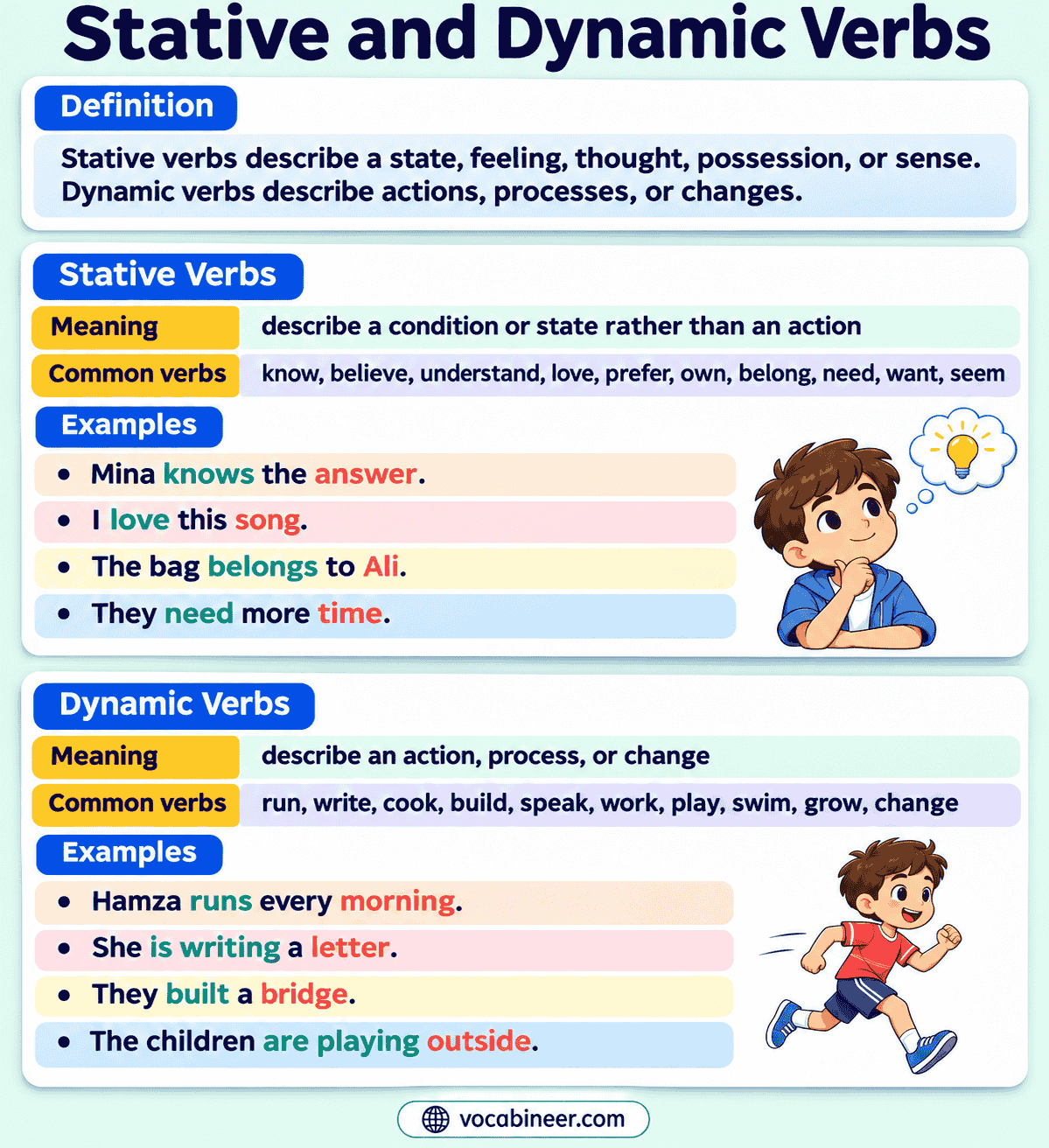
Stative and dynamic verbs describe two ways of presenting situations. A stative use expresses a state, condition, perception, emotion, relationship, or possession. A dynamic use presents an action, event, activity, process, or change. This distinction strongly affects whether a simple or continuous form sounds natural.
However, context matters more than a memorized verb list. The same verb can express a state in one sentence and an active process in another, as in I think you are right and I am thinking about the problem. This guide explains the major meanings, aspect rules, flexible verbs, continuous-form exceptions, comparisons, common mistakes, and practical examples.
In This Page
Stative and Dynamic Verbs at a Glance
Stative meanings present a situation as a condition or relationship without focusing on internal development. Dynamic meanings present a situation as something that happens, changes, develops, or unfolds through time.
| Feature | Stative Use | Dynamic Use |
|---|---|---|
| Meaning | State, condition, perception, emotion, or relationship | Action, activity, event, process, or change |
| Development | Usually presented as stable | Often presented as developing or changing |
| Continuous aspect | Usually avoided | Commonly available |
| Simple aspect | Common | Also common |
| Example | I know the answer. | I’m checking the answer. |
It is more accurate to discuss stative and dynamic uses than to place every verb permanently in one group. For example, have is stative when it means possession but dynamic when it describes an activity:
| Stative Use | Dynamic Use |
|---|---|
| She has a car. | She is having lunch. |
The progressive form often provides a useful clue, but it is not a perfect test. Some dynamic verbs appear in simple forms, and some normally stative meanings enter progressive constructions in special contexts.
What Is a Stative Verb?
A stative verb use describes how something is, appears, feels, relates, or exists rather than presenting an unfolding event. Stative meanings commonly express knowledge, belief, emotion, preference, possession, perception, composition, measurement, or dependence.
Examples include:
- I know the answer.
- She owns the house.
- The box contains six bottles.
- This bag weighs ten kilograms.
- We prefer the first option.
- The solution depends on the available evidence.
A state does not have to be permanent. I need help right now describes a temporary situation, yet need remains stative in this sentence. Stativity concerns how the speaker presents the situation, not simply how long it lasts.
Types of Stative Meanings
Thoughts and Knowledge
These verbs commonly describe knowledge, belief, memory, or understanding:
- believe
- know
- remember
- recognize
- suppose
- understand
Examples:
- I believe your explanation.
- She recognizes the building.
- We understand the problem.
Opinions and Attitudes
Verbs such as agree, doubt, mean, and think can describe opinions or attitudes.
- I think the plan is sensible.
- They doubt his story.
- This symbol means “danger.”
The verb think becomes dynamic when it means actively considering something: I am thinking about the proposal.
Emotions, Preferences, and Desires
Common verbs include love, hate, like, dislike, prefer, want, and wish.
- She loves classical music.
- I prefer tea.
- They want more information.
These meanings normally take simple forms, although informal or expressive contexts sometimes allow progressives such as I’m loving this song.
Possession and Relationships
Common verbs include belong, have, own, possess, and owe.
- This coat belongs to Sara.
- We own the apartment.
- He owes me twenty dollars.
Possessive have is normally stative, but other meanings of have can be dynamic.
Sensory Perception
The verbs hear, see, smell, sound, taste, and feel can describe automatic perception or a sensory quality.
- I hear music.
- The soup smells delicious.
- The fabric feels soft.
Several sensory verbs become dynamic when they describe a deliberate action.
Appearance and Condition
Common verbs include appear, fit, matter, resemble, and seem.
- The child seems tired.
- Your jacket fits perfectly.
- This question matters.
Composition and Inclusion
Common verbs include comprise, consist, contain, include, and involve.
- The course consists of ten lessons.
- The package contains three books.
- The price includes delivery.
Measurement and Value
The verbs cost, equal, measure, and weigh often have stative meanings.
- The ticket costs $20.
- The room measures five meters across.
- The parcel weighs two kilograms.
These verbs become dynamic when someone actively measures, weighs, or calculates something.
Common Stative Verbs
The following table groups verbs by their common stative meanings. It does not assign every verb permanently to one category.
| Category | Common Verbs |
|---|---|
| Knowledge | believe, know, remember, recognize, understand |
| Opinions | agree, doubt, mean, suppose, think |
| Emotions | love, hate, like, dislike, prefer |
| Desires | need, want, wish |
| Possession | belong, have, own, possess, owe |
| Perception | hear, see, smell, sound, taste |
| Appearance | appear, resemble, seem |
| Composition | comprise, consist, contain, include |
| Measurement | cost, equal, measure, weigh |
| Relationships | depend, fit, involve, matter, require |
Meaning and context remain decisive. The bag weighs ten kilograms is stative, while The clerk is weighing the bag is dynamic.
What Is a Dynamic Verb?
A dynamic use presents a situation as an action, event, activity, process, achievement, or change. Dynamic meanings can describe visible physical actions or internal mental activity.
- The children are playing outside.
- The snow is melting.
- She is considering the proposal.
- The train arrived at noon.
- They built a new bridge.
Dynamic verbs can appear in simple and continuous forms. The continuous form presents the situation as ongoing, temporary, developing, repeated, or limited in duration. The simple form may express a habit, completed event, schedule, general fact, or performative act.
Types of Dynamic Meanings
| Category | Meaning | Examples |
|---|---|---|
| Activity | Ongoing action without a necessary endpoint | run, swim, talk, work |
| Process | Gradual development or change | grow, improve, melt, develop |
| Accomplishment | Activity directed toward an endpoint | build a house, write a report |
| Achievement | Event occurring at a point | arrive, notice, win, reach |
| Mental activity | Active thought or investigation | consider, calculate, examine |
| Bodily activity | Physical action or experience | eat, walk, cough, sleep |
These categories describe different kinds of dynamic situations. A verb does not need to represent a voluntary physical action to qualify as dynamic.
Stative Versus Dynamic Verbs
| Stative Use | Dynamic Use |
|---|---|
| Describes a state or condition | Describes an action, event, or process |
| Usually uses simple aspect | Can use simple or continuous aspect |
| Often appears stable | Often involves development or change |
| I understand the question. | I’m analyzing the question. |
| She owns a bakery. | She runs a bakery. |
| The box contains tools. | He is filling the box. |
The distinction forms a continuum rather than a perfectly rigid division.
| Strongly Stative Uses | Flexible Uses | Strongly Dynamic Uses |
|---|---|---|
| know, belong, own, consist, contain | feel, hurt, live, hope, depend | run, build, investigate, dance |
| Usually resist progressive aspect | Allow different aspect choices in suitable contexts | Freely use simple or progressive aspect |
Tense and Aspect Are Different
Tense locates a situation in time, while aspect shows how the speaker views its internal timing or development.
| Grammatical Feature | Function | Example |
|---|---|---|
| Tense | Locates a situation in present or past time | works, worked |
| Progressive aspect | Presents a situation as ongoing or developing | is working, was working |
| Perfect aspect | Connects an earlier situation to a later reference point | has worked, had worked |
| Perfect progressive | Combines earlier duration with ongoing development | has been working |
An -ing form alone does not create progressive aspect. A progressive verb phrase requires a suitable form of be plus a present participle.
| Construction | Function |
|---|---|
| She is reading. | Progressive verb phrase |
| The girl reading by the window is Sara. | Participial modifier |
| Reading every day improves vocabulary. | Gerund clause |
Simple and Continuous Aspect
Simple Forms with Stative Meanings
- I know the answer.
- She owns two apartments.
- The soup tastes salty.
- This box contains books.
Simple Forms with Dynamic Meanings
Dynamic verbs do not require continuous forms.
- She walks to work every day.
- He wrote the report yesterday.
- The train leaves at six.
- I promise to help.
Continuous Forms with Dynamic Meanings
- She is walking to work.
- He is writing the report.
- The snow is melting.
- They are discussing the proposal.
| Simple Dynamic Form | Continuous Dynamic Form |
|---|---|
| She runs every morning. | She is running now. |
| He writes novels. | He is writing a novel. |
| The train arrived at six. | The train is arriving now. |
Therefore, the simple form does not prove that a verb is stative, and the continuous form is not the only sign of a dynamic meaning.
Why Stative Meanings Usually Avoid Continuous Forms
Progressive aspect commonly presents a situation as unfolding, temporary, developing, repeated, deliberate, or limited in duration. A stative meaning already presents a condition or relationship without focusing on internal stages. As a result, the simple form usually sounds more natural.
| Usually Unnatural | Natural Form |
|---|---|
| I am knowing the answer. | I know the answer. |
| She is owning a car. | She owns a car. |
| We are believing you. | We believe you. |
| This box is containing books. | This box contains books. |
However, this principle is a strong tendency rather than an exceptionless prohibition.
Can Stative Verbs Use Continuous Forms?
Yes, when context gives the verb a temporary, developing, deliberate, repeated, experiential, or expressive interpretation.
| Simple Stative Use | Continuous or Dynamic Use |
|---|---|
| I hope you can help. | I was hoping you could help. |
| I want to ask something. | I’ve been wanting to ask something. |
| I feel better. | I’m feeling better. |
| He is rude. | He is being rude. |
| I love this song. | I’m loving this song. |
| The project costs too much. | The project is costing more each week. |
Some progressive stative uses sound neutral and widely accepted. Others sound informal, promotional, regional, or deliberately expressive. For formal writing, prefer the widely established simple form unless the progressive conveys an important distinction.
Temporary Does Not Automatically Mean Progressive
A temporary situation can still require a simple stative form.
| Natural Temporary State | Marked or Unnatural Progressive |
|---|---|
| I need help right now. | I’m needing help right now. |
| I want a break today. | I’m wanting a break today. |
| She owns this car for now. | She is owning this car. |
Temporariness allows progressive aspect with some flexible verbs, but it does not override every verb’s normal behavior.
Verbs with Stative and Dynamic Meanings
| Verb | Stative Use | Dynamic Use |
|---|---|---|
| be | He is rude. | He is being rude. |
| have | She has a car. | She is having lunch. |
| think | I think you are right. | I’m thinking about the problem. |
| see | I see your point. | I’m seeing a doctor tomorrow. |
| look | You look tired. | You’re looking at me. |
| appear | She appears calm. | She is appearing on television. |
| feel | I feel tired. | She is feeling the fabric. |
| smell | The roses smell sweet. | He is smelling the roses. |
| taste | The soup tastes salty. | The chef is tasting the soup. |
| weigh | The bag weighs ten kilograms. | She is weighing the bag. |
| measure | The room measures five meters. | He is measuring the room. |
| fit | The jacket fits well. | They are fitting a new window. |
| cost | The ticket costs $20. | The repairs are costing more each day. |
| depend | It depends on the weather. | I’m depending on you. |
The progressive form does more than change grammar; it often selects a different meaning.
Important Meanings of Be
The lexical or linking verb be can describe a characteristic or temporary behavior. Auxiliary be has a different grammatical role.
| Use of Be | Example | Analysis |
|---|---|---|
| Stative linking use | He is polite. | Describes a general characteristic |
| Dynamic linking use | He is being polite. | Describes temporary behavior |
| Progressive auxiliary | He is speaking. | Helps form progressive aspect |
| Passive auxiliary | He was invited. | Helps form passive voice |
Auxiliary be should not be classified as stative or dynamic in exactly the same way as the lexical meaning of be.
Stative and Dynamic Passive Meanings
| Resulting State or Condition | Dynamic Event |
|---|---|
| The door is closed. | The door is being closed. |
| The window is broken. | The window is being broken. |
| The shop is surrounded by trees. | The shop is being surrounded by protesters. |
The first column emphasizes an existing condition. The second presents an event in progress.
Important Meanings of Have
| Stative Use | Dynamic Use |
|---|---|
| She has a car. — possession | She’s having lunch. — activity |
| He has blue eyes. — characteristic | He’s having trouble. — experience |
| The house has three bedrooms. — composition | They’re having a meeting. — organized event |
| She has two sisters. — relationship | She’s having her hair cut. — causative construction |
Do not use continuous have for ordinary possession: She has a car, not She is having a car.
Important Meanings of Think
| Meaning | Example | Classification |
|---|---|---|
| Opinion | I think the plan will work. | Stative |
| Active consideration | I’m thinking about the plan. | Dynamic |
| Developing intention | I’m thinking of leaving. | Dynamic |
The presence of about or of often signals an active mental process, although meaning remains the final guide.
Important Meanings of See
| Meaning | Example | Classification |
|---|---|---|
| Visual perception | I see the mountains. | Usually stative |
| Understanding | I see your point. | Stative |
| Meeting or visiting | I’m seeing the doctor tomorrow. | Dynamic |
| Romantic relationship | They’re seeing each other. | Dynamic |
| Attending to something | I’m seeing to the arrangements. | Dynamic phrasal use |
Important Meanings of Feel
| Meaning | Example | Classification |
|---|---|---|
| Opinion | I feel that we should wait. | Stative |
| Physical condition | I feel tired. | Stative or flexible |
| Current experience | I’m feeling tired. | Temporary progressive use |
| Deliberate touch | She’s feeling the fabric. | Dynamic |
Sensory Verbs
Sensory verbs often distinguish automatic perception from deliberate action.
| Automatic or Stative Perception | Deliberate Dynamic Action |
|---|---|
| I see the mountains. | I’m looking at the mountains. |
| I hear music. | I’m listening to music. |
| The soup smells good. | She is smelling the flowers. |
| The sauce tastes spicy. | The chef is tasting the sauce. |
| The fabric feels soft. | She is feeling the fabric. |
The dynamic alternatives focus on an intentional activity. However, voluntary versus involuntary meaning is not a reliable general test for all verbs.
Mental Verbs
Mental meaning does not automatically make a verb stative. Knowledge and opinion commonly form states, while active investigation or calculation forms a dynamic process.
| Stative Mental Meaning | Dynamic Mental Activity |
|---|---|
| I know the answer. | I’m calculating the answer. |
| I believe her. | I’m examining her claim. |
| I think it is correct. | I’m thinking about the problem. |
| I understand the rule. | I’m gradually understanding the process better. |
The final progressive example is possible when understanding develops gradually, but the simple form remains more natural in many contexts.
Flexible Verbs with Similar Simple and Continuous Meanings
Some verbs allow either aspect with only a small shift in emphasis.
| Simple Form | Continuous Form | Difference |
|---|---|---|
| My back hurts. | My back is hurting. | Continuous emphasizes the current experience. |
| I feel better. | I’m feeling better. | Both describe a present condition. |
| She lives in Lahore. | She’s living in Lahore. | Continuous often suggests a temporary arrangement. |
| He wears glasses. | He’s wearing glasses. | Habitual state versus present situation |
These examples show why progressive compatibility works as a clue rather than an absolute classification test.
Performative and Punctual Dynamic Verbs
Performative Verbs
Some dynamic verbs perform an action through the act of speaking. They normally use the simple present even though the action occurs at that moment.
- I promise to help.
- I apologize for the delay.
- I agree to the terms.
- I declare the meeting open.
- I recommend the second option.
These examples confirm that simple aspect does not automatically indicate a state.
Punctual Dynamic Verbs
Some dynamic verbs describe brief events. Their progressive forms may express approach, repetition, or development.
| Simple Form | Progressive Form | Meaning Change |
|---|---|---|
| The train arrived. | The train is arriving. | Completed event versus event in progress |
| She noticed the error. | She was gradually noticing a pattern. | Single realization versus developing awareness |
| He hit the door once. | He was hitting the door repeatedly. | Single event versus repeated activity |
| Our team won. | Our team is winning. | Completed result versus current advantage |
Repeated Behavior with Progressive Aspect
Progressive constructions with always, constantly, or forever can express repeated behavior and often communicate irritation, surprise, or emphasis.
- He is always losing his keys.
- She is constantly interrupting me.
- They are forever changing the schedule.
These are dynamic repeated actions rather than stable states.
Stative Verbs in Perfect Forms
Stative meanings work naturally in perfect constructions:
- I have known her for ten years.
- They have owned the house since 2015.
- We have always believed you.
- She had wanted to leave earlier.
Some verbs also appear naturally in the perfect progressive when the speaker emphasizes duration, repeated desire, temporary experience, or tentativeness.
- I’ve been wanting to call you.
- I’ve been hoping for good news.
- We’ve been loving our time here.
| Present Perfect | Present Perfect Progressive |
|---|---|
| Presents a state extending to the present | Emphasizes duration, repetition, temporariness, or intensity |
| I have wanted this for years. | I’ve been wanting to ask you something. |
| We have hoped for improvement. | We’ve been hoping for better news. |
Stative Verbs Versus Linking Verbs
The two labels describe different features.
| Stative Verb | Linking Verb |
|---|---|
| Classification depends on meaning | Classification depends on sentence function |
| May take a direct object | Connects the subject to a subject complement |
| I love music. | The music sounds beautiful. |
| Not every stative verb is linking | Many linking verbs express stative meanings |
In The music sounds beautiful, sounds is both stative in meaning and linking in function. In I love music, love is stative but transitive rather than linking.
Stative and Dynamic Meanings Versus Transitivity
Stative/dynamic classification describes situation meaning. Transitive/intransitive classification describes whether a verb takes a direct object.
| Meaning Category | Object Category |
|---|---|
| Stative or dynamic | Transitive or intransitive |
| Describes the type of situation | Describes whether the verb takes a direct object |
| I own a car. — stative and transitive | She runs. — dynamic and intransitive |
| The box contains books. — stative and transitive | He opened the door. — dynamic and transitive |
Therefore, a verb can be stative and transitive, stative and intransitive, dynamic and transitive, or dynamic and intransitive.
How to Identify a Stative or Dynamic Use
Use the following process:
- Read the complete sentence.
- Identify the verb’s meaning in context.
- Decide whether it describes a state, relationship, condition, action, event, or process.
- Check whether the situation involves change or development.
- Test whether a continuous form sounds natural.
- Determine whether the continuous form changes the meaning.
- Look for temporary, deliberate, repeated, or developing meaning.
- Identify any linking function or direct object.
- Consider the register, dialect, and speaker’s perspective.
- Avoid classifying the word from a list alone.
Do not rely on physical versus mental or voluntary versus involuntary meaning.
| Unreliable Assumption | Counterexample |
|---|---|
| Voluntary situations are always dynamic. | I think he is right. — opinion presented as a state |
| Involuntary situations are always stative. | The car is making a strange noise. — involuntary but dynamic |
| Physical situations are always dynamic. | The box weighs ten kilograms. — physical but stative |
| Mental situations are always stative. | She is calculating the total. — mental but dynamic |
Common Mistakes with Stative and Dynamic Verbs
Using Know in an Ordinary Continuous Form
| Unnatural | Natural | Explanation |
|---|---|---|
| I am knowing the answer. | I know the answer. | Know strongly resists progressive aspect in its ordinary meaning. |
Using Continuous Have for Possession
| Incorrect | Correct | Explanation |
|---|---|---|
| She is having a new car. | She has a new car. | Possessive have is stative. |
| She is having lunch. | She is having lunch. | Activity-based have is dynamic and correct. |
Treating Every Mental Verb as Stative
| Incorrect Assumption | Correct Analysis |
|---|---|
| All mental verbs are stative. | Know is usually stative, but consider, calculate, and investigate are dynamic. |
Treating Every Stative Verb as Linking
| Stative but Not Linking | Stative and Linking |
|---|---|
| I love music. | The music sounds beautiful. |
Treating Every Dynamic Verb as Transitive
| Dynamic Intransitive | Dynamic Transitive |
|---|---|
| The children laughed. | The children opened the box. |
Confusing See with Look At
| Automatic Perception | Deliberate Action |
|---|---|
| I see a bird. | I’m looking at the bird. |
Confusing Hear with Listen To
| Automatic Perception | Deliberate Action |
|---|---|
| I hear music. | I’m listening to music. |
Marking Every Stative Progressive as Incorrect
| Acceptable Progressive | Reason |
|---|---|
| I’m feeling better. | Temporary current condition |
| I was hoping you could help. | Tentative or polite request |
| He is being rude. | Temporary behavior |
| I’ve been wanting to call. | Duration and continuing desire |
Assuming Simple Aspect Proves a Stative Meaning
| Simple Dynamic Example | Why It Is Dynamic |
|---|---|
| She runs every morning. | Describes a habitual activity |
| The train arrived at six. | Describes a completed event |
| I promise to help. | Performs an action through speech |
Stative and Dynamic Verb Examples
| Category | Example | Analysis |
|---|---|---|
| Knowledge | I know the answer. | Stative |
| Belief | We believe you. | Stative |
| Emotion | She loves music. | Stative |
| Preference | They prefer tea. | Stative |
| Possession | He owns a farm. | Stative |
| Composition | The box contains tools. | Stative |
| Measurement | The bag weighs five kilograms. | Stative |
| Activity | The children are playing. | Dynamic |
| Process | The weather is improving. | Dynamic |
| Achievement | The train arrived. | Dynamic |
| Mental activity | She is considering the offer. | Dynamic |
| Performative | I apologize for the delay. | Dynamic in simple aspect |
| Stative think | I think you are right. | Opinion |
| Dynamic think | I’m thinking about the problem. | Active consideration |
| Stative have | She has a bicycle. | Possession |
| Dynamic have | She’s having breakfast. | Activity |
| Stative taste | The soup tastes salty. | Sensory quality |
| Dynamic taste | The chef is tasting the soup. | Deliberate action |
| Flexible feel | I’m feeling better. | Temporary condition |
| Dynamic be | He is being helpful. | Temporary behavior |
| Perfect state | I have known her for years. | State continuing to the present |
| Perfect progressive | I’ve been hoping for good news. | Duration and emphasis |
| Repeated behavior | He is always forgetting his keys. | Repeated dynamic action |
| Stative passive | The door is closed. | Existing condition |
| Dynamic passive | The door is being closed. | Event in progress |
FAQs
A stative verb use describes a state, condition, perception, emotion, possession, relationship, or measurement. Stative meanings normally use simple rather than continuous forms, as in “I know the answer.”
A dynamic verb use describes an action, activity, event, process, achievement, or change. Dynamic meanings can appear in simple or continuous forms, as in “She works every day” and “She is working now.”
Yes, in suitable contexts. A progressive form may express temporary behavior, active consideration, developing understanding, current experience, emphasis, or politeness. However, strongly stative meanings such as ordinary know, own, and belong generally resist progressive aspect.
Common examples include be, have, think, see, look, appear, feel, smell, taste, weigh, measure, fit, cost, and depend. Their classification changes with their meaning in the sentence.
Examine the verb’s meaning in context. Determine whether it presents a state or relationship, or an action, event, process, or change. Then test whether progressive aspect sounds natural and whether it changes the meaning. Context provides stronger evidence than a memorized list.
Conclusion
Stative meanings describe states, conditions, perceptions, emotions, possessions, and relationships, while dynamic meanings describe actions, events, activities, processes, and changes. Stative uses normally prefer simple forms, but progressive aspect becomes possible when context creates a temporary, developing, deliberate, or expressive interpretation. Because many verbs can perform both roles, identify the meaning of the complete sentence instead of classifying the verb by its spelling alone.
Read More
- Parts of Speech in English
- Nouns in English with Examples
- Common and Proper Nouns
- Countable and uncountable nouns
- Collective nouns
- Abstract and concrete nouns
- Gender nouns
- Compound nouns
- Possessive nouns
- Singular and plural nouns
- Plural noun rules