

English verbs follow different sentence patterns depending on whether they take an object. In Sara opened the door, the action passes to the door, which functions as the direct object. In The door opened, the same verb appears without an object because the subject experiences the change.
These patterns create the distinction between transitive and intransitive verbs. However, many verbs work both ways, and some take two objects, object complements, clauses, or required adverbial phrases. This guide explains each pattern, shows how transitivity affects passive voice, and resolves common problems involving prepositions, linking verbs, phrasal verbs, and omitted objects.
In This Page
What Are Transitive and Intransitive Verbs?
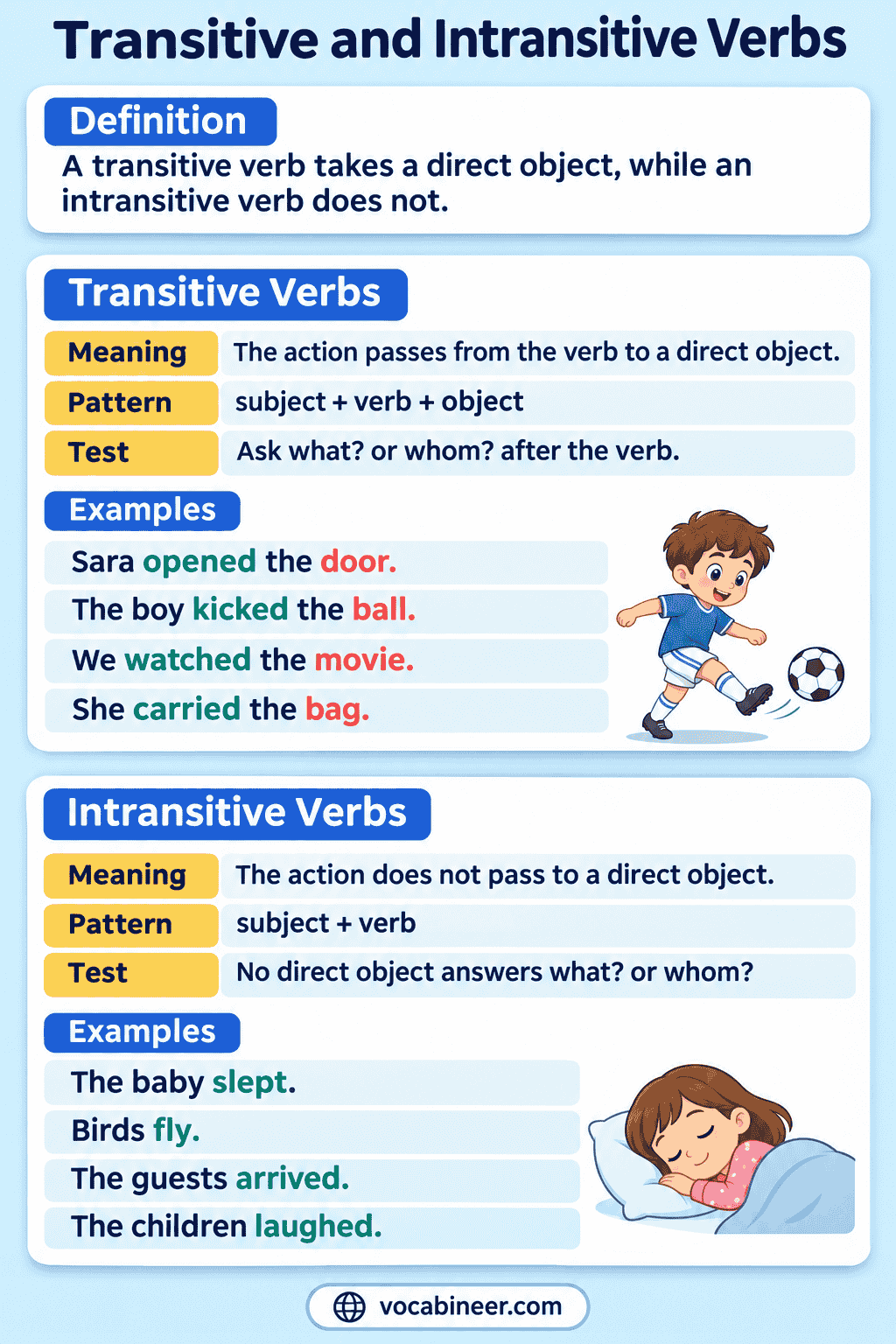
Transitivity describes the relationship between a verb and its objects. A transitive verb takes a direct object, while an intransitive verb does not.
The two basic structures are:
Transitive: subject + verb + direct object
Intransitive: subject + verb
| Transitive Use | Intransitive Use |
|---|---|
| Takes a direct object | Does not take a direct object |
| The object completes or extends the verb’s meaning | The verb functions without an object |
| Sara opened the door. | The door opened. |
| We watched the film. | Everyone laughed. |
Transitivity often describes how a verb works in a particular sentence rather than placing the verb permanently in one category. For example, read is transitive in She reads novels but intransitive in She reads every evening.
What Is a Direct Object?
A direct object is a noun, pronoun, phrase, or clause that directly follows a transitive verb and completes or extends its meaning. It often identifies the person or thing affected by the action.
- She opened the window.
- I called him.
- They bought a new computer.
- We know that she is right.
A useful first test is to ask what? or whom? after the verb:
She opened what? — The window.
I called whom? — Him.
However, this test does not work perfectly in every sentence. Learners must also distinguish direct objects from subject complements, adverbials, and nouns introduced by prepositions.
How Transitive Verbs Work
A transitive verb takes a direct object.
subject + transitive verb + direct object
| Subject | Transitive Verb | Direct Object |
|---|---|---|
| Sara | opened | the door |
| We | enjoyed | the concert |
| He | needs | help |
| They | discussed | the problem |
Some transitive verbs require an expressed object to complete their ordinary meaning.
| Incomplete | Complete |
|---|---|
| She carried. | She carried the bags. |
| They discussed. | They discussed the proposal. |
| He needs. | He needs assistance. |
Context can sometimes make an omitted object understandable. For instance, Have you eaten? usually means Have you eaten a meal or some food? Therefore, the presence or absence of an expressed object must be interpreted within the complete sentence and context.
How Intransitive Verbs Work
An intransitive verb does not take a direct object.
subject + intransitive verb
- The baby cried.
- Everyone laughed.
- The train arrived.
- Something happened.
An intransitive verb may still be followed by an adverb or a prepositional phrase.
| Sentence | Element After the Verb | Function |
|---|---|---|
| The baby cried loudly. | loudly | Adverb of manner |
| The train arrived at noon. | at noon | Prepositional phrase of time |
| They waited outside. | outside | Adverb of place |
| She slept on the sofa. | on the sofa | Prepositional phrase of place |
These expressions add information about time, place, manner, or another circumstance. They do not function as direct objects.
Transitive vs Intransitive Verbs
| Feature | Transitive Verb | Intransitive Verb |
|---|---|---|
| Direct object | Required or permitted | Not taken |
| Basic pattern | Subject + verb + object | Subject + verb |
| Passive voice | Often possible | Ordinary passive usually impossible |
| Example | She opened the door. | The door opened. |
| Following material | May be a direct object | Often an adverb or prepositional phrase |
The classification depends on the verb’s function in the actual sentence. Memorized lists can help, but they cannot replace sentence-level analysis.
Common Transitive Verbs
| Transitive Verb | Example |
|---|---|
| bring | She brought some food. |
| buy | We bought a laptop. |
| carry | He carried the bags. |
| contact | Please contact the manager. |
| discuss | They discussed the problem. |
| enjoy | I enjoyed the film. |
| explain | She explained the rule. |
| need | We need more time. |
| raise | They raised the price. |
| reach | He reached the station. |
These verbs commonly take direct objects in the meanings shown. Some may follow other patterns when their meanings change.
Common Intransitive Verbs
| Intransitive Verb | Example |
|---|---|
| arrive | The train arrived. |
| appear | A figure appeared. |
| cough | He coughed loudly. |
| cry | The baby cried. |
| die | The plant died. |
| disappear | The clouds disappeared. |
| happen | Something happened. |
| laugh | Everyone laughed. |
| rain | It rained all night. |
| sleep | The child slept peacefully. |
Although a prepositional phrase may follow one of these verbs, the noun inside that phrase does not become the verb’s direct object.
Verbs That Can Be Transitive or Intransitive
Many English verbs have both transitive and intransitive uses. These are sometimes called ambitransitive verbs.
| Transitive Use | Intransitive Use |
|---|---|
| She reads novels. | She reads every evening. |
| We ate dinner. | We already ate. |
| He won the race. | His team won. |
| She sings folk songs. | She sings beautifully. |
| They left the building. | They left at noon. |
In many of these examples, the object is optional because the intransitive sentence focuses on the activity or because the context makes the object unnecessary.
When Transitivity Changes the Meaning
Changing the object pattern can also change the verb’s meaning.
| Transitive Use | Intransitive Use |
|---|---|
| She runs a company. | She runs every morning. |
| He plays the piano. | The children play outside. |
| She changed her clothes. | The weather changed. |
| He grew a beard. | The child grew quickly. |
Therefore, identifying transitivity requires attention to both sentence structure and meaning.
Ergative Verbs
An ergative verb has related transitive and intransitive uses in which the transitive object becomes the intransitive subject.
| Transitive Use | Intransitive Use |
|---|---|
| Sara opened the door. | The door opened. |
| I boiled the water. | The water boiled. |
| The wind broke the branch. | The branch broke. |
| The company increased prices. | Prices increased. |
| She melted the butter. | The butter melted. |
In the transitive sentence, the subject causes the change. In the intransitive sentence, the subject experiences the change.
Ergative vs Ordinary Ambitransitive Verbs
| Ambitransitive Verb | Ergative Verb |
|---|---|
| Can appear with or without an object | Has a specific relationship between its two uses |
| She reads a book. / She reads. | She opened the door. / The door opened. |
| The subject usually performs the action in both uses | The transitive object becomes the intransitive subject |
| Object omission may leave the basic meaning unchanged | The intransitive subject experiences the change |
Every ergative verb has transitive and intransitive uses, but not every ambitransitive verb follows the ergative pattern.
Types of Transitive Verbs
Transitive verbs can follow several patterns depending on the number and type of elements they take.
Monotransitive Verbs
A monotransitive verb takes one direct object.
subject + verb + direct object
- She bought a laptop.
- We enjoyed the concert.
- They repaired the roof.
Ditransitive Verbs
A ditransitive verb can take an indirect object and a direct object.
subject + verb + indirect object + direct object
- She gave me a book.
- They sent us an email.
- The school offered him a place.
Many ditransitive verbs also allow a prepositional pattern.
| Double-Object Pattern | Prepositional Pattern |
|---|---|
| She gave me a book. | She gave a book to me. |
| He bought Sara a gift. | He bought a gift for Sara. |
| They sent us a message. | They sent a message to us. |
Complex Transitive Verbs
A complex transitive verb takes a direct object followed by an object complement.
subject + verb + direct object + object complement
- They painted the wall blue.
- The committee elected Sara chairperson.
- We found the room empty.
- They named the baby Adam.
The object complement describes, identifies, renames, or completes the meaning of the direct object.
Direct Objects vs Indirect Objects
| Direct Object | Indirect Object |
|---|---|
| Identifies what is transferred, affected, or communicated | Identifies the receiver or beneficiary |
| She gave me a book. | She gave me a book. |
| They sent us an email. | They sent us an email. |
| Often follows the indirect object | Usually comes before the direct object in a double-object pattern |
In She gave me a book, book is the thing transferred, while me identifies the recipient.
Limits of the Double-Object Pattern
Not every verb that takes a person and a thing allows the double-object structure.
| Correct Pattern | Incorrect Alternative |
|---|---|
| She gave me the book. | — |
| She gave the book to me. | — |
| She explained the rule to me. | She explained me the rule. |
| He described the problem to us. | He described us the problem. |
| They introduced Sara to the team. | They introduced the team Sara. |
Learners should check the pattern of each verb rather than assume that every verb + thing + to/for + person structure can become verb + person + thing.
Direct Objects vs Objects of Prepositions
| Direct Object | Object of a Preposition |
|---|---|
| Follows the verb without a preposition | Follows a preposition |
| She discussed the problem. | She listened to the speaker. |
| Discussed is transitive | Speaker is the object of to |
| The verb acts directly on the object | The preposition introduces the object |
In She arrived at the station, station is the object of at, not the direct object of arrived. The verb remains intransitive.
Objects vs Subject Complements
Linking verbs connect the subject to a complement instead of taking a direct object.
| Direct Object | Subject Complement |
|---|---|
| Receives or completes the action | Describes or identifies the subject |
| She painted the wall. | She became a doctor. |
| They opened the store. | The soup tastes salty. |
| Follows a transitive action verb | Follows a linking verb |
In She became a doctor, a doctor identifies she. It does not receive an action, so it is a subject complement rather than a direct object.
Action Uses vs Linking Uses
Some verbs can function as transitive action verbs or linking verbs.
| Transitive Action Verb | Linking Verb |
|---|---|
| She tasted the soup. | The soup tasted salty. |
| He smelled the flowers. | The flowers smelled sweet. |
| She felt the fabric. | The fabric felt soft. |
| They grew vegetables. | The child grew tired. |
In the linking examples, the expression after the verb describes the subject rather than receiving an action.
Forms That Can Function as Objects
A direct object or object-like complement does not always consist of one noun.
| Object Type | Example |
|---|---|
| Noun | She bought fruit. |
| Pronoun | I called her. |
| Noun phrase | They repaired the damaged roof. |
| -ing clause | He enjoys reading novels. |
| Infinitive clause | They want to leave. |
| That-clause | I believe that she is right. |
| Wh-clause | She explained what happened. |
Grammar frameworks differ in how they analyze some infinitive and clause patterns. However, each highlighted element completes the meaning of the verb.
Required Adverbial Complements
Some transitive verbs need both a direct object and a phrase showing place, direction, or another relationship.
subject + verb + object + required adverbial
- She put the keys on the table.
- They placed the chairs near the wall.
- He led the visitors into the hall.
- We sent the children outside.
The sentence She put the keys feels incomplete because put normally requires information about where the keys were placed.
Required Complement vs Optional Modifier
| Required Complement | Optional Modifier |
|---|---|
| She put the bag on the chair. | She slept on the chair. |
| The location completes the meaning of put | The location adds optional information about slept |
| Removing it makes the sentence incomplete | Removing it leaves a complete sentence |
| She put the bag is incomplete | She slept is complete |
Both expressions begin with prepositions, but they perform different grammatical jobs.
Transitive Verbs and Passive Voice
Many transitive sentences can become passive because the direct object can move into the subject position.
| Active Voice | Passive Voice |
|---|---|
| Sara opened the door. | The door was opened by Sara. |
| They repaired the road. | The road was repaired. |
| Someone stole my bicycle. | My bicycle was stolen. |
An ordinary intransitive verb cannot form this type of passive because it has no direct object:
- Active: The baby cried.
- Incorrect passive: The baby was cried.
Passive Voice with Ditransitive Verbs
Some ditransitive constructions allow either object to become the passive subject.
| Active Sentence | Recipient as Passive Subject | Thing as Passive Subject |
|---|---|---|
| They gave me a book. | I was given a book. | A book was given to me. |
| She sent us an invitation. | We were sent an invitation. | An invitation was sent to us. |
| The school offered him a place. | He was offered a place. | A place was offered to him. |
Not every two-object construction allows both passive patterns equally naturally.
Limits of the Passive Test
Passive transformation is a helpful test, but it does not define transitivity perfectly.
| Natural Passive | Awkward or Restricted Passive |
|---|---|
| They repaired the road. → The road was repaired. | She has a car. → A car is had by her. |
| Someone stole the bicycle. → The bicycle was stolen. | The dress suits her. → She is suited by the dress. |
A verb may take a direct object even when its passive form sounds unnatural because meaning and usage also affect passivization.
Prepositional Passives
English sometimes makes the object of a preposition the subject of a passive sentence.
| Active Sentence | Prepositional Passive |
|---|---|
| Someone dealt with the complaint. | The complaint was dealt with. |
| A child slept in the bed. | The bed was slept in. |
| Everyone laughed at him. | He was laughed at. |
These structures do not make the original verb directly transitive. The preposition remains attached to the verb in the passive construction.
Transitive and Intransitive Phrasal Verbs
The transitivity of a phrasal verb belongs to the complete expression, not only its main verb.
| Verb Type | Example | Object Pattern |
|---|---|---|
| Transitive phrasal verb | She turned the light off. | Takes a direct object |
| Intransitive phrasal verb | The plane took off. | Takes no object |
| Prepositional verb | She listened to the radio. | Object follows a preposition |
| Phrasal-prepositional verb | We put up with the noise. | Object follows the final preposition |
Separable vs Inseparable Phrasal Verbs
| Separable Phrasal Verb | Inseparable Verb Pattern |
|---|---|
| Turn the light off. | Look after the child. |
| Turn it off. | Look after her. |
| The object may separate the verb and particle | The object remains after the complete expression |
Pronoun objects normally appear between the verb and particle in separable phrasal verbs.
Implied and Understood Objects
A verb that commonly takes an object may appear without an expressed one when context or general knowledge supplies the meaning.
| Type | Example | Explanation |
|---|---|---|
| Understood object | Have you eaten? | The context supplies an understood meal or food |
| Unspecified object | She is reading. | The particular reading material is unimportant |
| Generic activity | He drinks. | Commonly refers to drinking alcohol |
| Contextual omission | Sara won, but Ali lost. | The event or competition is already understood |
A dictionary may call some of these intransitive or absolute uses. Therefore, readers should analyze the actual sentence rather than rely on one universal label.
Middle Constructions
A middle construction uses an active verb form but describes how easily or naturally something undergoes an action.
| Ordinary Transitive Use | Middle Construction |
|---|---|
| People read this book easily. | This book reads easily. |
| You can wash this fabric safely. | This fabric washes well. |
| Drivers handle the car smoothly. | The car handles smoothly. |
The subject of the middle construction corresponds in meaning to the object of the ordinary transitive sentence.
Cognate Objects
Some verbs usually treated as intransitive can take an object closely related to the verb’s meaning.
- She smiled a nervous smile.
- He dreamed a strange dream.
- They lived a peaceful life.
- She died a painful death.
These are called cognate objects. They show that English can extend ordinary verb patterns for emphasis or description.
Reflexive Objects
A reflexive pronoun can function as a direct object when the subject acts upon itself.
- He introduced himself.
- She blamed herself.
- They prepared themselves.
- I taught myself Spanish.
| With a Reflexive Object | With Another Object or Pattern |
|---|---|
| He introduced himself. | He introduced Sara. |
| She hurt herself. | She hurt her arm. |
| They prepared themselves. | They prepared dinner. |
Common Causative Verb Pairs
Related transitive and intransitive verbs often cause errors.
Raise vs Rise
| Raise | Rise |
|---|---|
| Transitive | Intransitive |
| Takes an object | Takes no direct object |
| They raised the price. | The price rose. |
| She raised her hand. | Her hand rose slowly. |
Lay vs Lie
| Lay | Lie |
|---|---|
| Transitive | Intransitive |
| Lay the book on the desk. | The book lies on the desk. |
| Past form: laid | Past form: lay |
| Past participle: laid | Past participle: lain |
Set vs Sit
| Set | Sit |
|---|---|
| Usually transitive in this meaning | Intransitive |
| She set the cup on the table. | The cup sat on the table. |
| Set the child on the chair. | The child sat on the chair. |
Transitivity and Pronoun Case
Direct and indirect objects require object pronouns.
| Incorrect | Correct |
|---|---|
| She called he. | She called him. |
| They invited we. | They invited us. |
| Sara gave I the book. | Sara gave me the book. |
| The teacher helped they. | The teacher helped them. |
Subject pronouns such as I, he, she, we, and they normally function as subjects, while me, him, her, us, and them function as objects.
Valency and Verb Patterns
Valency describes the number and type of required elements associated with a verb.
| Pattern | Structure | Example |
|---|---|---|
| One-place pattern | subject + verb | The baby slept. |
| Two-place pattern | subject + verb + object or complement | She opened the door. |
| Three-place pattern | subject + verb + two additional elements | She gave me a book. |
Valency provides a broader way to understand verb patterns, while transitivity focuses mainly on the presence and type of objects.
Dictionary Labels for Transitivity
Dictionaries often use abbreviations to show a verb’s possible patterns.
| Dictionary Label | Meaning |
|---|---|
| T, tr., or v.t. | Transitive |
| I, intr., or v.i. | Intransitive |
| T/I | Used transitively and intransitively |
A dictionary may provide separate entries when a verb’s transitive and intransitive uses have different meanings.
Common Preposition Errors
Some transitive verbs take a direct object without an added preposition.
| Incorrect | Correct |
|---|---|
| discuss about the problem | discuss the problem |
| enter into the room | enter the room |
| approach to the building | approach the building |
| contact with the manager | contact the manager |
| emphasize on the issue | emphasize the issue |
| reach to the station | reach the station |
These expressions may become correct when the preposition belongs to a different construction or meaning. For example, enter into an agreement is standard because it means to begin or become involved in the agreement.
How to Identify Transitivity in a Sentence
Use this process:
- Find the complete verb phrase.
- Identify the subject.
- Look for a noun, pronoun, phrase, or clause after the verb.
- Check whether that element functions as a direct object.
- Distinguish direct objects from prepositional objects and complements.
- Ask whether the sentence remains grammatically complete without the object.
- Consider whether the verb has another meaning or pattern.
- Use passive transformation only as a supporting test.
- Check a learner’s dictionary when the pattern remains unclear.
Consider this sentence:
The teacher gave the students an assignment.
- The teacher is the subject.
- Gave is a ditransitive verb.
- The students is the indirect object.
- An assignment is the direct object.
Common Mistakes with Transitive and Intransitive Verbs
Treating Every Noun After a Verb as a Direct Object
Incorrect analysis: Station is the direct object in She arrived at the station.
Correct analysis: Station is the object of the preposition at. The verb arrived remains intransitive.
Omitting a Required Object
Incorrect: She discussed.
Correct: She discussed the problem.
Adding an Unnecessary Preposition
Incorrect: We discussed about the issue.
Correct: We discussed the issue.
Treating a Subject Complement as an Object
Incorrect analysis: Teacher is an object in She became a teacher.
Correct analysis: Teacher is a subject complement after the linking verb became.
Assuming a Verb Always Has One Classification
Verbs such as read, write, eat, open, change, and grow can work transitively or intransitively depending on their use.
Forming Passive Voice from an Intransitive Verb
Incorrect: The station was arrived by the train.
Correct: The train arrived at the station.
Confusing Direct and Indirect Objects
In She gave me a book, me is the indirect object and book is the direct object.
Separating an Inseparable Phrasal Verb
Incorrect: She looked the child after.
Correct: She looked after the child.
Omitting a Required Adverbial
Incomplete: She put the bag.
Complete: She put the bag on the chair.
Using a Subject Pronoun as an Object
Incorrect: They invited we.
Correct: They invited us.
Confusing Raise and Rise
Incorrect: Prices raised last month.
Correct: Prices rose last month.
Use raised when a subject acts on an object: The company raised prices.
FAQs
A transitive verb takes a direct object, while an intransitive verb does not. For example, opened is transitive in Sara opened the door, while arrived is intransitive in The train arrived.
Yes. Many verbs work both ways. In She reads novels, reads is transitive. In She reads every evening, it is intransitive. The sentence pattern and meaning determine the classification.
Find the verb and ask what or whom it directly affects. Then confirm that no preposition introduces the possible object and that the word does not function as a subject complement or adverbial.
Yes, but the noun may belong to a prepositional phrase or another construction rather than functioning as a direct object. In She arrived at the station, station is the object of at.
Ordinary intransitive verbs cannot form a standard passive because they have no direct object to become the passive subject. However, English sometimes forms prepositional passives such as The bed was slept in.
Final Thoughts
Transitive verbs take direct objects, while intransitive verbs do not. However, many verbs follow more than one pattern, and their transitivity may change with their meaning and context. Therefore, it is more accurate to classify a verb’s use in a sentence than to assign every verb one permanent label.
To analyze a sentence correctly, distinguish direct objects from indirect objects, prepositional objects, adverbials, and subject complements. Also consider optional or understood objects, passive voice, phrasal verbs, and the verb’s dictionary patterns. Once these distinctions become familiar, English sentence structure becomes much easier to understand and use accurately.
Read More
- Parts of Speech in English
- Nouns in English with Examples
- Common and Proper Nouns
- Countable and uncountable nouns
- Collective nouns
- Abstract and concrete nouns
- Gender nouns
- Compound nouns
- Possessive nouns
- Singular and plural nouns
- Plural noun rules