

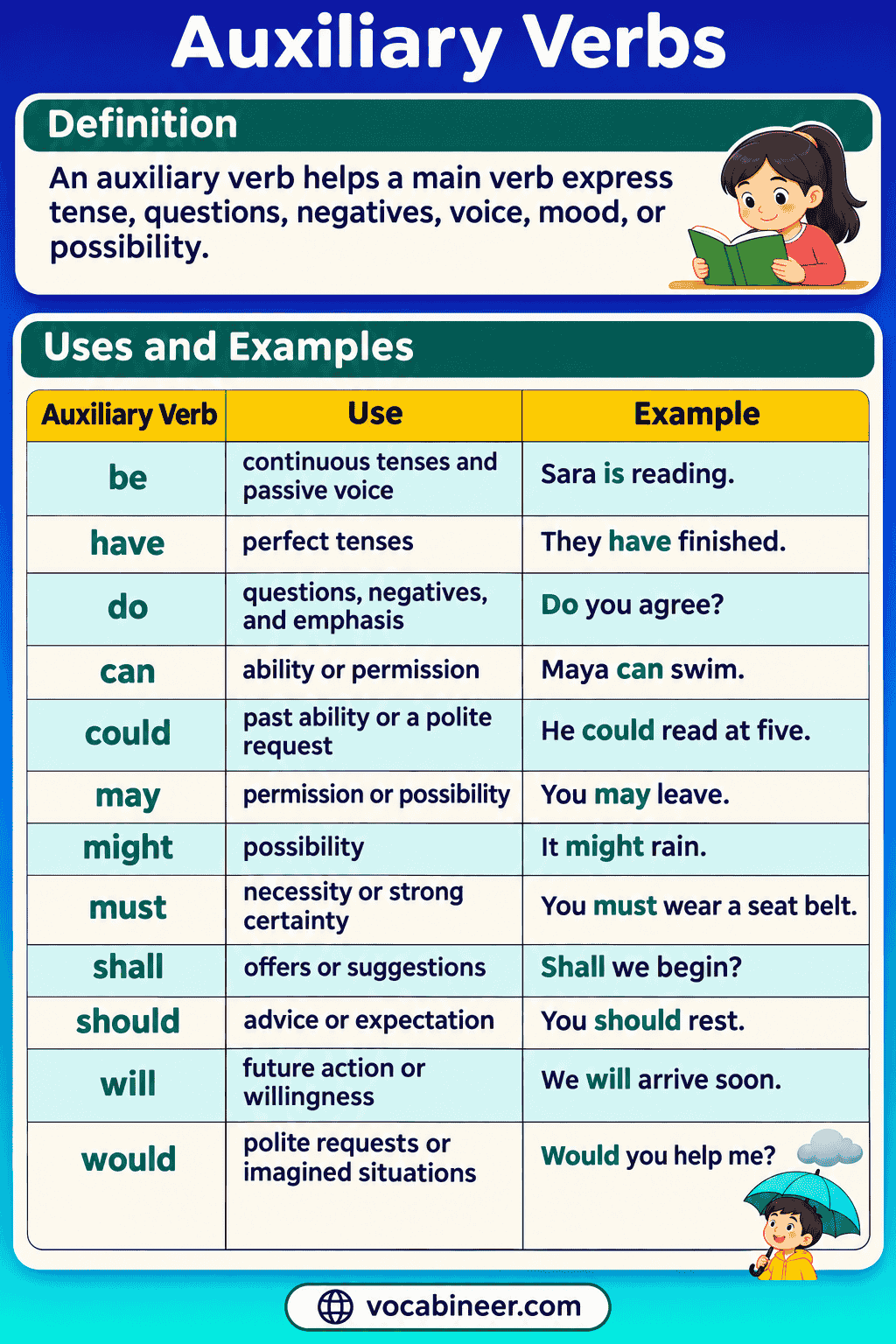
Auxiliary verbs help main verbs express grammatical information that a main verb cannot always show by itself. They help form continuous and perfect constructions, passive voice, questions, negative sentences, emphasis, and meanings such as ability, possibility, permission, and necessity.
English learners often call auxiliary verbs helping verbs. The main groups are primary auxiliaries, modal auxiliaries, and semi-modal forms. This guide explains how each group works, how several auxiliaries combine in one verb phrase, and how to avoid common mistakes with questions, negatives, contractions, tags, and verb forms.
In This Page
What Are Auxiliary Verbs?
An auxiliary verb is a verb that works with a main verb to form a complete verb phrase. The main verb carries the central meaning, while the auxiliary contributes information about aspect, voice, modality, negation, emphasis, or sentence structure.
| Sentence | Auxiliary Verb | Main Verb | Function |
|---|---|---|---|
| She is reading. | is | reading | Continuous aspect |
| They have arrived. | have | arrived | Perfect aspect |
| The door was opened. | was | opened | Passive voice |
| He can swim. | can | swim | Ability |
| Do you agree? | do | agree | Question formation |
An auxiliary may sometimes appear without a visible main verb when the missing words are clear from context:
Does Mina play tennis? — Yes, she does.
Here, does represents the understood phrase plays tennis.
Types of Auxiliary Verbs
English auxiliaries fall into three practical groups.
| Type | Members | Main Functions |
|---|---|---|
| Primary auxiliaries | be, have, do | Aspect, voice, questions, negatives, emphasis, and substitution |
| Modal auxiliaries | can, could, may, might, must, shall, should, will, would | Ability, possibility, permission, necessity, prediction, and intention |
| Semi-modals and related forms | ought to, have to, need to, used to, be able to, be going to | Meanings similar to those of central modals |
Grammar references differ in how they classify forms such as ought to, need, dare, and used to. However, the central modal list remains relatively stable.
Primary Auxiliary Verbs
The three primary auxiliaries are be, have, and do. Unlike central modals, they change form according to tense and subject.
| Base Verb | Forms |
|---|---|
| be | am, is, are, was, were, be, being, been |
| have | have, has, had |
| do | do, does, did |
Each primary auxiliary can also function as a main verb. Its position and relationship with the surrounding words determine its role.
Auxiliary Be
Auxiliary be forms continuous constructions and passive voice.
Continuous Forms
The continuous structure is:
be + present participle
| Form | Example |
|---|---|
| Present continuous | She is reading. |
| Past continuous | She was reading. |
| Future continuous | She will be reading. |
| Present perfect continuous | She has been reading. |
| Past perfect continuous | She had been reading. |
The present participle ends in -ing. Auxiliary be carries tense and agreement, while the participle identifies the ongoing activity.
Passive Voice
The basic passive structure is:
be + past participle
| Active Sentence | Passive Sentence |
|---|---|
| The chef prepared the meal. | The meal was prepared by the chef. |
| Workers repair the road. | The road is repaired by workers. |
| They will announce the result. | The result will be announced. |
| Someone has damaged the door. | The door has been damaged. |
Passive voice places attention on the receiver of the action. The performer may appear in a phrase beginning with by, but writers often omit it when it is unknown or unimportant.
Linking Be vs Auxiliary Be
The verb be does not always function as an auxiliary. It can also act as a linking verb that connects a subject to an identity, quality, condition, or location.
| Function | Example | Explanation |
|---|---|---|
| Linking be | Sara is tired. | Connects Sara to a description |
| Linking be | Omar is a teacher. | Connects Omar to an identity |
| Continuous auxiliary | Sara is working. | Helps form the continuous aspect |
| Passive auxiliary | Sara was invited. | Helps form passive voice |
In Sara is tired, no other verb follows is, so it functions as a linking verb. In Sara is working, is supports the main verb working.
Auxiliary Have
Auxiliary have forms perfect constructions.
The basic structure is:
have + past participle
| Perfect Form | Example |
|---|---|
| Present perfect | She has finished. |
| Past perfect | She had finished. |
| Future perfect | She will have finished. |
| Present perfect continuous | She has been working. |
| Past perfect passive | The work had been completed. |
The forms have and has express present-time agreement, while had expresses past time. The main verb appears as a past participle, which may be regular or irregular:
- have worked
- has written
- had gone
- have seen
Auxiliary Do
Auxiliary do supports questions, negatives, emphasis, short answers, tags, and substitution when a clause has no other auxiliary.
| Function | Example |
|---|---|
| Present question | Do you work here? |
| Third-person question | Does she drive? |
| Past question | Did they arrive? |
| Negative | We do not agree. |
| Emphasis | I do understand. |
| Short answer | Yes, she does. |
| Question tag | You know him, don’t you? |
After auxiliary do, the main verb remains in its base form.
| Incorrect | Correct |
|---|---|
| Does she works here? | Does she work here? |
| Did they arrived early? | Did they arrive early? |
| He does not likes coffee. | He does not like coffee. |
The tense and agreement appear on do, does, or did, so the main verb does not carry those endings.
Main Verbs vs Auxiliary Verbs
The words be, have, and do can function as main verbs or auxiliaries.
| Main Verb | Auxiliary Verb |
|---|---|
| She is a teacher. | She is teaching. |
| They have a car. | They have finished. |
| We do our homework. | We do not complain. |
Look for another verb to distinguish the two functions. If have supports a past participle, be supports a participle, or do supports a base verb, it probably functions as an auxiliary.
Modal Auxiliary Verbs
Modal auxiliaries express the speaker’s view of ability, possibility, permission, obligation, prediction, willingness, or likelihood.
| Modal | Common Uses | Example |
|---|---|---|
| can | ability, permission, general possibility | She can swim. |
| could | past ability, possibility, polite request | Could you help me? |
| may | permission, possibility | It may rain. |
| might | weaker possibility | They might arrive late. |
| must | necessity, strong conclusion | You must stop. |
| shall | formal future, offers, suggestions | Shall we begin? |
| should | advice, expectation, duty | You should rest. |
| will | prediction, intention, willingness | I will call you. |
| would | hypothetical meaning, past habit, polite request | I would help if I could. |
Modal Meaning Categories
Modal meanings can be grouped into three broad categories.
| Type | Meaning | Example |
|---|---|---|
| Dynamic | Ability or willingness | She can swim. |
| Deontic | Permission, duty, or obligation | You must leave. |
| Epistemic | Possibility, probability, or deduction | She must be home. |
The same modal may express more than one type of meaning. For example, must expresses obligation in You must leave but a logical conclusion in She must be home.
Rules for Modal Auxiliaries
Central modals follow several important rules:
- A modal is followed by the base form of a verb.
- A modal does not take -s with a third-person singular subject.
- Questions form through inversion, not auxiliary do.
- Negatives place not directly after the modal.
- Central modals do not normally have infinitive or participle forms.
| Incorrect | Correct |
|---|---|
| She can swims. | She can swim. |
| He must to leave. | He must leave. |
| Does she can drive? | Can she drive? |
| He cans speak English. | He can speak English. |
| She does not may attend. | She may not attend. |
Standard English also avoids placing two central modals together. Instead of She will can attend, use She will be able to attend.
Semi-Modal Verbs
Semi-modals express meanings similar to central modals but behave partly like main verbs.
| Semi-Modal | Main Meaning | Example |
|---|---|---|
| have to | external necessity | I have to leave. |
| ought to | advice or duty | You ought to apologize. |
| need to | necessity | We need to talk. |
| be able to | ability | She is able to swim. |
| be going to | plan or prediction | They are going to travel. |
| used to | past habit or state | He used to live here. |
| be supposed to | expectation or obligation | You are supposed to wait. |
Semi-modals often provide forms that central modals lack:
- She will be able to attend.
- They had to leave.
- We have had to change the plan.
- He may be going to resign.
Because they contain forms of be or have, some semi-modals change according to tense and subject.
Primary Auxiliaries vs Modal Auxiliaries
| Primary Auxiliaries | Modal Auxiliaries |
|---|---|
| Include be, have, and do | Include can, may, must, will, and others |
| Change form for tense or agreement | Usually do not change form |
| Can also function as main verbs | Normally function only as auxiliaries |
| Help form aspect, voice, questions, and negatives | Express ability, possibility, necessity, permission, and similar meanings |
| May be followed by participles or base verbs | Are followed by a base form |
Both groups can act as the first or finite auxiliary in a verb phrase.
The First Auxiliary in a Verb Phrase
When a verb phrase contains several verbs, the first auxiliary normally carries tense and subject agreement. It also performs the main grammatical operations in the clause.
| Verb Phrase | First or Finite Auxiliary | Remaining Verbs |
|---|---|---|
| She is working. | is | working |
| They have finished. | have | finished |
| He has been waiting. | has | been waiting |
| The work may have been completed. | may | have been completed |
The first auxiliary:
- Moves before the subject in questions
- Carries not in negative sentences
- Appears in question tags
- Receives contrastive emphasis
- Can represent an omitted verb phrase
| Function | Example |
|---|---|
| Question | Has she finished? |
| Negative | She has not finished. |
| Tag | She has finished, hasn’t she? |
| Emphasis | She has finished. |
| Ellipsis | Ali has finished, and Sara has too. |
Auxiliary Verb Order
When several auxiliaries occur together, they normally follow this order:
modal + perfect have + continuous be + passive be + main verb
| Structure | Example |
|---|---|
| modal + main verb | She may leave. |
| have + past participle | She has left. |
| be + present participle | She is leaving. |
| be + past participle | She was invited. |
| modal + have + past participle | She may have left. |
| have + been + present participle | She has been working. |
| modal + be + past participle | It must be completed. |
| modal + have + been + past participle | It may have been completed. |
Each auxiliary determines the form that follows it:
- A modal takes a base form.
- Perfect have takes a past participle.
- Continuous be takes a present participle.
- Passive be takes a past participle.
Modal Perfect and Continuous Forms
Modals can combine with perfect, continuous, and passive structures.
| Structure | Typical Meaning | Example |
|---|---|---|
| modal + base verb | Present or future possibility | She may leave. |
| modal + be + -ing | Ongoing possibility | She may be working. |
| modal + have + participle | Past possibility or judgment | She may have left. |
| modal + have been + -ing | Past ongoing possibility | She may have been waiting. |
| modal + be + participle | Modal passive | It must be completed. |
| modal + have been + participle | Past modal passive | It may have been completed. |
These structures allow speakers to express time and modality together.
Forming Questions
Most questions place the first auxiliary before the subject. This movement is called subject–auxiliary inversion.
| Statement | Question |
|---|---|
| She is studying. | Is she studying? |
| They have arrived. | Have they arrived? |
| He can swim. | Can he swim? |
| You like coffee. | Do you like coffee? |
| Sara called you. | Did Sara call you? |
When a simple present or simple past statement has no auxiliary, English adds do, does, or did.
Wh-Questions
Most wh-questions follow this structure:
question word + auxiliary + subject + main verb
- Where does she live?
- Why did they leave?
- When will you return?
- How long have you waited?
Subject Questions vs Object Questions
Subject questions do not normally use inversion or do-support because the question word itself is the subject.
| Subject Question | Object Question |
|---|---|
| Who called you? | Who did you call? |
| What happened? | What did she explain? |
Use emphatic do in a subject question only when the context requires special emphasis: Who did call you?
Making Negative Sentences
The word not normally follows the first auxiliary.
| Positive Sentence | Negative Sentence |
|---|---|
| She is working. | She is not working. |
| They have arrived. | They have not arrived. |
| He can attend. | He cannot attend. |
| We agree. | We do not agree. |
| Sara called. | Sara did not call. |
After did not, the main verb returns to its base form:
- Correct: She did not go.
- Incorrect: She did not went.
Emphatic Do and Imperatives
Auxiliary do can strengthen an affirmative statement:
- I do understand your concern.
- She does want to help.
- They did complete the project.
It can also add emphasis or politeness to an imperative:
- Do sit down.
- Do be careful.
- Do come again.
Negative imperatives use do not or don’t, even before be:
- Do not touch the wire.
- Don’t be late.
This imperative pattern is an exception to the ordinary rule that clauses with linking be do not use auxiliary do.
Short Answers, Substitution, and Ellipsis
An auxiliary can replace a verb phrase that listeners or readers already understand.
| Question or Statement | Short Response |
|---|---|
| Does she sing? | Yes, she does. |
| Have they arrived? | No, they haven’t. |
| Can Omar drive? | Yes, he can. |
| I haven’t finished. | Sara has. |
| They promised to help. | And they did. |
This use prevents unnecessary repetition:
I had not noticed the error, but my colleague had.
The auxiliary had represents had noticed the error.
Auxiliary Verbs in Question Tags
Question tags usually repeat the auxiliary from the main statement. Positive statements generally take negative tags, while negative statements generally take positive tags.
| Statement | Question Tag |
|---|---|
| She is working, | isn’t she? |
| They have arrived, | haven’t they? |
| He can swim, | can’t he? |
| You like coffee, | don’t you? |
| Sara called, | didn’t she? |
| They are not ready, | are they? |
Special Question Tags
| Main Statement | Question Tag |
|---|---|
| I am late, | aren’t I? |
| Let’s begin, | shall we? |
| Open the door, | will you? |
| Don’t leave, | will you? |
| Nobody called, | did they? |
| Everyone is ready, | aren’t they? |
Words such as nobody create negative meaning, so they normally take a positive tag.
Contractions with Auxiliary Verbs
Contractions are common in conversation and informal writing.
| Full Form | Contraction |
|---|---|
| is not | isn’t |
| are not | aren’t |
| was not | wasn’t |
| have not | haven’t |
| has not | hasn’t |
| do not | don’t |
| does not | doesn’t |
| did not | didn’t |
| will not | won’t |
| cannot | can’t |
| would not | wouldn’t |
| should not | shouldn’t |
Full forms may sound more formal or emphatic:
I do not agree with that conclusion.
Ambiguous Contractions
The contractions ’s and ’d can represent different auxiliaries.
| Contraction | Possible Full Forms | Examples |
|---|---|---|
| ’s | is or has | She’s working. / She’s finished. |
| ’d | had or would | She’d left. / She’d help. |
The following verb form reveals the meaning:
- ’s + -ing usually means is.
- ’s + past participle usually means has.
- ’d + past participle usually means had.
- ’d + base form usually means would.
Limits on Positive Contractions
A positive auxiliary is not normally contracted when it stands alone.
| Incorrect | Correct |
|---|---|
| Yes, she’s. | Yes, she is. |
| I think he’s. | I think he has. |
| Yes, I’ll. | Yes, I will. |
Negative contractions such as isn’t, hasn’t, and won’t can stand alone in short responses.
Auxiliary Agreement
Primary auxiliaries change according to subject and tense.
| Subject | Be | Have | Do |
|---|---|---|---|
| I | am | have | do |
| he, she, it | is | has | does |
| you, we, they | are | have | do |
| singular past | was | had | did |
| plural past | were | had | did |
Only the finite or first auxiliary carries agreement:
- She has been working.
- They have been working.
- He does understand.
- They do understand.
Auxiliaries in Existential There Sentences
Introductory there allows English to present the existence or presence of something.
- There is a problem.
- There are several options.
- There has been a mistake.
- There have been several changes.
- There may be another solution.
In formal writing, be generally agrees with the following noun phrase.
| Singular | Plural |
|---|---|
| There is one reason. | There are two reasons. |
| There has been a delay. | There have been several delays. |
Main Verb Have in Questions and Negatives
Different patterns occur, especially in American and British English.
| Pattern | Example |
|---|---|
| Common American pattern | Do you have a car? |
| Common pattern with have got | Have you got a car? |
| Negative with do | I don’t have a car. |
| Negative with have got | I haven’t got a car. |
In Do you have a car?, do is the auxiliary and have is the main verb. In Have you got a car?, have functions as part of the have got construction.
Be Passive vs Get Passive
English also uses get in an informal passive-like construction.
| Be Passive | Get Passive |
|---|---|
| The window was broken. | The window got broken. |
| The files were deleted. | The files got deleted. |
| Neutral and widely used | More informal and event-focused |
The get passive often emphasizes a change, event, or affected subject. However, get is not one of the three primary auxiliaries.
Auxiliaries in Spoken English
Auxiliaries are often unstressed and reduced in natural speech.
| Full or Stressed Form | Common Weak Form |
|---|---|
| can /kæn/ | /kən/ |
| have /hæv/ | /həv/ or /əv/ |
| was /wɒz/ | /wəz/ |
| are /ɑːr/ | /ər/ |
Weak forms help create natural English rhythm. However, speakers use full or stressed forms for emphasis and in short answers:
- Yes, I can.
- I do understand.
- She has finished.
How to Identify an Auxiliary Verb
Use this process:
- Find the complete verb phrase.
- Identify the verb carrying the central action or state.
- Look for verbs placed before the main verb.
- Check whether they express aspect, voice, modality, negation, or question structure.
- Decide whether be, have, or do functions independently or supports another verb.
- Check whether an auxiliary replaces an understood verb phrase.
Consider this sentence:
The documents may have been damaged.
- may expresses possibility.
- have forms the perfect construction.
- been helps form the passive.
- damaged is the main verb’s past participle.
Common Mistakes with Auxiliary Verbs
Omitting an Auxiliary
Incorrect: Where you are going?
Correct: Where are you going?
Adding Do Before Another Auxiliary
Incorrect: Do they have arrived?
Correct: Have they arrived?
Using Do with Linking Be
Incorrect: Does she be ready?
Correct: Is she ready?
Adding -s After a Modal
Incorrect: He can swims.
Correct: He can swim.
Adding To After a Central Modal
Incorrect: You must to leave.
Correct: You must leave.
Using the Wrong Participle After Have
Incorrect: She has went home.
Correct: She has gone home.
Confusing Continuous and Passive Forms
| Continuous | Passive |
|---|---|
| They are repairing the road. | The road is being repaired. |
| be + present participle | be + past participle |
Putting Auxiliaries in the Wrong Order
Incorrect: The work has may been completed.
Correct: The work may have been completed.
Contracting a Positive Short Answer
Incorrect: Yes, she’s.
Correct: Yes, she is.
Confusing ’s and ’d
Use the following verb to determine whether ’s means is or has, and whether ’d means had or would.
Using the Wrong Question Tag
Incorrect: She can swim, doesn’t she?
Correct: She can swim, can’t she?
Using Inversion in a Subject Question
Incorrect: Who did call you?
Correct in a neutral question: Who called you?
FAQs
An auxiliary verb works with a main verb to express grammatical information such as aspect, voice, modality, negation, questions, or emphasis. It is also called a helping verb.
The primary auxiliaries are be, have, and do. Their forms include am, is, are, was, were, been, have, has, had, do, does, and did.
A main verb carries the central meaning of the verb phrase, while an auxiliary supports it by adding grammatical information. However, be, have, and do can also function as main verbs in other contexts.
Yes. Several auxiliaries can appear in a fixed order, as in The work may have been completed. Here, may, have, and been support the main verb completed.
Yes. Central modals such as can, may, must, should, and will are auxiliary verbs. They express meanings such as ability, possibility, permission, necessity, and prediction.
Final Thoughts
Auxiliary verbs form an essential part of English grammar. They help speakers and writers create continuous and perfect constructions, passive voice, modal meanings, questions, negatives, emphasis, tags, and short answers.
To identify an auxiliary, examine the complete verb phrase and determine the job performed by each verb. Pay particular attention to the first auxiliary, because it normally carries tense, agreement, negation, inversion, and emphasis. Once these patterns become familiar, even longer verb phrases become easier to understand and construct correctly.
Read More
- Parts of Speech in English
- Nouns in English with Examples
- Common and Proper Nouns
- Countable and uncountable nouns
- Collective nouns
- Abstract and concrete nouns
- Gender nouns
- Compound nouns
- Possessive nouns
- Singular and plural nouns
- Plural noun rules