

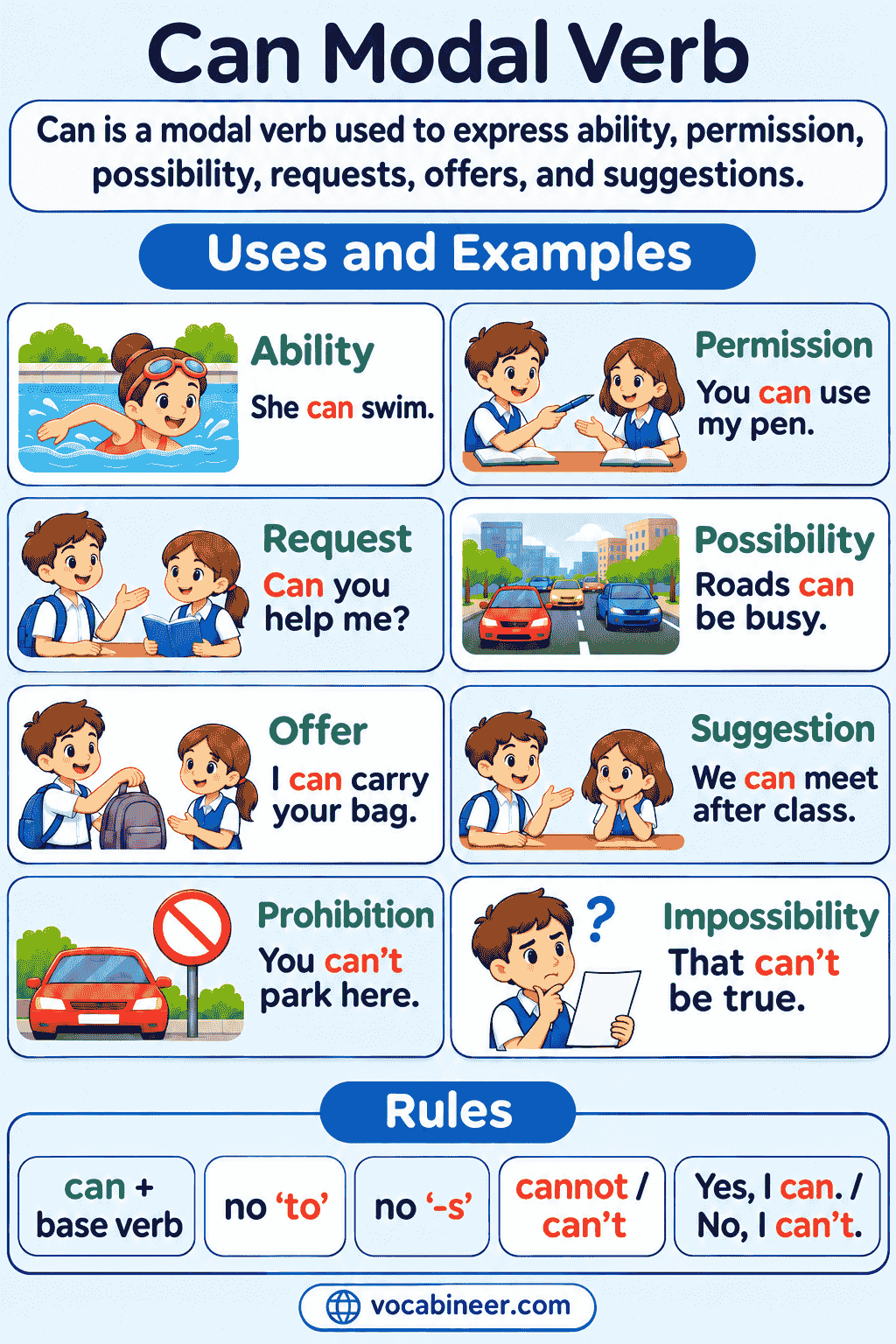
The modal verb can helps speakers express ability, permission, opportunity, possibility, requests, and offers. In “She can swim,” it shows ability; in “Can I leave?” it asks for permission; and in “Can you help me?” it makes a request. Although can is one of the first modal verbs English learners meet, its meaning changes with context.
Using can correctly also requires several special grammar rules. It never takes third-person singular -s, it must be followed by the base form of a verb, and it forms questions and negatives without do. Moreover, because can has no ordinary infinitive, participle, or complete set of tense forms, English often uses be able to or be allowed to in its place.
In This Page
Can at a Glance
Can is a core modal auxiliary verb. It appears before a main verb and adds a meaning such as ability, permission, or possibility.
| Use | Meaning | Example |
|---|---|---|
| Ability | Possessing a skill or capacity | Mira can swim. |
| Opportunity | Circumstances make something possible | We can meet tomorrow. |
| General possibility | Something is sometimes possible | Roads can become icy. |
| Permission | An action is permitted | You can leave now. |
| Request | Asking someone to act | Can you help me? |
| Offer | Offering assistance | Can I carry that? |
| Negative deduction | Something seems impossible | That can’t be true. |
The basic pattern is:
Subject + can + base form of the main verb
- I can read this.
- She can help us.
- They can arrive early.
Main Forms of Can
| Sentence type | Structure | Example |
|---|---|---|
| Affirmative | subject + can + base verb | She can drive. |
| Negative | subject + cannot/can’t + base verb | She can’t drive. |
| Yes–no question | can + subject + base verb | Can she drive? |
| Wh-question | question word + can + subject + base verb | Where can she drive? |
| Short answer | yes/no + subject + can/can’t | Yes, she can. |
| Passive | subject + can be + past participle | It can be repaired. |
Grammatical Features of Can
As a core modal, can behaves differently from an ordinary verb.
The Base Verb After Can
The main verb after can must appear in its bare infinitive, which is the base form without to.
| Correct | Incorrect |
|---|---|
| She can speak French. | She can to speak French. |
| He can work today. | He can works today. |
| We can leave now. | We can leaving now. |
The Same Form with Every Subject
Can does not change according to person or number. Therefore, it does not take third-person singular -s.
| Subject | Correct form |
|---|---|
| I | I can swim. |
| you | You can swim. |
| he, she, it | She can swim. |
| we | We can swim. |
| they | They can swim. |
Missing Infinitive and Participial Forms
Modal can does not have ordinary forms such as to can, canning, or canned for ability. Instead, English uses be able to where an infinitive, participle, or another unavailable form is required.
| Required structure | Incorrect | Correct |
|---|---|---|
| To-infinitive | I want to can swim. | I want to be able to swim. |
| Future after will | She will can drive. | She will be able to drive. |
| Present perfect | He has canned work. | He has been able to work. |
| After another modal | We might can come. | We might be able to come. |
Affirmative Forms with Can
An affirmative sentence places can after the subject and before the base verb.
Subject + can + base verb + remaining information
| Subject | Can | Base verb | Complete sentence |
|---|---|---|---|
| I | can | help | I can help you. |
| Aisha | can | speak | Aisha can speak Urdu. |
| The machine | can | produce | The machine can produce 100 parts an hour. |
| We | can | meet | We can meet after lunch. |
Do not add to or an inflection to the main verb. “She can sings” and “She can to sing” are both incorrect.
Negative Forms with Cannot and Can’t
The full negative form is cannot, normally written as one word. The contraction is can’t.
Subject + cannot/can’t + base verb
- I cannot attend the meeting.
- She can’t lift the box.
- We cannot use this entrance.
- They can’t hear us.
The contraction can’t is common in speech and informal writing. Cannot often appears in formal writing or when the speaker wants to emphasize the negative meaning.
Cannot and Can Not
The standard negative is cannot:
- Correct: I cannot stay.
- Normally incorrect: I can not stay.
However, the separate form may occur when not belongs to a larger construction rather than directly negating can:
You can not only read the article but also download it.
Here, not forms part of the paired expression not only…but also.
Questions with Can
Questions place can before the subject. They do not require do, does, or did.
Yes–No Questions
Can + subject + base verb?
- Can you swim?
- Can she attend?
- Can this machine print photographs?
- Can they hear us?
Wh-Questions
Place the question word before can:
Question word + can + subject + base verb?
- Where can we park?
- When can she start?
- How can I improve my pronunciation?
- Why can’t they attend?
Subject Questions
When the question word itself acts as the subject, it appears directly before can. No additional subject follows.
- Who can help us?
- What can cause this problem?
- Which device can connect to the network?
Negative Questions
Negative questions may request confirmation or express surprise, impatience, or criticism.
- Can’t you stay a little longer?
- Can’t she see the sign?
- Why can’t they follow the instructions?
Tone strongly affects the meaning. “Can’t you help?” may be a sincere question, but it can also sound impatient.
Short Answers and Question Tags
Short answers repeat can rather than the main verb.
| Question | Positive answer | Negative answer |
|---|---|---|
| Can you swim? | Yes, I can. | No, I can’t. |
| Can Ali come? | Yes, he can. | No, he can’t. |
| Can the printer work offline? | Yes, it can. | No, it can’t. |
Question tags normally use can’t after a positive statement and can after a negative statement.
- You can drive, can’t you?
- She can help, can’t she?
- They can’t enter, can they?
- This can’t be correct, can it?
Can for Present Ability
The most familiar use of can describes a present skill or capacity.
Skills and Learned Abilities
- Farah can speak three languages.
- My brother can play the guitar.
- The students can solve these equations.
- I can use the new design software.
Physical and Mental Capacity
- He can lift this box.
- I can remember every detail.
- She can understand complex instructions.
- This computer can process large files.
The negative can’t shows that the subject lacks the required ability or capacity:
- I can’t swim.
- He can’t reach the shelf.
- This phone can’t run the program.
Can for Future Ability and Opportunity
Although can has no separate future form, it can refer to the future when a present arrangement or circumstance already makes the action possible.
Available Future Actions
- I can meet you tomorrow.
- We can finish the project tonight.
- She can join us next week.
- You can collect the package on Monday.
Abilities That Develop Later
Use will be able to when an ability will develop or become available in the future.
| Available opportunity | Developing future ability |
|---|---|
| I can see the doctor tomorrow. | After the operation, I will be able to see clearly again. |
| She can drive us next week. | After her lessons, she will be able to drive. |
| We can access the room tomorrow. | After the update, we will be able to access the system remotely. |
Can for General Possibility
Can describes events or conditions that are sometimes possible, typical, or generally true.
- Winters can be extremely cold.
- Learning a language can take years.
- Small errors can cause serious problems.
- Dogs can become anxious during storms.
This meaning differs from a particular uncertain possibility.
| General possibility with can | Particular possibility with could, may, or might |
|---|---|
| Roads can be dangerous in winter. | This road could be dangerous tonight. |
| Exercise can improve sleep. | This exercise may improve your sleep. |
| Flights can be delayed by fog. | Our flight might be delayed. |
Therefore, affirmative can does not usually replace may, might, or could when the speaker is guessing about one uncertain present or future event.
Can for Permission
Can commonly asks for, gives, or refuses permission in everyday English.
Asking for Permission
- Can I use your phone?
- Can we leave early?
- Can I sit here?
- Can the children play outside?
Giving Permission
- You can use my laptop.
- The children can play in the garden.
- Visitors can take photographs here.
- You can leave whenever you are ready.
Refusing Permission
- You can’t park here.
- Students cannot use calculators during this test.
- Visitors can’t enter without identification.
In these examples, can’t does not describe inability. Instead, it means that a rule or authority does not permit the action.
Can for Requests
Questions beginning with Can you…? commonly request an action rather than information about ability.
- Can you open the window?
- Can you send me the document?
- Can you wait for five minutes?
- Can you explain this rule again?
Can sounds neutral and natural in everyday requests. Could usually makes the request more polite, indirect, or formal.
| Neutral request | More polite request |
|---|---|
| Can you help me? | Could you help me? |
| Can you close the door? | Could you close the door? |
| Can I have the bill? | Could I have the bill? |
Can for Offers and Suggestions
Use Can I…? to offer help:
- Can I carry your bag?
- Can I help you with the form?
- Can I get you some water?
An affirmative statement can also make an offer:
- I can drive you home.
- We can help you move.
- I can check the figures if you like.
Can can also present an available option or suggestion:
- We can take a taxi.
- You can try restarting the computer.
- We can meet after work.
Could makes a suggestion more tentative: “We could take a taxi.”
Can with Perception and Mental-Process Verbs
Can commonly accompanies verbs such as see, hear, smell, taste, understand, remember, imagine, and follow.
- I can hear music.
- She can see the mountains from her window.
- Can you smell smoke?
- I can understand your concern.
- We can follow the instructions.
- I can imagine how difficult that was.
These constructions often describe present access to a perception or thought rather than a learned skill.
Can’t for Impossibility and Deduction
Negative can’t can express the speaker’s strong conclusion that something is impossible or untrue.
Present Impossibility
- That can’t be correct.
- She can’t know the answer already.
- They can’t be at home; the lights are off.
- This can’t belong to Omar because his bag is blue.
Compare inability and deduction:
| Inability | Negative deduction |
|---|---|
| She can’t lift the box. | She can’t be the new manager. |
| The subject lacks the necessary capacity. | The speaker believes the idea is impossible. |
Past Deduction with Can’t Have
Use can’t have + past participle to conclude that a past event was impossible.
- She can’t have forgotten the appointment.
- They can’t have arrived before us.
- He can’t have written this message.
- You can’t have seen her yesterday because she was abroad.
Do not normally use affirmative can have for an uncertain past event. Use could have, may have, or might have instead:
- She could have missed the bus.
- They may have taken another route.
- He might have forgotten the date.
Can for Reproach, Surprise, and Impatience
Negative questions with can sometimes criticize someone or ask them to change their behavior.
- Can’t you stop making that noise?
- Can’t you be more careful?
- Why can’t you listen to the instructions?
- Can’t you wait for one minute?
Because these forms may sound annoyed, use them carefully. A direct request such as “Can you lower your voice, please?” often sounds more constructive.
Present, Past, and Future Forms of Ability
Because can lacks many tense forms, English uses several related constructions.
| Time or structure | Form | Example |
|---|---|---|
| Present ability | can | I can swim. |
| General past ability | could | I could swim at five. |
| Specific past success | was/were able to | We were able to escape. |
| Developing future ability | will be able to | She will be able to walk again. |
| Present perfect ability | have/has been able to | He has been able to return. |
| Past perfect ability | had been able to | They had been able to contact us. |
| After another modal | modal + be able to | We might be able to attend. |
General Past Ability
Use could for an ability that existed generally over a period in the past.
- She could read before she started school.
- I could run quickly when I was younger.
- They could speak French fluently.
Specific Successful Past Actions
For a successful action on one particular occasion, was/were able to is often more natural than affirmative could.
| General capacity | Specific achievement |
|---|---|
| He could climb well as a child. | He was able to climb through the window last night. |
| She could solve difficult puzzles. | She was able to solve yesterday’s puzzle. |
| We could contact clients in several languages. | We were able to contact the client before noon. |
Negative couldn’t can describe both general inability and failure on a particular occasion:
- I couldn’t swim as a child.
- We couldn’t open the door yesterday.
Can and Could
Could sometimes serves as the past form of can, but it also expresses politeness, uncertainty, suggestions, and hypothetical meanings.
| Meaning | Can | Could |
|---|---|---|
| Ability | Present ability | General past ability |
| Permission request | Neutral | More polite or indirect |
| Request | Direct and ordinary | More polite |
| Possibility | General or circumstantial | Particular and uncertain |
| Suggestion | Available option | More tentative option |
Examples:
- I can help now. — present ability
- I could swim at five. — past ability
- Can you help me? — neutral request
- Could you help me? — more polite request
- Storms can be dangerous. — general possibility
- The storm could be dangerous tonight. — particular possibility
Can and Be Able To
Both forms can express ability, but they have different grammatical ranges.
| Can | Be able to |
|---|---|
| Core modal auxiliary | Semi-modal expression |
| Uses one unchanged form | Changes for tense and agreement |
| Followed by a bare infinitive | Followed by a to-infinitive construction |
| Cannot follow another modal directly | Can follow another modal as be able to |
| Has no perfect or infinitive form | Works in perfect and infinitive structures |
Infinitive Structures
- I want to be able to speak confidently.
- She hopes to be able to return soon.
- You need to be able to explain your decision.
Future Structures
- After the lessons, he will be able to drive.
- The update will be able to support larger files.
- We will be able to enter when the office opens.
Perfect Structures
- She has been able to work again.
- We have not been able to contact him.
- They had been able to solve the earlier problems.
Forms After Other Modal Verbs
- We might be able to help.
- She should be able to finish today.
- They may be able to attend.
Core modals do not normally combine directly in standard English. Therefore, avoid forms such as might can or will can.
Can, Could, and May
These modals overlap in permission and possibility, but they are not interchangeable in every context.
| Function | Can | Could | May |
|---|---|---|---|
| Asking permission | Neutral | More polite | Formal |
| Giving permission | Common | Not normally preferred | Formal |
| Making a request | Common | More polite | Not normally used |
| General possibility | Common | Not normally used | Not normally used in the same sense |
| Particular uncertain possibility | Limited | Common | Common |
Examples:
- Can I leave? — neutral permission request
- Could I leave? — more polite permission request
- May I leave? — formal permission request
- Exercise can improve sleep. — general possibility
- This treatment may improve her sleep. — uncertain possibility
- A different treatment could improve her sleep. — possible outcome
Can’t and Mustn’t
Both forms can stop or discourage an action, but their core meanings differ.
| Can’t | Mustn’t |
|---|---|
| Inability, impossibility, or lack of permission | Strong prohibition |
| I can’t swim. | You mustn’t swim here. |
| That can’t be true. | Visitors mustn’t enter this room. |
| Students can’t use phones during the test. | Students mustn’t use phones during the test. |
In a rule, can’t often means that permission is absent, while mustn’t emphasizes a strong instruction or prohibition.
Passive Voice with Can
Use can + be + past participle when the subject receives the action.
| Active voice | Passive voice |
|---|---|
| You can repair the machine. | The machine can be repaired. |
| People can download the form. | The form can be downloaded. |
| We can solve this problem. | This problem can be solved. |
| The team can complete the work today. | The work can be completed today. |
The modal remains unchanged, be stays in its base form, and the main verb becomes a past participle.
Negative and interrogative passive forms follow the usual modal pattern:
- The machine cannot be repaired.
- Can the machine be repaired?
- Where can the form be downloaded?
Pronunciation of Can and Can’t
Affirmative can often has a weak, unstressed pronunciation in connected speech:
I can help you.
When can is emphasized or appears in a short answer, it receives stronger stress:
Yes, I can.
Negative can’t usually receives clear stress because the negative meaning carries important information:
I can’t attend.
The vowel in can’t varies between accents. Therefore, listeners should also notice stress, sentence meaning, and the presence of the final consonant rather than relying on one vowel pronunciation.
Modal Can and Lexical Can
The word can does not always function as a modal verb.
| Word class | Meaning | Example |
|---|---|---|
| Modal verb | Have ability or permission | She can swim. |
| Noun | A metal container | Open the can. |
| Lexical verb | Preserve food in a container | They can tomatoes every summer. |
| Informal lexical verb | Dismiss, reject, or stop | The company canned the project. |
Only modal can follows the special modal rules. Lexical can behaves like a regular verb:
- She cans fruit every summer.
- They canned the peaches yesterday.
- We are canning tomatoes.
Common Mistakes with Can
Adding Third-Person Singular S
| Incorrect | Correct |
|---|---|
| She cans speak English. | She can speak English. |
| He cans drive. | He can drive. |
Using To Before the Main Verb
| Incorrect | Correct |
|---|---|
| I can to help. | I can help. |
| They can to attend. | They can attend. |
Using Do-Support
| Incorrect | Correct |
|---|---|
| She doesn’t can swim. | She can’t swim. |
| Does he can help? | Can he help? |
Combining Two Core Modal Verbs
| Incorrect | Correct |
|---|---|
| She will can drive soon. | She will be able to drive soon. |
| We might can attend. | We might be able to attend. |
Forming Incorrect Infinitives and Participles
| Incorrect | Correct |
|---|---|
| I want to can swim. | I want to be able to swim. |
| She has canned speak clearly. | She has been able to speak clearly. |
Confusing General and Particular Possibility
| Less suitable | Natural form |
|---|---|
| Our flight can be delayed tonight. | Our flight might be delayed tonight. |
| He can have left early. | He may have left early. |
Use can for general possibility and may, might, or could for many particular uncertain events.
Writing Cannot Incorrectly
| Incorrect in an ordinary negative | Correct |
|---|---|
| I can not attend. | I cannot attend. |
A Practical Guide to Using Can
Follow these steps when deciding whether can is appropriate:
- Identify the intended meaning. Decide whether the sentence expresses ability, opportunity, possibility, permission, a request, an offer, or deduction.
- Check the time reference. Use could for general past ability and be able to where can lacks the required form.
- Use the base verb. Do not add to, -s, -ed, or -ing directly after modal can.
- Form negatives directly. Use cannot or can’t without do.
- Invert for questions. Place can before the subject.
- Check possibility meaning. Use can for general possibility but may, might, or could for many particular uncertain events.
- Choose the right level of politeness. Use could or may when the situation requires greater formality or indirectness.
FAQs
Can is a core modal auxiliary verb. It appears before the base form of a main verb and expresses meanings such as ability, permission, possibility, opportunity, requests, and offers.
No. Modal can has the same form with every subject. Write “I can swim,” “she can swim,” and “they can swim.” Do not add third-person singular -s.
The full negative is cannot, normally written as one word. Its contraction is can’t. Both forms must be followed by the base form of the main verb, as in “She cannot attend” and “She can’t attend.”
Both can express ability, but be able to has more grammatical forms. Use it where can cannot appear, including infinitive, perfect, future-after-modal, and certain future constructions: to be able to, has been able to, and will be able to.
Can commonly expresses present ability, available opportunity, general possibility, and neutral requests. Could can express general past ability, uncertain possibility, tentative suggestions, or more polite requests.
Final Summary
Can is a core modal auxiliary that expresses ability, permission, opportunity, general possibility, requests, offers, and negative deduction. It keeps the same form with every subject and must be followed by the base form of the main verb. Moreover, it forms negatives with cannot or can’t and forms questions by moving before the subject.
Because can lacks infinitive, participial, and several tense forms, English often uses be able to or be allowed to instead. Accurate use also requires distinguishing can from could, may, and must, particularly when expressing past ability, uncertain possibility, politeness, or prohibition.
Read More
- Verbs in English
- Action Verbs
- Regular Verbs
- Irregular Verbs
- Transitive and Intransitive verbs
- Finite and Non-finite verbs
- Principal Parts of Verbs
- Forms of Verbs