

Verb conjugation is the process of changing a verb or combining it with auxiliary verbs to express information such as time, person, number, aspect, mood, and voice. For example, the verb write appears as writes, wrote, is writing, and has written in different grammatical contexts. Each form helps the reader understand who performs the action, when it happens, and how it relates to another time or event.
English conjugation is simpler than conjugation in many other languages because most English verbs have only a few inflected forms. However, English also builds complex verb phrases with auxiliary verbs such as be, have, and do. This guide explains the five main verb forms, regular and irregular patterns, tense and aspect, agreement, questions, negatives, voice, mood, spelling rules, and common errors.
In This Page
English Verb Conjugation at a Glance
To conjugate a verb correctly, you must match its form to the subject and the intended meaning. English verbs change directly in a few situations, while auxiliary verbs create most longer constructions.
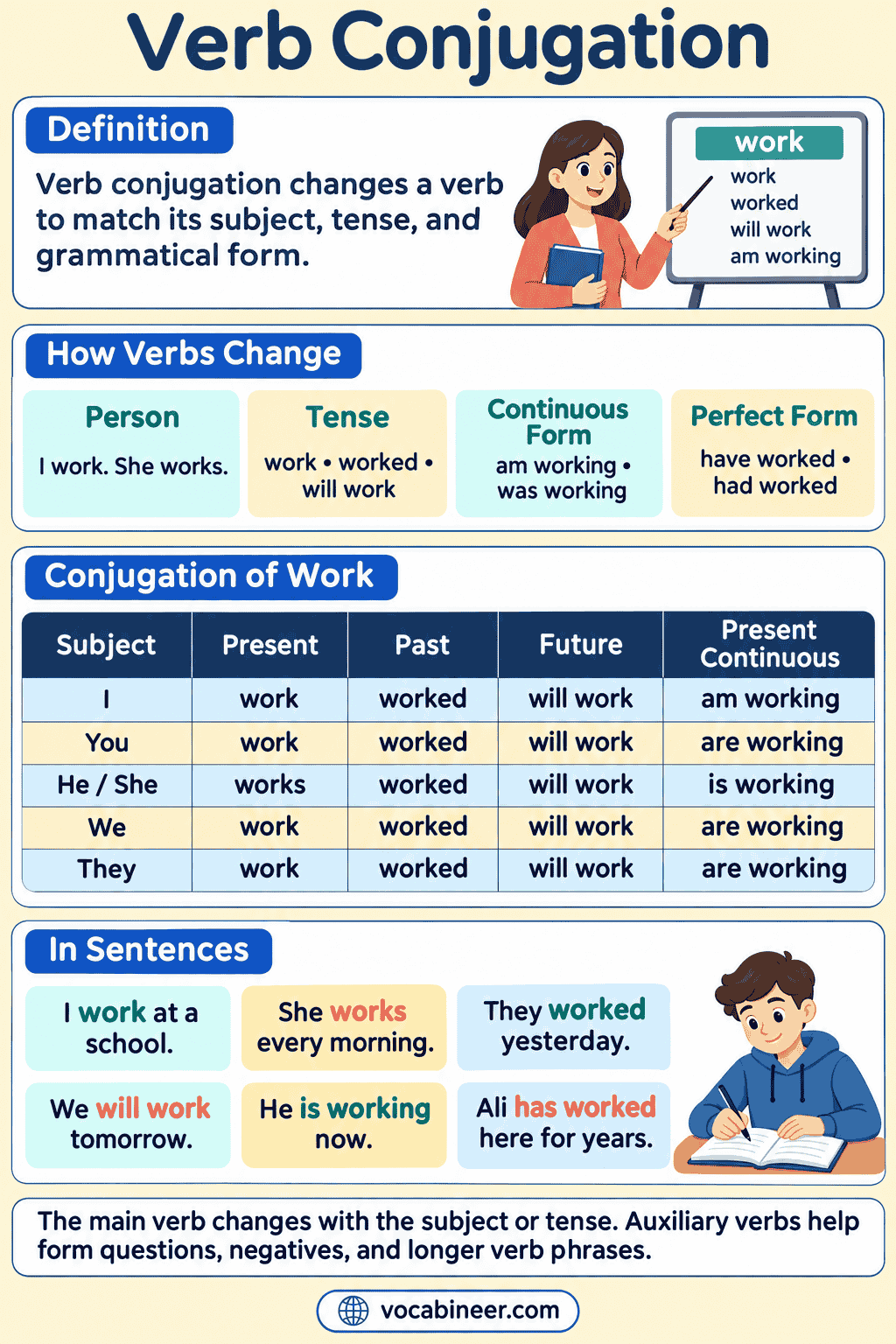
Consider the verb work:
| Meaning | Conjugated form | Example |
|---|---|---|
| Present with I, you, we, or they | work | They work nearby. |
| Present with he, she, or it | works | She works nearby. |
| Past | worked | She worked yesterday. |
| Action in progress | be + working | She is working now. |
| Completed action | have + worked | She has worked here before. |
| Passive construction | be + worked | The metal is worked by hand. |
The Five Main Verb Forms
Most English verbs have five main forms. Some forms may look identical, but their grammatical functions remain different.
| Form | Regular verb: work | Irregular verb: write | Main use |
|---|---|---|---|
| Base form | work | write | Infinitives, imperatives, modals, and forms after do |
| Third-person singular present | works | writes | Present tense with he, she, it, or a singular noun |
| Past form | worked | wrote | Past tense |
| Present participle | working | writing | Continuous constructions and some non-finite clauses |
| Past participle | worked | written | Perfect and passive constructions |
These forms supply the building blocks for nearly every English verb phrase.
Direct Inflection and Auxiliary-Based Conjugation
English expresses some grammatical information by changing the main verb itself. For instance, walk becomes walks or walked. This direct change is called inflection. However, English expresses many other meanings by adding auxiliary verbs: is walking, has walked, will walk, and might have walked.
| Method | Pattern | Example |
|---|---|---|
| Direct inflection | Main verb changes | She walks. / She walked. |
| Auxiliary construction | Auxiliary + required verb form | She is walking. / She has walked. |
Conjugation, Verb Form, Tense, and Inflection
These terms relate to one another, but they do not mean exactly the same thing.
| Term | Meaning | Example |
|---|---|---|
| Conjugation | The complete system of forms and constructions used with a verb | write, writes, wrote, is writing, has written |
| Verb form | A particular shape of a verb | Written is the past participle of write |
| Inflection | A change made to the verb itself | play → plays or played |
| Tense | A grammatical way of locating a situation in time | Works is present; worked is past |
| Aspect | The way an event unfolds or relates to another time | Is working is continuous; has worked is perfect |
Traditional teaching materials often describe English as having 12 tenses. This system is useful for learning patterns. From a stricter linguistic perspective, however, English verbs directly inflect mainly for present and past. Constructions with will, be, and have express future meaning and aspect through auxiliary verbs.
Person, Number, and Subject–Verb Agreement
A finite verb must agree with its subject where English grammar requires agreement. In the present simple, most verbs change only in the third-person singular.
| Person and number | Pronouns | Form of work |
|---|---|---|
| First-person singular | I | I work |
| Second-person singular or plural | you | you work |
| Third-person singular | he, she, it | he works |
| First-person plural | we | we work |
| Third-person plural | they | they work |
The verb be has more agreement forms than other English verbs:
| Subject | Present form | Past form |
|---|---|---|
| I | am | was |
| he, she, it | is | was |
| you, we, they | are | were |
Agreement with Complex Subjects
The words between a subject and its verb do not normally change the required form. Therefore, identify the true subject before choosing the verb.
- The box of old photographs belongs to Mia.
- The photographs in the box belong to Mia.
- Everyone in the two classes has a workbook.
- The title of those stories sounds familiar.
Subjects joined by and usually take a plural verb: “Amina and Sara work together.” However, two words that describe one unit or idea may take a singular verb: “Fish and chips is the special today.”
With either…or and neither…nor, the verb commonly agrees with the nearer subject: “Neither the teachers nor the principal is available.”
Principal Parts of English Verbs
The principal parts are the core forms used to build other conjugations. Dictionaries commonly show the base form, past form, and past participle because those forms reveal whether a verb follows a regular or irregular pattern.
| Verb type | Base form | Past form | Past participle |
|---|---|---|---|
| Regular | work | worked | worked |
| Irregular | sing | sang | sung |
| Irregular | bring | brought | brought |
| Irregular | go | went | gone |
The present participle and third-person singular can usually be predicted from spelling rules. In contrast, learners often need to memorize the principal parts of irregular verbs.
Regular Verb Conjugation
Regular verbs form the past and past participle by adding -ed or -d. Their other forms follow standard spelling patterns.
| Base | Third-person singular | Past | Present participle | Past participle |
|---|---|---|---|---|
| clean | cleans | cleaned | cleaning | cleaned |
| live | lives | lived | living | lived |
| carry | carries | carried | carrying | carried |
| stop | stops | stopped | stopping | stopped |
Although the pattern is regular, spelling may change before an ending is added. For example, carry becomes carried, while stop becomes stopped.
Irregular Verb Conjugation
Irregular verbs do not create their past forms simply by adding -ed. Because no single rule covers every irregular verb, learning them in pattern groups makes them easier to remember.
| Pattern | Base | Past | Past participle |
|---|---|---|---|
| Vowel changes in both forms | sing | sang | sung |
| Past and participle match | build | built | built |
| All three forms differ | write | wrote | written |
| All three forms match | cut | cut | cut |
| Past differs; participle returns to base | come | came | come |
Common Irregular Verbs
| Base form | Past form | Past participle | Example with participle |
|---|---|---|---|
| be | was/were | been | We have been patient. |
| begin | began | begun | The class has begun. |
| break | broke | broken | She has broken the seal. |
| choose | chose | chosen | They have chosen a route. |
| do | did | done | I have done the work. |
| drink | drank | drunk | He has drunk the water. |
| eat | ate | eaten | We have eaten already. |
| give | gave | given | She has given permission. |
| go | went | gone | They have gone home. |
| know | knew | known | I have known her for years. |
| see | saw | seen | Have you seen this film? |
| speak | spoke | spoken | We have spoken about it. |
| take | took | taken | He has taken the keys. |
| wear | wore | worn | She has worn that coat before. |
| write | wrote | written | They have written a report. |
Conjugation of Be, Have, and Do
The verbs be, have, and do can function as main verbs or auxiliaries. Consequently, they play a central role in English conjugation.
Forms of Be
| Base | Present | Past | Present participle | Past participle |
|---|---|---|---|---|
| be | am, is, are | was, were | being | been |
As a main or linking verb, be connects the subject to information about identity, condition, or location: “Maya is a teacher.”
As an auxiliary, it forms continuous constructions and the passive voice: “Maya is teaching” and “The lesson was recorded.”
Forms of Have
| Base | Third-person singular | Past | Present participle | Past participle |
|---|---|---|---|---|
| have | has | had | having | had |
As a main verb, have can express possession or experience: “He has a bicycle.” As an auxiliary, it forms perfect constructions: “He has finished the race.”
Forms of Do
| Base | Third-person singular | Past | Present participle | Past participle |
|---|---|---|---|---|
| do | does | did | doing | done |
As a main verb, do means to perform an activity: “They do their homework.” As an auxiliary, it forms many present- and past-simple questions, negatives, and emphatic statements:
- Do they agree?
- They do not agree.
- They do agree.
Tense and Aspect in English
Tense locates a situation in time, while aspect shows how that situation unfolds or relates to another time. The traditional 12-form system combines three time frames with four aspectual patterns.
| Traditional form | Structure | Example |
|---|---|---|
| Present simple | base / third-person singular | She writes. |
| Present continuous | am/is/are + present participle | She is writing. |
| Present perfect | have/has + past participle | She has written. |
| Present perfect continuous | have/has been + present participle | She has been writing. |
| Past simple | past form | She wrote. |
| Past continuous | was/were + present participle | She was writing. |
| Past perfect | had + past participle | She had written. |
| Past perfect continuous | had been + present participle | She had been writing. |
| Future simple | will + base form | She will write. |
| Future continuous | will be + present participle | She will be writing. |
| Future perfect | will have + past participle | She will have written. |
| Future perfect continuous | will have been + present participle | She will have been writing. |
Simple Constructions
Simple forms commonly express facts, habits, complete events, states, and scheduled situations. The exact meaning depends on the tense and context.
- Water boils at 100°C at standard atmospheric pressure.
- Nadia walks to college every day.
- We visited Lahore last winter.
- The train leaves at six tomorrow morning.
Continuous Constructions
The continuous aspect uses a form of be plus the present participle. It often presents an activity as developing, temporary, or in progress.
- I am reading the instructions.
- They were waiting outside.
- We will be travelling at noon.
Perfect Constructions
The perfect aspect uses a form of have plus the past participle. It connects an earlier situation to a later reference point.
- She has completed the assignment.
- They had left before the rain began.
- By Friday, I will have finished the report.
Perfect Continuous Constructions
The perfect continuous combines have, been, and the present participle. It emphasizes duration or repeated activity leading to a reference point.
- He has been studying for three hours.
- We had been driving all night.
- In June, she will have been working here for ten years.
Tense and Time Are Not Always the Same
A verb form does not always refer to the time suggested by its name. Context can give a present or past form a different time meaning.
| Form | Actual reference | Example |
|---|---|---|
| Present simple | Scheduled future | The semester starts next Monday. |
| Present continuous | Planned future | We are meeting them tomorrow. |
| Past form | Present hypothetical situation | If I knew the answer, I would tell you. |
| Past form | Present politeness or distance | I wanted to ask a question. |
Therefore, conjugation must reflect both grammatical structure and intended meaning.
Mood and Modality
Mood presents the speaker’s attitude toward an action or situation. Modality adds meanings such as ability, possibility, permission, advice, obligation, or prediction.
Indicative, Imperative, and Subjunctive Forms
| Mood | Main purpose | Example |
|---|---|---|
| Indicative | Statements and ordinary questions | She works here. |
| Imperative | Commands, requests, or instructions | Open the window. |
| Subjunctive | Demands, recommendations, wishes, or unreal situations | I suggest that he arrive early. |
The imperative usually uses the base form and leaves the understood subject you unstated. Its negative form uses do not or don’t: “Don’t touch the switch.”
In formal mandative clauses, the subjunctive also uses the base form regardless of the subject: “The committee requires that every member be present.”
In unreal clauses, were can appear with any person: “If I were you, I would wait.”
Modal and Semi-Modal Constructions
Core modal verbs include can, could, may, might, must, shall, should, will, and would. A modal takes the base form of the next verb and does not add third-person singular -s.
| Meaning | Construction | Example |
|---|---|---|
| Ability | can + base | She can swim. |
| Possibility | might + base | It might rain. |
| Advice | should + base | You should rest. |
| Obligation | must + base | Visitors must sign in. |
| Past possibility | might have + past participle | They might have missed the bus. |
Semi-modals include expressions such as have to, be able to, be going to, ought to, and used to. Unlike core modals, some semi-modals change form:
- She has to leave.
- They had to leave.
- We are able to help.
Finite and Non-Finite Verb Forms
A finite verb carries tense or agrees with a subject. A non-finite form does not independently show tense or person.
| Type | Form | Example |
|---|---|---|
| Finite verb | present or past form, or finite auxiliary | She works. / They have arrived. |
| To-infinitive | to + base form | She wants to work. |
| Bare infinitive | base form without to | She can work. |
| Present participle | -ing form | Working quietly, she finished early. |
| Past participle | participial form | Written clearly, the guide is easy to follow. |
| Gerund | -ing form functioning as a noun | Reading improves vocabulary. |
Gerunds and present participles share the same -ing form, but they perform different jobs. A gerund functions like a noun, whereas a participle forms a verb construction or modifies another expression.
The Structure of an English Verb Phrase
An English verb phrase may contain a modal, perfect have, continuous be, passive be, and a main verb. When several appear together, they follow a fixed order:
Modal + perfect have + continuous be + passive be + main verb
| Verb phrase | Analysis |
|---|---|
| will write | modal + main verb |
| has written | perfect have + main verb |
| is being repaired | continuous be + passive be + main verb |
| may have been waiting | modal + perfect have + continuous be + main verb |
| may have been being repaired | modal + perfect have + continuous be + passive be + main verb |
The final example is grammatically possible, although speakers often avoid such heavy constructions and choose a clearer sentence.
Forms Required After Auxiliaries
| Preceding word | Required next form | Example |
|---|---|---|
| do, does, did | Base form | Did she leave? |
| Modal verb | Base form | She can leave. |
| have, has, had | Past participle | She has left. |
| Continuous be | Present participle | She is leaving. |
| Passive be | Past participle | She was invited. |
Only the first auxiliary in a verb phrase normally carries tense and agrees with the subject: “She has been working,” but “They have been working.”
Affirmative, Negative, and Emphatic Structures
An affirmative clause usually places the subject before the finite verb. A negative clause places not after an auxiliary. When a present- or past-simple clause has no other auxiliary, English generally adds a form of do.
| Type | Structure | Example |
|---|---|---|
| Affirmative | subject + finite verb | Hana works here. |
| Negative with do | subject + do/does/did + not + base | Hana does not work here. |
| Negative with be | subject + be + not | Hana is not working. |
| Negative with perfect have | subject + have + not + participle | Hana has not finished. |
| Negative with a modal | subject + modal + not + base | Hana cannot attend. |
| Emphatic statement | subject + do/does/did + base | Hana does work here. |
After does or did, use the base form—not an inflected main verb. Therefore, “She does not work” and “Did he go?” are correct.
Questions and Short Answers
Most questions place the first auxiliary before the subject. If a simple present or simple past statement has no auxiliary, add do, does, or did.
| Statement | Question | Short answer |
|---|---|---|
| She works here. | Does she work here? | Yes, she does. |
| They arrived. | Did they arrive? | No, they didn’t. |
| He is sleeping. | Is he sleeping? | Yes, he is. |
| You have finished. | Have you finished? | No, I haven’t. |
| We can enter. | Can we enter? | Yes, you can. |
Wh-questions place a question word before the auxiliary: “Where does she work?” However, when the question word itself is the subject, no inversion or do-support is needed: “Who works here?”
Forms of be and core modal verbs do not use do in ordinary questions or negatives. Thus, write “Is she ready?” rather than “Does she be ready?” and “She cannot swim” rather than “She does not can swim.”
Tag Questions
A tag question normally repeats the auxiliary from the main clause and reverses its positive or negative value.
- She is waiting, isn’t she?
- They have arrived, haven’t they?
- Bilal works here, doesn’t he?
- You did not call, did you?
Contractions in Conjugated Verb Phrases
Contractions commonly combine a subject or auxiliary with a shortened verb or not.
| Full form | Contraction | Example |
|---|---|---|
| I am | I’m | I’m ready. |
| she is / she has | she’s | She’s waiting. / She’s finished. |
| we have | we’ve | We’ve arrived. |
| will not | won’t | He won’t object. |
| cannot | can’t | I can’t stay. |
| did not | didn’t | They didn’t leave. |
Context reveals whether ’s means is or has. If a present participle follows, it usually means is: “She’s working.” If a past participle follows, it usually means has: “She’s worked here before.”
Active and Passive Voice
Voice shows whether the subject performs an action or receives it.
| Voice | Structure | Example |
|---|---|---|
| Active | subject + verb + object | The technician repaired the computer. |
| Passive | receiver + be + past participle | The computer was repaired by the technician. |
The tense or aspect appears on the first auxiliary, while the passive main verb remains a past participle.
| Active | Passive |
|---|---|
| They clean the room. | The room is cleaned. |
| They cleaned the room. | The room was cleaned. |
| They are cleaning the room. | The room is being cleaned. |
| They have cleaned the room. | The room has been cleaned. |
| They will clean the room. | The room will be cleaned. |
Only verbs that take an object can normally create this kind of passive construction. For example, “They built the bridge” can become “The bridge was built.” In contrast, an intransitive sentence such as “The baby slept” has no object to promote into a passive subject.
Conditional Verb Constructions
Conditional sentences combine verb forms to express facts, likely results, hypothetical situations, or imagined past outcomes.
| Type | Common pattern | Example |
|---|---|---|
| Zero conditional | present + present | If water freezes, it expands. |
| First conditional | present + will + base | If it rains, we will stay inside. |
| Second conditional | past + would + base | If I had more time, I would travel. |
| Third conditional | past perfect + would have + participle | If they had left earlier, they would have arrived on time. |
The past form in the second conditional usually expresses hypothetical distance rather than past time. Likewise, would have + past participle presents an unreal past result.
Verb Forms in Reported Speech
When a past reporting verb introduces earlier speech, the following verb often shifts back in tense. This process is called backshifting.
| Direct speech | Reported speech |
|---|---|
| “I am tired.” | She said that she was tired. |
| “I have finished.” | She said that she had finished. |
| “I will call.” | She said that she would call. |
| “I can help.” | She said that she could help. |
Backshifting is not always necessary when the information remains true or the reporting context makes the time clear: “The teacher explained that water boils at 100°C at standard atmospheric pressure.”
Spelling Rules for Conjugated Verbs
Third-Person Singular Endings
| Base form pattern | Rule | Example |
|---|---|---|
| Most verbs | Add -s | read → reads |
| Ends in -s, -sh, -ch, -x, or -o | Add -es | watch → watches; go → goes |
| Consonant + y | Change y to i and add -es | study → studies |
| Vowel + y | Add -s | play → plays |
Past and Past-Participle Endings
| Base form pattern | Rule | Example |
|---|---|---|
| Most regular verbs | Add -ed | talk → talked |
| Ends in e | Add -d | live → lived |
| Consonant + y | Change y to i and add -ed | carry → carried |
| Short stressed vowel + final consonant | Double the consonant and add -ed | stop → stopped |
Present-Participle Endings
| Base form pattern | Rule | Example |
|---|---|---|
| Most verbs | Add -ing | read → reading |
| Final silent e | Drop e and add -ing | write → writing |
| Final -ie | Change ie to y and add -ing | lie → lying |
| Short stressed vowel + final consonant | Double the consonant and add -ing | run → running |
Some doubling patterns vary between British and American spelling. For example, British English commonly uses travelled and travelling, while American English usually uses traveled and traveling.
Pronunciation of -s and -ed Endings
The written ending does not always have the same pronunciation.
| Ending | Pronunciation | Environment | Example |
|---|---|---|---|
| -s | /s/ | After many voiceless sounds | stops |
| -s | /z/ | After vowels and many voiced sounds | runs |
| -es | /ɪz/ | After sibilant sounds | watches |
| -ed | /t/ | After many voiceless sounds | walked |
| -ed | /d/ | After vowels and many voiced sounds | played |
| -ed | /ɪd/ | After /t/ or /d/ | wanted |
These pronunciation patterns depend on the final sound of the base verb, not simply its final letter.
Stative Verbs and Continuous Forms
Stative verbs commonly describe possession, knowledge, belief, preference, perception, or condition. Therefore, they often appear in simple rather than continuous forms.
| Usual simple form | Less suitable in the same meaning |
|---|---|
| I know the answer. | I am knowing the answer. |
| She owns this apartment. | She is owning this apartment. |
| We believe you. | We are believing you. |
However, some verbs can express either a state or a dynamic activity. Their conjugation then depends on meaning.
| Stative meaning | Dynamic meaning |
|---|---|
| I think the plan is sensible. | I am thinking about the plan. |
| She has a new laptop. | She is having lunch. |
| The soup tastes salty. | The chef is tasting the soup. |
Phrasal Verb Conjugation
In a phrasal verb, conjugate the verb component while leaving the particle unchanged.
| Base form | Present | Past | Perfect |
|---|---|---|---|
| give up | gives up | gave up | has given up |
| look after | looks after | looked after | has looked after |
| take off | takes off | took off | has taken off |
If a separable phrasal verb takes a pronoun object, place the pronoun between the verb and particle: “Turn it off,” not “Turn off it.”
British and American Variations
British and American English sometimes prefer different forms, although both varieties generally understand each version.
| Base verb | Common British form | Common American form |
|---|---|---|
| learn | learnt / learned | learned |
| dream | dreamt / dreamed | dreamed |
| spell | spelt / spelled | spelled |
| get | got | gotten for some meanings; got for others |
| travel | travelled / travelling | traveled / traveling |
Consistency matters most. Choose the variety appropriate for your audience and use it throughout the same document.
Using Dictionaries and Conjugation References
A reliable dictionary helps you confirm a verb’s principal parts, pronunciation, transitivity, and regional variants. When checking a verb, look for:
- its past and past-participle forms;
- whether it is regular or irregular;
- whether it takes an object;
- whether it functions as a stative or dynamic verb;
- any British and American alternatives;
- example sentences showing its typical complements.
Automated conjugators can provide quick charts, but context still determines the correct construction. A generated form may be grammatically possible without being natural for the intended meaning.
Common Mistakes with Verb Conjugation
Using an Inflected Verb After Does or Did
The auxiliary carries the tense or agreement, so the main verb must return to its base form.
| Incorrect | Correct |
|---|---|
| She doesn’t likes coffee. | She doesn’t like coffee. |
| Did he went home? | Did he go home? |
Confusing the Past Form with the Past Participle
Use the past form for the simple past and the past participle after perfect have.
| Incorrect | Correct |
|---|---|
| She has wrote the email. | She has written the email. |
| They have went outside. | They have gone outside. |
Omitting Third-Person Singular -s
| Incorrect | Correct |
|---|---|
| He work at home. | He works at home. |
| My sister study biology. | My sister studies biology. |
Adding -s After a Modal Verb
| Incorrect | Correct |
|---|---|
| She can drives. | She can drive. |
| He must leaves. | He must leave. |
Using the Wrong Auxiliary
| Incorrect | Correct |
|---|---|
| She is finished her work. | She has finished her work. |
| They have playing outside. | They are playing outside. |
Misusing Stative Verbs in Continuous Forms
| Less natural for the intended meaning | Natural form |
|---|---|
| I am understanding the rule. | I understand the rule. |
| She is owning two shops. | She owns two shops. |
Breaking Subject–Verb Agreement
| Incorrect | Correct |
|---|---|
| The list of names are here. | The list of names is here. |
| Everyone have arrived. | Everyone has arrived. |
A Practical Method for Conjugating English Verbs
Use this process whenever you need to choose a verb form:
- Identify the subject. Determine its person and whether it is singular or plural.
- Choose the time reference. Decide whether the situation relates to the present, past, future, or another reference point.
- Choose the aspect. Decide whether you need a simple, continuous, perfect, or perfect continuous construction.
- Choose the mood or modality. Check whether the sentence expresses a fact, command, possibility, obligation, wish, or hypothetical situation.
- Choose the voice. Decide whether the subject performs or receives the action.
- Select the auxiliaries. Put them in the order modal + perfect have + continuous be + passive be.
- Apply the required main-verb form. Use the base form, present participle, or past participle as required.
- Add negation or inversion. Place not after the first auxiliary or invert that auxiliary with the subject to form a question.
- Check spelling and irregular forms. Confirm endings, doubled consonants, and principal parts.
- Read the complete sentence. Make sure the form expresses the intended time and meaning naturally.
For example, suppose the subject is the documents, the intended time is the future, the action will be complete before Friday, and the subject receives the action. The required construction is future perfect passive: “The documents will have been signed by Friday.”
Frequently Asked Questions
What is verb conjugation?
Verb conjugation is the system of changing a verb or combining it with auxiliary verbs to express person, number, tense, aspect, mood, and voice. Examples include write, writes, wrote, is writing, and has been written.
How many forms does an English verb have?
Most English verbs have five main forms: the base form, third-person singular present, past form, present participle, and past participle. Some of these forms look identical, especially in regular verbs.
Does English have 12 tenses?
The traditional teaching system presents 12 combinations of time and aspect. This framework is useful for learners. However, many linguists describe English as having two directly inflected tenses—present and past—while auxiliaries and context express future time and aspect.
What is the difference between a regular and an irregular verb?
A regular verb forms its past and past participle with -ed or -d, as in work–worked–worked. An irregular verb follows another pattern, as in write–wrote–written or cut–cut–cut.
How can I choose the correct conjugated form?
First, identify the subject, time, aspect, mood, and voice. Next, choose the necessary auxiliaries and put the main verb in the form required after them. Finally, check agreement, spelling, and any irregular principal parts.
Final Summary
English verb conjugation combines a small set of inflected forms with a powerful auxiliary system. Most verbs use five main forms, while be, have, and do support a wide range of tense, aspect, question, negative, emphatic, and passive constructions. Regular verbs follow predictable ending rules, whereas irregular verbs require knowledge of their principal parts.
To conjugate accurately, identify the subject and intended meaning before selecting a form. Then check auxiliary order, agreement, spelling, and irregular patterns. With this method, even complex phrases such as might have been waiting or will have been completed become easier to understand and construct.
Read More
- Verbs in English
- Action Verbs
- Regular Verbs
- Irregular Verbs
- Transitive and Intransitive verbs
- Finite and Non-finite verbs
- Principal Parts of Verbs
- Forms of Verbs