

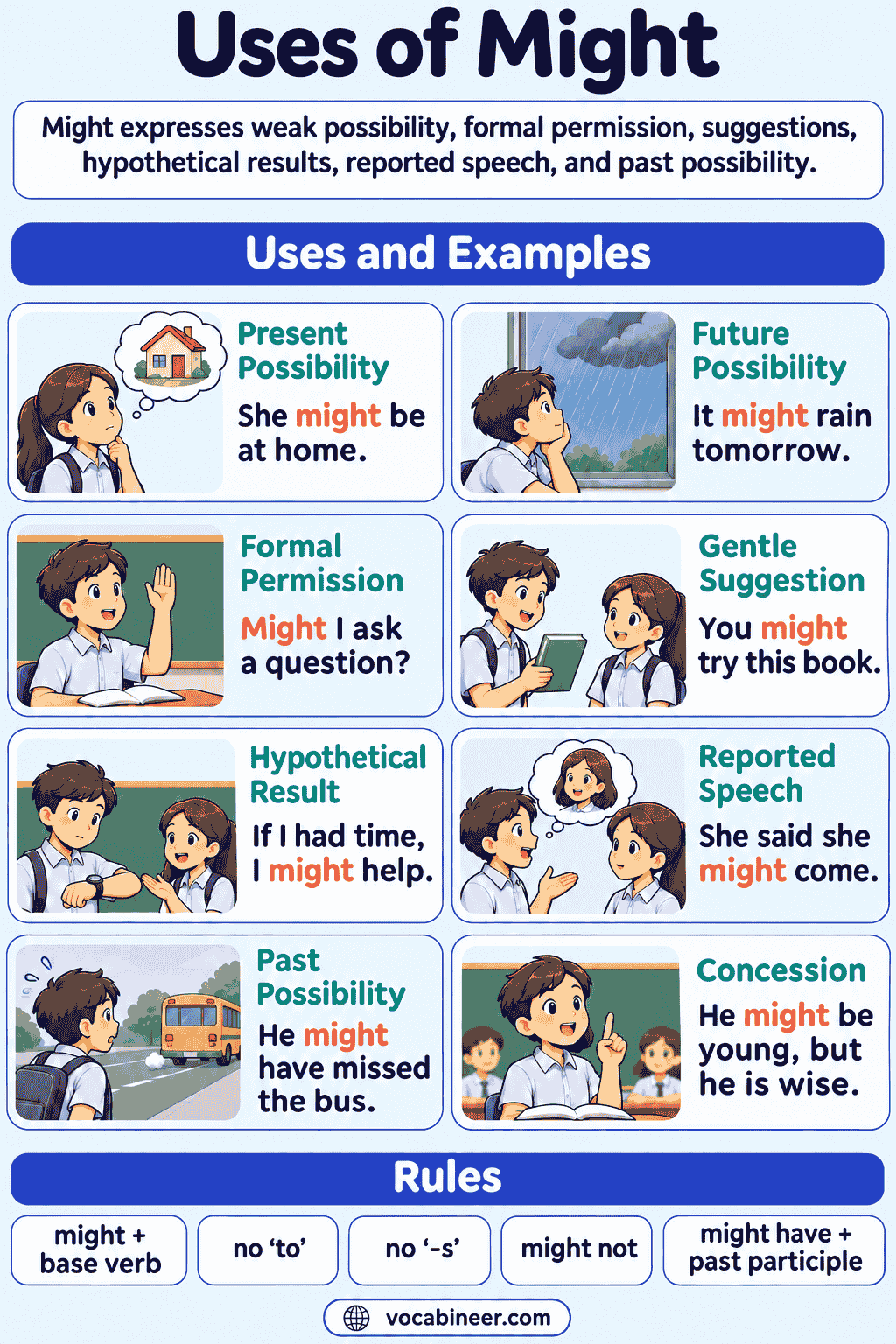
The modal verb might most commonly expresses an uncertain possibility. In “Sara might be at home,” the speaker considers her presence possible but does not know whether she is there. However, might also appears in tentative plans, hypothetical results, polite suggestions, formal permission requests, reported speech, and criticism.
Using might correctly requires attention to structure and context. For instance, might have can describe an unknown past event, an unrealized opportunity, or a past action that deserves criticism. This guide explains these meanings, the major sentence patterns, comparisons with related modal verbs, and the mistakes learners should avoid.
In This Page
Might at a Glance
Might is a modal auxiliary verb. It comes before the base form of another verb and adds meanings such as possibility, remoteness, tentativeness, or indirectness. Its form remains the same with every subject.
| Feature | Rule | Example |
|---|---|---|
| Grammatical class | Modal auxiliary verb | She might agree. |
| Main verb form | Use the base form without to | They might leave. |
| Third-person form | Do not add -s | He might join us. |
| Negative form | Use might not or mightn’t | She might not come. |
| Question form | Place might before the subject | Might this work? |
| Past reference | Use might have + past participle | He might have forgotten. |
| Possible ability | Use might be able to | I might be able to help. |
The main uses of might include:
- Present and future possibility
- Tentative intentions and plans
- Ongoing and past possibility
- Possible ability or necessity
- Hypothetical and conditional results
- Polite suggestions and indirect advice
- Very formal permission requests
- Present and past criticism
- Reported speech and past viewpoints
- Cautious claims in formal writing
The Core Meaning of Might
The idea of remoteness connects many uses of might. It can create distance from certainty, reality, directness, or an original speaker’s viewpoint.
| Type of Distance | Example | Effect |
|---|---|---|
| From certainty | She might know. | Her knowledge is possible, not certain. |
| From reality | If I had time, I might go. | Going belongs to an imagined situation. |
| From directness | You might try again. | The suggestion sounds less forceful. |
| From the original viewpoint | He said he might leave. | Might reports an earlier possibility. |
Therefore, defining might only as “weak possibility” is incomplete. Context determines whether it marks uncertainty, hypothesis, politeness, criticism, or reported meaning.
Grammatical Features of Might
Like other central modal verbs, might does not take ordinary verb endings. It has no -s, -ed, or -ing form, and it takes a bare infinitive rather than to + verb.
- Correct: She might arrive soon.
- Incorrect: She mights arrive soon.
- Correct: We might need help.
- Incorrect: We might to need help.
- Correct: Might this be true?
- Incorrect: Does this might be true?
Moreover, might does not normally combine directly with another central modal.
- Incorrect: She will might come.
- Correct: She might come.
- Correct alternative: It will be possible for her to come.
Although might historically relates to may, modern English also uses it as an independent modal for present, future, and hypothetical meanings. Consequently, it is misleading to call it only the past tense of may.
Sentence Structures with Might
Affirmative Sentences
Place might after the subject and before the base form of the main verb.
Structure: Subject + might + base verb
- I might call later.
- She might know the answer.
- They might arrive before noon.
- The weather might improve tomorrow.
Negative Sentences
Add not immediately after might. Do not add do not, does not, or did not.
Structure: Subject + might not + base verb
- I might not attend the meeting.
- He might not understand the instructions.
- The shop might not open today.
- Their plan might not work.
The contraction mightn’t occurs mainly in British English. The full form might not works naturally in all major varieties.
Questions with Might
Place might before the subject.
Structure: Might + subject + base verb?
- Might this be the cause?
- Might she know where he is?
- Might they arrive tonight?
- Might I ask a question?
Direct questions about possibility are grammatical but can sound formal. In everyday speech, “Do you think this might be the cause?” often sounds more natural than “Might this be the cause?”
Short Answers and Natural Replies
For possibility, might can stand alone when the missing verb phrase is clear.
- “Will Aisha come?” “She might.”
- “Could this plan work?” “It might.”
- “Are they joining us?” “They might not.”
However, replies to formal permission questions usually avoid “Yes, you might.” More natural responses include “Yes, of course,” “Certainly,” or “I’m afraid not.”
Might for Present and Future Possibility
The most common use of might presents a situation as possible but uncertain. It does not assign an exact probability.
Present Possibility
Use might + base verb or might be + complement for possible present situations.
- She might know the answer.
- The keys might belong to Omar.
- He might be tired.
- This information might be incorrect.
The speaker lacks enough evidence to make a definite claim. Nevertheless, each situation remains possible.
Future Possibility
The same structure can refer to the future when context or a time expression establishes the time.
- We might travel next month.
- It might rain tomorrow.
- The meeting might finish early.
- I might see her this evening.
Do not combine will and might. The modal already presents the future event as possible.
Negative Possibility
Use might not + base verb when a negative situation is possible.
- He might not come tonight.
- The package might not arrive on time.
- They might not accept the proposal.
- The results might not support the theory.
Here, might not means “perhaps not.” It does not mean that the event is impossible.
Specific and General Possibility
Use might for a specific uncertain situation. In contrast, can often describes something that is generally or occasionally possible.
| Meaning | Natural Form | Example |
|---|---|---|
| Specific uncertainty | might | This dog might be dangerous. |
| General possibility | can | Dogs can be dangerous. |
| Specific weather prediction | might | It might be cold tonight. |
| General climatic possibility | can | It can be cold here in winter. |
This distinction matters because can does not usually replace might in a specific deduction. For example, “He might be in his office” expresses an uncertain guess, while “He can be in his office” does not normally carry that meaning.
Might for Ongoing Possibility
Use might be + verb-ing when an action is possibly in progress now or around a relevant time.
Structure: Subject + might be + present participle
- She might be sleeping.
- They might be waiting outside.
- He might be working from home today.
- The technicians might be checking the system.
The word after might be determines the structure.
| Pattern | Function | Example |
|---|---|---|
| might be + adjective | Possible state | She might be tired. |
| might be + noun phrase | Possible identity | He might be the new manager. |
| might be + prepositional phrase | Possible location | They might be at home. |
| might be + verb-ing | Possible ongoing action | She might be studying. |
Might for Tentative Plans
With first-person subjects, might often presents an intention that the speaker has not yet decided to carry out.
- I might stay home tonight.
- We might visit Islamabad next month.
- I might order the soup.
- We might take the children to the park.
These statements differ from external predictions. “I might stay home” communicates an undecided personal choice, whereas “She might stay home” may express the speaker’s guess about someone else.
| Sentence | Likely Meaning |
|---|---|
| I might leave early. | I am considering leaving early. |
| She might leave early. | Perhaps she will leave early. |
| We might buy a new car. | We are considering that plan. |
Might for Past Possibility
Use might have + past participle to make a present judgment about a possible past event.
Might Have with a Past Participle
Structure: Subject + might have + past participle
- She might have missed the bus.
- They might have taken the wrong road.
- I might have left my phone at work.
- The storm might have damaged the roof.
In these examples, the speaker does not know whether the event happened.
Might Have Been with a Complement
Use might have been before an adjective, noun phrase, or prepositional phrase for a possible past state.
- He might have been ill.
- That might have been the cause.
- They might have been at home.
- The instructions might have been unclear.
Might Have Been with a Present Participle
Use might have been + verb-ing for an action that was possibly in progress during a past period.
- She might have been sleeping when you called.
- They might have been waiting for the wrong train.
- He might have been driving, so he could not answer.
- The company might have been testing the product at that time.
Negative Past Possibility
Place not after might to describe a possible negative past situation.
- She might not have received the email.
- They might not have understood the question.
- He might not have been paying attention.
- The payment might not have been processed.
These sentences leave the actual outcome unknown unless the surrounding context supplies more information.
Different Meanings of Might Have
The pattern might have + past participle does not always express the same idea. Context reveals whether the outcome is unknown, unrealized, narrowly avoided, or criticized.
| Meaning | Example | Interpretation |
|---|---|---|
| Uncertain past event | She might have missed the bus. | Perhaps she missed it; the outcome is unknown. |
| Unrealized possibility | We might have won with more practice. | We did not win. |
| Avoided result | He might have been seriously injured. | Serious injury was possible but apparently did not occur. |
| Past criticism | You might have warned me. | You should have warned me but did not. |
| Conditional result | If they had hurried, they might have arrived on time. | Timely arrival was possible but unreal. |
Unrealized Possibilities
In an unrealized possibility, the speaker knows that the event did not occur.
- We might have won if we had practiced more.
- She might have become a doctor, but she chose engineering.
- I might have accepted the offer under different circumstances.
Avoided Results
Sometimes might have describes a possible negative outcome that fortunately did not happen.
- You might have fallen.
- The child might have been hurt.
- We might have lost all our data without the backup.
Past Criticism
With critical intonation, might have suggests that someone should have acted differently.
- You might have told me that the meeting was cancelled.
- She might have offered to help.
- They might have apologized for the delay.
Therefore, readers must examine the full sentence rather than translate might have mechanically.
Might for Possible Ability
Might does not directly express ability. However, might be able to presents ability or opportunity as possible.
Might Be Able To
- I might be able to help tomorrow.
- She might be able to finish before noon.
- They might be able to repair the machine.
- With more practice, he might be able to compete professionally.
Might Have Been Able To
Use might have been able to for possible or unrealized past ability.
- She might have been able to prevent the error.
- We might have been able to arrive earlier with a better route.
- They might have been able to save more money.
| Meaning | Form | Example |
|---|---|---|
| Present ability | can | She can solve the problem. |
| Past general ability | could | She could solve complex problems at ten. |
| Possible ability | might be able to | She might be able to solve it. |
| Possible past ability | might have been able to | She might have been able to solve it. |
Might for Possible Necessity
Two common patterns express uncertain or possible necessity: might have to and might need to.
Might Have To
Use might have to + base verb when an obligation or necessity is possible.
- I might have to work late.
- We might have to cancel the trip.
- She might have to take another test.
- They might not have to attend the meeting.
Do not confuse this structure with might have + past participle.
| Pattern | Meaning | Example |
|---|---|---|
| might have to + base verb | Possible necessity | We might have to leave. |
| might have + past participle | Possible past action | We might have left already. |
For possible past necessity, use might have had to + base verb:
- They might have had to wait outside.
- She might have had to change her plans.
Might Need To
Might need to presents a possible need and often sounds cautious.
- You might need to restart the device.
- We might need to change the schedule.
- She might need to speak with a specialist.
- The team might need to collect more evidence.
Depending on context, this pattern can express possibility, gentle advice, or a warning.
Might in Conditional Sentences
Might commonly expresses a possible result in real, remote, or unreal conditions.
Open Conditions
- If the weather improves, we might go outside.
- If she finishes early, she might join us.
- If you restart the device, it might work.
Remote Conditions
In second conditional patterns, might presents one possible result of an imagined situation.
- If I had more time, I might learn Arabic.
- If he lived nearby, we might see him more often.
- If she knew the answer, she might tell us.
Unreal Past Conditions
Use might have + past participle in a third conditional result.
- If they had left earlier, they might have caught the train.
- If we had checked the figures, we might have found the error.
- If she had applied, she might have received the scholarship.
Mixed Conditional Patterns
- If she had accepted the offer, she might be living abroad now.
- If he were more careful, he might not have made that mistake.
- If they had saved more money, they might own a house now.
| Modal | Meaning | Example |
|---|---|---|
| might | One possible result | If I had time, I might go. |
| would | Expected hypothetical result | If I had time, I would go. |
Might with Implied Conditions
Sometimes context supplies an unstated if-clause.
- I might join you. (If I finish my work.)
- That might be useful. (If the situation arises.)
- I might have helped. (If you had asked me.)
Therefore, a sentence with might can sound conditional even when it contains no written if-clause.
Might for Suggestions and Advice
Might can make a suggestion sound less direct than an imperative or a sentence with should.
Suggestions with Might
- You might try restarting the computer.
- We might take a different route.
- You might ask your teacher for clarification.
- She might consider applying again.
Might Want To
- You might want to save a copy.
- You might want to check the date again.
- They might want to contact their bank.
This pattern can sound helpful, but tone matters. “You might want to reconsider that comment” may function as a warning rather than a casual suggestion.
Might Like To and Might Prefer To
- You might like to read the final section.
- You might prefer to sit near the window.
- I thought you might like some tea.
- Guests might prefer to book in advance.
These patterns sound polite because they avoid telling another person directly what to do.
Might for Permission
Might I…? can ask for permission, but it sounds very formal, deferential, or old-fashioned in some contexts.
- Might I ask a question?
- Might I sit here?
- Might we leave a little early?
- Might I interrupt for a moment?
In everyday English, May I…?, Can I…?, or Could I…? is usually more natural. Moreover, might generally asks for permission rather than grants it.
| Function | Natural Example |
|---|---|
| Very formal permission request | Might I come in? |
| Formal permission request | May I come in? |
| Everyday permission request | Can I come in? |
| Natural positive reply | Yes, of course. |
| Granting permission | Yes, you may. |
Might for Criticism
Present Criticism
Might can suggest what someone should do now. Tone often makes the criticism clear.
- You might be more careful.
- You might at least apologize.
- He might show a little patience.
- They might try listening before they respond.
Past Criticism
Use might have + past participle to criticize a past omission or action.
- You might have warned me.
- She might have thanked them.
- They might have arrived on time.
- He might have offered to help.
This meaning usually implies that the expected action did not occur.
Might in Past Viewpoint Clauses
Might often follows past-tense verbs of thought, expectation, fear, hope, or uncertainty.
- I thought she might call.
- He feared that the plan might fail.
- We hoped the weather might improve.
- They wondered whether she might return.
- She was worried that she might be late.
In these examples, might presents a possibility from an earlier viewpoint. This pattern is broader than reported speech because the original idea may have been a thought, fear, hope, or expectation rather than spoken words.
Might in Reported Speech
When reporting earlier words, might often replaces may. This change is called backshift.
| Direct Speech | Reported Speech |
|---|---|
| She said, “I may leave early.” | She said that she might leave early. |
| He said, “It may rain.” | He said that it might rain. |
| They said, “We may need help.” | They said that they might need help. |
However, may can remain when the possibility is still current or when the reporter chooses not to backshift.
- The doctor said that the treatment may take several weeks.
- The notice explained that delays may occur during repairs.
Thus, might is sometimes the reported form of may, but it is not merely a past-tense replacement in every sentence.
Might in Past Purpose Clauses
Formal English can use might after so that or in order that when the main action belongs to the past.
- She spoke slowly so that everyone might understand.
- They left early so that they might avoid traffic.
- The evidence was preserved so that researchers might examine it.
- The rules were revised in order that every applicant might receive fair treatment.
In everyday English, speakers may use could instead. Nevertheless, might remains useful in formal and literary styles.
Might for Concession and Contrast
The pattern might … but accepts a point before introducing a contrast.
- He might be inexperienced, but he learns quickly.
- The method might cost more, but it produces better results.
- She might have failed once, but she has not given up.
- The apartment might be small, but it is comfortable.
Here, might makes the accepted point tentative or less central than the contrast that follows.
Might in Academic and Formal Writing
Academic writers use might to hedge a claim, present a hypothetical interpretation, or avoid overstating evidence.
- These findings might indicate a broader pattern.
- A larger sample might produce different results.
- This difference might arise from environmental factors.
- One might argue that the policy needs revision.
| Direct Claim | Cautious Claim |
|---|---|
| The change affects performance. | The change might affect performance. |
| The difference results from age. | The difference might result from age. |
| This evidence proves the theory. | This evidence might support the theory. |
In formal argument, one might argue introduces a possible interpretation without presenting it as the only valid position.
Might in Passive Constructions
Use a passive form when the receiver of an action matters more than the performer or when the performer is unknown.
| Time | Structure | Example |
|---|---|---|
| Present or future | might be + past participle | The meeting might be cancelled. |
| Past | might have been + past participle | The message might have been deleted. |
- Applications might be reviewed next week.
- The road might be closed tomorrow.
- Your order might be delayed by bad weather.
- The documents might have been sent to the wrong address.
- The error might have been caused by outdated software.
Questions About Possibility
Direct inversion with might is correct but often formal.
- Might this be the answer?
- Might she know where the documents are?
- Might they have taken another route?
Indirect questions usually sound more natural in everyday English.
- Do you think this might be the answer?
- Is it possible that she might know?
- Could they have taken another route?
Might can also appear in question tags, although such tags are uncommon.
- That might work, mightn’t it?
- She might not agree, might she?
Adverb Placement and Negation
Adverbs usually appear after might and before the main verb. In perfect forms, placement depends on the intended emphasis.
| Pattern | Example |
|---|---|
| might + adverb + base verb | She might still come. |
| might + already + have + participle | They might already have left. |
| might + have + adverb + participle | He might have accidentally deleted it. |
| might not + always + base verb | This method might not always work. |
The position of not also affects meaning.
- She might not attend.
Perhaps she will not attend. - She might not always agree.
Perhaps she does not agree in every case. - She might choose not to attend.
Perhaps she will deliberately decide against attending.
Ellipsis with Might
When the missing verb phrase is clear, might or might not can stand alone.
- “Will Sara join us?” “She might.”
- Ali may attend, and Hamza might too.
- Some people might agree, but others might not.
- I do not think it will work, although it might.
This pattern reduces repetition and sounds natural in conversation.
Common Expressions with Might
Might As Well
Might as well can express the best available choice, reluctant acceptance, or little difference between alternatives.
| Meaning | Example |
|---|---|
| Best available choice | We might as well start now. |
| Reluctant acceptance | The bus has gone, so we might as well walk. |
| Little practical difference | If you ignore the instructions, you might as well not read them. |
| Strong negative comparison | You might as well talk to a wall. |
Might Just
Might just can emphasize a small, surprising, or increasingly credible possibility.
- This might just work.
- You might just be right.
- I might just call her myself.
Might Even
Might even adds a more surprising possibility.
- She might even win the competition.
- They might even finish ahead of schedule.
Might Yet
Might yet means that a possibility remains despite current appearances.
- He might yet change his mind.
- The team might yet recover.
I Thought You Might
This expression introduces a tentative offer, suggestion, or expectation.
- I thought you might like some tea.
- I thought you might want to see the report.
- I thought you might need some help.
Try As I Might
Try as I might means “despite trying very hard.”
- Try as I might, I could not open the jar.
- Try as she might, she could not remember his name.
Might Compared with Related Modals
Might vs May
Both modals express possibility, and their meanings often overlap. Might can sound more tentative or remote, while may often sounds slightly more formal. However, neither modal carries a fixed probability percentage.
| Point | Might | May |
|---|---|---|
| Present or future possibility | It might rain. | It may rain. |
| Hypothetical distance | Common | Less common |
| Reported speech | Often backshifts may | Often the original form |
| Permission | Very formal request | Formal request or authorization |
| Granting permission | Unusual | Natural in formal contexts |
Might vs Could
| Use | Might | Could |
|---|---|---|
| Specific possibility | The plan might work. | The plan could work. |
| Hypothetical result | We might succeed. | We could succeed. |
| Past ability | Not used directly | She could swim at five. |
| Polite request | Might I ask? | Could you help? |
| Possible ability | might be able to | Could expresses actual or hypothetical ability. |
Might vs Can
| Use | Might | Can |
|---|---|---|
| Specific uncertainty | He might be home. | Not normally used for this meaning |
| General possibility | Less natural | Roads can be dangerous in winter. |
| Present ability | Not used directly | She can swim. |
| Possible ability | She might be able to help. | She can help expresses actual ability. |
Might vs Must
| Might | Must |
|---|---|
| She might be at work. | She must be at work. |
| Possible but uncertain | Strong logical conclusion |
Might vs Would
| Might | Would |
|---|---|
| If I had time, I might go. | If I had time, I would go. |
| Going is one possible result. | Going is the expected hypothetical result. |
Might Not vs Cannot
| Form | Meaning | Example |
|---|---|---|
| might not | Perhaps not | She might not come. |
| cannot/can’t | Impossible | She can’t be at work; the office is closed. |
| cannot/can’t | Lacks ability | She can’t swim. |
Might Have vs May Have
Both forms can describe an uncertain past event.
| Might Have | May Have |
|---|---|
| She might have forgotten. | She may have forgotten. |
| Often sounds more tentative | Often sounds slightly more formal |
However, might have works more naturally for unrealized or counterfactual possibilities: “We might have won if we had practiced more.”
Might Have vs Could Have
| Form | Common Meaning | Example |
|---|---|---|
| might have | Possible past event | She might have left. |
| might have | Unrealized possible result | We might have won. |
| could have | Past opportunity or ability | She could have applied. |
| could have | Possible explanation | He could have forgotten. |
Pronunciation of Might
Might is pronounced /maɪt/, rhyming with light and right. In connected speech, the final /t/ may sound less distinct before another consonant, but learners should still recognize it as part of the word.
The contraction mightn’t occurs mainly in British English, while might not is more common in American English and works everywhere.
Common Mistakes with Might
Using To After Might
| Incorrect | Correct |
|---|---|
| She might to come later. | She might come later. |
| We might to need help. | We might need help. |
Adding S to the Main Verb
| Incorrect | Correct |
|---|---|
| He might comes tomorrow. | He might come tomorrow. |
| The price might increases. | The price might increase. |
Using Do, Does, or Did
| Incorrect | Correct |
|---|---|
| Does she might know? | Might she know? |
| She does not might agree. | She might not agree. |
Combining Might with Another Modal
| Incorrect | Correct |
|---|---|
| She will might come. | She might come. |
| He may might help. | He may help. / He might help. |
Writing Might Of Instead of Might Have
| Incorrect | Correct |
|---|---|
| She might of left. | She might have left. |
| They might of forgotten. | They might have forgotten. |
Using the Wrong Form After Might Have
| Incorrect | Correct |
|---|---|
| She might have forget. | She might have forgotten. |
| They might have go home. | They might have gone home. |
Confusing Might Have To with Might Have
| Meaning | Correct Structure | Example |
|---|---|---|
| Possible necessity | might have to + base verb | We might have to leave. |
| Possible past action | might have + past participle | We might have left already. |
Using Might Directly for Ability
| Incorrect or Unnatural | Natural |
|---|---|
| She might swim very well. | She can swim very well. |
| I might speak three languages. | I can speak three languages. |
| Perhaps she can help. | She might be able to help. |
Treating Might Only as the Past of May
In “It might rain tomorrow,” might clearly refers to the future. Therefore, time reference comes from the complete verb phrase and context, not from the modal alone.
Treating Might Not as Impossibility
- She might not be home.
Perhaps she is not home. - She cannot be home.
Evidence makes her presence impossible.
Misinterpreting Might Have
Do not assume every might have sentence describes an unknown event. Context may show that the event did not happen or that the speaker is criticizing someone.
Assigning Fixed Probability Percentages
Avoid claims such as “might always means a 30% chance.” Context, intonation, evidence, and speaker preference affect the degree of certainty.
Practical Guide to Using Might
| Intended Meaning | Recommended Form | Example |
|---|---|---|
| Uncertain present possibility | might + base verb | She might know. |
| Uncertain future possibility | might + base verb | We might travel tomorrow. |
| Possible ongoing action | might be + verb-ing | He might be sleeping. |
| Possible past event | might have + past participle | They might have left. |
| Tentative personal plan | might + base verb | I might stay home. |
| Possible ability | might be able to | She might be able to help. |
| Possible necessity | might have to | We might have to wait. |
| Gentle advice | might + base verb | You might try again. |
| Very formal permission | Might I + base verb? | Might I enter? |
| Hypothetical result | might + base verb | If I had time, I might go. |
| Unreal past result | might have + past participle | We might have won. |
| Past criticism | might have + past participle | You might have warned me. |
FAQs
Might mainly expresses uncertain possibility. It can also present tentative plans, hypothetical results, polite suggestions, formal permission requests, criticism, possible ability, and reported meaning.
Use subject + might + base verb in an affirmative sentence, as in “She might come.” Add not for the negative, and place might before the subject in a question.
Both modals express possibility, and their meanings often overlap. Might can sound more tentative, remote, or hypothetical, while may often sounds slightly more formal. Neither has a fixed certainty percentage.
Might have + past participle can express an uncertain past event, an unrealized possibility, an avoided result, a conditional outcome, or criticism. Context identifies the intended meaning.
Might does not directly express ability. Use can or could for actual ability and might be able to for possible ability, as in “She might be able to help.”
Final Summary
The modal verb might commonly expresses uncertainty, but it also creates distance from reality and directness. It takes a base verb, keeps the same form with every subject, forms negatives with might not, and forms questions without do. Structures such as might be doing, might have done, might be able to, and might have to extend its meaning across time and situation.
Most importantly, context determines how might functions. It can present a tentative plan, a hypothetical result, a polite suggestion, a formal permission request, or criticism. Likewise, might have may describe an unknown past event or an outcome known not to have happened. By focusing on structure, context, and speaker attitude, you can use might accurately in both everyday and formal English.
Read More
- Verbs in English
- Action Verbs
- Regular Verbs
- Irregular Verbs
- Transitive and Intransitive verbs
- Finite and Non-finite verbs
- Principal Parts of Verbs
- Forms of Verbs