

Verbs change form so that they can express time, agreement, aspect, voice, and other grammatical meanings. For example, write, writing, wrote, and written are different forms of the same verb. These forms are called the principal parts because they provide the foundation for building complete verb phrases and sentences.
Learning the principal parts of verbs helps you choose between forms such as went and gone or wrote and written. This guide explains the three-part and four-part systems, shows how each form works, and covers regular and irregular patterns, spelling rules, auxiliaries, commonly confused verbs, and frequent errors.
In This Page
What Are the Principal Parts of a Verb?
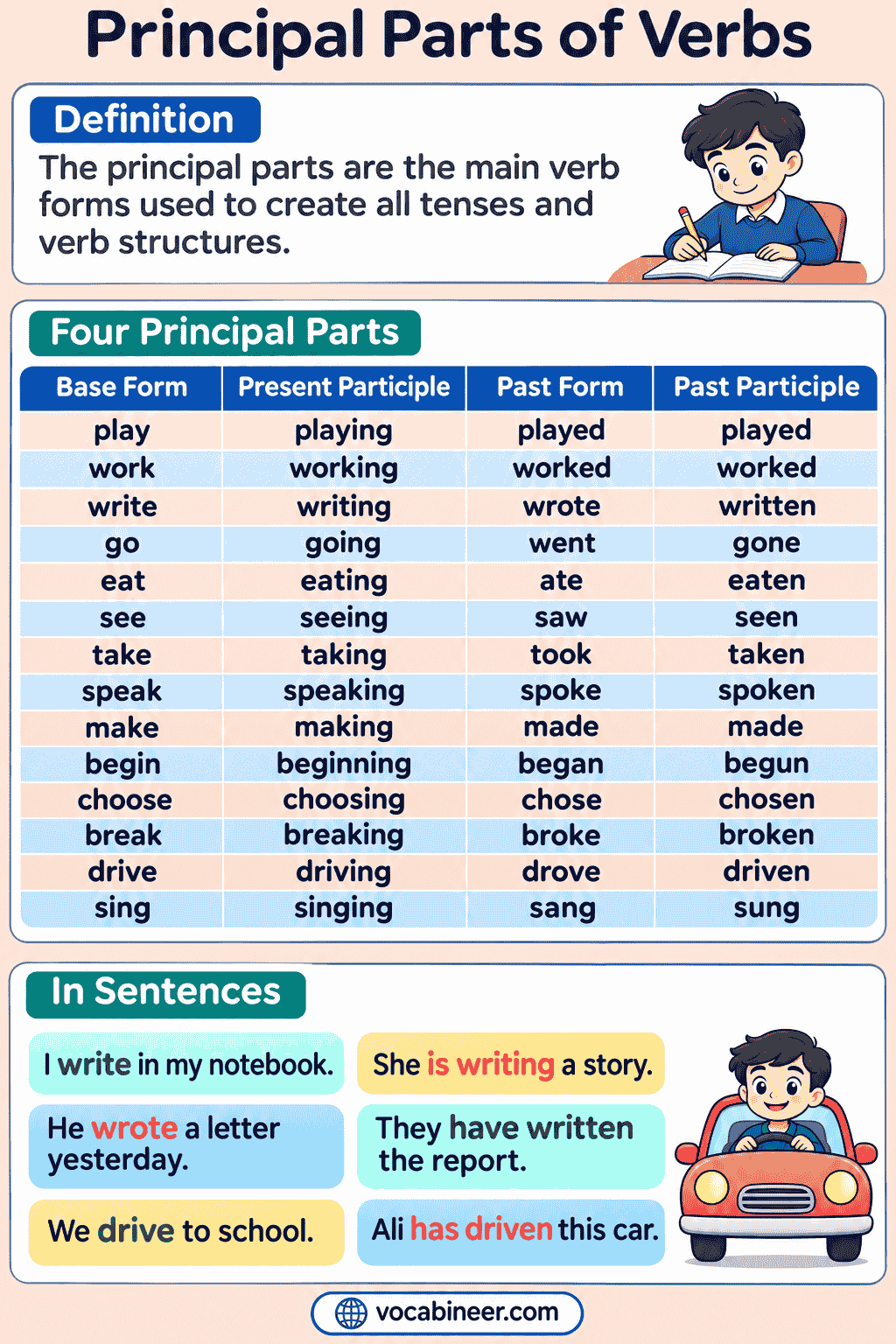
The principal parts of a verb are its fundamental forms. Traditional school grammar commonly identifies four principal parts: the base form, present participle, past form, and past participle. Together, these forms supply the information needed to create the verb’s main grammatical constructions.
Consider the verb write:
| Principal part | Form | Example |
|---|---|---|
| Base form | write | They write every day. |
| Present participle | writing | They are writing now. |
| Past form | wrote | They wrote yesterday. |
| Past participle | written | They have written already. |
Why Are They Called Principal Parts?
The word principal means main or fundamental. Once you know a verb’s principal parts, you can combine them with subjects and auxiliary verbs to create a wide range of constructions.
This information matters most with irregular verbs. A learner can predict work–working–worked–worked, but forms such as write–writing–wrote–written must be learned. Therefore, dictionaries often display the unpredictable parts of irregular verbs.
Do Verbs Have Three or Four Principal Parts?
Grammar systems count principal parts in two common ways. Neither system changes how English works; the difference concerns terminology and classification.
| Three-part system | Four-part system |
|---|---|
| Base or present form | Base form |
| Past form | Present participle |
| Past participle | Past form |
| Treats the -ing form as predictable | Lists the present participle separately |
| Common in dictionaries and many modern grammar references | Common in traditional school grammar |
The three-part system focuses on the forms that reveal whether a verb is regular or irregular: write–wrote–written. The four-part system also includes the present participle: write–writing–wrote–written.
Throughout this guide, the four-part model provides the main framework. However, readers using a three-part textbook can simply treat the present participle as an additional predictable form.
Principal Parts and the Five Verb Forms
Principal parts and the five complete verb forms overlap, but they are not identical systems.
| Principal parts | Five verb forms |
|---|---|
| Usually counted as three or four | Commonly counted as five |
| Identify the fundamental forms used to build constructions | Include every common inflected form of a main verb |
| Usually exclude the third-person singular form | Include the third-person singular form |
| May include write, writing, wrote, and written | Include write, wrote, written, writing, and writes |
The third-person singular form, such as writes or works, does not normally count as a principal part because its formation is highly predictable. Nevertheless, it belongs to the complete five-form description of English verbs.
The Base Form
The base form is the uninflected form of a verb. It serves as the dictionary form and provides the foundation for the other principal parts.
The Base Form in the Simple Present
Use the base form with I, you, we, and they, as well as plural subjects:
- I work from home.
- You speak clearly.
- We study English.
- They write reports.
- The students read every morning.
With he, she, it, or another singular subject, the simple present normally adds -s or -es:
- She works from home.
- Ali studies English.
Although works and studies are verb forms, they do not usually count as principal parts.
The Base Form After Do and Modal Verbs
Use the base form after do, does, and did:
- Do they live nearby?
- She does not drive.
- Did he write the email?
The main verb returns to its base form because the auxiliary carries the tense or agreement marking. Therefore, “Did he wrote?” and “Does she works?” are incorrect.
Modal verbs also take a bare base form:
- She can swim.
- You should check the answer.
- They might arrive late.
- We must leave now.
Base Form and Infinitive
The base form can function as a bare infinitive or appear after to as a to-infinitive.
| Bare infinitive | To-infinitive |
|---|---|
| Uses the base form without to | Uses to before the base form |
| Often follows modal verbs, let, and make | Often follows verbs such as want, hope, and plan |
| She can write. | She wants to write. |
| Let him speak. | He plans to speak. |
The marker to introduces an infinitive, but it is not part of the verb’s base form itself.
The Base Form in Commands
Imperatives use the base form:
- Open the door.
- Read the instructions.
- Please wait here.
The Present Participle
The present participle consists of the base form plus -ing, with any necessary spelling changes. Despite its name, it does not always refer to present time.
Present Participles in Continuous Constructions
Combine a form of be with a present participle to create a continuous construction:
- She is writing now.
- They were waiting outside.
- We have been working all morning.
- He will be travelling next week.
The auxiliary carries tense and agreement, while the participle contributes the continuous meaning.
Present Participles as Modifiers
Present participles can describe nouns:
- a smiling child
- the rising sun
- a growing business
- the woman standing outside
Present Participles in Non-Finite Clauses
A present participle can introduce a clause without independently marking tense:
- Walking home, Sara called her mother.
- Knowing the answer, he raised his hand.
- The students sat quietly, waiting for the lesson to begin.
Because these participles are non-finite, another finite verb anchors the sentence.
Present Participle and Gerund
Present participles and gerunds share the same -ing form, but they perform different functions.
| Present participle | Gerund |
|---|---|
| Forms a continuous verb phrase or modifies another element | Performs a noun-like function |
| She is reading. | Reading improves vocabulary. |
| The student reading outside is Sara. | Sara enjoys reading. |
| Can introduce a participial clause | Can serve as a subject, object, or complement |
Modern grammar references sometimes use the broader term -ing form for both uses. However, the traditional distinction remains useful for learners.
The Past Form
The past form creates the simple past. Regular verbs usually add -ed, whereas irregular verbs may change their spelling or use a completely different form.
- We worked yesterday.
- She wrote a letter.
- They went home early.
- He bought a new bag.
Except for be, the past form does not change according to the subject:
- I walked home.
- She walked home.
- They walked home.
The verb be uses was and were:
- I was tired.
- They were tired.
Past Forms in Unreal Situations
A past form can express distance from reality rather than past time:
- If I knew the answer, I would tell you.
- I wish she lived closer.
- If he had more time, he could help.
Formal English often uses were with every subject in an unreal condition:
- If I were you, I would wait.
The Past Participle
The past participle combines with auxiliary verbs or functions as a modifier. It does not usually express past tense by itself.
Past Participles in Perfect Constructions
Use a past participle after a form of have:
- She has written the report.
- They have finished the project.
- We had left before noon.
- He will have completed the course by June.
Past Participles in Passive Voice
Use a past participle after an appropriate form of be to create passive voice:
- The report was written yesterday.
- The rooms are cleaned daily.
- The road is being repaired.
- The results will be announced tomorrow.
Past Participles as Modifiers
Past participles can modify nouns or introduce reduced clauses:
- a broken window
- the written instructions
- the documents sent yesterday
- Exhausted by the journey, the travellers rested.
- Built in 1920, the house remains in good condition.
Adjective-Like Participle and Passive Construction
| Adjective-like use | Passive construction |
|---|---|
| Describes a state or quality | Describes an action received by the subject |
| The window is broken. | The window was broken by the ball. |
| An agent is usually irrelevant | An agent may appear in a by phrase |
Context determines whether a participle describes a state or forms part of a passive construction.
Past Form and Past Participle
Regular verbs often use the same form for both parts. However, irregular verbs frequently distinguish them.
| Past form | Past participle |
|---|---|
| Creates the simple past | Helps create perfect and passive constructions |
| Can serve as the finite verb of a past-tense clause | Usually appears with an auxiliary |
| She wrote the report. | She has written the report. |
| They broke the window. | The window was broken. |
| He went home. | He has gone home. |
Consequently, wrote, broke, and went cannot replace written, broken, and gone after have.
Present Participle and Past Participle
| Present participle | Past participle |
|---|---|
| Usually ends in -ing | May end in -ed, -en, -n, -t, or another form |
| Helps form continuous constructions | Helps form perfect and passive constructions |
| Often suggests an active or developing meaning | Often suggests a completed or received action |
| The child is breaking the toy. | The toy has broken. |
| a falling leaf | a fallen leaf |
Neither participle normally serves as the only verb in an independent clause. “She writing” and “He written” are incomplete because they lack finite auxiliaries. Correct forms include “She is writing” and “He has written.”
How Principal Parts Build Verb Constructions
Principal parts combine with auxiliaries to express different grammatical meanings.
| Construction | Pattern | Example |
|---|---|---|
| Simple present | Base or third-person singular form | They write; she writes. |
| Simple past | Past form | She wrote. |
| Continuous | be + present participle | She is writing. |
| Perfect | have + past participle | She has written. |
| Perfect continuous | have been + present participle | She has been writing. |
| Passive | be + past participle | It was written. |
| Modal construction | Modal + base form | She can write. |
A principal part is a form, not a complete tense. For example, written is a past participle. The complete phrase has written expresses present perfect meaning, while was written expresses past passive meaning.
Finite and Non-Finite Principal Parts
Finite verbs show tense, agreement, or modality and anchor clauses. Non-finite forms do not independently show those features.
| Finite use | Non-finite use |
|---|---|
| They write every day. | They can write today. |
| She wrote yesterday. | She wants to write. |
| Shows present or past tense directly | Depends on another verb or clause element |
Present and past forms can function as finite verbs. In contrast, infinitives and participles are non-finite. However, non-finite forms can join a finite auxiliary to create a complete verb phrase, as in is writing or has written.
Principal Parts of Regular and Irregular Verbs
| Regular verbs | Irregular verbs |
|---|---|
| Form the past and past participle with -ed or -d | Do not follow the standard -ed pattern |
| Past and past participle normally match | Past and past participle may match or differ |
| work–working–worked–worked | write–writing–wrote–written |
| live–living–lived–lived | go–going–went–gone |
| study–studying–studied–studied | take–taking–took–taken |
The terms regular and irregular mainly describe the formation of the past and past participle. All ordinary verbs create their present participle with -ing, although spelling changes may occur.
Common Irregular-Verb Patterns
| Pattern | Examples |
|---|---|
| Base, past, and past participle remain identical | cut–cut–cut; put–put–put; hit–hit–hit |
| Past and past participle match | build–built–built; buy–bought–bought; teach–taught–taught |
| Base and past participle match | come–came–come; run–ran–run |
| All three forms differ | write–wrote–written; sing–sang–sung; begin–began–begun |
| Past participle ends in -en or -n | break–broke–broken; take–took–taken; show–showed–shown |
| Spelling remains the same but pronunciation changes | read /riːd/–read /red/–read /red/ |
How Auxiliary Verbs Select Principal Parts
The auxiliary usually determines which principal part follows it.
| Auxiliary | Required form | Example |
|---|---|---|
| do, does, did | Base form | Did she call? |
| Modal verbs | Base form | She may call. |
| have, has, had | Past participle | She has called. |
| A form of be for continuous aspect | Present participle | She is calling. |
| A form of be for passive voice | Past participle | She was called. |
This pattern explains why changing the auxiliary can change the required principal part:
- She wrote the message.
- She has written the message.
- She is writing the message.
- The message was written yesterday.
Spelling Rules for Present Participles
| Rule | Base form | Present participle |
|---|---|---|
| Add -ing to most verbs | read | reading |
| Remove a silent final e | write | writing |
| Keep final -ee | see | seeing |
| Change final ie to y | lie | lying |
| Double a final consonant after a stressed consonant–vowel–consonant pattern | run | running |
| Do not usually double after an unstressed final syllable | open | opening |
| Add k after final c | panic | panicking |
British English commonly doubles final l in travelling, whereas American English usually uses traveling.
Spelling and Pronunciation of Regular Past Forms
Spelling Rules
| Rule | Base form | Past and past participle |
|---|---|---|
| Add -ed to most verbs | work | worked |
| Add -d after final e | live | lived |
| Change consonant + y to -ied | study | studied |
| Keep y after a vowel | play | played |
| Double a final consonant after a stressed consonant–vowel–consonant pattern | stop | stopped |
| Do not usually double after an unstressed final syllable | open | opened |
Pronunciation of -ed
| Pronunciation | General pattern | Examples |
|---|---|---|
| /t/ | After most voiceless sounds | worked, washed, laughed |
| /d/ | After vowels and most voiced sounds | played, cleaned, called |
| /ɪd/ | After /t/ or /d/ | wanted, needed, started |
Principal Parts of Be, Have, and Do
The primary auxiliaries be, have, and do can also function as main verbs. Their forms occur frequently, so they deserve special attention.
| Verb | Base form | Present participle | Past form | Past participle | Other present forms |
|---|---|---|---|---|---|
| be | be | being | was/were | been | am, is, are |
| have | have | having | had | had | has |
| do | do | doing | did | done | does |
The verb be has more forms than an ordinary English verb because it changes for both tense and subject agreement.
Modal Verbs and Principal Parts
Modal verbs such as can, may, must, and should do not have a normal complete set of principal parts. For example, English does not use forms such as canning or musted as modal forms. Instead, alternative expressions supply missing meanings:
- can → be able to
- must → have to
For this reason, grammarians often describe central modal verbs as defective verbs.
Common Verbs and Their Principal Parts
| Base form | Present participle | Past form | Past participle |
|---|---|---|---|
| answer | answering | answered | answered |
| begin | beginning | began | begun |
| break | breaking | broke | broken |
| bring | bringing | brought | brought |
| choose | choosing | chose | chosen |
| come | coming | came | come |
| cut | cutting | cut | cut |
| do | doing | did | done |
| drink | drinking | drank | drunk |
| drive | driving | drove | driven |
| eat | eating | ate | eaten |
| give | giving | gave | given |
| go | going | went | gone |
| know | knowing | knew | known |
| make | making | made | made |
| open | opening | opened | opened |
| read | reading | read | read |
| run | running | ran | run |
| see | seeing | saw | seen |
| speak | speaking | spoke | spoken |
| stop | stopping | stopped | stopped |
| study | studying | studied | studied |
| take | taking | took | taken |
| teach | teaching | taught | taught |
| write | writing | wrote | written |
Commonly Confused Principal Parts
| Verbs | Difference | Principal parts |
|---|---|---|
| lie and lay | Lie means recline; lay means put something down | lie–lying–lay–lain; lay–laying–laid–laid |
| rise and raise | Rise means move upward; raise means lift something | rise–rising–rose–risen; raise–raising–raised–raised |
| sit and set | Sit means take a seated position; set means place something | sit–sitting–sat–sat; set–setting–set–set |
| fall and fell | Fall means move downward; fell can mean cut down | fall–falling–fell–fallen; fell–felling–felled–felled |
| hang and hang | Use hung for suspending most things; use hanged for execution | hang–hanging–hung–hung; hang–hanging–hanged–hanged |
British and American Variations
Some principal parts have accepted regional alternatives.
| British English | American English | Note |
|---|---|---|
| learnt | learned | Both forms occur in British English |
| dreamt | dreamed | Both are standard |
| spelt | spelled | Both are standard |
| travelled, travelling | traveled, traveling | British English commonly doubles final l |
| got | gotten | American English uses gotten for some participle meanings |
These variations are not mistakes. However, writers should follow one regional style consistently.
How Dictionaries Show Principal Parts
Dictionaries list a verb under its base form. Because regular forms are predictable, an entry may not display all of them. However, dictionaries usually provide the past and past participle of irregular verbs:
- write — wrote — written
- sing — sang — sung
- take — took — taken
A dictionary may also display forms with notable spelling changes, such as lying or panicking. When an unfamiliar verb causes uncertainty, checking its dictionary entry is more reliable than guessing.
Common Mistakes with Principal Parts
| Incorrect | Correct | Explanation |
|---|---|---|
| Did she wrote? | Did she write? | Use the base form after did. |
| Does he works here? | Does he work here? | Use the base form after does. |
| She can writes. | She can write. | A modal takes the base form. |
| He has went home. | He has gone home. | Use the past participle after has. |
| She has wrote a letter. | She has written a letter. | Written is the past participle. |
| The glass was broke. | The glass was broken. | Passive voice requires the past participle. |
| They are study. | They are studying. | Continuous constructions require a present participle. |
| She is lieing down. | She is lying down. | Change final ie to y before -ing. |
| They stoped working. | They stopped working. | Double the final consonant in stop. |
| He had chose the blue one. | He had chosen the blue one. | Perfect constructions require a past participle. |
How to Choose the Correct Principal Part
Follow these steps when deciding which form to use:
- Look for an auxiliary. Use the base form after do and modals, the past participle after have, and the present participle or past participle after be, depending on the meaning.
- Identify the construction. Simple past requires the past form, continuous aspect requires the present participle, and perfect aspect requires the past participle.
- Check the voice. Passive voice uses a form of be followed by the past participle.
- Check whether the verb is regular. If it is regular, apply the relevant -ed or -ing spelling rule.
- Confirm irregular forms. Consult a reliable dictionary when the past or past participle cannot be predicted.
- Check the whole verb phrase. Make sure a participle has the finite auxiliary it needs.
FAQs
The four traditionally taught principal parts are the base form, present participle, past form, and past participle. For example, the principal parts of write are write, writing, wrote, and written.
Some systems list only the base, past, and past participle because the present participle forms predictably with -ing. Both three-part and four-part systems describe the same underlying verb patterns.
The past form creates the simple past, as in “She wrote.” The past participle normally follows have or be, as in “She has written” or “It was written.”
No. The systems overlap, but the five-form model includes the third-person singular form, such as writes. Principal-parts systems usually omit that predictable form and count either three or four fundamental forms.
Use a past participle after have, as in “has written.” After be, use a present participle for a continuous construction or a past participle for passive voice. Use the base form after did, as in “Did she write?”
Final Summary
The principal parts of a verb provide the basic forms needed to create English verb constructions. Traditional grammar lists the base form, present participle, past form, and past participle. However, many modern references use a three-part system that omits the predictable present participle.
The base form follows do and modal verbs, the present participle helps form continuous constructions, the past form creates the simple past, and the past participle helps form perfect and passive constructions. Once learners understand these patterns—and memorize the unpredictable parts of irregular verbs—they can select verb forms more accurately and avoid many common grammar errors.
Read More
- Parts of Speech in English
- Nouns in English with Examples
- Common and Proper Nouns
- Countable and uncountable nouns
- Collective nouns
- Abstract and concrete nouns
- Gender nouns
- Compound nouns
- Possessive nouns
- Singular and plural nouns
- Plural noun rules