

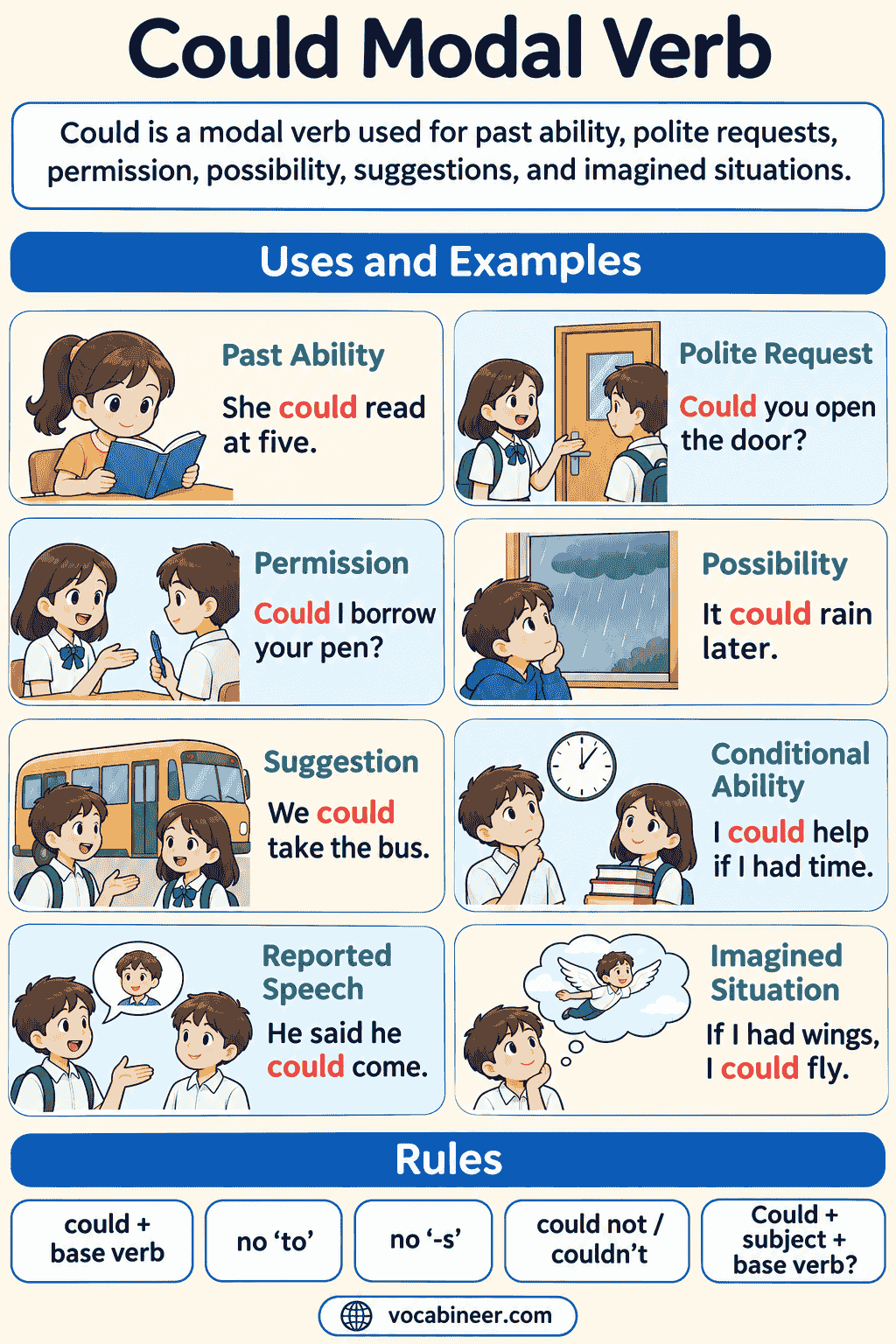
The modal verb could expresses general ability in the past, uncertain possibility, polite requests, permission questions, suggestions, and hypothetical opportunities. For example, “She could swim at five” describes past ability, while “It could rain tonight” expresses present or future uncertainty. Therefore, the surrounding context determines both its time reference and meaning.
Although could often relates to can, it is not simply its past-tense form. Speakers also use it to sound more polite, less certain, or more tentative. Moreover, structures such as could have, couldn’t have, and could have been express several different past possibilities, missed opportunities, criticisms, and unreal situations. This guide explains each use with clear structures, comparisons, and examples.
In This Page
Could at a Glance
Could is a core modal auxiliary. It comes before the base form of a main verb and remains unchanged with every subject.
| Use | Meaning | Example |
|---|---|---|
| General past ability | A skill or capacity existed in the past | She could read at four. |
| Present or future possibility | Something is possible but uncertain | It could rain tonight. |
| Polite request | Asking someone to act politely | Could you help me? |
| Permission question | Asking politely to do something | Could I leave early? |
| Suggestion | Presenting one possible action | We could take a taxi. |
| Hypothetical ability | Ability under an imagined condition | I could help if I had time. |
| Reported can | Reporting an earlier use of can | She said she could come. |
| Missed opportunity | A possible past action did not happen | You could have called. |
The basic structure is:
Subject + could + base form of the main verb
- I could help.
- She could attend.
- They could arrive tomorrow.
Main Forms of Could
| Sentence type | Structure | Example |
|---|---|---|
| Affirmative | subject + could + base verb | She could swim. |
| Negative | subject + could not/couldn’t + base verb | She couldn’t swim. |
| Yes–no question | could + subject + base verb | Could she swim? |
| Wh-question | question word + could + subject + base verb | When could she swim? |
| Short answer | yes/no + subject + could/couldn’t | Yes, she could. |
| Passive | subject + could be + past participle | It could be repaired. |
| Modal perfect | subject + could have + past participle | She could have won. |
| Perfect passive | subject + could have been + past participle | It could have been repaired. |
Grammatical Features of Could
Like other core modals, could follows special grammatical rules.
The Base Verb After Could
The main verb after could must remain in its bare infinitive, which is the base form without to.
| Correct | Incorrect |
|---|---|
| She could speak French. | She could spoke French. |
| He could help us. | He could to help us. |
| They could arrive tomorrow. | They could arriving tomorrow. |
The Same Form with Every Subject
Could does not change according to person or number.
- I could help.
- You could help.
- She could help.
- We could help.
- They could help.
Therefore, forms such as coulds and coulded are incorrect when could functions as a modal.
No Do-Support
Questions and negatives do not require do, does, or did.
| Incorrect | Correct |
|---|---|
| She didn’t could attend. | She couldn’t attend. |
| Did he could help? | Could he help? |
No Direct Combination with Another Core Modal
Standard English does not normally place two core modals together. Use an alternative expression when another modal is needed.
| Incorrect | Correct |
|---|---|
| She might could attend. | She might be able to attend. |
| They will could help. | They will be able to help. |
Time Reference and Modal Remoteness
The form could does not automatically refer to past time. It can locate an ability in the past, but it can also make a present or future statement less direct, less certain, or more hypothetical. This distancing effect is sometimes called modal remoteness.
| Time or effect | Example | Meaning |
|---|---|---|
| Past | She could swim at five. | General past ability |
| Present | She could be at home. | Uncertain present possibility |
| Future | We could meet tomorrow. | Possible future arrangement |
| Polite distance | Could you help me? | Polite present request |
| Hypothetical distance | I could help if I had time. | Imagined ability |
Consequently, readers must interpret could from the complete sentence rather than from its form alone.
Affirmative and Negative Forms
An affirmative sentence places could after the subject and before the base verb:
Subject + could + base verb
- She could sing beautifully.
- We could leave after lunch.
- This plan could work.
The negative forms are could not and couldn’t:
Subject + could not/couldn’t + base verb
- She could not swim.
- We couldn’t open the door.
- That couldn’t be correct.
Couldn’t is common in conversation and informal writing. The full form could not may sound more formal or emphatic.
Questions, Short Answers, and Tags
Yes–No Questions
Place could before the subject:
Could + subject + base verb?
- Could you help me?
- Could she swim at five?
- Could this plan work?
Wh-Questions
Place the question word before could:
- Where could we stay?
- How could they solve the problem?
- When could she start?
Subject Questions
When the question word acts as the subject, no additional subject appears after could:
- Who could help us?
- What could cause this error?
- Which method could work best?
Short Answers
Repeat the modal in short answers:
- Could she swim at five? — Yes, she could.
- Could they hear you? — No, they couldn’t.
However, a permission request normally receives an answer with can or may:
- Could I leave early? — Yes, you can.
- Could I use this room? — No, you may not.
Question Tags
- She could swim, couldn’t she?
- They couldn’t hear us, could they?
- We could try again, couldn’t we?
Could for General Past Ability
Could commonly describes a skill, capacity, or opportunity that existed over a period in the past.
- I could swim when I was five.
- She could read before starting school.
- They could speak several languages.
- He could run for hours when he was younger.
The negative form describes general past inability:
- I couldn’t swim as a child.
- She couldn’t understand written Arabic then.
- The old computer couldn’t process large files.
Could and Specific Past Achievements
Affirmative could does not normally describe one successful action on a particular occasion. Instead, use was/were able to or managed to.
| General past ability | Specific successful action |
|---|---|
| She could solve difficult puzzles. | She was able to solve yesterday’s puzzle. |
| He could climb well as a child. | He managed to climb through the window. |
| We could contact clients in several languages. | We were able to contact the client before noon. |
The restriction does not usually apply to negative couldn’t. It can describe failure on one particular occasion:
- We couldn’t open the door yesterday.
- She couldn’t find her keys.
- They couldn’t finish the work on time.
Could and Managed To
| Could | Managed to |
|---|---|
| Describes a general past ability | Describes success after effort or difficulty |
| He could climb well. | He managed to climb through the window. |
| Does not necessarily emphasize effort | Emphasizes that the attempt succeeded |
Could with Perception and Mental-Process Verbs
Could can describe one particular past event with verbs of perception or mental processing. This use is an important exception to the usual specific-achievement restriction.
- I could hear voices outside.
- She could see smoke in the distance.
- We could smell something burning.
- He couldn’t remember her name.
- I could understand why they were upset.
These sentences describe what someone perceived, remembered, or understood at a particular past time.
Could for General Past Possibility
Could can also describe something that was sometimes possible, typical, or likely under past conditions.
- Winters there could be extremely cold.
- Travelling at night could be dangerous.
- A small mistake could cause serious delays.
- You could easily get lost in the old town.
This meaning resembles present general possibility with can, but the reference period lies in the past.
Could for Present and Future Possibility
Could expresses an uncertain possibility in the present or future.
- She could be at home.
- It could rain later.
- This could cause a problem.
- They could arrive tomorrow.
- The plan could work.
Here, could does not refer to past time. Instead, it presents the outcome as possible but uncertain.
Could for Polite Requests
Could you…? introduces a polite or indirect request.
- Could you help me?
- Could you close the window?
- Could you send the report today?
- Could you wait for a moment?
The request concerns the present or future. The past-looking form creates social distance and makes the request less direct.
Extra-Polite Request Patterns
Several structures soften a request further:
- Could you possibly send the file today?
- Do you think you could help me?
- I was wondering if you could check this report.
- Could I possibly speak to the manager?
These forms suit formal, professional, or delicate situations. Nevertheless, tone and context still affect politeness.
Indirect Questions with Could
Requests such as Could you tell me…? often introduce an indirect question. The embedded question follows statement word order rather than direct-question inversion.
| Direct question | Indirect question |
|---|---|
| Where is the station? | Could you tell me where the station is? |
| When does the office open? | Could you tell me when the office opens? |
| Why did she leave? | Could you explain why she left? |
Avoid double inversion:
- Incorrect: Could you tell me where is the station?
- Correct: Could you tell me where the station is?
Could for Permission
Asking for Permission
Could I…? politely asks for permission.
- Could I borrow your pen?
- Could we leave early?
- Could I ask a question?
- Could I use your phone?
Could generally asks for permission rather than grants it. Therefore, replies normally use can or may:
- Could I leave early? — Yes, you can.
- Could I borrow this? — Yes, you may.
General Past Permission
Could can describe permission that existed generally or repeatedly in the past.
- When we were children, we could play outside until dark.
- Staff members could use the library whenever they wanted.
- We could stay up late during school holidays.
Permission on One Past Occasion
For permission granted on one particular occasion, was/were allowed to is usually clearer.
| General past permission | Permission on one occasion |
|---|---|
| We could stay up late during holidays. | We were allowed to stay up late last night. |
| Staff could use the hall whenever it was free. | The staff were allowed to use the hall yesterday. |
Could for Suggestions and Options
Could presents one possible course of action without making it compulsory.
- We could take the train.
- You could ask your teacher.
- They could meet after work.
- We could try another method.
The expression could always introduces a fallback option:
- We could always take a taxi.
- You could always apply again next year.
- If the shop is closed, we could always order online.
Could and Should for Suggestions
| Could | Should |
|---|---|
| Presents one possible option | Recommends an advisable action |
| You could talk to your teacher. | You should talk to your teacher. |
| Leaves the decision open | Suggests that the action is preferable |
Could and Might in Suggestions
| Could | Might |
|---|---|
| Commonly proposes an option | More often expresses uncertainty |
| We could take a taxi. | We might take a taxi. |
| Suggests a possible action | Says the action may happen |
Could for Tentative Offers
Could can make an offer less definite or dependent on circumstances.
- I could help you tomorrow.
- We could give you a lift.
- I could check the report if that would help.
- She could bring some food.
For an immediate and direct offer, can is often more natural: “Can I help you?”
Could for Hypothetical Ability and Opportunity
Could can mean would be able to in an imagined situation.
- I could help if I had more time.
- She could win if she trained harder.
- We could live there if we found work.
- You could improve quickly with regular practice.
The condition may be stated or understood from context.
Could and Would Be Able To
| Could | Would be able to |
|---|---|
| Compact and natural in many hypothetical statements | Makes the meaning of ability explicit |
| I could help if I had time. | I would be able to help if I had time. |
| Can also express possibility or suggestion | Focuses specifically on ability |
Could in Reported Speech
When an earlier statement contains can, reported speech often changes it to could.
| Direct speech | Reported speech |
|---|---|
| “I can help.” | She said she could help. |
| “You can wait here.” | They told us we could wait there. |
| “You can book online.” | He explained that we could book online. |
When the original statement already contains could, it often remains unchanged:
- Direct: “I could help tomorrow.”
- Reported: She said she could help the next day.
Could for Hedging and Tentative Opinions
Could softens a claim by presenting it as one possible interpretation rather than a certainty. This use appears frequently in academic, analytical, and professional writing.
- This could indicate a larger problem.
- The results could support the theory.
- One explanation could be insufficient training.
- The policy could affect smaller businesses.
Adverbs can adjust the degree or character of possibility:
- The change could possibly improve efficiency.
- The plan could easily fail.
- The evidence could certainly support another interpretation.
- She could probably finish today.
Adverbs usually appear after the modal and before the main verb.
Could for Criticism and Emotional Reactions
Could can criticize present behavior or express shock and disbelief.
Present Criticism
- You could at least say thank you.
- He could try to be more considerate.
- They could show a little patience.
Rhetorical and Emotional Questions
- How could you do that?
- How could this happen?
- How could they have forgotten us?
These questions often express disapproval, surprise, or distress rather than request factual information.
The Meanings of Could Have
The structure is:
Subject + could have + past participle
Its meaning depends on context.
Unrealized Ability or Opportunity
The subject had the ability or opportunity, but the action did not happen.
- She could have won, but she withdrew.
- We could have stayed longer.
- He could have applied for the job.
- I could have helped if you had asked.
Past Possibility
The speaker presents one possible explanation for a past event.
- She could have missed the train.
- They could have taken another road.
- He could have forgotten the date.
- The message could have come from Ali.
Criticism
The speaker believes an action was possible and probably should have happened.
- You could have called me.
- She could have warned us.
- They could have cleaned the room.
- He could have arrived on time.
Regret and Missed Possibilities
- I could have been a musician.
- We could have lived abroad.
- She could have studied medicine.
- They could have avoided the problem.
Conditional Past Ability
Could have can mean would have been able to under a different condition.
- I could have finished if I had started earlier.
- She could have attended if the meeting had been online.
- We could have helped if we had known.
Because one structure carries several meanings, context must show whether could have expresses possibility, opportunity, criticism, regret, or conditional ability.
Could Have Done and Could Have Been Doing
These structures present different views of a possible past event.
| Structure | Meaning | Example |
|---|---|---|
| could have + past participle | Possible or unrealized completed action | She could have finished the report. |
| could have been + present participle | Possible ongoing past activity | She could have been working at home. |
The continuous form emphasizes an activity in progress, while the simple modal-perfect form commonly presents the event as a whole.
The Meanings of Couldn’t Have
The structure couldn’t have + past participle has two major interpretations.
Past Impossibility or Negative Deduction
- She couldn’t have written this.
- They couldn’t have arrived before noon.
- He couldn’t have known the answer.
The speaker concludes that the past event was impossible.
Conditional Inability
- I couldn’t have finished without your help.
- We couldn’t have won without our captain.
- She couldn’t have travelled without a passport.
Here, couldn’t have means would not have been able to.
Could Be and Could Have Been
| Structure | Meaning | Example |
|---|---|---|
| could be + noun/adjective | Present or future possibility | It could be dangerous. |
| could be + present participle | Possible ongoing action | She could be waiting outside. |
| could be + past participle | Passive possibility | It could be repaired. |
| could have been + noun/adjective | Possible or unreal past state | He could have been a doctor. |
| could have been + present participle | Possible ongoing past action | She could have been waiting outside. |
| could have been + past participle | Perfect passive possibility | It could have been repaired. |
Could in Conditional Sentences
| Conditional meaning | Example |
|---|---|
| Present hypothetical ability | If I had more time, I could help. |
| Future possibility | If the weather improves, we could leave tomorrow. |
| Past unrealized ability | If you had called, I could have helped. |
| Conditional inability | Without your support, I couldn’t have finished. |
Unlike would, could focuses on ability, opportunity, or possibility.
Could and Can
| Can | Could |
|---|---|
| Present ability | General past ability |
| Neutral request | More polite request |
| Neutral permission question | More polite permission question |
| General possibility | Particular uncertain possibility |
| Available suggestion | More tentative suggestion |
| Direct offer | Tentative offer |
Could and Was or Were Able To
| Could | Was/Were able to |
|---|---|
| General ability over a past period | Specific successful achievement |
| Common with perception and mental-process verbs | Emphasizes successful completion |
| Can express uncertain present or future possibility | Refers to actual ability or achievement |
| She could swim at five. | She was able to reach the shore yesterday. |
Negative couldn’t can describe a specific failure: “She couldn’t reach the shore.”
Could and Would
| Could | Would |
|---|---|
| Ability, opportunity, or possibility | Willingness, preference, intended action, or conditional result |
| I could help if needed. | I would help if you asked. |
| Focuses on what is possible | Focuses on what someone intends or expects to happen |
Could, May, and Might
| Modal | Typical emphasis | Example |
|---|---|---|
| could | Possible outcome or option | It could rain. |
| may | Neutral uncertain possibility | It may rain. |
| might | Often tentative possibility | It might rain. |
These modals overlap in many possibility statements. However, could often emphasizes one possible outcome or available option.
Could Have and Would Have
| Could have | Would have |
|---|---|
| Past ability, opportunity, or possibility | Expected or intended result under an unreal condition |
| I could have helped. | I would have helped if you had asked. |
| The action was possible | The action was the likely conditional result |
Passive Voice with Could
Use could be + past participle for present or future passive possibility:
| Active | Passive |
|---|---|
| We could solve the problem. | The problem could be solved. |
| They could repair the machine. | The machine could be repaired. |
| Someone could misuse the data. | The data could be misused. |
Use could have been + past participle for a past passive possibility or unrealized outcome:
- The accident could have been prevented.
- The work could have been completed earlier.
- The message could have been misunderstood.
- The building could have been damaged.
Ellipsis After Could
The main verb or longer verb phrase may be omitted when its meaning is clear from context.
- I can’t attend, but Sara could.
- I didn’t finish, although I could have.
- “Could you help?” “Yes, I could.”
This omission avoids unnecessary repetition. The modal retains the meaning of the understood verb phrase.
Common Expressions with Could
Could Do With
Could do with means “need” or “would benefit from.”
- I could do with some rest.
- This room could do with a fresh coat of paint.
Couldn’t Help
Couldn’t help + gerund means that someone could not prevent a reaction.
- She couldn’t help laughing.
- I couldn’t help noticing the mistake.
Couldn’t Agree More
This expression shows complete agreement:
- I couldn’t agree more.
Couldn’t Care Less
This expression means that someone does not care at all:
- He couldn’t care less about the result.
Could Be Worse
This expression suggests that a situation is not ideal but remains acceptable:
- The weather could be worse.
Couldn’t Possibly
Couldn’t possibly may express strong impossibility or a polite refusal:
- I couldn’t possibly accept such an expensive gift.
- She couldn’t possibly finish all that work today.
Pronunciation of Could and Couldn’t
The letter l is silent in both could and couldn’t. In connected speech, affirmative could is often unstressed. It receives stronger stress when the speaker contrasts ability with inability or emphasizes a possibility:
- I could help, but I chose not to.
- She said she couldn’t attend, but she could.
The contraction couldn’t is common in both speech and informal writing.
Common Mistakes with Could
Using an Inflected Main Verb
| Incorrect | Correct |
|---|---|
| She could spoke French. | She could speak French. |
| He could helps us. | He could help us. |
Adding To Before the Main Verb
| Incorrect | Correct |
|---|---|
| He could to help. | He could help. |
Using Do-Support
| Incorrect | Correct |
|---|---|
| She didn’t could attend. | She couldn’t attend. |
| Did he could help? | Could he help? |
Using Could for a Specific Achievement
| Less suitable | Natural form |
|---|---|
| We escaped because we could open the door. | We escaped because we were able to open the door. |
Using Could to Grant Permission
| Less natural reply | Natural reply |
|---|---|
| Could I leave? — Yes, you could. | Could I leave? — Yes, you can/may. |
Using the Wrong Form After Could Have
| Incorrect | Correct |
|---|---|
| She could have went home. | She could have gone home. |
| They could have took a taxi. | They could have taken a taxi. |
Forming the Perfect Passive Incorrectly
| Incorrect | Correct |
|---|---|
| It could have be prevented. | It could have been prevented. |
Using Inversion Inside an Indirect Question
| Incorrect | Correct |
|---|---|
| Could you tell me where is the station? | Could you tell me where the station is? |
A Practical Guide to Using Could
Use this process when choosing could:
- Identify the meaning. Decide whether the sentence expresses past ability, possibility, a request, permission, a suggestion, or a hypothetical result.
- Check the time reference. Remember that could may refer to the past, present, future, or an unreal situation.
- Distinguish general ability from achievement. Use was/were able to or managed to for many specific successful past actions.
- Use the base verb. Do not add to, -s, -ed, or -ing directly after could.
- Use the past participle after have. Write could have gone, not could have went.
- Interpret perfect forms from context. Determine whether could have expresses possibility, opportunity, criticism, regret, or conditional ability.
- Match the level of politeness. Use softened patterns such as Could you possibly…? when appropriate.
- Check embedded word order. Use statement order inside an indirect question.
FAQs
Could is a core modal auxiliary. It appears before the base form of a main verb and can express past ability, possibility, polite requests, permission questions, suggestions, and hypothetical ability.
No. Could expresses general past ability and reported can, but it also refers to present or future possibility, polite requests, tentative suggestions, and hypothetical situations.
Could commonly describes a general ability in the past. Was/were able to often describes a successful action on one particular occasion. However, couldn’t can describe failure on a specific occasion.
Could have + past participle may express a past possibility, an unrealized opportunity, criticism, regret, or conditional past ability. The surrounding context determines the intended meaning.
Could emphasizes ability, opportunity, or possibility. Would more often expresses willingness, preference, intended action, or the expected result of an unreal condition.
Final Summary
Could is a flexible modal auxiliary that can refer to past, present, future, or hypothetical situations. It expresses general past ability, uncertain possibility, polite requests, permission questions, suggestions, offers, reported can, and conditional opportunity. It remains unchanged with every subject and must be followed by the base form of the main verb.
The structures could have, couldn’t have, could be, and could have been add several important meanings, including past possibility, missed opportunity, criticism, regret, deduction, and passive possibility. Accurate use depends on context and on clear distinctions between could, can, was able to, would, may, and might.
Read More
- Verbs in English
- Action Verbs
- Regular Verbs
- Irregular Verbs
- Transitive and Intransitive verbs
- Finite and Non-finite verbs
- Principal Parts of Verbs
- Forms of Verbs