

Compound verbs combine two elements to create a single verb with a unified meaning. Words such as babysit, proofread, hand-wash, and overcome function as individual vocabulary items even though each developed from more than one element. Like other verbs, they can express actions, processes, or changes and can appear in different tenses and sentence structures.
However, grammar resources do not always use the term compound verb in the same way. Some traditional materials also apply it to an auxiliary and main verb working together, as in is reading or has finished. Modern grammar usually calls such a combination a verb phrase. This article explains both uses of the term, then focuses on lexical compound verbs, their formation, spelling, conjugation, meaning, and differences from related structures.
In This Page
Compound Verbs at a Glance
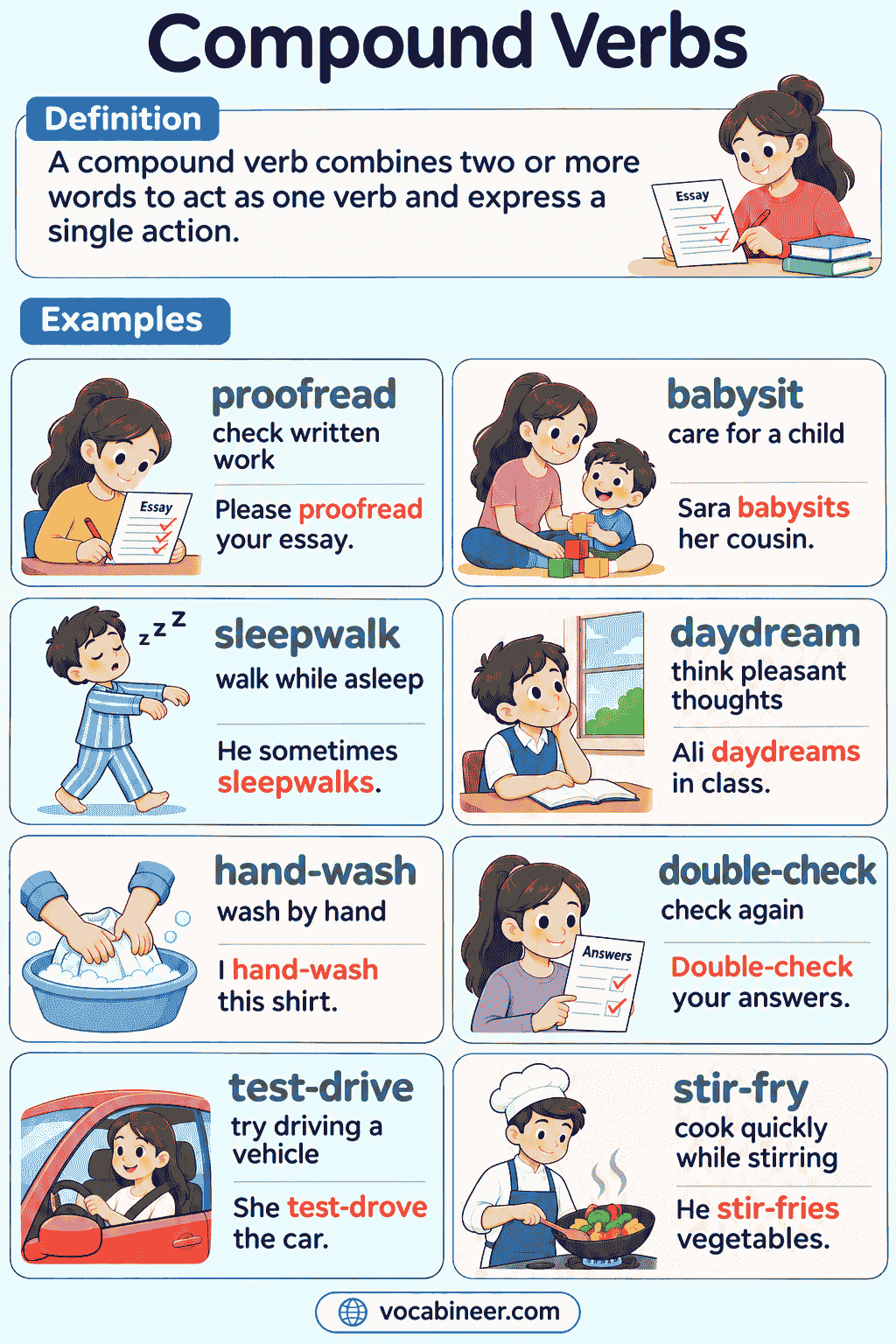
A lexical compound verb contains two meaningful elements that function together as one established verb. The complete unit carries one central meaning and performs one verbal job in a sentence.
| Compound verb | Components | Meaning | Example |
|---|---|---|---|
| babysit | baby + sit | Care for a child temporarily | Zara babysits her cousin. |
| proofread | proof + read | Check a text for errors | Please proofread the letter. |
| hand-wash | hand + wash | Wash something by hand | You should hand-wash this scarf. |
| dry-clean | dry + clean | Clean with a chemical process rather than water | They dry-cleaned the coat. |
| overcome | over + come | Successfully deal with a difficulty | She overcame her fear. |
| double-check | double + check | Check again for accuracy | We double-checked the figures. |
Compound verbs may appear as one word or with a hyphen. Their spelling is not always predictable, so established dictionary usage remains the safest guide.
Two Meanings of Compound Verb
The term has two uses in grammar materials:
| Use of the term | Structure | Examples | Preferred modern label |
|---|---|---|---|
| Lexical meaning | Two elements form one vocabulary item | proofread, babysit, hand-wash | Compound verb |
| Traditional classroom meaning | One or more auxiliaries combine with a main verb | is reading, has finished, will arrive | Verb phrase or complex verb phrase |
This distinction matters. Proofread is a lexical item that a dictionary can list as a verb. In contrast, has proofread is a grammatical phrase created from the auxiliary has and the past participle proofread.
How Compound Verbs Are Formed
English forms compound verbs through several combinations. The following categories are useful for learners, although scholars may analyze the internal structure of individual words differently.
Noun and Verb Combinations
A noun can combine with a verb to create a new verbal meaning.
| Compound verb | Components | Meaning | Example |
|---|---|---|---|
| babysit | baby + sit | Care for a child | Amir babysits on weekends. |
| proofread | proof + read | Check written material | I proofread every article. |
| brainwash | brain + wash | Pressure someone into accepting ideas | The group tried to brainwash its members. |
| hand-wash | hand + wash | Wash manually | Hand-wash delicate fabrics. |
| house-hunt | house + hunt | Search for a home | They are house-hunting this month. |
Adjective and Verb Combinations
An adjective or adjective-like first element may combine with a verb.
| Compound verb | Components | Meaning | Example |
|---|---|---|---|
| dry-clean | dry + clean | Clean without ordinary washing | We dry-cleaned the suit. |
| fine-tune | fine + tune | Make small improvements | The engineer fine-tuned the system. |
| highlight | high + light | Emphasize or mark clearly | The report highlights three risks. |
| whitewash | white + wash | Conceal faults or unpleasant facts | The inquiry must not whitewash the failure. |
| shortlist | short + list | Select for final consideration | They shortlisted six candidates. |
Preposition-Like Element and Verb Combinations
Some verbs begin with elements such as over-, under-, out-, up-, or down-. Depending on the grammatical analysis, these first elements may be described as prepositions, particles, or prefixes.
| Verb | Internal pattern | Meaning | Example |
|---|---|---|---|
| overcome | over + come | Succeed against a problem | We overcame several obstacles. |
| underestimate | under + estimate | Judge as smaller or weaker | Do not underestimate the task. |
| outperform | out + perform | Perform better than | The new model outperformed the old one. |
| upgrade | up + grade | Improve to a higher standard | They upgraded the software. |
| bypass | by + pass | Avoid or go around | The road bypasses the town. |
Some grammarians classify words such as underestimate and outperform as prefixed verbs rather than true compounds. A learner-focused article can group them with compound-like formations while acknowledging this difference.
Verb and Verb Combinations
Two verbal elements sometimes combine to describe a linked or specialized action.
| Compound verb | Meaning | Example |
|---|---|---|
| stir-fry | Fry while stirring | We stir-fried the vegetables. |
| freeze-dry | Preserve by freezing and removing moisture | The company freeze-dries fruit. |
| crash-land | Make an emergency landing | The pilot crash-landed safely. |
| drop-kick | Kick after dropping an object | The player drop-kicked the ball. |
Other Sources of Compound Verbs
Not every compound verb begins as two words deliberately joined to create a verb. English also produces them through back-formation, conversion, and analogy.
Back-Formation
Back-formation creates a shorter word by removing what speakers interpret as an ending from a longer word. For example, babysit developed in relation to babysitter and babysitting. Similarly, housekeep relates to housekeeper and housekeeping.
Common examples include:
- babysit from babysitter;
- housekeep from housekeeper;
- chain-smoke from chain-smoker or chain-smoking;
- proofread in relation to proofreader and proofreading;
- freeze-dry in relation to freeze-dried and freeze-drying.
Conversion
Conversion changes a word’s grammatical class without adding an affix. A compound noun or adjective may therefore begin functioning as a verb.
| Noun or adjective use | Verb use |
|---|---|
| The committee created a shortlist. | The committee shortlisted five applicants. |
| His name appeared on a blacklist. | The organization blacklisted the supplier. |
| We need a final double-check. | Please double-check the totals. |
| The problem produced a snowball effect. | The costs snowballed rapidly. |
New and Productive Compounds
English continues to create verbs for new activities and technologies. Words such as fact-check, livestream, crowdfund, and crowdsource demonstrate this productive process.
However, not every understandable combination becomes an established word. A new form gains acceptance through repeated community use. During that process, its spelling may vary before one form becomes dominant.
Closed and Hyphenated Compound Verbs
Compound spelling reflects convention and historical development rather than one universal rule.
| Written form | Description | Examples |
|---|---|---|
| Closed compound | Written as one word | babysit, proofread, overcome, shortlist |
| Hyphenated compound | Joined with a hyphen | hand-wash, dry-clean, double-check, stir-fry |
| Variable or developing form | Spelling differs across dictionaries or changes over time | Check current dictionary usage |
Newer or less familiar combinations often retain a hyphen because it makes the relationship between the elements clear. As a compound becomes more familiar, writers may begin closing it. For instance, many technology-related terms have moved from open or hyphenated spellings to single words.
Do not remove or add a hyphen simply because a form looks more natural. Instead:
- consult a current dictionary;
- use the spelling suited to the intended variety of English;
- remain consistent throughout the same text;
- distinguish a lexical compound from a spaced phrasal or prepositional verb.
Common Compound Verbs and Their Meanings
| Compound verb | Meaning | Example sentence |
|---|---|---|
| babysit | Care for a child temporarily | I babysit my niece after school. |
| backslide | Return to a worse condition or old habit | His progress stopped when he backslid. |
| blacklist | Exclude or reject officially | The platform blacklisted the account. |
| brainwash | Forcefully influence someone’s beliefs | The leader tried to brainwash his followers. |
| bypass | Avoid or go around | This route bypasses the city centre. |
| crash-land | Make an emergency landing | The aircraft crash-landed in a field. |
| cross-examine | Question closely in a legal case | The lawyer cross-examined the witness. |
| double-check | Check a second time | Double-check the address before leaving. |
| downgrade | Move to a lower level | The agency downgraded the warning. |
| dry-clean | Clean without ordinary washing | They dry-cleaned the curtains. |
| fine-tune | Make small, precise improvements | We fine-tuned the design. |
| freeze-dry | Preserve by freezing and removing water | The factory freeze-dries coffee. |
| hand-wash | Wash manually | She hand-washed the silk blouse. |
| highlight | Emphasize or draw attention to | The speaker highlighted the main issue. |
| house-hunt | Search for a place to live | They are house-hunting near the university. |
| mass-produce | Produce in large quantities | The company mass-produces batteries. |
| overcome | Successfully deal with a problem | He overcame his initial doubts. |
| outperform | Perform better than someone or something | Our team outperformed its rivals. |
| proofread | Check writing for errors | Please proofread your application. |
| shortlist | Select for final consideration | The panel shortlisted four designs. |
| sleepwalk | Walk while asleep | He occasionally sleepwalks. |
| snowball | Increase rapidly in size or importance | The small disagreement snowballed. |
| stir-fry | Fry quickly while stirring | She stir-fried the noodles. |
| underestimate | Judge as less important or difficult | We underestimated the cost. |
| upgrade | Improve to a higher standard | I upgraded my computer. |
| whitewash | Hide faults or uncomfortable facts | The report tried to whitewash the incident. |
Conjugating Compound Verbs
A compound verb functions as one verb, so it can show tense, agreement, and participial form. Some follow regular patterns, while others contain or develop irregular forms.
| Base form | Third-person singular | Past | Present participle | Past participle |
|---|---|---|---|---|
| double-check | double-checks | double-checked | double-checking | double-checked |
| dry-clean | dry-cleans | dry-cleaned | dry-cleaning | dry-cleaned |
| hand-wash | hand-washes | hand-washed | hand-washing | hand-washed |
| stir-fry | stir-fries | stir-fried | stir-frying | stir-fried |
| shortlist | shortlists | shortlisted | shortlisting | shortlisted |
| babysit | babysits | babysat | babysitting | babysat |
| overcome | overcomes | overcame | overcoming | overcome |
| proofread | proofreads | proofread | proofreading | proofread |
Regular Patterns
Most regular compound verbs add the usual endings:
- double-check → double-checks, double-checked, double-checking;
- hand-wash → hand-washes, hand-washed, hand-washing;
- mass-produce → mass-produces, mass-produced, mass-producing;
- shortlist → shortlists, shortlisted, shortlisting.
The hyphen normally remains when an established compound is conjugated: dry-cleans, dry-cleaned, and dry-cleaning.
Irregular Patterns
Some compounds inherit an irregular pattern from their verbal element or develop an established irregular form.
| Base | Past | Past participle | Example |
|---|---|---|---|
| babysit | babysat | babysat | She has babysat for us before. |
| overcome | overcame | overcome | They have overcome the delay. |
| proofread | proofread | proofread | I proofread it yesterday. |
The present and past forms of proofread have the same spelling but different pronunciations. The present contains the vowel sound used in read as a present-tense verb, while the past follows the pronunciation of past-tense read.
Compound Verbs in Larger Verb Phrases
A lexical compound can serve as the main verb inside a longer phrase. Auxiliary verbs then express tense, aspect, modality, or voice.
| Construction | Example | Analysis |
|---|---|---|
| Modal | You should proofread the email. | modal + compound main verb |
| Continuous | She is babysitting tonight. | be + present participle |
| Perfect | They have shortlisted six candidates. | have + past participle |
| Passive | The coat was dry-cleaned. | passive be + past participle |
| Modal perfect passive | The figures should have been double-checked. | modal + perfect + passive + compound verb |
Only the first auxiliary normally carries tense and subject agreement. The compound main verb takes the form required by the preceding auxiliary.
Finite and Non-Finite Forms
Compound verbs can appear in both finite and non-finite constructions.
| Form | Example | Function |
|---|---|---|
| Finite present | She proofreads reports. | Shows present tense and agreement |
| Finite past | She proofread the report. | Shows past tense |
| To-infinitive | She wants to proofread it. | Complements wants |
| Bare infinitive | She can proofread it. | Follows a modal verb |
| Gerund | Proofreading takes time. | Functions as a noun |
| Present participle | She is proofreading it. | Forms a continuous construction |
| Past participle | The proofread document is ready. | Modifies a noun or forms a verb phrase |
The same written form may perform different grammatical functions. For example, proofreading acts as a noun in “Proofreading requires concentration” but forms part of a verb phrase in “She is proofreading the article.”
Transitive and Intransitive Compound Verbs
A transitive compound verb takes a direct object, whereas an intransitive one does not. Some verbs can behave differently according to meaning and context.
| Type | Compound verb | Example |
|---|---|---|
| Transitive | proofread | She proofread the contract. |
| Transitive | hand-wash | We hand-washed the blankets. |
| Transitive | underestimate | They underestimated the distance. |
| Intransitive | sleepwalk | The child sleepwalks occasionally. |
| Intransitive | crash-land | The plane crash-landed. |
| Intransitive | snowball | The problem snowballed. |
The complete compound determines the object pattern. Therefore, knowing the behavior of the final element alone may not be enough. A dictionary can confirm whether the compound takes an object and which complements normally follow it.
Active and Passive Voice
Transitive compound verbs can usually form passive constructions because their objects can become passive subjects.
| Active voice | Passive voice |
|---|---|
| The editor proofread the article. | The article was proofread by the editor. |
| The company mass-produced the device. | The device was mass-produced. |
| The panel shortlisted five candidates. | Five candidates were shortlisted. |
| The cleaner dry-cleaned the coat. | The coat was dry-cleaned. |
Intransitive compound verbs normally cannot form this type of passive because they have no direct object. For example, “The child sleepwalked” and “The aircraft crash-landed” do not provide objects that can become passive subjects.
Compound Verbs and Verb Phrases
Although some traditional resources call auxiliary combinations compound verbs, lexical compounds and verb phrases have different structures.
| Compound verb | Verb phrase |
|---|---|
| Forms one lexical vocabulary item | Forms a grammatical combination |
| Contains two meaningful elements within the verb | Contains a main verb with one or more auxiliaries or modals |
| May be closed or hyphenated | Usually contains separately written words |
| Listed as a verb in a dictionary | Built according to grammatical rules |
| Example: proofread | Example: has been reading |
A compound verb can appear inside a verb phrase: “She has been proofreading the report.” Here, has and been are auxiliaries, while proofreading is the participial form of the compound main verb proofread.
Compound Verbs and Phrasal Verbs
A phrasal verb contains a main verb and a separate adverb particle, such as turn off, give up, or look up. Although its meaning may be unified, its grammatical structure differs from that of a lexical compound.
| Compound verb | Phrasal verb |
|---|---|
| Usually written as one word or with a hyphen | Normally written as separate words |
| Functions as one lexical word | Contains a verb and particle |
| Its internal elements normally remain together | A separable phrasal verb may allow an object between its parts |
| Inflection appears on the established verbal form | Inflection appears on the main verb |
| She proofread the letter. | She looked the word up. |
Pronoun placement provides a useful test. A pronoun can divide a separable phrasal verb: “Turn it off.” However, a pronoun cannot divide proofread or double-check.
Not every phrasal verb is separable. For instance, look after remains together before its object: “She looks after him.” Therefore, object placement helps with classification, but it should not serve as the only test.
Compound Verbs and Prepositional Verbs
A prepositional verb combines a verb with a selected preposition, and that preposition introduces an object.
| Compound verb | Prepositional verb |
|---|---|
| The editor proofread the article. | The editor referred to the article. |
| Forms one lexical word | Contains a verb followed by a preposition |
| The elements cannot be independently analyzed in the clause | The preposition introduces its own object |
In “referred to the article,” to remains a separate preposition. In proofread, however, proof forms part of the lexical verb itself.
Compound Verbs and Compound Predicates
A compound predicate contains two or more verbs or verb phrases that share a subject. These verbs commonly connect with and, but, or or.
| Compound verb | Compound predicate |
|---|---|
| Contains one lexical verb formed from multiple elements | Contains two or more coordinated verbs or verb phrases |
| Expresses one central verbal meaning | Expresses multiple actions or states |
| She proofread the article. | She read the article and corrected the errors. |
A sentence can contain compound verbs within a compound predicate:
The editor proofread the article and double-checked every reference.
Here, proofread and double-checked are two compound verbs. Together, they form a compound predicate because they share the subject the editor.
Compound Verbs and Compound Nouns
Some identical forms can function as nouns or verbs. Sentence structure reveals their role.
| Compound noun | Compound verb |
|---|---|
| We completed a final double-check. | We double-checked the figures. |
| The committee prepared a shortlist. | The committee shortlisted four candidates. |
| The organization maintained a blacklist. | The organization blacklisted the account. |
| The change caused a downgrade. | The agency downgraded the rating. |
As a noun, the form can take a determiner or adjective: a careful double-check. As a verb, it can show tense and agreement: she double-checks or they double-checked.
Meaning and Lexicalization
Compound meanings vary in transparency. Some are easy to predict, while others have become figurative or specialized.
| Meaning type | Explanation | Examples |
|---|---|---|
| Transparent | The components clearly reveal the meaning | hand-wash, stir-fry, proofread |
| Partly figurative | The components suggest the meaning but do not explain it completely | brainwash, whitewash, snowball |
| Lexicalized | Speakers recognize the form as an established vocabulary item | babysit, overcome, underestimate |
Lexicalization occurs when speakers begin treating a combination as a conventional word with an established meaning and form. Consequently, an accepted compound may behave differently from a newly invented combination.
Stress and Pronunciation
Pronunciation can support identification, but it does not provide an infallible test. Established compounds often have a recognizable unified stress pattern. Nevertheless, stress varies across words, accents, and contexts.
Writers should pay particular attention to irregular pronunciation. For example, present-tense proofread and past-tense proofread share the same spelling, yet the final element follows the present and past pronunciations of read respectively.
Because stress alone cannot establish word status, combine pronunciation evidence with meaning, spelling, grammatical behavior, and dictionary recognition.
Identifying Compound Verbs
Use the following process to decide whether an expression functions as a compound verb:
- Check its meaning. Determine whether the elements express one established verbal idea.
- Check its sentence function. Confirm that the entire unit performs one verbal job.
- Check its spelling. Look for an accepted closed or hyphenated form.
- Consult a dictionary. Confirm that the expression appears as a verb.
- Examine its inflection. Test whether it forms tense and participles as one unit.
- Test object placement. Determine whether an object can separate the elements, as it may in a phrasal verb.
- Look for auxiliaries. Separate lexical elements from words that merely express tense, aspect, mood, or voice.
- Look for coordination. Check whether the sentence actually contains two verbs joined in a compound predicate.
No single test settles every case. However, dictionary evidence combined with grammatical behavior usually provides a dependable answer.
Common Mistakes with Compound Verbs
Treating Every Verb Phrase as a Lexical Compound
An auxiliary and main verb form a verb phrase in modern grammatical terminology.
| Structure | Accurate analysis |
|---|---|
| is reading | Auxiliary is + main verb reading |
| has finished | Auxiliary has + main verb finished |
| will arrive | Modal will + main verb arrive |
Confusing Compound Verbs with Phrasal Verbs
| Incorrect classification | Accurate classification |
|---|---|
| proofread as a phrasal verb | Lexical compound verb |
| turn off as a closed compound | Phrasal verb |
| look after as a hyphenated compound | Prepositional or multi-word verb |
Confusing a Compound Predicate with a Compound Verb
“Mina opened the file and read the message” contains two coordinated verbs sharing one subject. Therefore, it has a compound predicate, not one compound verb.
Separating a Lexical Compound
A lexical compound normally remains intact.
| Incorrect | Correct |
|---|---|
| Please proof the article read. | Please proofread the article. |
| They double the figures checked. | They double-checked the figures. |
Using the Wrong Conjugated Form
| Incorrect | Correct |
|---|---|
| She has babysitted before. | She has babysat before. |
| They have overcame the problem. | They have overcome the problem. |
| He stir-frys the vegetables. | He stir-fries the vegetables. |
Guessing the Spelling
Do not assume that every compound must be closed or hyphenated. Write proofread, babysit, hand-wash, and double-check according to established usage rather than forcing them into one spelling pattern.
Inventing Unestablished Compounds
English can create new words, but placing two ordinary words together does not automatically produce a standard compound verb. Before using an unfamiliar combination in formal writing, check whether readers recognize it and whether a dictionary records it.
A Practical Guide to Using Compound Verbs
Follow these steps when writing a compound verb:
- Choose a recognized verb that expresses the intended meaning precisely.
- Confirm whether it is written as one word or with a hyphen.
- Identify whether it follows a regular or irregular conjugation pattern.
- Check whether it requires a direct object or another complement.
- Keep the lexical compound intact.
- Add auxiliaries before it when expressing tense, aspect, modality, or voice.
- Maintain the same spelling convention throughout the document.
- Avoid confusing it with a phrasal verb or compound predicate.
For example, suppose you want to describe a second careful review of some figures. The established compound is double-check. It remains hyphenated and conjugates regularly:
- We double-check the figures every week.
- She double-checks every total.
- They double-checked the calculations yesterday.
- I am double-checking the final column.
- The results have been double-checked.
FAQs
A compound verb is a lexical verb formed from two elements that work together as one vocabulary unit, such as babysit, proofread, hand-wash, or overcome. Some traditional materials also use the term for an auxiliary and main verb, although modern grammar usually calls that structure a verb phrase.
Yes. Some compound verbs are hyphenated, including dry-clean, hand-wash, and double-check. Others are closed words, such as babysit and proofread. A current dictionary can confirm the accepted spelling.
No. A lexical compound verb generally forms one closed or hyphenated word. A phrasal verb contains a separately written verb and particle, as in turn off or give up. Some phrasal verbs also allow an object between their parts.
Regular compound verbs take ordinary endings, as in double-checks, double-checked, and double-checking. Irregular compounds follow established patterns, such as babysit–babysat and overcome–overcame–overcome.
A compound verb is one lexical verb formed from multiple elements. A compound predicate contains two or more coordinated verbs that share a subject. In “She proofread the article and corrected the title,” proofread is a compound verb, while proofread and corrected together form a compound predicate.
Final Summary
Compound verbs combine meaningful elements into single verbal units such as proofread, babysit, dry-clean, and overcome. They can be closed or hyphenated, regular or irregular, transitive or intransitive, and finite or non-finite. Moreover, they can appear as main verbs inside longer phrases, including has proofread, is babysitting, and was dry-cleaned.
The term compound verb also appears in some traditional resources as a label for auxiliary and main-verb combinations. However, modern grammar usually calls these structures verb phrases. By checking meaning, spelling, inflection, object placement, and dictionary recognition, learners can distinguish lexical compound verbs from verb phrases, phrasal verbs, prepositional verbs, and compound predicates.
Read More
- Verbs in English
- Action Verbs
- Regular Verbs
- Irregular Verbs
- Transitive and Intransitive verbs
- Finite and Non-finite verbs
- Principal Parts of Verbs
- Forms of Verbs