

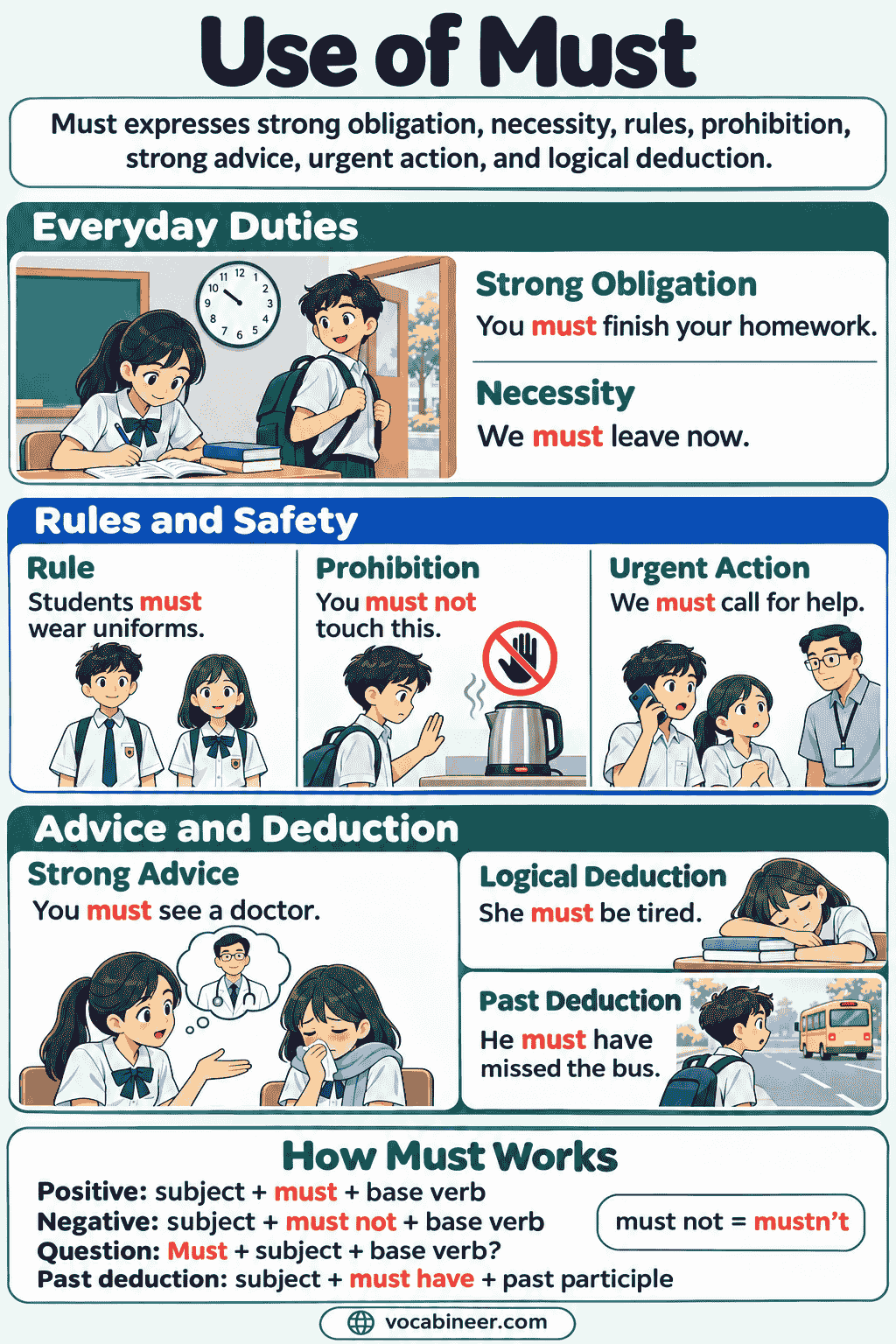
The modal verb must expresses strong obligation, necessity, prohibition, and logical certainty. In sentences such as “You must wear a seat belt” and “She must be at work,” the same word performs two different jobs: the first sentence states a requirement, while the second presents a confident conclusion. Recognizing this difference is essential for using must correctly.
This guide explains the uses of must in affirmative, negative, and interrogative sentences. It also covers time reference, deductions, passive structures, reported speech, pronunciation, common expressions, and comparisons with forms such as have to, should, need to, and can’t.
In This Page
Must at a Glance
Must is a modal auxiliary verb. It comes before the base form of a main verb and does not change according to the subject.
| Use | Meaning | Example |
|---|---|---|
| Obligation | Something is required | You must submit the form today. |
| Necessity | Something is essential | We must find a solution. |
| Prohibition | Something is not allowed | Visitors must not touch the exhibits. |
| Strong deduction | The speaker feels almost certain | They must be at home. |
| Strong advice | The speaker recommends something enthusiastically | You must try this dessert. |
| Insistence or invitation | The speaker strongly encourages someone | You must come and visit us. |
The Two Main Meanings of Must
Most uses of must belong to one of two broad categories:
- Obligation or necessity: The speaker presents an action as required or essential.
- Logical deduction: The speaker reaches a confident conclusion from available evidence.
Compare the meanings below.
| Type | Sentence | Intended meaning |
|---|---|---|
| Obligation | Sam must be in the office by nine. | Sam is required to be there. |
| Deduction | Sam must be in the office; his car is outside. | The evidence makes this conclusion very likely. |
Context usually shows which meaning the speaker intends.
Basic Grammar Rules
The following rules apply whenever must functions as a modal verb:
- Use the base form of the main verb after must: must go, must study, must be.
- Do not add to between must and the main verb.
- Do not add -s when the subject is he, she, or it.
- Form questions by placing must before the subject.
- Form the negative with must not or mustn’t.
- Do not use do, does, or did to form questions or negatives with modal must.
| Correct | Incorrect |
|---|---|
| She must leave now. | She must leaves now. |
| You must be careful. | You must to be careful. |
| Must we wait here? | Do we must wait here? |
| He must not enter. | He does not must enter. |
Sentence Structures with Must
The form of must remains the same with every subject.
Affirmative Sentences
Use subject + must + base verb.
Structure: Subject + must + base form + rest of sentence
| Subject | Example |
|---|---|
| I | I must finish this report. |
| You | You must follow the instructions. |
| He | He must call the manager. |
| She | She must attend the meeting. |
| It | It must remain closed. |
| We | We must act quickly. |
| They | They must show identification. |
Negative Sentences
Use subject + must not + base verb. The contraction is mustn’t.
Structure: Subject + must not/mustn’t + base form + rest of sentence
- You must not park here.
- Employees mustn’t share their passwords.
- We must not ignore the warning.
In rules and instructions, must not usually expresses prohibition rather than a lack of necessity.
Questions with Must
Place must before the subject.
Structure: Must + subject + base form + rest of sentence?
- Must I bring my passport?
- Must we complete every section?
- Must visitors remove their shoes?
Questions with must are grammatically correct, although they can sound formal or express reluctance. In everyday conversation, Do I have to…? is often more natural.
Short Answers
The correct negative answer depends on the intended meaning.
| Question | Short answer | Meaning |
|---|---|---|
| Must I attend? | Yes, you must. | Attendance is required. |
| Must I attend? | No, you don’t have to. | Attendance is optional. |
| May I enter this room? | No, you mustn’t. | Entry is prohibited. |
Avoid answering No, you mustn’t when you merely mean that an action is unnecessary. That answer means the person is forbidden to do it.
Must for Obligation and Necessity
Use must when a duty, rule, or situation makes an action necessary. It often sounds strong and direct.
Personal Obligations
Speakers can use must for obligations they feel or impose themselves.
- I must reply to her email today.
- We must remember to lock the door.
- I must stop staying up so late.
In these examples, the speaker treats the action as personally important or unavoidable.
Rules and Official Requirements
Must frequently appears in regulations, notices, instructions, contracts, and formal policies.
- Passengers must wear seat belts.
- All applications must include two references.
- Candidates must arrive 30 minutes before the examination.
- Protective equipment must be worn inside the laboratory.
Because must sounds authoritative, writers should use it only when a requirement truly exists.
Present and Future Obligations
Although must has no separate tense forms, it can refer to the present or future when the context makes the time clear.
| Time reference | Example |
|---|---|
| Present | You must keep this door closed. |
| Immediate future | We must leave in ten minutes. |
| Specific future time | You must submit the assignment by Friday. |
Therefore, it is incorrect to say that must can refer only to the present. However, other forms are needed in many past, perfect, conditional, and non-finite constructions.
Must Not for Prohibition
Must not and mustn’t tell someone that an action is forbidden or unacceptable.
Formal Rules and Notices
- Visitors must not feed the animals.
- Emergency exits must not be blocked.
- Confidential documents must not leave the building.
The full form must not often appears in formal writing because it gives the prohibition extra emphasis.
Personal Prohibitions
- You mustn’t tell anyone the secret.
- Children must not play near the road.
- We mustn’t make the same mistake again.
Mustn’t vs Don’t Have To
These forms do not have the same meaning.
| Form | Meaning | Example |
|---|---|---|
| mustn’t | The action is prohibited. | You mustn’t use your phone during the test. |
| don’t have to | The action is not necessary, but it is allowed. | You don’t have to bring a calculator; one will be provided. |
| needn’t | The action is unnecessary. | You needn’t wait for me. |
This distinction changes the entire meaning of a sentence. “You mustn’t come early” forbids an early arrival, while “You don’t have to come early” allows it but does not require it.
Expressing Obligation in Different Time Frames
Must is a defective modal, which means it lacks several forms that ordinary verbs have. It has no infinitive, participle, or regular past-tense form. Consequently, English uses forms of have to where must cannot fit grammatically.
Past Obligation with Had To
Use had to + base verb for an obligation that existed in the past.
| Present obligation | Past obligation |
|---|---|
| I must leave now. | I had to leave early yesterday. |
| She must wear a uniform. | She had to wear a uniform at school. |
| We must show identification. | We had to show identification at the entrance. |
Do not use must have + past participle for a completed past obligation. That structure normally expresses a deduction about the past.
Future Obligation with Will Have To
Use will have to when a future situation or circumstance will create an obligation.
- We will have to renew the license next year.
- She will have to take another train tomorrow.
- New employees will have to complete the training.
Both must and will have to can refer to the future. However, must often presents a direct present requirement concerning a future action, while will have to emphasizes a future necessity or circumstance.
Perfect and Conditional Forms
Use a form of have to when the grammar requires a perfect tense or another modal.
| Required form | Example |
|---|---|
| Present perfect | I have had to change my plans. |
| Past perfect | She had had to wait for hours before help arrived. |
| Future perfect | By June, they will have had to complete three assessments. |
| Conditional | We would have to leave early. |
| After another modal | You may have to provide more information. |
Although had had to looks unusual, it is grammatically correct: the first had forms the past perfect, and had to carries the meaning of obligation.
Infinitive and Gerund Forms
Because to must and musting do not exist, use to have to and having to.
- I dislike having to rush.
- She hopes not to have to move again.
- Having to repeat the work was frustrating.
- He seems to have to travel frequently.
Must for Logical Deductions
Must can express a conclusion that the speaker considers strongly supported by evidence. In this use, it does not create an obligation.
Present Deductions
Use must + base verb or must be + complement for a conclusion about the present.
- The lights are on, so someone must be inside.
- You worked all night. You must feel exhausted.
- This must belong to Aisha; her name is on it.
- They must know the answer.
The conclusion is strong, but must does not make it an absolute fact. It shows the speaker’s high level of confidence.
Ongoing Deductions
Use must be + verb-ing for an action that the speaker believes is happening now.
- I can hear music. They must be having a party.
- He is not answering. He must be driving.
- The children are quiet; they must be sleeping.
Past Deductions with Must Have
Use must have + past participle to draw a strong conclusion about a completed past action or situation.
Structure: Subject + must have + past participle
- The ground is wet. It must have rained last night.
- Sana knew the result, so someone must have told her.
- I cannot find my keys. I must have left them at work.
- They arrived very quickly. They must have taken a taxi.
Here, must have does not mean that the past action was required. It means that the speaker believes the action probably occurred.
Ongoing Past Deductions
Use must have been + verb-ing for an activity that was probably in progress in the past.
- He looked tired. He must have been working all night.
- The roads were flooded, so it must have been raining for hours.
- They did not hear the phone. They must have been sleeping.
Use must have been + adjective, noun, or past participle for other past conclusions.
- The journey must have been exhausting.
- That must have been a difficult decision.
- The window must have been broken during the storm.
Negative Deductions with Can’t
In many contexts, use can’t or cannot when evidence makes a positive claim seem impossible.
| Positive deduction | Negative deduction |
|---|---|
| She must be at work; her car is there. | She can’t be at home; her car is at work. |
| They must have received the message. | They can’t have received the message, or they would have replied. |
Must not can sometimes express a deduction about a negative situation, particularly in American English: “He must not know about the change.” However, it can also sound like prohibition. When ambiguity is possible, use a clearer alternative such as “He probably doesn’t know” or restructure the sentence.
Understanding Must Be and Must Have
The meaning of these combinations depends on the words that follow them.
Meanings of Must Be
| Pattern | Use | Example |
|---|---|---|
| must be + place | Deduction about location | She must be at school. |
| must be + adjective | Deduction about a condition | You must be hungry. |
| must be + noun phrase | Deduction about identity | He must be the new teacher. |
| must be + verb-ing | Deduction about an ongoing action | They must be waiting outside. |
| must be + past participle | Obligation in the passive voice | The form must be signed. |
Context distinguishes an obligation from a deduction. “The door must be locked” may mean that someone is required to lock it or that the speaker concludes it is already locked.
Must Have Followed by a Noun
When a noun follows have, the verb have means possess, experience, or contain. The structure does not refer automatically to the past.
- Drivers must have a valid license.
- Every bedroom must have a window.
- Applicants must have relevant experience.
Must Have Followed by a Past Participle
When a past participle follows must have, the structure usually expresses a past deduction.
- She must have forgotten the appointment.
- They must have seen the notice.
- The package must have arrived yesterday.
| Pattern | Meaning | Example |
|---|---|---|
| must have + noun | Required possession or feature | You must have a ticket. |
| must have + past participle | Strong conclusion about the past | You must have bought a ticket online. |
Passive Structures with Must
Use the passive when the action or receiver matters more than the person performing it.
| Time and meaning | Structure | Example |
|---|---|---|
| Present or future obligation | must be + past participle | Applications must be submitted online. |
| Ongoing passive deduction | must be being + past participle | The road must be being repaired. |
| Past passive deduction | must have been + past participle | The documents must have been moved. |
The form must be being + past participle is correct but often sounds heavy. When possible, a clearer sentence may work better: “They must be repairing the road.”
Must for Strong Advice and Recommendations
Speakers also use must to give forceful advice or an enthusiastic recommendation. The tone and context make this use less authoritative than a formal rule.
Urgent Advice
- You must see a doctor if the pain continues.
- We must take this warning seriously.
- You must back up your files regularly.
Because must is strong, should may be more suitable when the advice is helpful but not urgent.
Enthusiastic Recommendations
- You must read this novel.
- Visitors must try the local food.
- You must watch that documentary.
Here, must communicates enthusiasm rather than a literal requirement.
Invitations and Encouragement
- You must come to dinner sometime.
- You must visit us when you are in Lahore.
- We must meet again soon.
Tone matters. A warm tone makes the sentence sound welcoming, while a stern tone can make the same wording sound like an order.
Questions with Must
Questions containing must may request information about an obligation, express reluctance, or criticize repeated behavior.
Must I vs Do I Have To
| Form | Typical tone | Example |
|---|---|---|
| Must I…? | Formal or sometimes reluctant | Must I complete this section? |
| Do I have to…? | Neutral and common in conversation | Do I have to complete this section? |
The two questions often seek the same factual information. Nevertheless, Must I…? can suggest that the speaker hopes the answer is no.
Must You for Criticism
Must you…? often criticizes an annoying action, especially when the speaker views it as unnecessary or repeated.
- Must you tap your pen constantly?
- Must you interrupt every time I speak?
- Why must he complain about everything?
These are not neutral questions about rules. They convey irritation, so learners should use them carefully.
Question Tags with Must
For an obligation expressed with must, the tag commonly repeats the modal.
- We must leave now, mustn’t we?
- You must submit the form, mustn’t you?
With deductive must, speakers often choose a tag that matches the verb and time of the presumed fact.
- She must be tired, isn’t she?
- They must have left, haven’t they?
Usage varies, especially in informal speech, but matching the underlying claim usually sounds natural.
Common Expressions with Must
Several fixed or semi-fixed expressions use must to manage tone and conversation.
I Must Admit
Use I must admit before acknowledging something, often reluctantly.
- I must admit, your plan worked well.
- I must admit, I was surprised by the result.
I Must Say
Use I must say to emphasize an opinion or reaction.
- I must say, the service was excellent.
- I must say, that decision seems unfair.
I Must Confess
Use I must confess to introduce a personal admission. It is often more formal or dramatic than I must admit.
- I must confess, I had forgotten her name.
- I must confess, I enjoyed the film more than I expected.
I Really Must Go
I really must go is a polite way to announce that it is time to leave.
- It is getting late, so I really must go.
- Thank you for dinner, but we must be going.
The progressive expression must be going is idiomatic here and refers to the need to leave soon.
If You Must
If you must gives reluctant permission or accepts that another person insists on doing something.
- “Can I tell them?” “If you must.”
- Take the car if you must, but drive carefully.
The expression can sound unenthusiastic or disapproving.
Must in Reported Speech
The treatment of must in reported speech depends on its meaning and whether the requirement remains valid.
Reported Obligations
Must often changes to had to when reporting a past obligation.
| Direct speech | Reported speech |
|---|---|
| She said, “I must leave.” | She said that she had to leave. |
| He said, “We must pay today.” | He said that they had to pay that day. |
Rules That Remain Valid
Writers can retain must when reporting a rule or requirement that is still in force.
- The notice says that visitors must show identification.
- The guide explained that passengers must remain seated during takeoff.
Depending on the viewpoint and context, had to may also be possible in a past report.
Reported Deductions
Deductive must commonly remains unchanged because it expresses the original speaker’s conclusion.
- Lina said, “He must be tired.”
Lina said that he must be tired. - Omar said, “They must have missed the bus.”
Omar said that they must have missed the bus.
Must Compared with Related Forms
Related modals and semi-modals differ in strength, tone, grammar, or time reference. These contrasts are tendencies rather than rigid rules because real usage depends heavily on context.
Must vs Have To
| Feature | Must | Have to |
|---|---|---|
| Basic meaning | Strong obligation or necessity | Obligation or necessity |
| Common source | Often presents the requirement directly | Often highlights rules or circumstances |
| Past form | Usually replaced by had to | Had to |
| Future form | Can refer to the future | Will have to is widely used |
| Questions | Must I…? sounds formal or reluctant | Do I have to…? is common and neutral |
| Negative | Mustn’t means prohibited | Don’t have to means unnecessary |
The traditional internal-versus-external distinction is useful but not absolute. Speakers often choose between these forms according to tone, dialect, emphasis, and sentence structure.
Must vs Should
| Must | Should |
|---|---|
| Expresses a requirement or very strong advice | Expresses advice, expectation, or a milder duty |
| You must wear a helmet; it is the law. | You should wear a hat in the sun. |
| We must act immediately. | We should consider the options first. |
Must vs Need To
| Must | Need to |
|---|---|
| Strong and often authoritative | More neutral and practical |
| Common in formal instructions | Common in everyday explanations |
| You must submit the original document. | You need to charge the battery. |
Both forms can express necessity, and their meanings often overlap.
Must vs Have Got To
| Must | Have got to |
|---|---|
| Suitable for formal and informal contexts | Mainly informal, especially in speech |
| Common in written rules | Common for immediate personal necessity |
| You must remain seated. | I’ve got to leave now. |
In very informal speech, have got to may be pronounced like gotta, but that spelling is unsuitable for formal writing.
Must vs Will
Must expresses necessity or a deduction, whereas will commonly expresses futurity, willingness, or a confident prediction.
| Sentence | Meaning |
|---|---|
| You must call tomorrow. | Calling is necessary. |
| You will call tomorrow. | The speaker predicts or states that the call will happen. |
| He must be at work. | Evidence supports the conclusion. |
| He will be at work tomorrow. | This is a future prediction or arrangement. |
Must vs May, Might, and Could
| Modal | Degree of confidence | Example |
|---|---|---|
| must | Strong conclusion | She must be busy. |
| may | Real possibility | She may be busy. |
| might | More tentative possibility | She might be busy. |
| could | One possible explanation | She could be busy. |
Avoid attaching a fixed mathematical percentage to each modal. Their strength changes with context, intonation, and the evidence available.
Must vs Can’t
| Form | Function | Example |
|---|---|---|
| must | Strong positive deduction | This must be the correct address. |
| can’t/cannot | Strong negative deduction | This can’t be the correct address. |
Must Have vs Had To
| Form | Meaning | Example |
|---|---|---|
| must have + past participle | Deduction about the past | She must have left early. |
| had to + base verb | Past obligation | She had to leave early. |
This is one of the most important distinctions in the topic. The first sentence presents a conclusion; the second reports a requirement.
Must Have vs May Have
| Form | Confidence | Example |
|---|---|---|
| must have + past participle | Strong conclusion | He must have forgotten. |
| may have + past participle | Possibility | He may have forgotten. |
| might have + past participle | Tentative possibility | He might have forgotten. |
Pronunciation of Must
In careful pronunciation, must is commonly /mʌst/. However, natural connected speech can change the final consonants.
Strong and Reduced Forms
Speakers usually pronounce must clearly when they emphasize an obligation or contrast.
- You must call me.
- I said you must, not that you should.
Before another consonant, the final /t/ may be very light or unreleased in fluent speech. Learners should still recognize and preserve the word’s grammatical function even when every sound is not strongly audible.
Pronunciation of Mustn’t
Mustn’t is commonly pronounced /ˈmʌsənt/ or /ˈmʌstənt/, depending on accent and speaking style. Because the negative ending may be difficult to hear, speakers should pronounce it clearly when misunderstanding could affect safety or permission.
Common Mistakes with Must
Using To After Must
Use a bare infinitive, not to + verb.
| Incorrect | Correct |
|---|---|
| You must to leave. | You must leave. |
| We must to be careful. | We must be careful. |
Adding S to the Main Verb
The main verb stays in its base form even with a third-person singular subject.
| Incorrect | Correct |
|---|---|
| She must works today. | She must work today. |
| He must arrives early. | He must arrive early. |
Using Do, Does, or Did with Must
Modal must forms its own questions and negatives.
| Incorrect | Correct |
|---|---|
| Do I must wait? | Must I wait? |
| She doesn’t must go. | She must not go. |
Combining Must with Another Modal
Two central modal verbs do not normally appear together in standard English.
| Incorrect | Correct |
|---|---|
| You may must wait. | You may have to wait. |
| We will must leave. | We will have to leave. |
Using Must for Past Obligation
Use had to for a completed obligation in the past.
| Incorrect | Correct |
|---|---|
| Yesterday, I must work late. | Yesterday, I had to work late. |
Confusing Must Have with Had To
Use must have + past participle for deduction and had to + base verb for obligation.
| Meaning | Correct sentence |
|---|---|
| Past deduction | They must have waited for hours. |
| Past obligation | They had to wait for hours. |
Confusing Mustn’t with Don’t Have To
| Intended meaning | Correct form |
|---|---|
| The action is forbidden. | You mustn’t enter. |
| The action is optional. | You don’t have to enter. |
Using Mustn’t for a Negative Deduction
When ruling out a possibility, can’t is usually clearer than mustn’t.
| Unclear or unintended | Clear |
|---|---|
| He mustn’t be the owner. | He can’t be the owner. |
Misunderstanding Must Be and Must Have
Always check what follows the structure and what the context suggests.
- The report must be completed today. — obligation in the passive voice
- The report must be complete already. — present deduction
- You must have a permit. — required possession
- You must have obtained a permit. — past deduction
Using Must for a Neutral Prediction
Use will when you simply predict a future event without expressing necessity or evidence-based deduction.
| Intended meaning | Natural choice |
|---|---|
| Neutral prediction | It will rain tomorrow. |
| Strong conclusion from present evidence | Look at those clouds. It must be going to rain. |
Treating Must and Have To as Completely Different
These forms frequently overlap. The idea that must is always internal and have to is always external is too rigid. Instead, consider the speaker’s tone, the source of the obligation, the time reference, and the grammar of the sentence.
Assigning Must a Fixed Certainty Percentage
Must expresses a strong conclusion, but grammar does not assign it an exact certainty score. Evidence, context, and intonation determine how confident the statement sounds.
Choosing the Correct Form
Use this practical guide when deciding whether must or a related form fits the sentence.
| Intended meaning | Recommended form | Example |
|---|---|---|
| Strong present requirement | must | You must sign here. |
| Prohibition | mustn’t | You mustn’t smoke here. |
| No obligation | don’t have to / needn’t | You don’t have to stay. |
| Past obligation | had to | We had to cancel. |
| Future circumstance | will have to | I will have to call later. |
| Strong present deduction | must | She must know. |
| Strong past deduction | must have + past participle | She must have known. |
| Strong negative deduction | can’t / cannot | She can’t know the answer yet. |
| Advice | should | You should rest. |
| Possibility | may, might, or could | He might be late. |
| Obligation after another modal | have to | We may have to wait. |
Before choosing must, ask whether the sentence expresses a requirement or a conclusion. Next, check the time reference. Finally, decide whether the tone should be strong, neutral, formal, enthusiastic, or tentative.
FAQs
Must mainly expresses a strong obligation, necessity, prohibition, or logical deduction. Its exact meaning depends on the sentence and context.
Use the base form of the verb without to, as in must leave, must study, and must be. The form remains the same with every subject.
Mustn’t means that an action is prohibited. Don’t have to means that an action is optional or unnecessary.
Use had to for a past obligation. However, use must have + past participle for a strong deduction about a past event, as in “She must have forgotten.”
Both can express obligation. Must often sounds stronger or more direct, while have to is common for practical requirements and works in more grammatical forms. Nevertheless, their meanings overlap in many contexts.
Final Summary
Must is a powerful modal verb that expresses obligation, necessity, prohibition, strong advice, and confident deduction. It takes the base form of a verb, remains unchanged with every subject, and forms questions without do. Use mustn’t for prohibition, but use don’t have to or needn’t when something is unnecessary.
Because must lacks past, infinitive, participle, and combined-modal forms, English often replaces it with have to. Use had to for past obligation, will have to for many future necessities, and must have + past participle for deductions about the past. By separating obligation from deduction and choosing the right form for the time and tone, you can use must accurately and naturally.
Read More
- Verbs in English
- Action Verbs
- Regular Verbs
- Irregular Verbs
- Transitive and Intransitive verbs
- Finite and Non-finite verbs
- Principal Parts of Verbs
- Forms of Verbs