

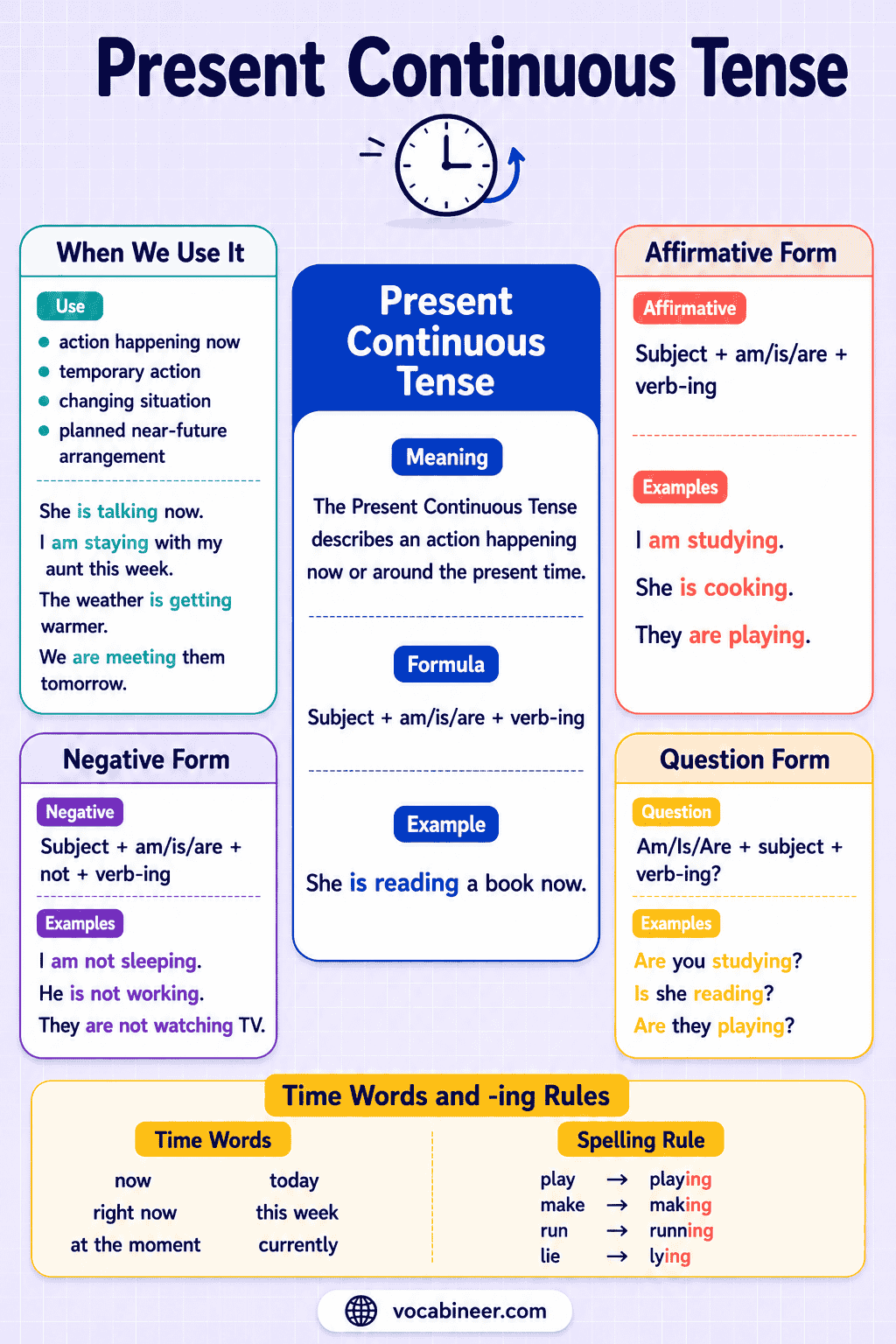
The Present Continuous Tense marks activity in progress, temporary situations, developing conditions, temporary repeated behavior, and organized future arrangements. Its structure requires a present form of be—am, is, or are—followed by the -ing form of the main verb.
Present Continuous is also called Present Progressive. A complete understanding of this tense requires its uses, sentence structures, subject agreement, contractions, -ing spelling rules, stative-verb restrictions, future-reference use, comparisons with related tense forms, and common errors.
In This Page
What Is the Present Continuous Tense?
The Present Continuous Tense is formed with am, is, or are plus a main verb in -ing form.
Basic structure:
S + am/is/are + V-ing
Examples:
- I am reading.
- She is studying.
- He is working.
- We are waiting.
- They are playing.
Every Present Continuous construction requires two grammatical elements:
- a present form of be
- a main verb in -ing form
Therefore:
She is working now.
is complete, while:
She working now.
is not a complete Present Continuous construction.
The grammatical meaning depends on context. The same structure can mark current activity, temporary situations, developing conditions, temporary habits, or arranged future events.
Present Continuous and Present Progressive
Present Continuous and Present Progressive are two names for the same grammatical construction.
For example:
The children are playing outside.
The verb phrase are playing can be identified as Present Continuous or Present Progressive.
This article uses Present Continuous consistently.
When to Use the Present Continuous
Present Continuous has several related uses. Each use contains progressive meaning, but the relevant time and context can differ.
Actions Happening Now
Present Continuous commonly marks activity in progress at or around the present reference time.
Examples:
- Emma is talking on the phone.
- I am writing an email.
- The children are playing outside.
- The dog is sleeping under the table.
- Dad is making dinner.
These sentences mark activities that are in progress in the present context.
Activities Around the Present
An activity does not need to occur at the exact moment of speaking. Present Continuous can also mark an activity occurring during the current period.
Examples:
- I am reading a new novel this week.
- She is taking an online course this month.
- We are working on a new project.
- He is learning Spanish these days.
The activities belong to the current period even if they are not occurring at the exact second when the sentences are spoken.
Temporary Situations
Present Continuous marks situations limited to a temporary period.
Examples:
- I am staying with my sister this week.
- He is working in a café for the summer.
- They are living with relatives while their house is being renovated.
- Maya is using her brother’s car this month.
Compare:
She lives in Lahore.
Simple Present marks a general or relatively stable situation.
She is living in Lahore for a few months.
Present Continuous marks a temporary situation.
Changing or Developing Situations
Present Continuous can mark a change or development in progress.
Examples:
- The weather is getting warmer.
- Prices are rising.
- Your English is improving.
- The city is growing rapidly.
- More people are working remotely.
- The days are becoming shorter.
Each example contains a condition that is changing rather than remaining stable.
Temporary or New Habits
Present Continuous can mark repeated behavior that belongs to a limited period.
Compare:
He walks to work every day.
Simple Present marks an established habit.
He is walking to work this month.
Present Continuous marks a temporary repeated pattern.
More examples:
- She is exercising every morning this week.
- We are eating at home more often these days.
- Daniel is taking the bus while his car is being repaired.
Repeated Behavior with Always or Constantly
Present Continuous can combine with always, constantly, continually, or similar expressions when repeated behavior also carries an evaluative meaning.
Examples:
- He is always interrupting me.
- You are constantly losing your keys.
- They are always changing their plans.
- She is continually complaining about the weather.
This construction commonly marks repeated behavior together with irritation, criticism, surprise, or another strong evaluation.
How to Form the Present Continuous
Present Continuous requires am, is, or are plus a main verb in -ing form.
Am, Is, and Are
The subject determines the form of be.
| Subject | Form of Be |
|---|---|
| I | am |
| he / she / it | is |
| singular noun | is |
| you / we / they | are |
| plural noun | are |
Examples:
- I am studying.
- She is studying.
- My brother is studying.
- We are studying.
- The students are studying.
Affirmative Sentences
The affirmative structure is:
S + am/is/are + V-ing
Examples:
- I am reading a book.
- She is preparing dinner.
- He is talking to his teacher.
- We are waiting for the bus.
- They are playing soccer.
The auxiliary be is required.
Incorrect:
She working now.
Correct:
She is working now.
Negative Sentences
The negative structure is:
S + am/is/are + not + V-ing
Examples:
- I am not sleeping.
- She is not working today.
- He is not watching television.
- We are not waiting outside.
- They are not coming tonight.
Common contractions include:
- is not → isn’t
- are not → aren’t
Examples:
She isn’t working today.
They aren’t waiting outside.
The form amn’t is not standard in ordinary modern English. Instead, use:
I am not working.
Yes/No Questions
The question structure is:
Am/Is/Are + S + V-ing?
Examples:
- Are you working?
- Is she coming?
- Is he sleeping?
- Are they waiting outside?
- Am I speaking too quickly?
Present Continuous questions require the auxiliary before the subject.
Incorrect:
She is working?
Correct:
Is she working?
Short Answers
Short answers repeat the correct form of be.
Are you working?
Yes, I am. / No, I’m not.
Is she studying?
Yes, she is. / No, she isn’t.
Are they coming?
Yes, they are. / No, they aren’t.
The main verb does not need to be repeated in a short answer.
Wh-Questions
Wh-questions normally use:
Wh-word + am/is/are + S + V-ing?
Examples:
- What are you doing?
- Where is she going?
- Why are they laughing?
- Who is he talking to?
- What are the children watching?
The auxiliary be remains necessary.
Incorrect:
What you doing?
Correct:
What are you doing?
Present Continuous Contractions
Contractions occur frequently in everyday speech and informal writing.
Affirmative Contractions
- I am → I’m
- he is → he’s
- she is → she’s
- it is → it’s
- we are → we’re
- you are → you’re
- they are → they’re
Examples:
- I’m working today.
- She’s studying now.
- They’re waiting outside.
Negative Contractions
- is not → isn’t
- are not → aren’t
Examples:
- He isn’t sleeping.
- We aren’t leaving yet.
Contractions change pronunciation and style, but they do not change the tense structure or meaning.
Verb + -ing Spelling Rules
The main verb takes an -ing form, and some verbs require spelling changes before the ending is added.
Add -ing to Most Verbs
Most verbs take -ing directly.
- work → working
- read → reading
- play → playing
- speak → speaking
- clean → cleaning
- help → helping
Examples:
She is working.
They are playing.
Drop Final Silent e
Many verbs ending in silent e drop the e before -ing.
- make → making
- write → writing
- come → coming
- take → taking
- drive → driving
- use → using
Examples:
She is making dinner.
He is writing a letter.
Some verbs retain e because removing it would change the spelling pattern or pronunciation, so the rule should not be applied mechanically to every final e.
Double the Final Consonant Where Required
Some verbs double the final consonant before -ing, especially when the final syllable is stressed and has the relevant short vowel + consonant pattern.
- run → running
- sit → sitting
- swim → swimming
- stop → stopping
- begin → beginning
Examples:
He is running in the park.
We are sitting near the window.
Consonant doubling depends on spelling and stress patterns, so it does not apply to every verb ending in a consonant.
Change -ie to y
Verbs ending in -ie normally change ie to y before -ing.
- lie → lying
- die → dying
- tie → tying
Examples:
The cat is lying on the sofa.
She is tying her shoes.
Time Expressions with the Present Continuous
Certain expressions commonly occur with Present Continuous because they establish a current, temporary, developing, or future-arrangement context.
Common examples include:
- now
- right now
- at the moment
- currently
- today
- this week
- this month
- these days
- tonight
- tomorrow
Examples:
- She is studying right now.
- I am working from home this week.
- Prices are increasing these days.
- We are meeting them tomorrow.
These expressions do not determine the tense automatically. The grammatical meaning and context determine whether Present Continuous fits the sentence.
Present Continuous and Stative Verbs
Many stative verbs normally do not occur in Present Continuous when they express states rather than activities.
Common stative meanings include:
- knowledge
- belief
- possession
- preference
- need
- emotion
- perception
- relationship
Common verbs include:
- know
- believe
- understand
- own
- need
- want
- prefer
- belong
- like
- love
- remember
Examples:
I know the answer.
She owns that house.
We need more time.
They belong to the same club.
These ordinary stative meanings normally occur in Simple Present rather than Present Continuous.
Incorrect in the ordinary state meaning:
I am knowing the answer.
Correct:
I know the answer.
Verbs That Change Meaning
Some verbs can occur in both simple and continuous forms when their meaning changes.
Compare:
I think she is right.
Here, think expresses an opinion.
I am thinking about the problem.
Here, think refers to an ongoing mental activity.
Another example:
I have a car.
Here, have marks possession.
We are having dinner.
Here, have refers to an activity.
Compare:
The soup tastes good.
The verb expresses a state or perception.
The chef is tasting the soup.
The verb marks an activity.
Therefore, the grammatical behavior depends on the meaning of the verb in the sentence, not only on the verb itself.
Be in Continuous Form
The verb be can occur in a continuous construction when it marks temporary behavior.
Compare:
He is rude.
Simple Present marks a general characteristic.
He is being rude.
Present Continuous marks temporary behavior in the current situation.
Another example:
She is patient.
This can describe a general characteristic.
She is being patient with the children today.
This marks temporary behavior in the stated situation.
Present Continuous vs Simple Present
Present Continuous and Simple Present can both refer to situations connected with the present, but their grammatical meanings differ.
| Simple Present | Present Continuous |
|---|---|
| general or regular situation | ongoing or temporary situation |
| She works here. | She is working here this week. |
| He lives in London. | He is living in London for a few months. |
| They play tennis every Saturday. | They are playing more tennis this summer. |
| Prices usually stay stable. | Prices are rising this month. |
General vs Temporary Situations
I work from home.
Simple Present marks a general or regular situation.
I am working from home this week.
Present Continuous marks a temporary situation.
Established vs Temporary Habits
She takes the train to work.
Simple Present marks an established routine.
She is taking the bus this week.
Present Continuous marks temporary repeated behavior.
Stable vs Developing Situations
The town has a population of 20,000.
This marks a current state.
The town is growing rapidly.
Present Continuous marks development in progress.
Time expressions can indicate the relevant context, but grammatical meaning determines whether Simple Present or Present Continuous fits the sentence.
Present Continuous vs Present Perfect Continuous
These two forms both contain progressive marking, but they establish different time relationships.
Compare:
I am working on the report.
Present Continuous marks activity in progress around the present.
I have been working on the report since 9 a.m.
Present Perfect Continuous relates earlier ongoing activity or duration to the present.
Another contrast:
She is studying now.
The sentence marks current activity.
She has been studying for three hours.
The sentence marks an activity that began earlier and includes duration up to the present.
A starting point or duration often makes the distinction clearer, but context remains necessary.
Present Continuous for Future Arrangements
Present Continuous can mark future reference when an arrangement has already been organized.
Examples:
- We are meeting Sarah tonight.
- I am seeing the dentist tomorrow.
- They are flying to Dubai on Friday.
- My parents are visiting us this weekend.
- The manager is meeting the new staff at ten tomorrow.
The verb phrase remains Present Continuous, while the context establishes future time.
Arranged future events commonly include a specific:
- time
- date
- place
- person
- appointment
- organized plan
Compare:
I am going to study tonight.
This commonly marks an intention or plan.
I am meeting my tutor at seven.
This marks an arranged event with a specific time.
Present Continuous commonly marks future arrangements that have already been organized.
Present Continuous Sentence Examples
The following examples show the tense across several common contexts.
Current Activity
- I am answering an email.
- She is washing the dishes.
- They are talking outside.
Temporary Situation
- We are staying at a hotel this week.
- He is using my laptop today.
- I am working in another office this month.
Developing Situation
- The temperature is falling.
- Technology is changing rapidly.
- Her condition is improving.
Temporary Habit
- He is drinking less coffee these days.
- We are walking more this month.
Future Arrangement
- I am having lunch with Anna tomorrow.
- They are arriving on Friday.
- She is meeting her manager at three.
Negative Examples
- I am not going out tonight.
- She isn’t sleeping.
- They aren’t attending the meeting.
Question Examples
- Are you coming with us?
- Is he working today?
- What are they doing?
Common Present Continuous Mistakes
Present Continuous mistakes commonly involve the auxiliary be, the -ing form, subject agreement, question order, spelling, or stative meaning.
Missing the auxiliary be
Incorrect:
She working now.
Correct:
She is working now.
Present Continuous requires am/is/are + V-ing.
Using the wrong form of be
Incorrect:
They is playing outside.
Correct:
They are playing outside.
Use are with you, we, and they.
Using V1 instead of V-ing
Incorrect:
He is work today.
Correct:
He is working today.
The main verb requires the -ing form.
Using V-ing without be
Incorrect:
We waiting for the bus.
Correct:
We are waiting for the bus.
Both parts of the Present Continuous structure are required.
Using incorrect question order
Incorrect:
She is working?
Correct:
Is she working?
Questions require the auxiliary before the subject.
Using incorrect -ing spelling
Incorrect:
She is makeing dinner.
Correct:
She is making dinner.
Many verbs ending in silent e drop the e before -ing.
Using the wrong subject agreement
Incorrect:
I is working today.
Correct:
I am working today.
Use am only with I.
Using an ordinary stative meaning in Present Continuous
Incorrect:
I am knowing the answer.
Correct:
I know the answer.
The ordinary stative meaning of know normally occurs in Simple Present.
Omitting be in Wh-questions
Incorrect:
What you doing?
Correct:
What are you doing?
The auxiliary remains necessary in Wh-questions.
FAQs
Present Continuous is an English tense form built with am/is/are + V-ing. It commonly marks current activity, temporary situations, developing conditions, temporary repeated behavior, and organized future arrangements.
Yes. Present Progressive and Present Continuous are two names for the same grammatical construction.
Use am with I, is with he, she, and it, and are with you, we, and they. These forms of be combine with a main verb in -ing form.
Most verbs take -ing directly. Many verbs ending in silent e drop the e, some verbs double a final consonant according to spelling and stress patterns, and verbs ending in -ie change ie to y before -ing.
Simple Present commonly marks general, regular, or stative situations, while Present Continuous commonly marks ongoing, temporary, or developing activity. Compare She works here with She is working here this week.
Read More
- 12 English Tenses Chart
- All Tenses Rules and Formula
- English Tenses with Examples
- Indefinite Tense (Simple Tense)