

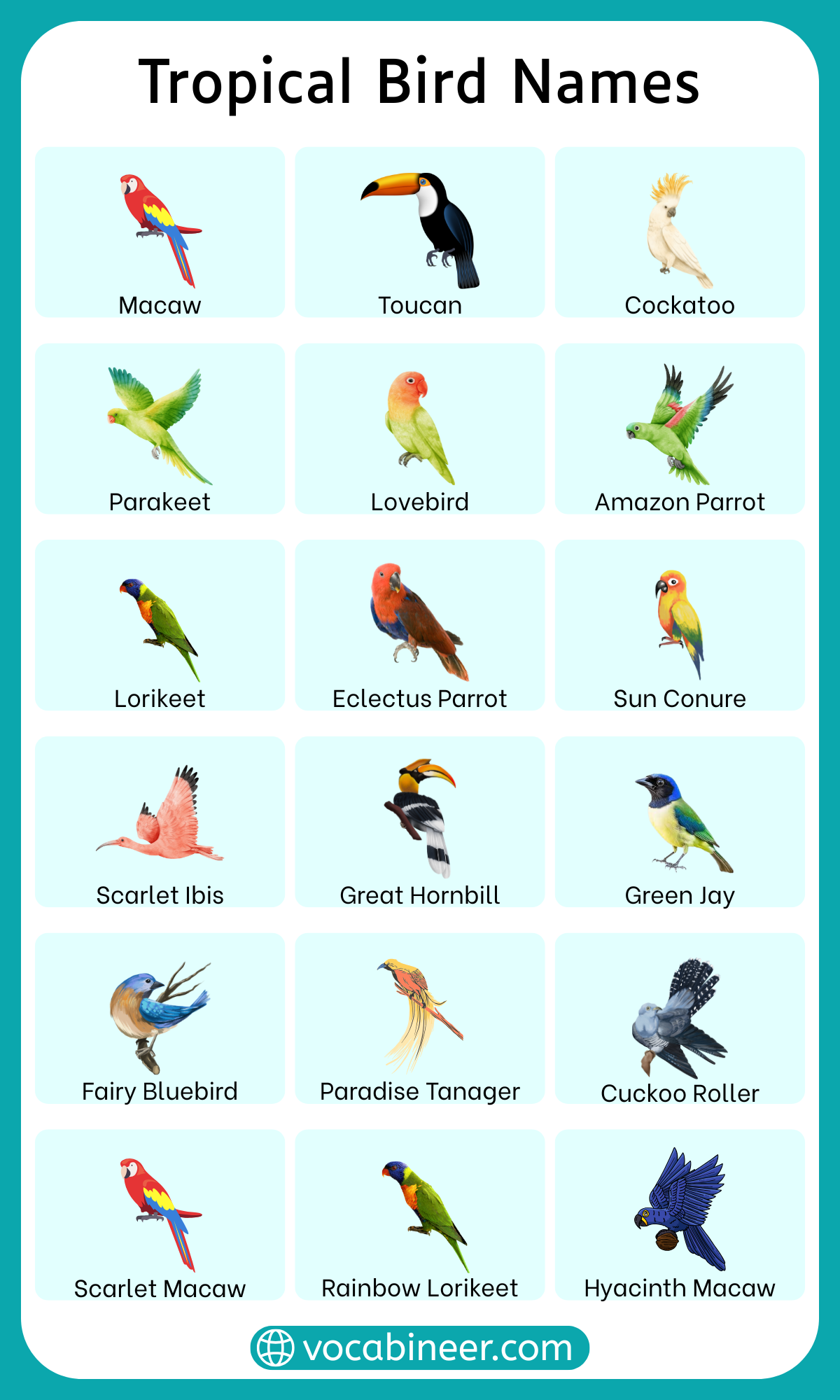
Tropical bird names help learners identify colorful and unusual birds found in warm regions around the world. Many tropical species stand out because of their bright feathers, distinctive beaks, striking calls, or interesting habits.
This guide groups tropical birds by common species, rarer examples, and habitat so readers can learn each name more easily with pictures. It also builds a useful tropical bird names list for wildlife vocabulary, classroom learning, travel, and nature discussions.
In This Page
Common Tropical Bird Names with Pictures
Tropical regions are home to many colorful and fascinating birds, including parrots, toucans, hummingbirds, hornbills, and birds-of-paradise. These birds live in warm forests, wetlands, grasslands, and coastal habitats, where they find food and shelter throughout the year.
Macaw
Macaws are large, colorful parrots found mainly in tropical forests of Central and South America. Their strong curved beaks help them crack nuts and seeds.
Toucan
Toucans are known for their large, colorful bills and bright bodies. They commonly live in tropical forests and feed on fruits, insects, and small animals.
Parrot
Tropical parrots include many species with colorful feathers and strong curved beaks. They often eat fruits, seeds, nuts, and other plant foods.
Hummingbird
Hummingbirds are tiny birds that can hover while feeding on flower nectar. Many species live in tropical regions of the Americas.
Kingfisher
Kingfishers are recognized for their pointed bills and often bright plumage. Tropical species may live near rivers, lakes, forests, and coastal areas.
Hornbill
Hornbills have large curved bills, and many species have a noticeable structure called a casque above the bill. They are common in tropical forests across Africa and Asia.
Bird-of-Paradise
Birds-of-paradise are famous for their elaborate feathers and courtship displays. Most species live in tropical forests of New Guinea and nearby regions.
Turaco
Turacos are colorful tropical birds found mainly in sub-Saharan Africa. Many species have distinctive crests and bright green, red, or purple feathers.
Motmot
Motmots are tropical birds found mainly in Central and South America. Several species have long tails with distinctive racket-shaped tips.
Quetzal
Quetzals are striking forest birds with colorful feathers and long tails. They are associated with tropical and cloud forests of Central America.
Sunbird
Sunbirds are small nectar-feeding birds found mainly in tropical Africa and Asia. Their slender, curved bills help them reach nectar in flowers.
Bee-Eater
Bee-eaters have slim bodies, pointed bills, and vivid plumage. They catch flying insects, including bees, while in flight.
Lorikeet
Lorikeets are small to medium-sized parrots with colorful feathers and brush-tipped tongues. They commonly feed on nectar, pollen, fruits, and flowers.
Cockatoo
Cockatoos are parrots with strong bills and distinctive movable crests. Several species inhabit tropical and subtropical forests and woodlands of Australia and nearby islands.
Puffbird
Puffbirds are tropical forest birds found mainly in Central and South America. Their broad heads and short bills give them a distinctive appearance.
Trogon
Trogons are colorful forest birds with compact bodies and long tails. They occur in tropical forests across the Americas, Africa, and Asia.
Flamingo
Flamingos are long-legged birds known for their pink or reddish plumage and curved bills. They live around tropical and subtropical lakes, lagoons, and coastal wetlands.
Scarlet Ibis
The scarlet ibis is a bright red wading bird found in tropical parts of South America and the Caribbean. It uses its long curved bill to search for food in shallow water.
Crowned Crane
Crowned cranes are tall African birds with long legs and a distinctive golden feather crown. They inhabit tropical and subtropical grasslands and wetlands.
Weaver Bird
Weaver birds are known for constructing intricate nests from grass and other plant fibers. Many species live in tropical and subtropical regions of Africa and Asia.
Colorful Tropical Birds
These species are known for striking feather colors. Their names are often remembered easily because of their unique looks.
- Scarlet Ibis: Vivid red plumage and a curved bill, common in wetlands.
- Rainbow Lorikeet: Multicolored feathers with green, blue, orange, and yellow.
- Toco Toucan: Largest toucan, orange bill with black body and white throat.
- Gouldian Finch: Tiny bird with purple chest, green back, and colorful head.
- Keel-billed Toucan: Famous for a rainbow-colored beak that looks almost painted.
- Paradise Tanager: Small Amazon bird with bright green head and blue belly.
Tropical Parrots and Parakeets
Parrots are the largest group of tropical birds. They are intelligent, social, and popular as pets.
- African Grey Parrot: Grey feathers, red tail, famous for learning many words.
- Blue-and-Yellow Macaw: Large parrot with blue wings and a golden chest.
- Eclectus Parrot: Males are green, females are red and purple.
- Sun Conure: Small parrot with glowing orange and yellow feathers.
- Cockatoo: White or black parrots with feather crests; the sulphur-crested cockatoo is well known.
- Lovebird: Tiny, colorful parrot often seen in pairs, very social.
Wetland Tropical Birds
Wetlands are home to some of the tallest and most elegant tropical birds.
- Flamingo: Pink feathers, filter-feeding bill, often in large groups.
- Roseate Spoonbill: Pink body and spoon-shaped bill for sweeping water.
- Jacana: Long toes let it walk across lily pads.
- Purple Gallinule: Purple-blue body with red and yellow bill.
- Anhinga: Called the snakebird, long neck and sharp bill, swims with body underwater.
- Heron: Tall, slender waders with long legs and pointed bills, many tropical species exist.
Rainforest Tropical Birds
Rainforests shelter some of the most colorful and unique tropical bird names.
- Toucan: Bright beak, loud call, and tree-dwelling habits.
- Harpy Eagle: Giant eagle with feather crown, among the strongest tropical raptors.
- Resplendent Quetzal: Green and red with long tail feathers, sacred in Central America.
- Hornbill: Large curved beak with casque, found in Asia and Africa.
- Blue-crowned Motmot: Bright blue crown and racket-shaped tail feathers.
- Leafbird: Small green bird, blends into leaves, native to Southeast Asia.
Nocturnal Tropical Birds
These birds are mostly active at night. Their names are unique and worth remembering.
- Potoo: Camouflaged, wide-mouthed bird that perches like tree bark.
- Nightjar: Mottled brown feathers, hunts insects at dusk.
- Tropical Owl Species: Barn owls and screech owls live in forests and farms.
- Oilbird: Nocturnal fruit eater from South America, uses sound to navigate in caves.
Regional Tropical Bird Names
South and Central American Birds
This region has some of the most famous tropical bird species.
- Scarlet Macaw: Large, brightly colored parrot common in Central America.
- Toco Toucan: Huge orange beak, iconic of the tropics.
- Hoatzin: Brown bird with spiky crest, feeds on leaves.
- Paradise Tanager: Small, glowing multicolored rainforest bird.
Southeast Asian Birds
Asian forests hold many tropical bird names that are vibrant and striking.
- Hornbill: Known for its casque and strong bill.
- Sunbird: Tiny nectar feeders with shiny feathers.
- Leafbird: Bright green, blends with leaves in canopy.
- Kingfisher: Blue-green plumage, dives for fish.
African Tropical Birds
Africa’s tropics include parrots, fruit-eaters, and striking ground birds.
- Turaco: Green plumage with red wings, unique pigments.
- Grey Parrot: Intelligent, social bird native to African forests.
- Weaver Bird: Builds woven grass nests in colonies.
- Secretary Bird: Tall bird of savannahs with long legs and a hooked beak.
Caribbean Tropical Birds
Island tropics add more bird names to learn.
- Scarlet Ibis: National bird of Trinidad, bright red plumage.
- Bananaquit: Small yellow-breasted bird common in gardens.
- Flamingo: Iconic pink bird found in Caribbean lagoons.
- Pacific Tropical Birds
Pacific islands also have unique tropical bird names.
- Kagu: Endangered grey bird from New Caledonia.
- Palm Cockatoo: Large black cockatoo with red cheek patches.
- Fruit Dove: Small, brightly colored doves found across Pacific islands.
Rare Tropical Birds
These species are lesser known but complete the list of tropical bird names.
- Hoatzin: Amazonian bird with a spiky crest, unusual digestive system.
- Motmot: Colorful bird with a long tail that ends in rackets.
- Turaco: African fruit eater with green and red feathers.
- Kingfisher: Dives for fish with sharp bill, many species are tropical.
- Oilbird: Nocturnal fruit eater, uses echolocation in caves.
- Palm Cockatoo: Striking parrot with red cheeks, found in Papua New Guinea.
How to Identify Tropical Birds by Appearance
Tropical birds can be identified by color, beak size, and flight style. Parrots often have curved beaks and bright feathers. Toucans show oversized colorful bills. Flamingos stand on long pink legs. Camouflage is common in night birds like the potoo or nightjar, while rainforest birds like the quetzal have brilliant shimmering colors.
Frequently Asked Questions
Tropical birds are species that live mainly in warm regions near the equator, including rainforests, islands, wetlands, and coastal areas.
Common examples include toucans, macaws, parrots, hornbills, lorikeets, cockatoos, hummingbirds, and birds-of-paradise.
Macaws, lorikeets, toucans, hummingbirds, and many birds-of-paradise are well known for vivid feathers and striking color patterns.
Many live in rainforests, tropical forests, mangroves, wetlands, islands, and other warm habitats with plenty of food and shelter.
They help learners build wildlife vocabulary, identify birds in pictures or nature, and talk more confidently about travel, habitats, and animals.
Read More