“Very” is one of the most common words in English, and it is useful in many simple sentences. However, when you use it too often, your writing can sound weak, plain, or repetitive. Instead of writing very good, very bad, or very tired, you can often choose one stronger word that gives the same meaning more clearly.
This guide gives you 500 words to use instead of very in English. The words are divided into easy categories, so English learners, students, writers, and general readers can quickly find the right replacement. As a result, you can improve your vocabulary, write stronger sentences, and make your English sound more natural and expressive.
In This Page
What Does “Very” Mean?
Very means “to a high degree” or “more than usual.” It makes an adjective stronger.
For example, very cold means “extremely cold,” and very happy means “extremely happy.” However, English often has a stronger single word that sounds cleaner and more natural.
Common Words to Use Instead of Very
These common replacements are useful in daily English, school writing, and simple conversations.
| Very Phrase | Better Word |
|---|---|
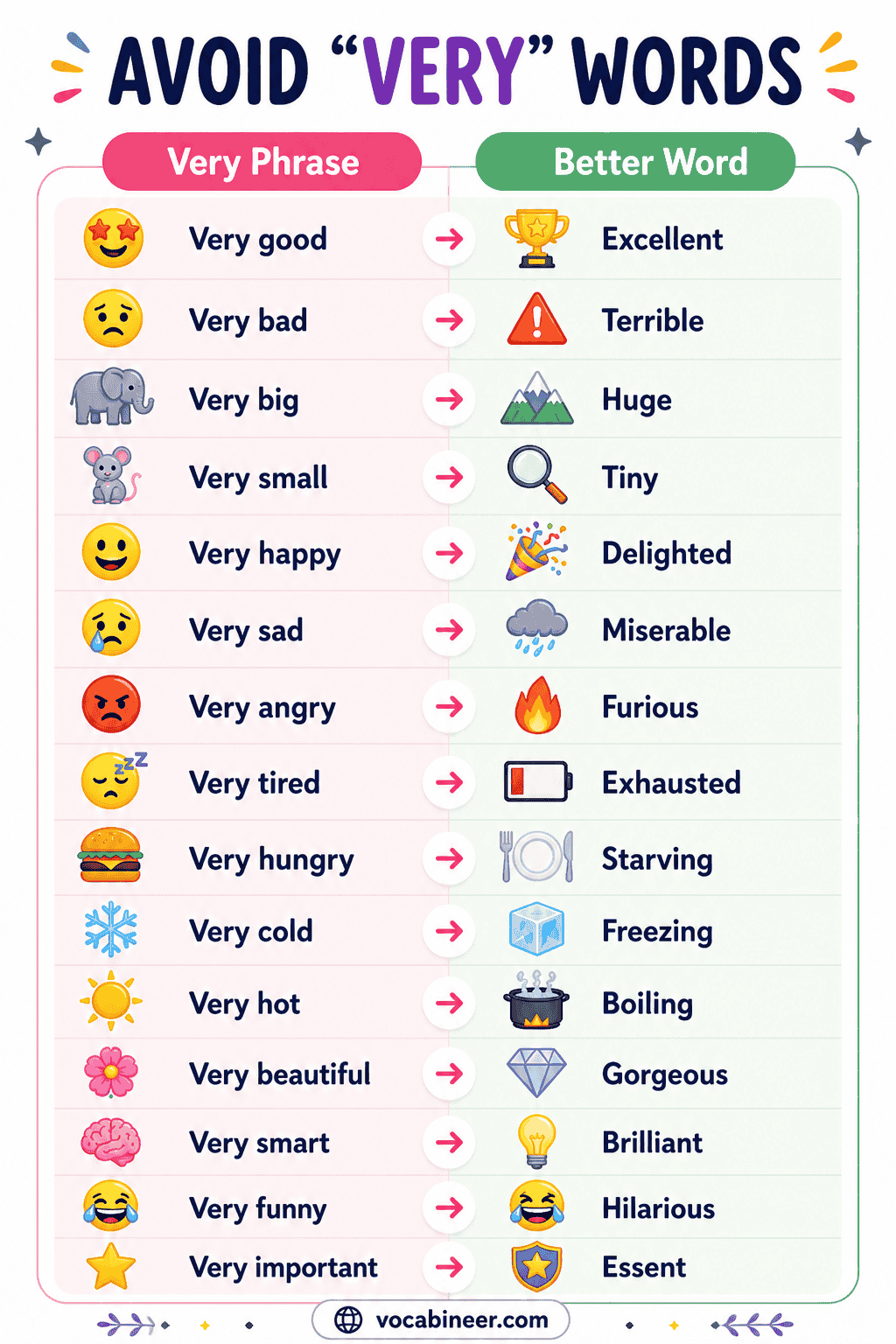
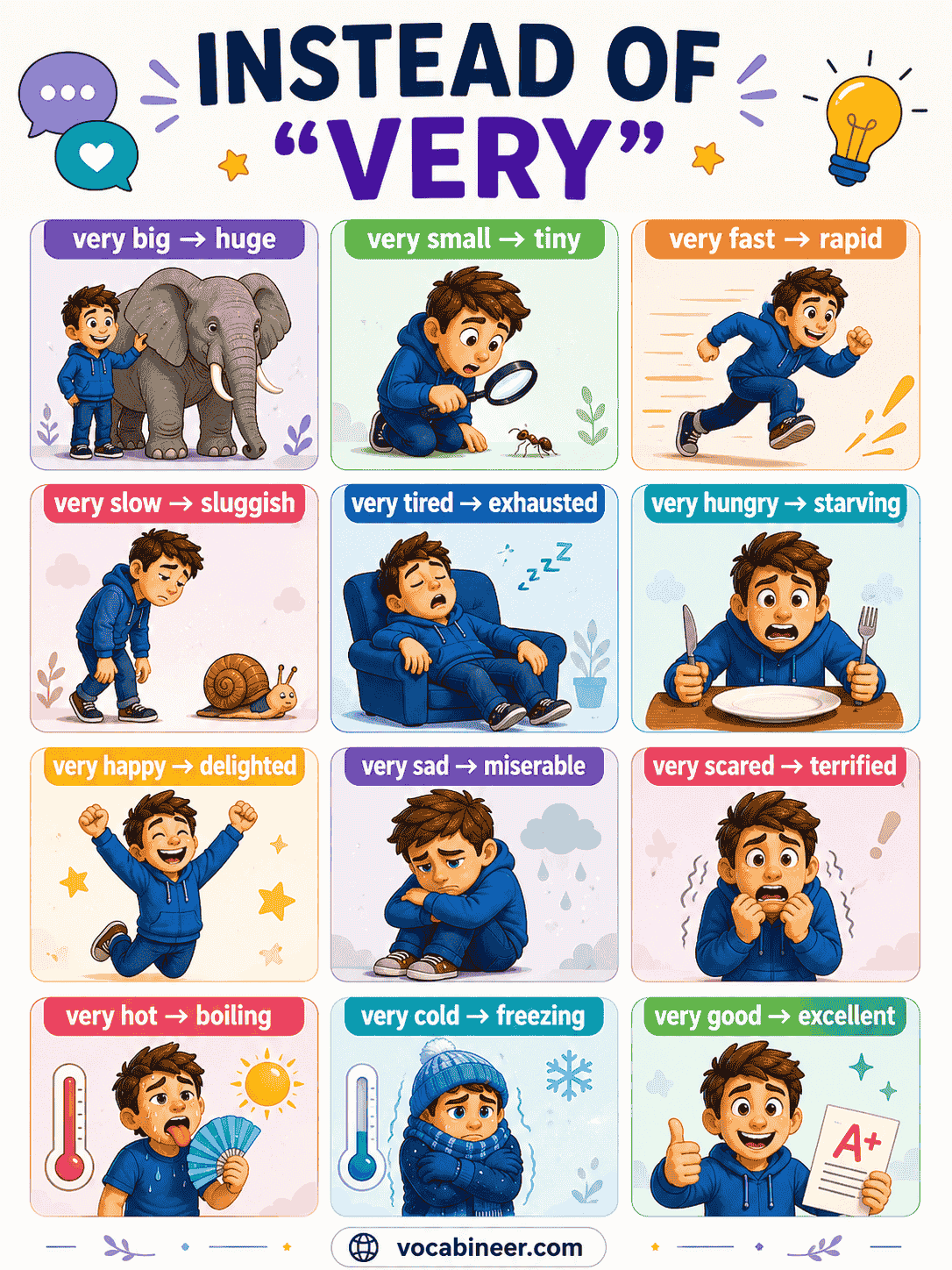
| Very big | Huge |
| Very small | Tiny |
| Very happy | Delighted |
| Very sad | Miserable |
| Very angry | Furious |
| Very tired | Exhausted |
| Very hungry | Starving |
| Very thirsty | Parched |
| Very cold | Freezing |
| Very hot | Boiling |
| Very beautiful | Gorgeous |
| Very ugly | Hideous |
| Very smart | Brilliant |
| Very foolish | Ridiculous |
| Very fast | Rapid |
| Very slow | Sluggish |
| Very easy | Effortless |
| Very difficult | Challenging |
| Very simple | Basic |
| Very complex | Complicated |
| Very clean | Spotless |
| Very dirty | Filthy |
| Very quiet | Silent |
| Very loud | Deafening |
| Very old | Ancient |
| Very new | Brand-new |
| Very rich | Wealthy |
| Very poor | Needy |
| Very strong | Powerful |
| Very weak | Frail |
| Very brave | Courageous |
| Very afraid | Terrified |
| Very funny | Hilarious |
| Very serious | Solemn |
| Very pretty | Lovely |
| Very bright | Radiant |
| Very dark | Gloomy |
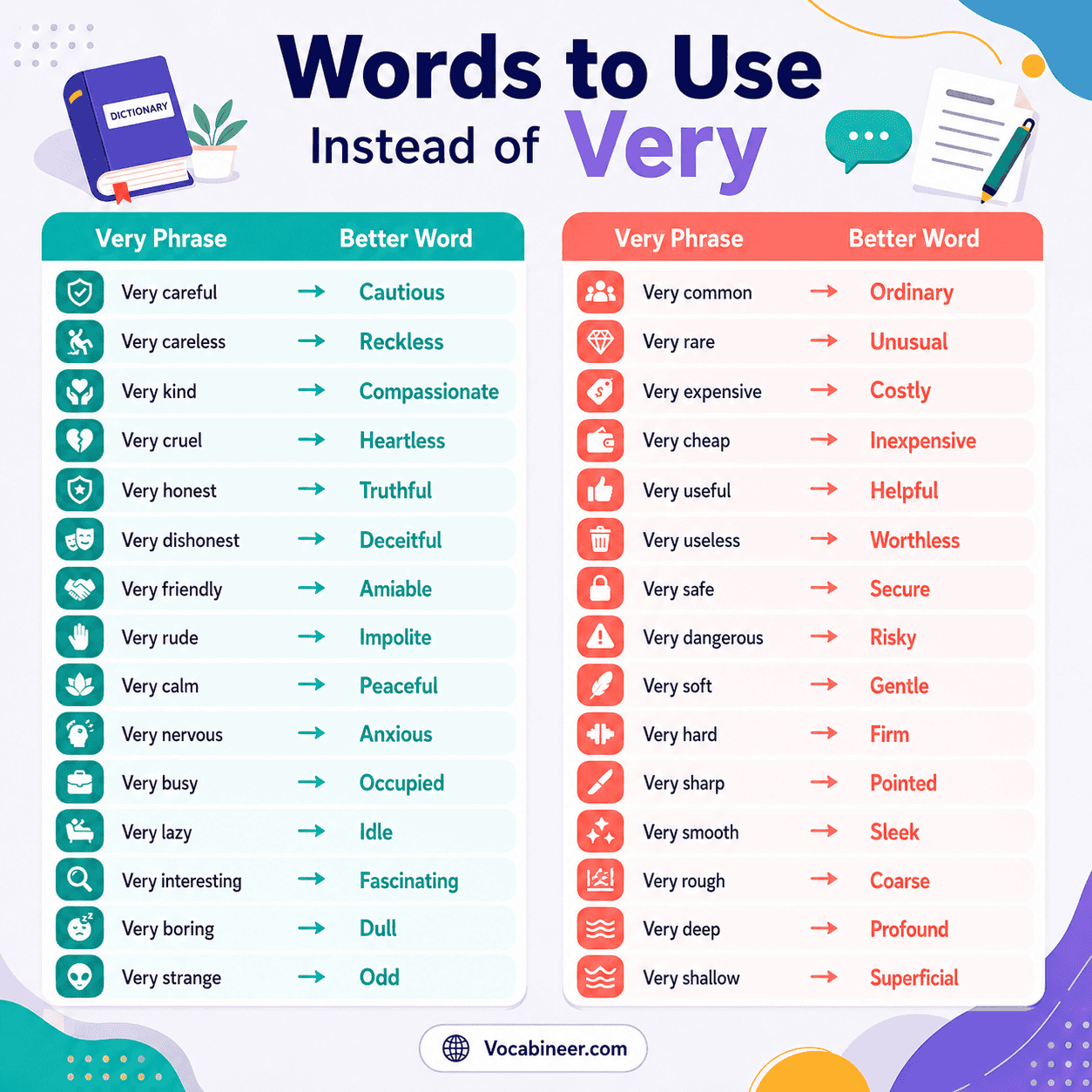
| Very careful | Cautious |
| Very careless | Reckless |
| Very kind | Compassionate |
| Very cruel | Heartless |
| Very honest | Truthful |
| Very dishonest | Deceitful |
| Very friendly | Amiable |
| Very rude | Impolite |
| Very calm | Peaceful |
| Very nervous | Anxious |
| Very busy | Occupied |
| Very lazy | Idle |
| Very interesting | Fascinating |
Easy Words Instead of Very for Beginners
These easy replacements are simple, clear, and safe for English learners to use.
| Very Phrase | Better Word |
|---|---|
| Very nice | Kind |
| Very good-looking | Attractive |
| Very bad-looking | Unattractive |
| Very hard | Difficult |
| Very soft | Gentle |
| Very wet | Soaked |
| Very dry | Arid |
| Very sweet | Sugary |
| Very sour | Tart |
| Very bitter | Sharp |
| Very salty | Briny |
| Very fresh | Crisp |
| Very old-fashioned | Outdated |
| Very modern | Contemporary |
| Very famous | Renowned |
| Very unknown | Obscure |
| Very clear | Obvious |
| Very confusing | Puzzling |
| Very sure | Certain |
| Very unsure | Doubtful |
| Very lucky | Fortunate |
| Very unlucky | Unfortunate |
| Very noisy | Rowdy |
| Very peaceful | Serene |
| Very proud | Pleased |
| Very humble | Modest |
| Very excited | Thrilled |
| Very shocked | Astonished |
| Very worried | Concerned |
| Very relaxed | Comfortable |
| Very messy | Untidy |
| Very neat | Tidy |
| Very crowded | Packed |
| Very lonely | Isolated |
| Very young | Youthful |
| Very mature | Grown-up |
| Very polite | Courteous |
| Very helpful | Supportive |
| Very loyal | Faithful |
| Very quick | Swift |
Stronger Words for Positive Feelings
Positive feeling words help you describe happiness, excitement, kindness, and comfort more clearly.
| Very Phrase | Better Word |
|---|---|
| Very joyful | Cheerful |
| Very glad | Pleased |
| Very thankful | Grateful |
| Very hopeful | Optimistic |
| Very loving | Affectionate |
| Very pleased | Satisfied |
| Very cheerful | Joyous |
| Very peaceful | Tranquil |
| Very calm | Relaxed |
| Very confident | Assured |
| Very brave | Fearless |
| Very kind-hearted | Benevolent |
| Very generous | Giving |
| Very patient | Tolerant |
| Very respectful | Polite |
| Very honest | Sincere |
| Very loyal | Devoted |
| Very friendly | Warm |
| Very sweet | Charming |
| Very gentle | Tender |
| Very pleasant | Delightful |
| Very excited | Eager |
| Very interested | Curious |
| Very inspired | Motivated |
| Very creative | Imaginative |
| Very proud | Honored |
| Very satisfied | Content |
| Very relaxed | At ease |
| Very safe | Secure |
| Very welcome | Accepted |
| Very loved | Cherished |
| Very blessed | Fortunate |
| Very peaceful inside | Contented |
| Very energetic | Lively |
| Very playful | Spirited |
| Very hopeful about success | Encouraged |
| Very happy with results | Delighted |
| Very excited to begin | Enthusiastic |
| Very thankful for help | Appreciative |
| Very calm in trouble | Composed |
| Very kind to others | Caring |
| Very nice to everyone | Friendly |
| Very brave in danger | Courageous |
| Very sure of success | Confident |
| Very pleased with work | Satisfied |
Better Words for Negative Feelings
These words help you describe fear, sadness, anger, worry, and discomfort more naturally.
| Very Phrase | Better Word |
|---|---|
| Very unhappy | Miserable |
| Very upset | Distressed |
| Very afraid | Frightened |
| Very scared | Terrified |
| Very worried | Anxious |
| Very nervous | Tense |
| Very embarrassed | Ashamed |
| Very confused | Puzzled |
| Very bored | Uninterested |
| Very lonely | Isolated |
| Very disappointed | Discouraged |
| Very annoyed | Irritated |
| Very mad | Furious |
| Very jealous | Envious |
| Very guilty | Remorseful |
| Very sorry | Regretful |
| Very hopeless | Desperate |
| Very hurt | Wounded |
| Very stressed | Overwhelmed |
| Very tired | Drained |
| Very weak emotionally | Fragile |
| Very angry inside | Resentful |
| Very sad about loss | Heartbroken |
| Very afraid of danger | Petrified |
| Very shocked by news | Stunned |
| Very worried about exams | Nervous |
| Very confused by rules | Bewildered |
| Very bored in class | Restless |
| Very unhappy at work | Dissatisfied |
| Very upset by words | Offended |
| Very angry at behavior | Outraged |
| Very scared at night | Alarmed |
| Very nervous before speaking | Uneasy |
| Very tired after work | Exhausted |
| Very sad after failure | Dejected |
| Very worried about money | Concerned |
| Very embarrassed in public | Humiliated |
| Very confused by directions | Lost |
| Very lonely at home | Alone |
| Very disappointed by results | Let down |
| Very annoyed by noise | Bothered |
| Very guilty about mistake | Ashamed |
| Very hopeless about future | Despairing |
| Very hurt by criticism | Upset |
| Very stressed by pressure | Strained |
Stronger Words for Size and Amount
These words are useful when you describe height, weight, length, quantity, or space.
| Very Phrase | Better Word |
|---|---|
| Very large | Massive |
| Very little | Minimal |
| Very heavy | Weighty |
| Very light | Featherlight |
| Very wide | Broad |
| Very narrow | Slim |
| Very long | Lengthy |
| Very short | Brief |
| Very tall | Towering |
| Very low | Short |
| Very deep | Profound |
| Very shallow | Superficial |
| Very full | Stuffed |
| Very empty | Vacant |
| Very thick | Dense |
| Very thin | Skinny |
| Very wide road | Broad road |
| Very narrow path | Tight path |
| Very high wall | Tall wall |
| Very low roof | Short roof |
| Very big house | Spacious house |
| Very small room | Tiny room |
| Very large crowd | Huge crowd |
| Very little space | Limited space |
| Very heavy bag | Bulky bag |
| Very light box | Lightweight box |
| Very long journey | Lengthy journey |
| Very short trip | Brief trip |
| Very deep hole | Deep hole |
| Very shallow pool | Shallow pool |
| Very full bottle | Filled bottle |
| Very empty street | Deserted street |
| Very thick book | Heavy book |
| Very thin paper | Fine paper |
| Very large amount | Enormous amount |
| Very small amount | Tiny amount |
| Very high number | Large number |
| Very low number | Small number |
| Very big difference | Major difference |
| Very small difference | Minor difference |
| Very wide area | Broad area |
| Very narrow space | Tight space |
| Very long line | Extended line |
| Very short note | Brief note |
| Very full schedule | Packed schedule |
Words Instead of Very for Temperature and Weather
Weather words become stronger and clearer when you replace “very” with exact vocabulary.
| Very Phrase | Better Word |
|---|---|
| Very warm | Cozy |
| Very cool | Chilly |
| Very rainy | Wet |
| Very windy | Breezy |
| Very sunny | Bright |
| Very cloudy | Overcast |
| Very stormy | Turbulent |
| Very foggy | Misty |
| Very icy | Frozen |
| Very dusty | Dusty |
| Very muddy | Mucky |
| Very hot day | Scorching day |
| Very cold day | Freezing day |
| Very rainy day | Wet day |
| Very windy day | Blustery day |
| Very sunny day | Bright day |
| Very cloudy day | Gray day |
| Very stormy night | Wild night |
| Very dark night | Pitch-dark night |
| Very quiet night | Silent night |
| Very hot weather | Sweltering weather |
| Very cold weather | Frigid weather |
| Very wet weather | Rainy weather |
| Very dry weather | Dry weather |
| Very strong wind | Powerful wind |
| Very light wind | Gentle breeze |
| Very heavy rain | Downpour |
| Very light rain | Drizzle |
| Very thick fog | Dense fog |
| Very bright sun | Blazing sun |
| Very cold water | Icy water |
| Very hot water | Boiling water |
| Very clean air | Fresh air |
| Very dirty air | Polluted air |
| Very dry land | Parched land |
| Very wet ground | Soggy ground |
| Very cold morning | Frosty morning |
| Very hot afternoon | Scorching afternoon |
| Very cool evening | Chilly evening |
| Very rough sea | Choppy sea |
Better Words for Speed and Movement
These words help describe how quickly, slowly, smoothly, or strongly something moves.
| Very Phrase | Better Word |
|---|---|
| Very rapid | Swift |
| Very slow-moving | Leisurely |
| Very active | Energetic |
| Very playful | Lively |
| Very powerful | Mighty |
| Very weak-looking | Delicate |
| Very smooth | Sleek |
| Very rough | Coarse |
| Very sharp | Pointed |
| Very flexible | Adaptable |
| Very stiff | Rigid |
| Very quick runner | Speedy runner |
| Very slow walker | Sluggish walker |
| Very fast car | Speedy car |
| Very slow train | Slow train |
| Very active child | Energetic child |
| Very playful dog | Lively dog |
| Very strong movement | Forceful movement |
| Very weak movement | Faint movement |
| Very smooth ride | Comfortable ride |
| Very rough road | Bumpy road |
| Very sharp turn | Sudden turn |
| Very quick answer | Prompt answer |
| Very slow reply | Delayed reply |
| Very fast growth | Rapid growth |
| Very slow progress | Gradual progress |
| Very active lifestyle | Busy lifestyle |
| Very flexible plan | Adjustable plan |
| Very stiff material | Rigid material |
| Very powerful engine | Strong engine |
Stronger Words for Appearance and Personality
These words help you describe how people, places, objects, and characters look or behave.
| Very Phrase | Better Word |
|---|---|
| Very attractive | Beautiful |
| Very handsome | Striking |
| Very elegant | Graceful |
| Very stylish | Fashionable |
| Very colorful | Vibrant |
| Very plain | Simple |
| Very shiny | Glossy |
| Very dull | Lifeless |
| Very magical | Enchanting |
| Very real | Genuine |
| Very fake | Artificial |
| Very exact | Precise |
| Very wrong | Incorrect |
| Very right | Correct |
| Very complete | Whole |
| Very incomplete | Partial |
| Very open | Accessible |
| Very closed | Shut |
| Very tight | Snug |
| Very loose | Baggy |
| Very quiet person | Reserved |
| Very talkative | Chatty |
| Very wise | Insightful |
| Very creative | Imaginative |
| Very talented | Gifted |
| Very skilled | Expert |
| Very careful work | Detailed |
| Very clever | Intelligent |
| Very silly | Ridiculous |
| Very shy person | Timid |
| Very confident person | Assured |
| Very honest person | Trustworthy |
| Very strange person | Odd |
| Very helpful person | Supportive |
| Very loud sound | Deafening sound |
| Very soft sound | Gentle sound |
| Very quiet sound | Faint sound |
| Very bright light | Brilliant light |
| Very dim light | Faint light |
| Very dark room | Gloomy room |
| Very clean room | Spotless room |
| Very dirty room | Filthy room |
| Very beautiful place | Stunning place |
| Very ugly place | Hideous place |
| Very peaceful place | Serene place |
| Very dangerous place | Hazardous place |
| Very safe place | Secure place |
| Very far place | Distant place |
| Very near place | Nearby place |
| Very beautiful morning | Lovely morning |
| Very busy morning | Hectic morning |
| Very peaceful morning | Calm morning |
| Very rude person | Impolite person |
| Very polite person | Courteous person |
| Very neat appearance | Tidy appearance |
Words Instead of Very Good, Very Bad, and Very Important
These phrases are common in English, so it helps to learn several stronger options.
| Very Phrase | Better Word |
|---|---|
| Very good | Excellent |
| Very good work | Outstanding work |
| Very good idea | Brilliant idea |
| Very good result | Impressive result |
| Very good quality | High quality |
| Very good choice | Wise choice |
| Very good student | Outstanding student |
| Very good teacher | Excellent teacher |
| Very good answer | Strong answer |
| Very good example | Clear example |
| Very bad | Terrible |
| Very bad idea | Awful idea |
| Very bad result | Poor result |
| Very bad behavior | Unacceptable behavior |
| Very bad quality | Low quality |
| Very bad choice | Poor choice |
| Very bad weather | Awful weather |
| Very bad food | Awful food |
| Very bad smell | Foul smell |
| Very bad mistake | Serious mistake |
| Very important | Essential |
| Very important point | Key point |
| Very important rule | Key rule |
| Very important lesson | Essential lesson |
| Very important reason | Major reason |
| Very important decision | Crucial decision |
| Very important detail | Vital detail |
| Very important issue | Serious issue |
| Very important topic | Key topic |
| Very important message | Main message |
| Very good news | Wonderful news |
| Very bad news | Terrible news |
| Very important job | Crucial job |
| Very good plan | Solid plan |
| Very bad plan | Weak plan |
Words Instead of Very in Sentences
Sentence examples show how stronger words make writing smoother and clearer.
| Weak Sentence | Better Sentence |
|---|---|
| The room was very clean. | The room was spotless. |
| The movie was very funny. | The movie was hilarious. |
| The soup was very hot. | The soup was boiling. |
| The child was very tired. | The child was exhausted. |
| The test was very difficult. | The test was challenging. |
| The answer was very simple. | The answer was basic. |
| The street was very quiet. | The street was silent. |
| The music was very loud. | The music was deafening. |
| The bag was very heavy. | The bag was bulky. |
| The baby was very sleepy. | The baby was drowsy. |
| The story was very sad. | The story was tragic. |
| The flowers were very beautiful. | The flowers were gorgeous. |
| The water was very cold. | The water was icy. |
| The road was very narrow. | The road was slim. |
| The house was very big. | The house was spacious. |
| The food was very tasty. | The food was delicious. |
| The lesson was very useful. | The lesson was helpful. |
| The question was very hard. | The question was tough. |
| The student was very smart. | The student was brilliant. |
| The sky was very dark. | The sky was gloomy. |
| The weather was very dry. | The weather was arid. |
| The teacher was very kind. | The teacher was caring. |
| The man was very brave. | The man was courageous. |
| The place was very safe. | The place was secure. |
| The news was very shocking. | The news was astonishing. |
Very + Adjective vs Stronger Word Chart
This chart gives quick replacements you can use while writing essays, stories, emails, and daily sentences.
| Very Phrase | Stronger Word |
|---|---|
| Very boring | Dull |
| Very strange | Odd |
| Very common | Ordinary |
| Very rare | Unusual |
| Very expensive | Costly |
| Very cheap | Inexpensive |
| Very useful | Helpful |
| Very useless | Worthless |
| Very safe | Secure |
| Very dangerous | Risky |
| Very hard surface | Firm |
| Very deep thought | Profound |
| Very strong reason | Powerful reason |
| Very weak reason | Poor reason |
| Very serious problem | Severe problem |
| Very simple answer | Clear answer |
| Very hard question | Tough question |
| Very short answer | Brief answer |
| Very long answer | Detailed answer |
| Very close friend | Best friend |
| Very old friend | Longtime friend |
| Very new friend | Recent friend |
| Very angry person | Furious person |
| Very kind person | Caring person |
| Very funny person | Hilarious person |
| Very boring person | Dull person |
| Very brave person | Courageous person |
| Very rich person | Wealthy person |
| Very poor person | Needy person |
| Very famous person | Well-known person |
| Very small problem | Minor problem |
| Very big problem | Major problem |
| Very tasty food | Delicious food |
| Very spicy food | Fiery food |
| Very old food | Stale food |
| Very healthy food | Nutritious food |
| Very unhealthy food | Junk food |
| Very expensive meal | Costly meal |
| Very cheap meal | Budget meal |
| Very big meal | Huge meal |
| Very small meal | Light meal |
| Very full stomach | Stuffed stomach |
| Very hungry child | Starving child |
| Very thirsty child | Parched child |
| Very tired worker | Exhausted worker |
| Very scared child | Frightened child |
| Very calm child | Peaceful child |
| Very bright student | Brilliant student |
| Very weak student | Struggling student |
| Very strict teacher | Firm teacher |
| Very difficult lesson | Challenging lesson |
| Very easy lesson | Simple lesson |
| Very boring lesson | Dull lesson |
| Very interesting lesson | Fascinating lesson |
| Very confusing lesson | Puzzling lesson |
| Very long class | Lengthy class |
| Very short class | Brief class |
| Very good essay | Excellent essay |
| Very bad essay | Poor essay |
| Very clear writing | Clear writing |
| Very weak writing | Poor writing |
| Very strong writing | Powerful writing |
| Very simple writing | Plain writing |
| Very formal writing | Professional writing |
| Very casual writing | Informal writing |
| Very creative writing | Imaginative writing |
| Very boring writing | Dull writing |
| Very detailed writing | Thorough writing |
| Very short sentence | Brief sentence |
| Very long sentence | Lengthy sentence |
| Very clear sentence | Direct sentence |
| Very confusing sentence | Unclear sentence |
| Very good grammar | Correct grammar |
| Very bad grammar | Poor grammar |
| Very common mistake | Frequent mistake |
| Very small mistake | Minor mistake |
| Very serious mistake | Major mistake |
Casual vs Formal Words Instead of Very
Some words fit casual speech, while others sound better in essays or professional writing.
| Very Phrase | Casual Word | Formal Word |
|---|---|---|
| Very good | Great | Excellent |
| Very bad | Awful | Unacceptable |
| Very important | Big | Essential |
| Very smart | Clever | Brilliant |
| Very hard | Tough | Challenging |
| Very clear | Easy to understand | Obvious |
| Very serious | Big | Severe |
| Very common | Usual | Frequent |
| Very rare | Unusual | Exceptional |
| Very useful | Handy | Helpful |
| Very weak | Poor | Ineffective |
| Very strong | Powerful | Significant |
| Very fast | Quick | Rapid |
| Very slow | Slow | Gradual |
| Very rich | Loaded | Wealthy |
| Very poor | Broke | Needy |
| Very angry | Mad | Furious |
| Very sad | Upset | Miserable |
| Very happy | Glad | Delighted |
| Very tired | Worn out | Exhausted |
| Very easy | Simple | Effortless |
| Very difficult | Hard | Complex |
| Very quiet | Still | Silent |
| Very loud | Noisy | Deafening |
| Very detailed | Full | Thorough |
Words Instead of Very for Essay Writing
Essay writing needs clear, strong, and natural vocabulary. These words can help students improve their style.
| Very Phrase | Essay-Friendly Word |
|---|---|
| Very important | Crucial |
| Very clear | Evident |
| Very serious | Severe |
| Very strong | Significant |
| Very weak | Ineffective |
| Very common | Frequent |
| Very rare | Uncommon |
| Very useful | Valuable |
| Very detailed | Thorough |
| Very simple | Basic |
| Very complex | Complicated |
| Very good point | Strong point |
| Very bad effect | Harmful effect |
| Very big change | Major change |
| Very small change | Minor change |
| Very important factor | Key factor |
| Very strong argument | Convincing argument |
| Very weak argument | Poor argument |
| Very clear example | Direct example |
| Very serious issue | Critical issue |
| Very common problem | Frequent problem |
| Very useful method | Effective method |
| Very bad habit | Harmful habit |
| Very good reason | Valid reason |
| Very big success | Major success |
| Very bad failure | Serious failure |
| Very clear idea | Precise idea |
| Very important evidence | Crucial evidence |
| Very strong evidence | Solid evidence |
| Very weak evidence | Limited evidence |
| Very useful information | Valuable information |
| Very complex topic | Difficult topic |
| Very simple explanation | Basic explanation |
| Very serious concern | Major concern |
| Very common view | Popular view |
Common Mistakes When Replacing Very
Replacing “very” is useful, but you should choose words carefully.
Using words that are too dramatic
Some strong words can sound too extreme. For example, terrified is stronger than very afraid, so use it only when the fear is serious.
Choosing a word with the wrong meaning
Do not replace words only because they sound advanced. For example, ancient means very old, but it usually describes objects, buildings, history, or ideas.
Using difficult words in simple writing
Simple writing often works better than fancy writing. Therefore, choose clear words that your reader can understand easily.
Repeating the same strong word too often
Strong words lose power when you repeat them. Instead, vary your vocabulary naturally.
When You Should Not Replace Very
Sometimes, “very” is the best and most natural choice.
You can keep very when the stronger word sounds too formal, too emotional, or too dramatic. For example, in daily speech, “I am very happy” may sound more natural than “I am delighted” in some situations.
Also, keep very when you want simple and direct meaning. Strong vocabulary should improve your sentence, not make it confusing.
How to Use Stronger Words Naturally
Use stronger words when they make your sentence clearer, shorter, and more exact.
First, check the meaning of the stronger word. Then, use it in a simple sentence. Finally, read the sentence again to see if it sounds natural. For example, very tired can become exhausted, but very nice can change in different ways depending on meaning, such as kind, pleasant, or lovely.
FAQs
You can often use one stronger word instead of “very + adjective.” For example, use huge instead of very big, tiny instead of very small, and exhausted instead of very tired.
No, it is not wrong. However, using “very” too often can make writing sound weak. Stronger words can make your writing clearer and more interesting.
Some better words for very good are excellent, wonderful, outstanding, impressive, and superb.
Some better words for very bad are terrible, awful, poor, dreadful, and unacceptable.
Students do not need to avoid it completely. However, they should learn stronger words so their essays, stories, and answers sound more fluent.
Summary
Using better words instead of very can make your English stronger, clearer, and more natural. Words like huge, tiny, furious, freezing, excellent, and exhausted help you express ideas with more power. However, use stronger words carefully, because the best word always depends on the meaning, tone, and situation.
Read More
- Basic vs Advanced English Words
- 1000 Daily Use English Words
- Rhyming Words in English
- 100+ Examples of Homophones