

Polygon shapes are important in geometry, drawing, design, buildings, road signs, tiles, patterns, and classroom learning. Students often learn polygon names by counting sides, corners, and angles.
A polygon is a flat closed shape made with straight lines. Common polygon shapes include triangle, square, rectangle, pentagon, hexagon, octagon, and decagon. Learning these names with pictures and examples helps kids and students understand shapes more easily.
In This Page
What Is a Polygon?
A polygon is a two-dimensional closed shape made only with straight sides. The sides must join together without gaps.
For example, a triangle is a polygon because it has three straight sides and it is closed. A square is also a polygon because it has four straight sides. However, a circle is not a polygon because it has a curved line, not straight sides.
A shape is a polygon when it has:
- Straight sides
- A closed outline
- Three or more sides
- Corners where the sides meet
- No curved edges

Basic Features of a Polygon
A polygon has a few basic parts that make it easy to identify. These parts are sides, corners, vertices, and angles.
| Feature | Meaning | Example |
|---|---|---|
| Side | A straight line in a polygon | A triangle has 3 sides |
| Corner | A point where two sides meet | A square has 4 corners |
| Vertex | Another name for a corner | A pentagon has 5 vertices |
| Angle | The space formed where two sides meet | A rectangle has 4 angles |
| Closed shape | A shape with no open gap | A hexagon is closed |
| Straight line | A line that does not curve | Polygon sides are straight |
A polygon cannot have curved sides. That is why circles, ovals, and hearts are not polygons.
Quick Polygon Shapes Chart
This chart gives a quick overview of common polygon shapes, their sides, and simple examples.
| Polygon Shape | Number of Sides | Number of Corners | Real-Life Example |
|---|---|---|---|
| Triangle | 3 | 3 | Pizza slice, road sign |
| Quadrilateral | 4 | 4 | Book, window |
| Square | 4 | 4 | Tile, chessboard square |
| Rectangle | 4 | 4 | Door, notebook |
| Pentagon | 5 | 5 | Pentagon sign, badge |
| Hexagon | 6 | 6 | Honeycomb cell |
| Heptagon | 7 | 7 | Seven-sided design |
| Octagon | 8 | 8 | Stop sign |
| Nonagon | 9 | 9 | Nine-sided pattern |
| Decagon | 10 | 10 | Ten-sided coin design |
| Dodecagon | 12 | 12 | Clock-like polygon pattern |
| Icosagon | 20 | 20 | Twenty-sided design |
This chart helps students connect each polygon name with its side count.
Common Polygon Shapes with Pictures
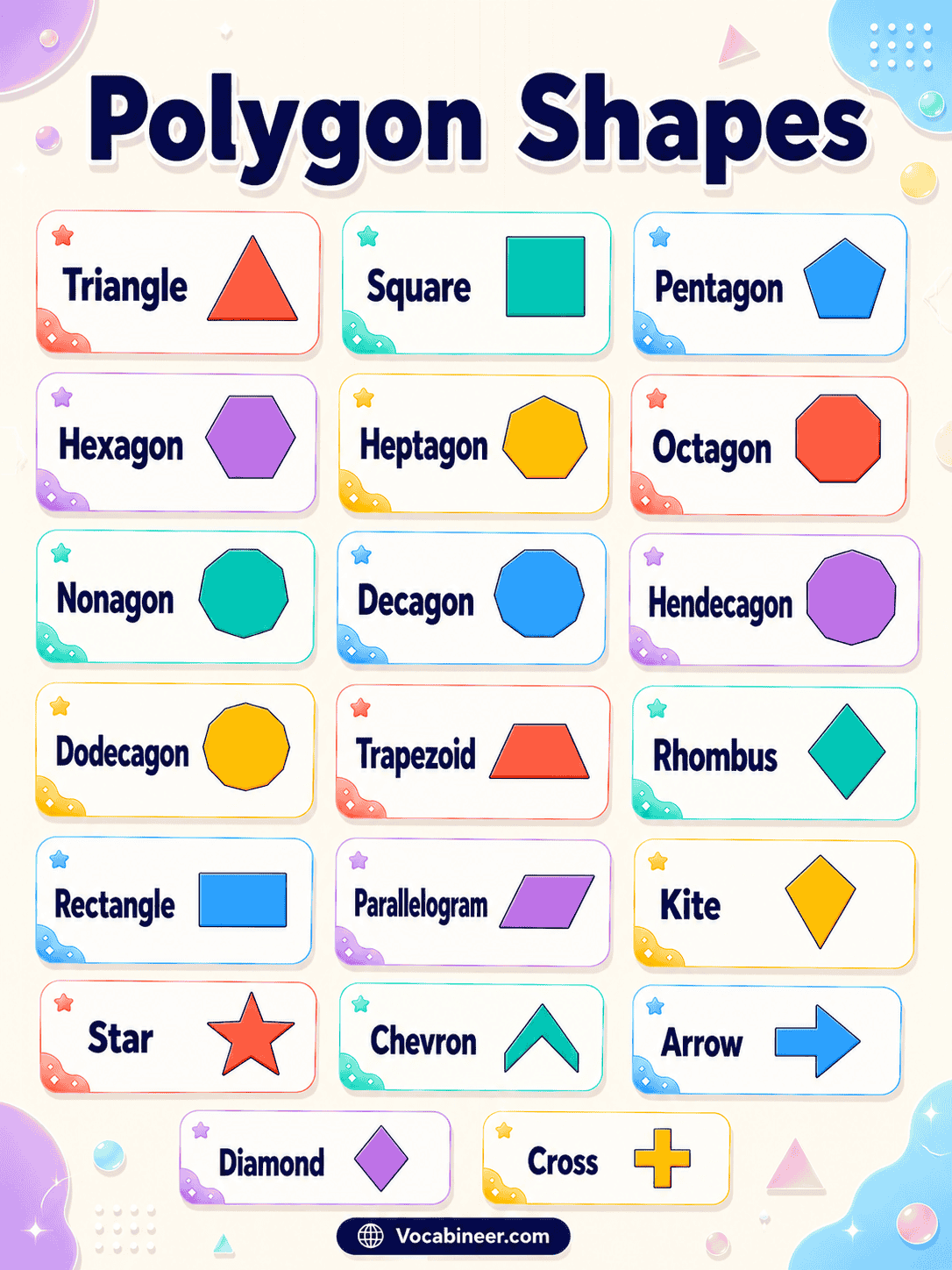
Pictures make polygon shapes easier to recognize. Use this section as a visual shape-card section with one image, the shape name, the number of sides, and a short meaning.
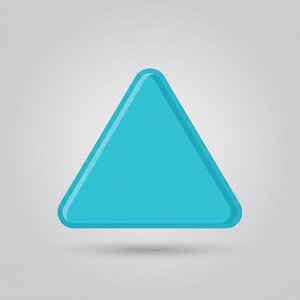
Triangle
A polygon with 3 sides and 3 corners.
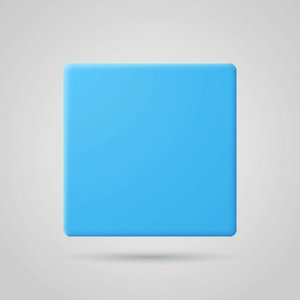
Square
A four-sided polygon with all sides equal and all angles equal.
Rectangle
A four-sided polygon with opposite sides equal and four right angles.

Rhombus
A four-sided polygon with all sides equal, but the angles may not be right angles.

Trapezoid
A four-sided polygon with at least one pair of parallel sides. In some lessons, a trapezoid means a four-sided polygon with exactly one pair of parallel sides.

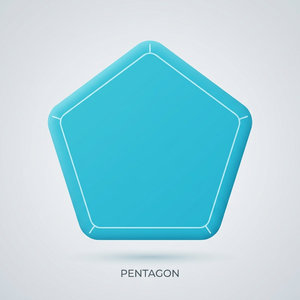
Pentagon
A polygon with 5 sides and 5 corners.
Hexagon
A polygon with 6 sides and 6 corners.

Heptagon
A polygon with 7 sides and 7 corners.

Octagon
A polygon with 8 sides and 8 corners.

Nonagon
A polygon with 9 sides and 9 corners.

Decagon
A polygon with 10 sides and 10 corners.

Dodecagon
A polygon with 12 sides and 12 corners.

Polygon Names from 3 to 20 Sides
Polygons are often named by the number of sides they have. The side count helps students remember each shape name.
| Number of Sides | Polygon Name |
|---|---|
| 3 | Triangle |
| 4 | Quadrilateral |
| 5 | Pentagon |
| 6 | Hexagon |
| 7 | Heptagon |
| 8 | Octagon |
| 9 | Nonagon |
| 10 | Decagon |
| 11 | Hendecagon |
| 12 | Dodecagon |
| 13 | Tridecagon |
| 14 | Tetradecagon |
| 15 | Pentadecagon |
| 16 | Hexadecagon |
| 17 | Heptadecagon |
| 18 | Octadecagon |
| 19 | Enneadecagon |
| 20 | Icosagon |
The most common polygon names for kids are triangle, square, rectangle, pentagon, hexagon, and octagon. Longer names are usually used in advanced geometry lessons.
Polygon Shape Names for Kids
Kids learn polygon names faster when the explanation is simple and visual. Start with common polygons before moving to advanced names.
Easy polygon names for kids:
- Triangle — a shape with 3 sides
- Square — a shape with 4 equal sides
- Rectangle — a shape with 4 sides and 4 square corners
- Pentagon — a shape with 5 sides
- Hexagon — a shape with 6 sides
- Octagon — a shape with 8 sides
- Kite — a four-sided shape that looks like a flying kite
- Rhombus — a slanted four-sided shape with equal sides
- Trapezoid — a four-sided polygon with at least one pair of parallel sides
- Star shape — a shape made with straight lines that can be a polygon if it is closed
Simple examples help children remember polygon shapes. A stop sign is an octagon, a slice of pizza can look like a triangle, and a honeycomb cell often looks like a hexagon.
Polygon Sides, Corners, Vertices, and Angles
Polygons have sides, corners, vertices, and angles. These words are often used in geometry lessons.
| Term | Meaning | Example |
|---|---|---|
| Side | A straight line that forms part of a polygon | A pentagon has 5 sides |
| Corner | A point where two sides meet | A square has 4 corners |
| Vertex | A geometry word for corner | A triangle has 3 vertices |
| Vertices | More than one vertex | A hexagon has 6 vertices |
| Angle | The space between two sides at a corner | A rectangle has 4 angles |
| Interior angle | An angle inside the polygon | A triangle has 3 interior angles |
| Exterior angle | An angle outside the polygon | Used in advanced polygon lessons |
| Diagonal | A line connecting two non-neighboring vertices | A square has 2 diagonals |
In simple learning, corners and vertices usually mean the same thing. Students may hear “corners” in early grades and “vertices” in geometry.
How to Identify a Polygon
A shape must follow certain rules to be called a polygon. These rules make it easy to separate polygons from non-polygons.
A shape is a polygon if:
- It is flat and two-dimensional.
- It is closed with no open gaps.
- It is made only of straight line segments.
- It has at least three sides.
- Its sides meet at corners.
- It does not have curved edges.
A shape is not a polygon if:
- It has a curved side.
- It is open.
- It has fewer than three sides.
- Its lines do not connect fully.
- It is a 3D object like a cube or sphere.
For example, a triangle is a polygon, but a circle is not. A square is a polygon, but an open zigzag line is not.
Types of Polygons
Polygons can be grouped in different ways. The most common types are regular, irregular, convex, and concave polygons.
Regular Polygons
A regular polygon has all sides equal and all angles equal. It looks even and balanced.
Examples of regular polygons:
- Equilateral triangle
- Square
- Regular pentagon
- Regular hexagon
- Regular octagon
- Regular decagon
A regular hexagon has six equal sides and six equal angles. Honeycomb cells often look like regular hexagons.
A square is a regular polygon because all four sides and all four angles are equal. Most rectangles are not regular polygons because their length and width are different.
Irregular Polygons
An irregular polygon does not have all sides and angles equal. It can still be a polygon as long as it is closed and made with straight sides.
Examples of irregular polygons:
- Scalene triangle
- Irregular quadrilateral
- Rectangle that is not a square
- Irregular pentagon
- Irregular hexagon
- Uneven trapezoid
- Uneven kite shape
Many real-life shapes are irregular polygons because their sides and angles are not all equal.
Convex Polygons
A convex polygon has no inward dent. All corners point outward, and every interior angle is less than 180 degrees.
Examples of convex polygons:
- Square
- Rectangle
- Regular pentagon
- Regular hexagon
- Regular octagon
- Most simple triangles
Convex polygons look simple and smooth because none of their sides push inward.
Concave Polygons
A concave polygon has at least one inward dent. One or more angles point inward, and at least one interior angle is greater than 180 degrees.
Examples of concave polygons:
- Arrow-shaped polygon
- Dart-shaped polygon
- Some star-like polygons
- Irregular polygon with an inward corner
Concave polygons are still polygons if they are closed and made of straight sides.
Regular vs Irregular Polygons
Regular and irregular polygons are both closed shapes with straight sides, but their sides and angles are different.
| Feature | Regular Polygon | Irregular Polygon |
|---|---|---|
| Sides | All sides are equal | Sides may be different |
| Angles | All angles are equal | Angles may be different |
| Shape | Balanced and even | Uneven or mixed |
| Example | Square, regular hexagon | Rectangle, irregular pentagon |
| Easy to measure | Usually easier | May need more checking |
A square is a regular quadrilateral because all sides and angles are equal. A rectangle that is not a square is irregular because only its opposite sides are equal.
Convex vs Concave Polygons
Convex and concave polygons are different because of their shape direction. A convex polygon has no dent, while a concave polygon has an inward dent.
| Feature | Convex Polygon | Concave Polygon |
|---|---|---|
| Shape | No inward dent | Has an inward dent |
| Corners | All corners point outward | At least one corner points inward |
| Interior angles | Each angle is less than 180° | At least one angle is more than 180° |
| Diagonals | Diagonals stay inside | Some diagonals may go outside |
| Example | Square, triangle, hexagon | Arrow-shaped polygon |
A square is convex. An arrow-shaped polygon with an inward point is concave.
Simple and Complex Polygons
Simple and complex polygons are another way to classify polygon shapes. This idea is more advanced, but it helps students understand polygon structure.
| Feature | Simple Polygon | Complex Polygon |
|---|---|---|
| Sides | Sides do not cross each other | Sides cross each other |
| Shape | Easy to trace around | Lines may overlap or cross |
| Outline | Clear closed boundary | Boundary can look twisted |
| Example | Triangle, square, pentagon | Self-crossing star polygon |
Most polygons students learn first are simple polygons. Complex polygons are usually introduced later in geometry.
Polygon and Non-Polygon Shapes
Some shapes look similar to polygons, but they do not follow polygon rules. A polygon must be closed and made only with straight sides.
| Feature | Polygon | Non-Polygon |
|---|---|---|
| Lines | Made of straight lines | May have curved lines |
| Shape | Closed | May be open or curved |
| Sides | Has 3 or more straight sides | May have no straight sides |
| Examples | Triangle, square, pentagon | Circle, oval, heart |
| Rule | Must follow polygon rules | Does not follow all polygon rules |
Examples of polygons:
- Triangle
- Square
- Rectangle
- Pentagon
- Hexagon
- Octagon
Examples of non-polygons:
- Circle
- Oval
- Crescent
- Heart
- Open line
- Curved shape
A circle is not a polygon because it has a curved boundary. An oval is also not a polygon for the same reason.
Common Polygon Shapes in Real Life
Polygon shapes appear in many places around us. Real-life examples make geometry easier to remember.
- Triangle: pizza slice, yield sign, roof shape
- Square: floor tile, chessboard square, sticky note
- Rectangle: door, book, phone screen, window
- Rhombus: diamond pattern, kite design, fabric print
- Trapezoid: bridge support, handbag shape, lampshade side
- Pentagon: badge, house outline, decorative tile
- Hexagon: honeycomb, bolt head, floor pattern
- Octagon: stop sign, table design, warning sign
- Nonagon: decorative pattern, art design
- Decagon: coin design, geometric decoration
Students can look around the classroom or home to find polygon shapes in everyday objects.
Polygon Shapes by Category
Grouping polygons by side count helps students learn them step by step. Start with three-sided and four-sided shapes, then move to polygons with more sides.
Three-Sided Polygon
A three-sided polygon is called a triangle. It has 3 sides, 3 corners, and 3 angles.
Types of triangles include:
- Equilateral triangle
- Isosceles triangle
- Scalene triangle
- Right triangle
- Acute triangle
- Obtuse triangle
Triangles are common in road signs, roof designs, bridges, and patterns.
Four-Sided Polygons
Four-sided polygons are called quadrilaterals. They have 4 sides and 4 corners.
Common four-sided polygons include:
- Square
- Rectangle
- Rhombus
- Parallelogram
- Trapezoid
- Kite
Four-sided polygons are very common in daily life. Doors, books, windows, screens, and tables often look like rectangles or squares.
Five-Sided and Six-Sided Polygons
A five-sided polygon is called a pentagon. A six-sided polygon is called a hexagon.
Examples:
- Pentagon: 5 sides and 5 corners
- Hexagon: 6 sides and 6 corners
- Regular pentagon: all 5 sides and angles are equal
- Regular hexagon: all 6 sides and angles are equal
Hexagons are easy to find in honeycombs, tiles, and geometric patterns.
Seven-Sided to Ten-Sided Polygons
Polygons with seven to ten sides are usually learned after the basic shapes.
| Number of Sides | Polygon Name |
|---|---|
| 7 | Heptagon |
| 8 | Octagon |
| 9 | Nonagon |
| 10 | Decagon |
The octagon is the most familiar shape in this group because stop signs often have eight sides.
Polygons with More Than Ten Sides
Polygons can have more than ten sides. These names are less common, but they are useful in advanced geometry.
Examples:
- Hendecagon — 11 sides
- Dodecagon — 12 sides
- Tridecagon — 13 sides
- Tetradecagon — 14 sides
- Pentadecagon — 15 sides
- Hexadecagon — 16 sides
- Heptadecagon — 17 sides
- Octadecagon — 18 sides
- Enneadecagon — 19 sides
- Icosagon — 20 sides
As the number of sides increases, polygons can begin to look more rounded, but they are still polygons if the sides are straight.
Example Sentences with Polygon Shapes
Example sentences help students use polygon names in simple English. These sentences are useful for classroom writing and speaking practice.
- A triangle has three sides.
- A square has four equal sides.
- A rectangle has four corners.
- A pentagon has five sides.
- A hexagon has six sides.
- A stop sign is shaped like an octagon.
- A honeycomb cell looks like a hexagon.
- A quadrilateral has four sides.
- A regular polygon has equal sides and equal angles.
- An irregular polygon has unequal sides or angles.
- A circle is not a polygon.
- A concave polygon has an inward dent.
- A convex polygon has no inward dent.
- A dodecagon has twelve sides.
- A polygon must be a closed shape.
These sentences can also be used for worksheets, quizzes, and classroom practice.
Common Mistakes with Polygon Shapes
Students often confuse polygons with other shapes. These common mistakes can be avoided by checking the rules.
| Mistake | Correct Idea |
|---|---|
| Calling a circle a polygon | A circle is not a polygon because it has a curved edge |
| Thinking all four-sided shapes are squares | All squares are quadrilaterals, but not all quadrilaterals are squares |
| Confusing corners and vertices | Corners and vertices often mean the same thing in basic geometry |
| Forgetting that a polygon must be closed | An open shape is not a polygon |
| Thinking curved shapes are polygons | Polygons only have straight sides |
| Calling every 4-sided shape a rectangle | A rectangle is only one type of quadrilateral |
| Thinking regular and irregular mean same | Regular polygons have equal sides and angles |
| Confusing hexagon and heptagon | Hexagon has 6 sides; heptagon has 7 sides |
A good way to check a polygon is to ask: Is it closed? Does it have only straight sides? Does it have at least three sides?
Tips for Learning Polygon Shapes
Learning polygon shapes becomes easier when students start with the most common examples. Begin with triangle, square, rectangle, pentagon, hexagon, and octagon. After that, move to longer names like nonagon, decagon, dodecagon, and icosagon.
Counting sides is the best way to remember polygon names. For example, a pentagon has five sides, a hexagon has six sides, and an octagon has eight sides. Pictures also help because students can connect the name with the shape.
Real-life examples make learning stronger. A stop sign can help students remember octagon, while a honeycomb can help them remember hexagon. Drawing each polygon and labeling its sides, corners, and angles also makes the lesson easier.
Polygon Practice Ideas
Practice activities help students remember polygon names, sides, and features. These ideas work well for classrooms, worksheets, and home learning.
- Draw a triangle, square, pentagon, and hexagon.
- Count the sides of each polygon.
- Label the corners and vertices.
- Match polygon names with pictures.
- Sort polygons and non-polygons.
- Find polygon shapes in the classroom.
- Write one real-life example for each polygon.
- Color regular polygons one color and irregular polygons another color.
- Circle all shapes with straight sides.
- Create a polygon chart from 3 to 10 sides.
- Make a polygon flashcard set.
- Use sticks or straws to build polygon shapes.
- Compare regular and irregular polygons.
- Write sentences using polygon names.
- Complete a polygon side-count quiz.
These activities are simple, visual, and useful for kids.
Printable Polygon Worksheet
A printable worksheet can help students review polygon names in a clear way. It should include shapes, side counts, and simple questions.
Worksheet ideas:
- Match each polygon to its name.
- Count the sides and corners.
- Write the number of vertices.
- Circle the polygons.
- Cross out the non-polygons.
- Color the triangle, square, pentagon, and hexagon.
- Write the real-life example of each polygon.
- Complete the side-count table.
- Label regular and irregular polygons.
- Draw your own polygon.
A good worksheet should use clear pictures and simple instructions. For younger kids, start with common shapes. For older students, include polygon names from 3 to 20 sides.
FAQs
A polygon is a flat closed shape made with straight sides. It must have at least three sides. Triangles, squares, pentagons, and hexagons are polygons.
Common polygon shapes include triangle, square, rectangle, pentagon, hexagon, heptagon, octagon, nonagon, and decagon. Kids usually learn triangle, square, rectangle, pentagon, hexagon, and octagon first.
Polygons are usually named by the number of sides they have. A triangle has 3 sides, a pentagon has 5 sides, a hexagon has 6 sides, and a decagon has 10 sides.
No, a circle is not a polygon because it has a curved edge. A polygon must be made only with straight sides.
A regular polygon has all sides and angles equal. An irregular polygon has sides or angles that are not all equal.
Summary
Polygon shapes are flat closed shapes made with straight sides. They have sides, corners, vertices, and angles. Common polygon names include triangle, square, rectangle, pentagon, hexagon, heptagon, octagon, nonagon, and decagon.
Learning polygon shapes becomes easier when students count sides, look at pictures, compare shape types, and connect polygons with real-life examples. With charts, examples, comparisons, practice ideas, and worksheets, kids and students can understand polygon names more clearly.
Read More