

Root words help children unlock the meanings of unfamiliar English words. When students recognize a familiar root inside a longer word, they can often make a smart guess about what that word means, which improves vocabulary, spelling, and reading comprehension.
You’ll learn what roots are, how prefixes and suffixes work with them, how roots differ from base words, and what many common Greek and Latin roots mean. You’ll also see word-building examples, sentences, tables, practice activities, and a complete answer key.
In This Page
What Is a Root Word?
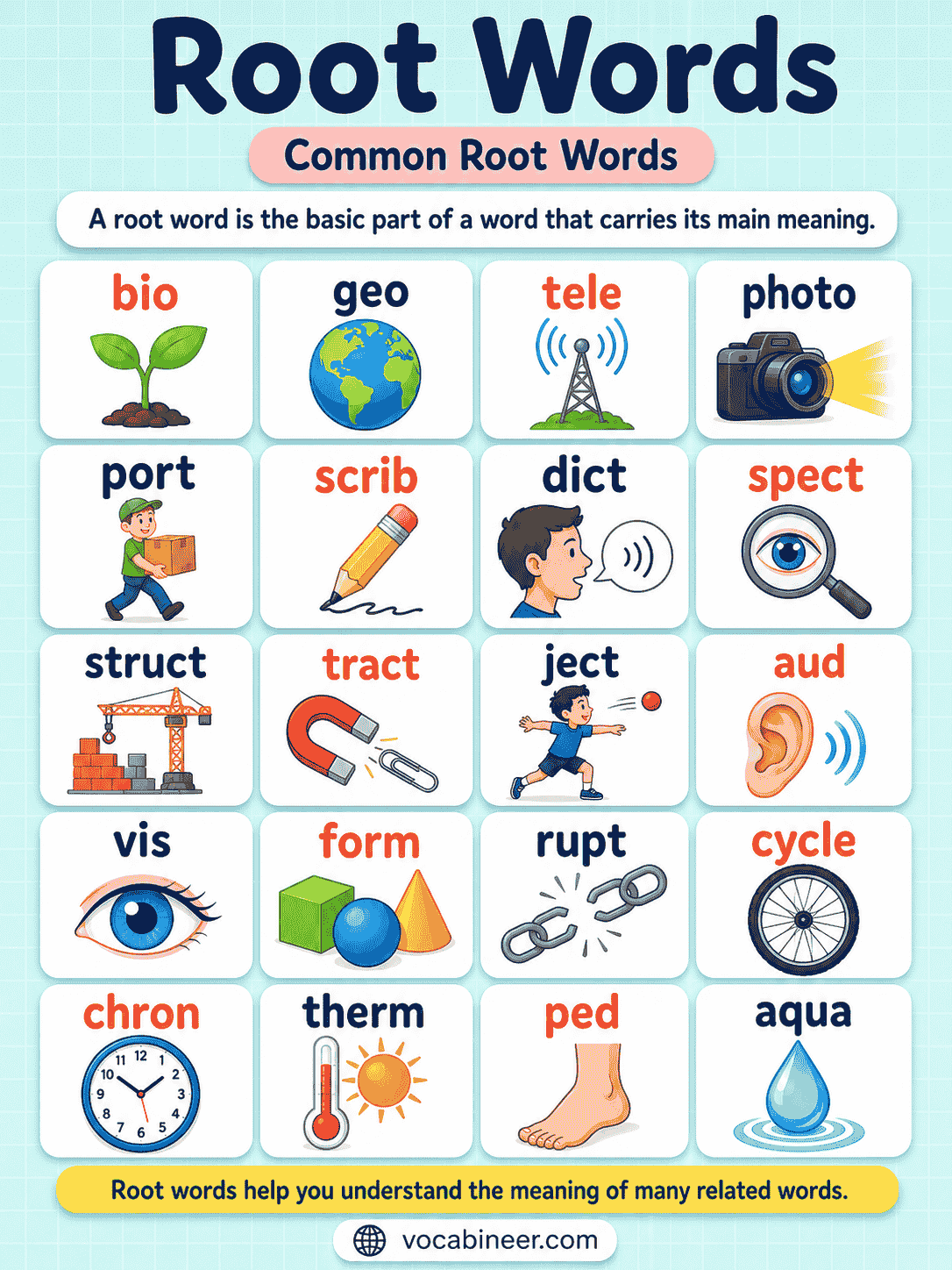
A root is the main part of a word that carries its core meaning. Some roots can stand alone as complete words, while others need prefixes, suffixes, or other word parts to form complete English words.
For example:
- act = do → action, react, actor
- bio = life → biology, biography, biosphere
- dict = say or speak → predict, dictate, contradict
- aud = hear → audio, audience, audition
- port = carry → transport, import, export
In elementary lessons, people often use the term root word for both complete roots and roots that cannot stand alone. However, it is useful to remember that some roots, such as bio and dict, usually appear as parts of larger words.
How Do Roots Build Words?
Roots carry the main meaning, while prefixes and suffixes can change or expand that meaning.
Look at the root port, which means carry.
- transport = carry across or from one place to another
- import = bring or carry in
- export = carry or send out
- portable = able to be carried
The root keeps its basic meaning while the other word parts help create new words.
Root, Prefix, and Suffix
Prefixes, roots, and suffixes each have a different job in a word.
| Word Part | Where It Appears | Main Job | Example |
|---|---|---|---|
| Prefix | beginning | changes or adds meaning | re- in rewrite |
| Root | core of the word | carries the main meaning | write in rewrite |
| Suffix | end | changes meaning or word form | -er in writer |
Understanding these parts makes long words easier to break apart.
Prefix + Root
A prefix comes before a root or base and changes its meaning.
Examples:
- pre + view → preview = see beforehand
- trans + port → transport = carry across
- re + write → rewrite = write again
- sub + marine → submarine = under the sea
Notice that the prefix adds meaning while the root keeps its central idea.
Root + Suffix
A suffix comes after a root or base and can change its meaning or grammatical form.
Examples:
- act + ion → action
- teach + er → teacher
- friend + ship → friendship
- help + ful → helpful
The suffix may turn a verb into a noun, create an adjective, or add another meaning.
Prefix + Root + Suffix
Some words contain all three parts.
Examples:
- un + help + ful → unhelpful
- re + write + ing → rewriting
- dis + agree + ment → disagreement
- un + kind + ness → unkindness
Breaking a long word into smaller parts can make its meaning easier to understand.
| Prefix | Root/Base | Suffix | New Word | Meaning |
|---|---|---|---|---|
| re- | write | -ing | rewriting | writing again |
| un- | kind | -ness | unkindness | the state of being unkind |
| dis- | agree | -ment | disagreement | a lack of agreement |
| help- | help | -ful | helpful | giving help |
Greek and Latin Roots in English
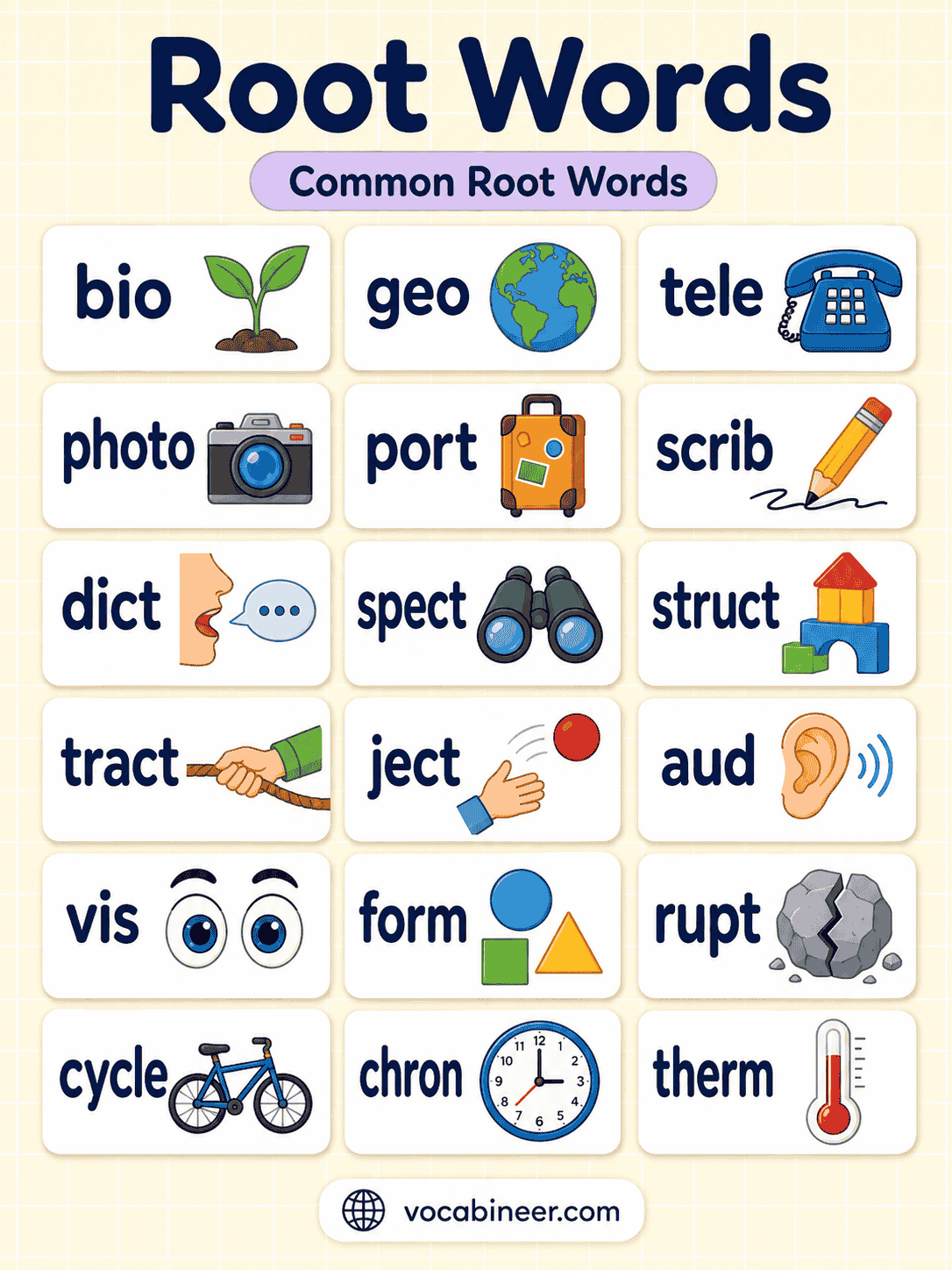
Many academic, scientific, and school-related English words contain roots from Greek and Latin.
For example, Greek roots appear in words such as:
- bio = life
- geo = earth
- phon = sound
- photo = light
- therm = heat
Latin roots appear in words such as:
- port = carry
- dict = say
- scrib/script = write
- struct = build
- rupt = break
English also contains word roots from Old English, French, and many other languages. Therefore, Greek and Latin roots are especially useful for school vocabulary, but they are not the only sources of English words.
Common Root Words With Meanings and Examples
Learning a few high-value roots can help children understand many larger words.
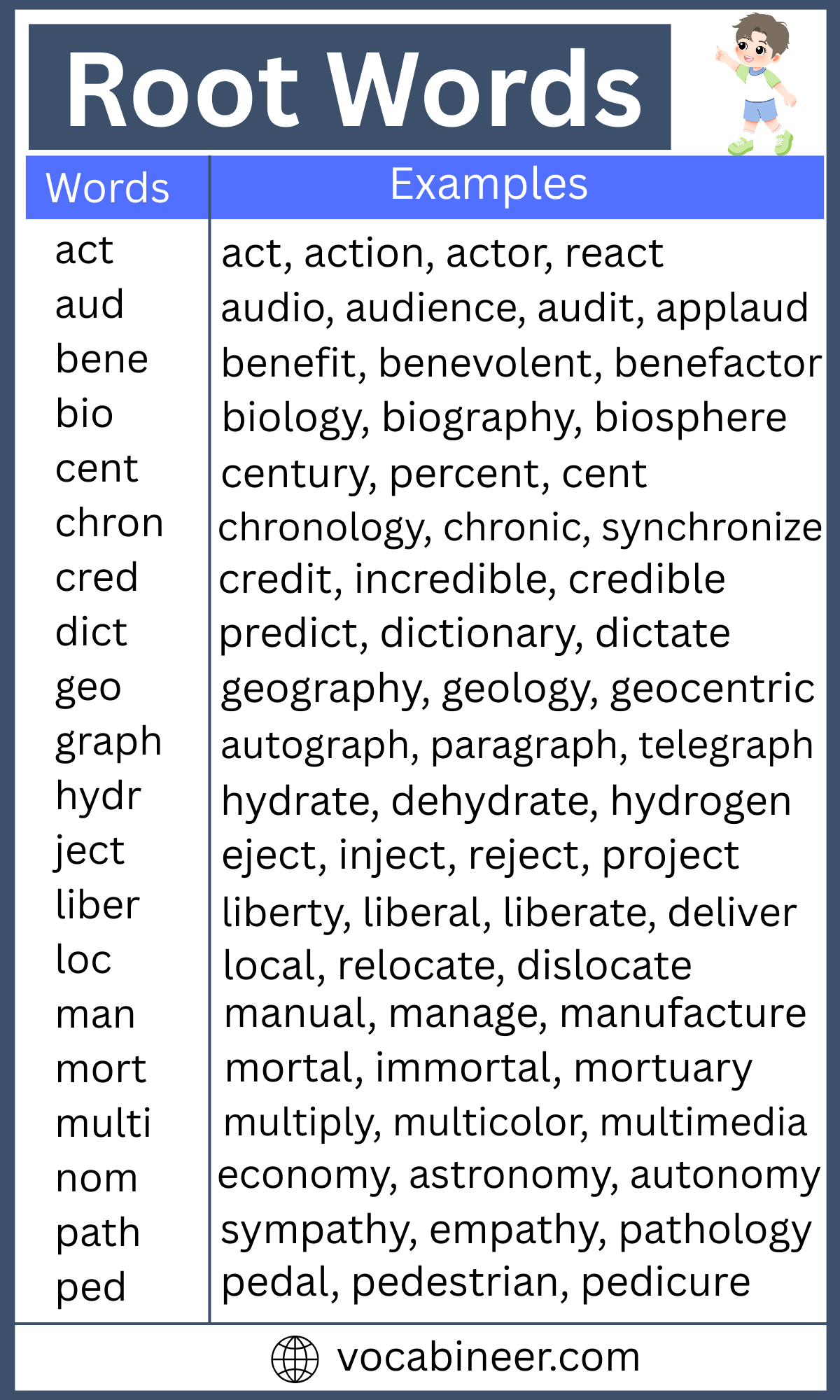
| Root | Meaning | Example Words |
|---|---|---|
| act | do | action, actor, active |
| aqua | water | aquarium, aquatic, aqueduct |
| aud | hear | audio, audience, audition |
| bell | war | bellicose, rebellion, antebellum |
| bio | life | biology, biography, biosphere |
| chron | time | chronology, chronic, synchronize |
| cred | believe | credit, credible, incredible |
| dict | say, speak | predict, dictate, contradict |
| form | shape | transform, formation, deform |
| geo | earth | geography, geology, geothermal |
| graph | write, draw | autograph, graphic, paragraph |
| homo | same | homonym, homogeneous, homophone |
| ject | throw | eject, inject, project |
| loc | place | locate, location, relocate |
| meter | measure | thermometer, speedometer, barometer |
| morph | form, shape | morphology, metamorphosis, amorphous |
| nav | ship, sail | naval, navigate, navy |
| oct | eight | octagon, octave, octet |
| path | feeling | sympathy, empathy, apathy |
| phon | sound | telephone, microphone, phonics |
| photo | light | photograph, photosynthesis, photocopy |
| port | carry | transport, import, export |
| quest/quer | ask, seek | question, request, query |
| rupt | break | erupt, interrupt, rupture |
| scrib/script | write | scribble, manuscript, inscription |
| spec | look, see | inspect, spectator, spectacle |
| struct | build | construct, structure, instruct |
| tele | far | telephone, telescope, television |
| therm | heat | thermal, thermostat, thermometer |
| vid/vis | see | video, visible, vision |
These roots do not always appear in exactly the same spelling in every word. However, recognizing their meaning can still help readers understand unfamiliar vocabulary.
Root Word Examples in Sentences
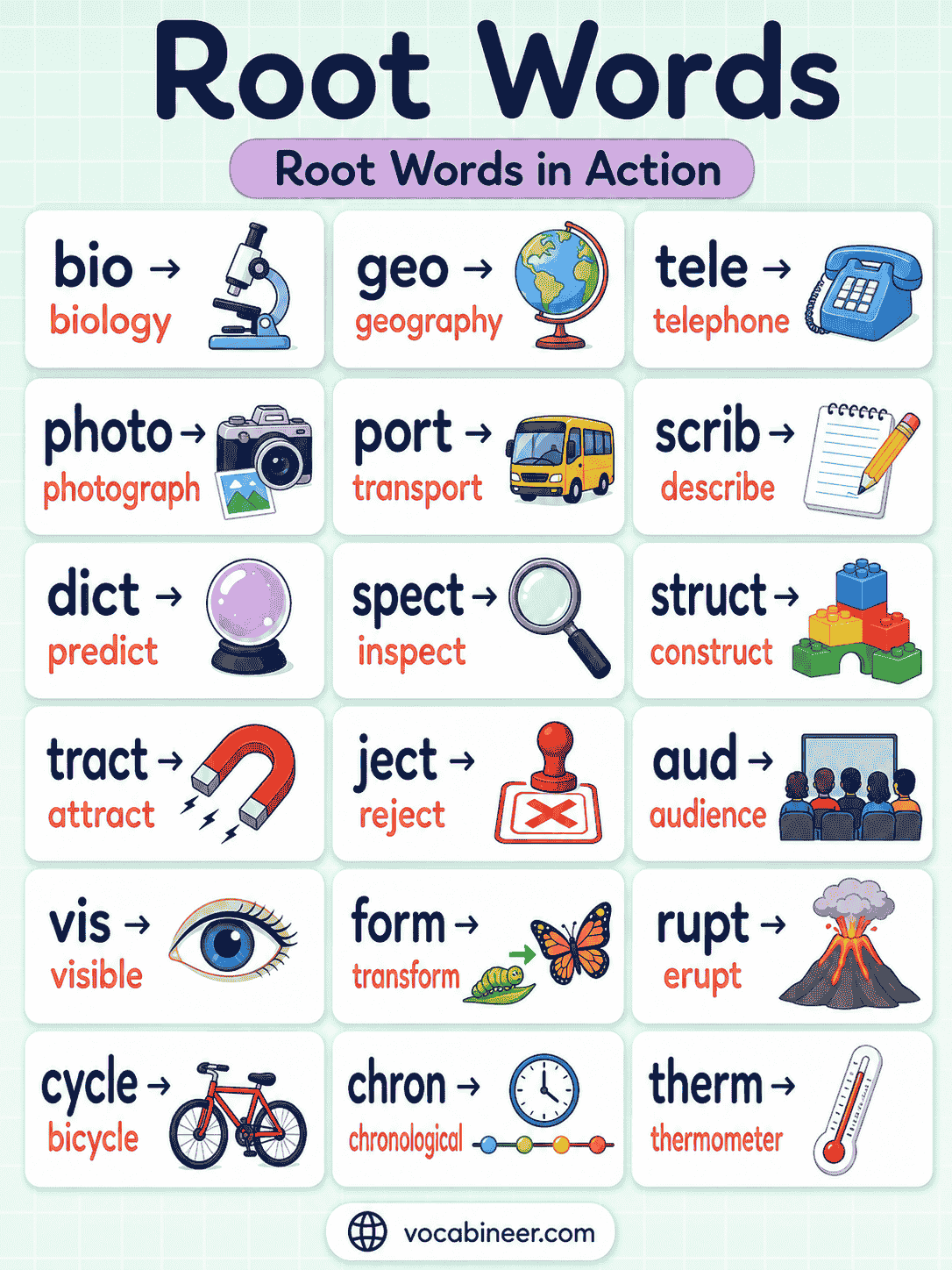
Seeing roots inside complete sentences makes their meanings easier to remember.
Aud = hear
The audience listened carefully to the speaker.
The root aud relates to hearing.
Bio = life
Mia read a biography of a famous scientist.
The root bio means life.
Geo = earth
We studied geography during social studies.
The root geo relates to the earth.
Struct = build
Workers will construct a new bridge.
The root struct means build.
Port = carry
The truck will transport the boxes to the store.
The root port means carry.
Therm = heat
A thermometer measures temperature.
The root therm relates to heat.
Phon = sound
We used a microphone so everyone could hear clearly.
The root phon means sound.
Photo = light
Plants use light during photosynthesis.
The root photo means light.
Cred = believe
Her explanation sounded credible.
The root cred means believe.
Tele = far
We looked at the moon through a telescope.
The root tele means far.
Root vs. Base Word
A root and a base word are related ideas, but they are not always exactly the same.
A root carries the deepest core meaning of a word. Some roots can stand alone, but many Greek and Latin roots cannot.
A base word is a form that can take prefixes or suffixes. In elementary grammar, a base word is often a complete English word.
Compare:
| Feature | Root | Base Word |
|---|---|---|
| Main job | carries the core meaning | provides a form for building new words |
| Can stand alone? | sometimes | often in elementary examples |
| Example | bio = life | help |
| Larger words | biology, biography | helpful, helpless |
For example:
- bio is a root in biology
- help is a base word in helpful
- write can act as a base in rewrite and writer
The most important idea for children is that both roots and base words help us understand how larger words are built.
How Root Words Help You Understand New Words
Roots act like meaning clues inside unfamiliar words.
Suppose you see the word geothermal for the first time.
You may already know:
- geo = earth
- therm = heat
Those two roots suggest that geothermal has something to do with heat from the earth.
Now consider transport.
- trans- = across
- port = carry
Together, the parts suggest the idea of carrying something across or from one place to another.
This strategy does not give the exact dictionary meaning every time, but it can help readers make a strong first guess.
Easy Ways to Learn Root Words
Root words become easier to remember when children study them as meaningful word families instead of isolated definitions.
Learn a few roots at a time.
Start with useful roots such as bio, geo, port, dict, struct, and aud.
Group words by root.
For example, place transport, import, export, and portable together under port.
Break long words into parts.
Look for a prefix, root, and suffix before guessing the meaning.
Use flashcards.
Write the root on one side and its meaning with two examples on the other.
Use roots in sentences.
Writing a sentence with a root-based word helps connect meaning to real language.
Look for roots while reading.
Science, geography, and other school subjects contain many Greek and Latin roots.
Root Words Practice
Complete each activity before checking the answer key.
Find the Root
Identify the root in each word.
- transport
- biology
- predict
- geography
- construct
- audible
- thermal
- photograph
Match the Root to Its Meaning
Match each root with the correct meaning.
- bio
- geo
- aud
- port
- dict
- therm
Meanings:
a. carry
b. earth
c. say or speak
d. life
e. hear
f. heat
Build the Word
Combine the word parts.
- re + write
- trans + port
- un + kind + ness
- dis + agree + ment
- teach + er
- help + ful
Use Roots to Guess the Meaning
Use the root meanings to choose the best answer.
- If geo means earth, what is geology most likely connected to?
- a. music
- b. the earth
- c. cooking
- If aud means hear, what does audible most likely mean?
- a. able to be heard
- b. able to be carried
- c. full of light
- If port means carry, what does portable most likely describe?
- a. something easy to carry
- b. something very hot
- c. something that makes sound
- If therm means heat, what does thermal most likely relate to?
- a. heat
- b. writing
- c. water
- If struct means build, what does construct most likely mean?
- a. to break
- b. to build
- c. to hear
Complete the Word Family
Add two related words for each root.
- port → transport, ________, ________
- bio → biology, ________, ________
- struct → construct, ________, ________
- aud → audio, ________, ________
- geo → geography, ________, ________
Answer Key
Find the Root
- transport — port
- biology — bio
- predict — dict
- geography — geo
- construct — struct
- audible — aud
- thermal — therm
- photograph — photo
Match the Root to Its Meaning
- bio — d. life
- geo — b. earth
- aud — e. hear
- port — a. carry
- dict — c. say or speak
- therm — f. heat
Build the Word
- re + write → rewrite
- trans + port → transport
- un + kind + ness → unkindness
- dis + agree + ment → disagreement
- teach + er → teacher
- help + ful → helpful
Use Roots to Guess the Meaning
- b. the earth
- a. able to be heard
- a. something easy to carry
- a. heat
- b. to build
Complete the Word Family
Possible answers include:
- port → transport, import, export
- bio → biology, biography, biosphere
- struct → construct, structure, instruct
- aud → audio, audience, audition
- geo → geography, geology, geothermal
Other correct words containing the same root may also be accepted.
FAQs
A root word is the simplest form of a word that holds the main meaning. Other words are built from it using prefixes and suffixes.
A base word can stand alone (like happy), while a root word sometimes can’t (like bio). Roots are the foundation of many words.
Yes, the majority of English root words come from Latin and Greek. However, some also come from Old English and other languages.
Common examples include bio (life), port (carry), dict (say), and scrib/script (write). These appear in hundreds of English words.
Learning root words helps you guess the meaning of new words. It improves vocabulary, spelling, and reading comprehension.
Read More
- Word Families for Kids
- CVC Rhyming Words for Kids
- Preschool Vocabulary Words
- Short Vowel Words for Kids
- Long Vowel Words for Kids
- 300+ Kindergarten Words
- Sight Words for Kids