

The -ag word family includes words that share the same -ag ending and short a sound. Words such as bag, rag, tag, wag, drag, and flag help beginning readers recognize a familiar spelling pattern and blend sounds more confidently.
Learning these words together supports phonics, spelling, pronunciation, and reading fluency. This lesson introduces easy -ag words, consonant-blend words, simple meanings, picture ideas, sentences, a short reading story, and focused practice activities.
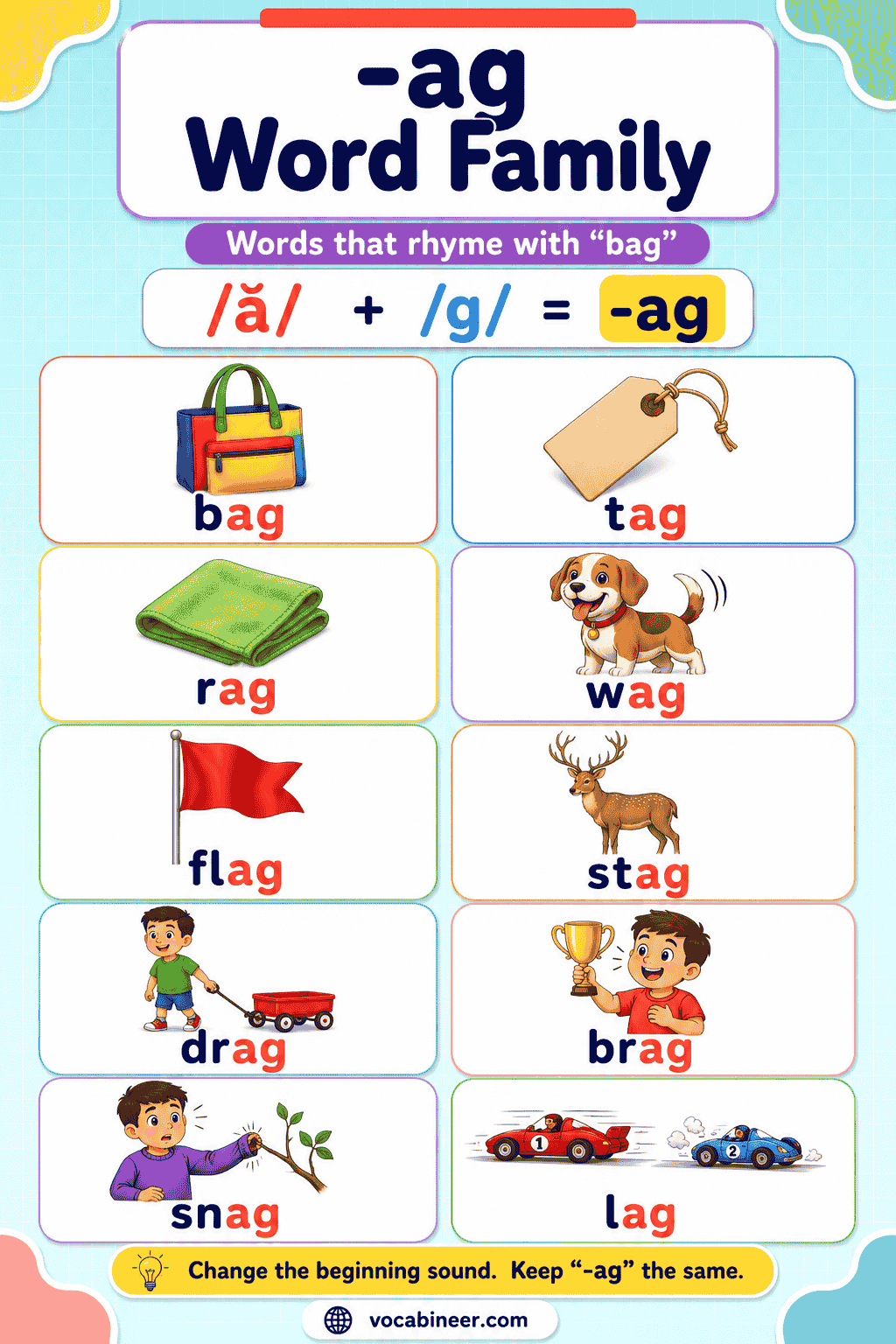
In This Page
What Is the -ag Word Family?
A word family is a group of words that share the same ending letters and a similar ending sound. In the -ag family, the letters a and g remain the same while the beginning sound changes.
For example:
- b + ag = bag
- r + ag = rag
- t + ag = tag
- w + ag = wag
The letter a makes its short sound, as in apple, while g makes its usual hard sound. Together, -ag sounds like the ending of bag.
Many beginner -ag words follow a CVC pattern:
- C means consonant.
- V means vowel.
- C means consonant.
The word bag, for instance, follows the pattern b-a-g. Once children recognize the shared ending, they can read several new words by changing only the first sound.
Words such as agent, magic, dragon, and wagon contain the letters ag, but they do not belong to the short-a -ag word family because they do not end with the same /ag/ sound.
How to Make -ag Words
Children can form -ag words by placing a consonant or consonant blend before the shared ending.
Begin with:
-ag
Next, add a starting sound:
| Beginning | Ending | Complete word |
|---|---|---|
| b | ag | bag |
| r | ag | rag |
| t | ag | tag |
| w | ag | wag |
| l | ag | lag |
| n | ag | nag |
| s | ag | sag |
Ask children to pronounce the sounds separately before blending them:
/b/ + /ag/ = bag
/r/ + /ag/ = rag
/t/ + /ag/ = tag
With repeated practice, children begin to recognize -ag as one familiar word part rather than sounding out every letter separately.
Easy -ag Words for Kids
Start with familiar words that are easy to understand and illustrate. After children master these, introduce the less concrete action words.
Bag – A container used to carry or store things.
My books are in the bag.
Rag – An old piece of cloth used for cleaning.
Dad wiped the table with a rag.
Tag – A small label attached to an object.
The price is written on the tag.
Wag – To move from side to side, especially a tail.
The happy dog can wag its tail.
Gag – To choke or feel as though something is blocking the throat. It can also mean a joke.
The strong smell made him gag.
Lag – To move slowly or fall behind.
Do not lag behind the group.
Nag – To keep reminding or complaining to someone repeatedly.
Please do not nag your brother.
Sag – To bend, droop, or hang downward.
The heavy bag made the shelf sag.
These words rhyme because they share the same final sound:
bag, gag, lag, nag, rag, sag, tag, wag
The words bag, rag, tag, and wag are usually the easiest choices for an introductory lesson because they are familiar and simple to show in pictures.
The word hag also follows the -ag sound pattern. However, it can be an insulting term for an older woman, so it is better reserved for carefully explained fairy-tale vocabulary rather than a core children’s list.
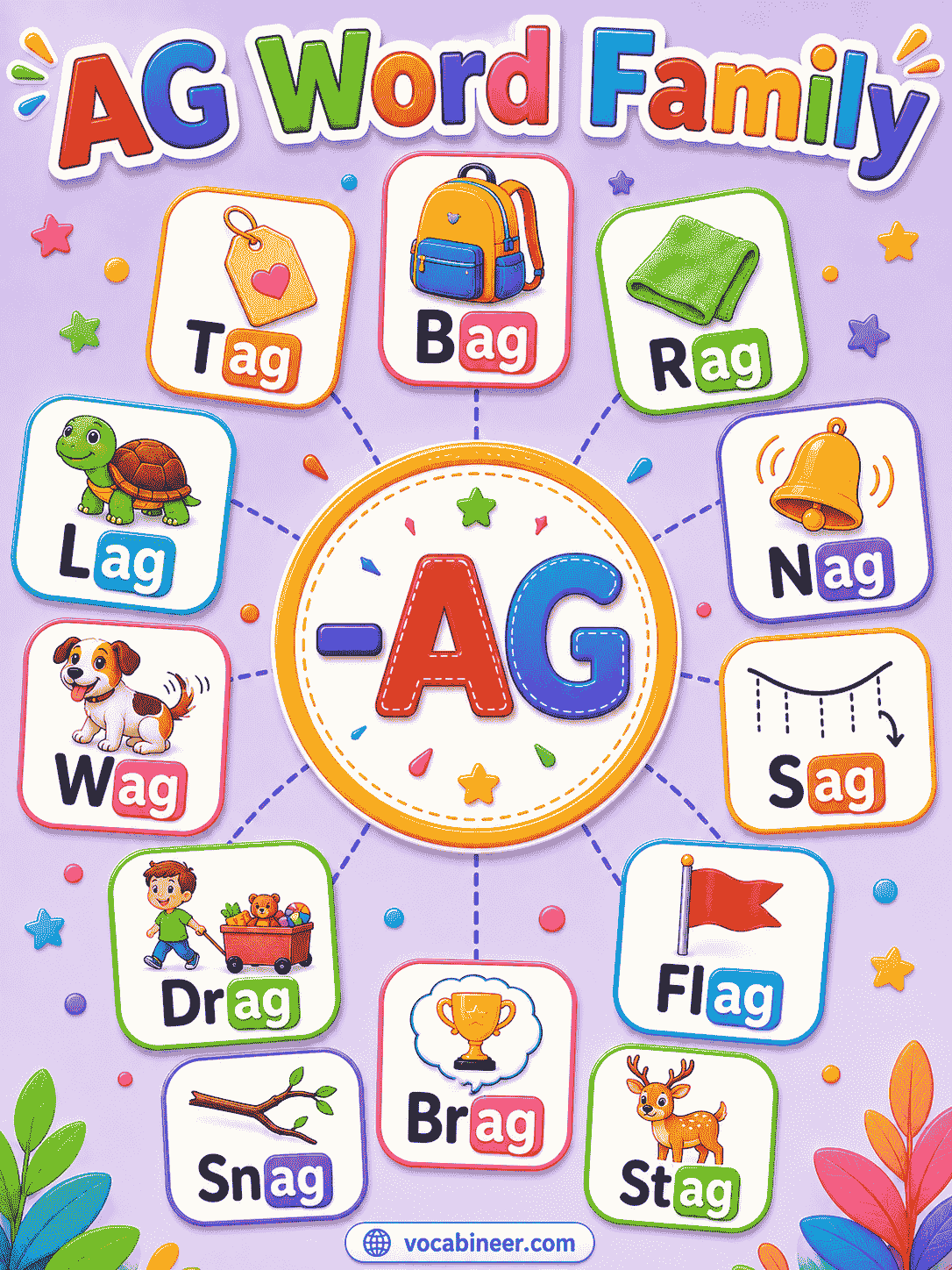
-ag Words with Beginning Blends
After mastering simple CVC words, children can practice words that begin with consonant blends.
In a blend, two or more consonant sounds appear before -ag, and each beginning sound can still be heard.
Brag – To speak too proudly about yourself or something you have done.
It is not polite to brag.
br + ag = brag
Crag – A steep, rough rock or cliff.
The goat stood on the crag.
cr + ag = crag
Drag – To pull something along a surface.
Do not drag the box across the floor.
dr + ag = drag
Flag – A piece of cloth used as a symbol for a country, group, or organization.
The flag moved in the wind.
fl + ag = flag
Snag – A small problem or something that becomes caught.
My sleeve caught on a snag.
sn + ag = snag
Stag – An adult male deer.
The stag stood near the trees.
st + ag = stag
Most of these words follow a CCVC structure because two consonants appear before the vowel:
- brag = b-r-a-g
- drag = d-r-a-g
- flag = f-l-a-g
- snag = s-n-a-g
- stag = s-t-a-g
Although crag is a correct word, it may be less familiar to young children. Therefore, teachers can introduce brag, drag, flag, snag, and stag first.
-ag Words with Pictures and Meanings
Pictures help children connect each written word with an object, action, or situation. Concrete nouns are easy to illustrate, while action words need clear scenes.
| -ag word | Simple meaning | Helpful picture idea |
|---|---|---|
| Bag | A container for carrying things | A schoolbag filled with books |
| Rag | An old cleaning cloth | A cloth wiping a table |
| Tag | A small label | A price tag on a shirt |
| Wag | To move from side to side | A dog moving its tail |
| Gag | To choke or retch | A person reacting to a bad smell |
| Lag | To fall behind | A child behind others in a race |
| Nag | To remind or complain repeatedly | Someone giving the same reminder |
| Sag | To droop downward | A heavy rope hanging low |
| Brag | To talk too proudly | A child showing off a prize |
| Crag | A steep rough rock | A rocky cliff |
| Drag | To pull along a surface | A child pulling a box |
| Flag | A cloth symbol | A flag flying on a pole |
| Snag | A problem or caught section | Fabric caught on a branch |
| Stag | An adult male deer | A deer with antlers |
For lag, nag, sag, brag, drag, and snag, the illustration should show the action clearly. A single object without context may not communicate the meaning accurately.
Longer Words with -ag
Some longer words contain a complete -ag family word such as bag or tag. These compounds help children recognize familiar word chunks inside larger words.
Beanbag – A soft bag filled with small beads or beans.
The child sat on a beanbag.
Handbag – A bag carried by hand or over the shoulder.
Her keys were inside the handbag.
Sandbag – A strong bag filled with sand.
Workers placed a sandbag near the door.
Schoolbag – A bag used to carry school supplies.
My schoolbag is under the desk.
Mailbag – A large bag used for carrying letters and packages.
The carrier lifted the mailbag.
Sleeping Bag – A warm padded bag used for sleeping outdoors.
We used a sleeping bag in the tent.
Name Tag – A label that displays a person’s name.
I wore a name tag at the event.
Price Tag – A label showing how much something costs.
The price tag was attached to the toy.
Zigzag – A line or path made of sharp turns in opposite directions.
Draw a zigzag across the page.
Ragtag – Untidy, mixed, or poorly organized.
The story followed a ragtag group of travelers.
These words work best as extension vocabulary. Children should first master short words such as bag, rag, tag, and wag before reading compounds with two or more syllables.
Words such as dragon, wagon, magnet, and magic do not belong to the same family. Although they contain the letters ag, they do not end with the complete short-a -ag sound.
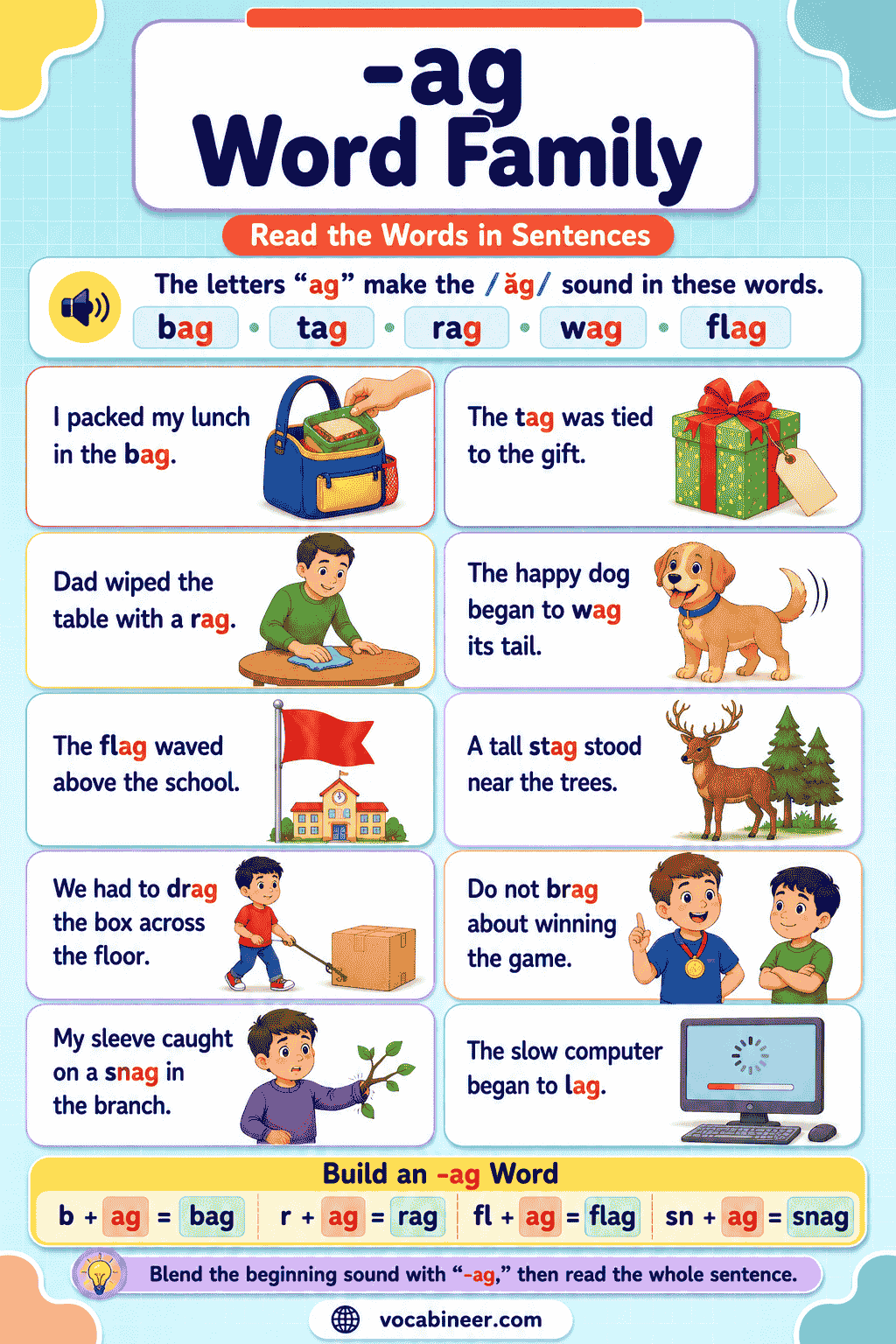
-ag Word Family Sentences
Short sentences give children a chance to read target words in meaningful contexts.
- The tag is on the bag.
- Dad used a rag.
- The dog can wag its tail.
- Do not drag the bag.
- The flag is on the pole.
- The stag ran into the woods.
- Mia began to lag behind.
- The shelf started to sag.
- Do not brag about your score.
- My coat caught on a snag.
- A name tag was on the bag.
- The dog gave its tail a wag.
- Sam used a rag to clean the desk.
- The heavy box made the shelf sag.
- We had to drag the branch away.
- A red flag waved in the wind.
- The stag stood beside the crag.
- The price tag fell from the shirt.
- Her books filled the schoolbag.
- Please do not nag him again.
Children can underline each -ag word after reading. They can also circle the beginning sound and draw a box around the shared -ag ending.
Short -ag Word Family Story
A short story allows children to meet several -ag words in connected reading.
The Bag with a Tag
Dad had a red bag. A small tag was tied to the bag.
The dog ran over and began to wag its tail. Then it tried to drag the bag across the rug.
Dad used a rag to clean a mark from the bag. At last, he placed it beside a flag.
The dog sat down and gave its tail one final wag.
Story Words
The story includes these -ag words:
- bag;
- tag;
- wag;
- drag;
- rag;
- flag.
Reading Questions
What color was Dad’s bag?
The bag was red.
What was tied to the bag?
A small tag was tied to it.
What did the dog try to do?
The dog tried to drag the bag.
What did Dad use to clean the bag?
He used a rag.
Where did Dad place the bag?
He placed it beside a flag.
-ag Word Family Practice
These activities reinforce blending, spelling, word recognition, and comprehension.
Add the Beginning Sound
Complete each word by adding the missing first letter.
- __ag — a container for carrying things
- __ag — an old cleaning cloth
- __ag — a small label
- __ag — to move a tail from side to side
- __ag — to fall behind
- __ag — to droop downward
Answers: bag, rag, tag, wag, lag, sag
Match Words with Pictures
Match each word with the correct picture or description.
| Word | Picture or meaning |
|---|---|
| Bag | A. A male deer |
| Flag | B. A container with handles |
| Stag | C. A dog moving its tail |
| Wag | D. A cloth symbol on a pole |
| Rag | E. An old cleaning cloth |
Answers: Bag—B, Flag—D, Stag—A, Wag—C, Rag—E
Complete the Sentence
Choose from bag, drag, flag, rag, sag, tag, and wag.
- The dog can ______ its tail.
- Put the books in the ______.
- The shirt has a price ______.
- Dad used a ______ to clean the table.
- Do not ______ the chair.
- The heavy shelf may ______.
- The ______ waved in the wind.
Answers: wag, bag, tag, rag, drag, sag, flag
Sort CVC and Blend Words
Place the words in the correct group:
bag, brag, drag, flag, lag, rag, snag, tag, wag
| CVC words | Words with beginning blends |
|---|---|
| bag | brag |
| lag | drag |
| rag | flag |
| tag | snag |
| wag |
Find the Rhyming Word
Choose the word that rhymes with the first word.
- Bag: dog or tag
- Rag: rug or wag
- Flag: frog or drag
- Snag: stag or snake
- Wag: web or sag
Answers: tag, wag, drag, stag, sag
Build New -ag Words
Change the beginning sound to make a new word.
- Change b in bag to r.
- Change r in rag to t.
- Change t in tag to w.
- Change w in wag to l.
- Add fl before -ag.
- Add dr before -ag.
Answers: rag, tag, wag, lag, flag, drag
Write an -ag Word
Ask children to write:
- one word naming a container;
- one word naming a cleaning cloth;
- one word naming a label;
- one word describing a dog’s tail movement;
- one word naming a male deer;
- one word naming a cloth symbol.
Possible answers are bag, rag, tag, wag, stag, and flag.
FAQs
Common -ag words include bag, gag, lag, nag, rag, sag, tag, and wag. Blend words include brag, crag, drag, flag, snag, and stag.
The ending uses the short a sound followed by a hard g, as heard in bag, rag, and tag.
Many basic words, including bag, lag, rag, sag, tag, and wag, are CVC words. Words such as brag, drag, and flag begin with consonant blends.
No. Words such as dragon, wagon, magic, and magnet contain the letters ag, but they do not end with the same short-a -ag sound.
Children can blend beginning sounds with -ag, match words to pictures, sort CVC and blend words, complete sentences, read a short story, and change initial letters to build new words.
Read More
- CVC Rhyming Words for Kids
- Preschool Vocabulary Words
- Short Vowel Words for Kids
- Long Vowel Words for Kids
- 300+ Kindergarten Words
- Sight Words for Kids