

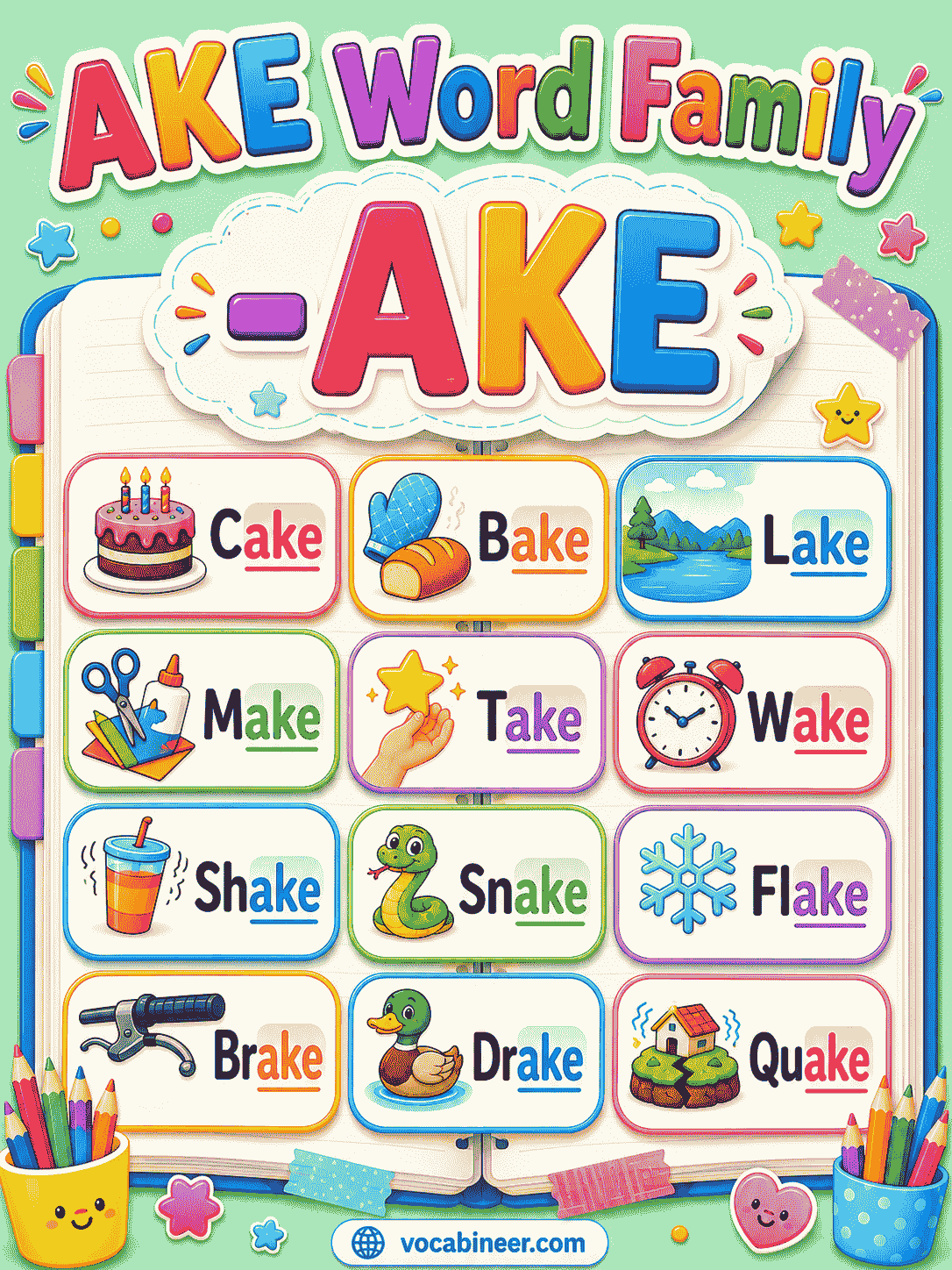
The -ake word family introduces children to a common long-a spelling pattern found in words such as bake, cake, lake, make, rake, snake, and take. When learners recognize the shared ending, they can decode words more quickly, improve spelling, and read with greater confidence.
Through clear meanings, short example sentences, reading practice, and simple activities, children can learn to use -ake words in isolation and connected text. This lesson also explains consonant blends, the sh digraph, longer words containing -ake, and the difference between brake and break.
In This Page
What Is the -ake Word Family?
The -ake word family includes words that share the ending -ake and usually rhyme with cake.
In each word, the beginning sound changes while the ending remains the same:
- b + ake = bake
- c + ake = cake
- t + ake = take
Once children recognize -ake as a familiar spelling unit, they do not need to sound out every letter separately. Instead, they can blend the beginning sound with the shared ending.
For example:
- /b/ + /ake/ = bake
- /m/ + /ake/ = make
- /r/ + /ake/ = rake
As a result, pattern recognition helps children read unfamiliar words more smoothly and spell related words more accurately.
How the -ake Spelling Pattern Works
The -ake ending usually contains the long a sound. In words such as bake, cake, lake, and make, the final e is silent, but it helps the letter a make its long sound.
Compare these short- and long-vowel words:
| Short-vowel word | Long-a word |
|---|---|
| mad | made |
| tap | tape |
| cap | cape |
The same silent-e rule appears in -ake words. Although the final e is not pronounced, it changes the sound of the vowel that comes before the consonant.
Teachers commonly call this the silent-e pattern. It is also known as magic e or the vowel-consonant-e pattern.
A simple way to read an -ake word is to:
- identify the beginning sound;
- recognize the -ake ending;
- blend the two parts together.
For instance:
m + ake = make
sn + ake = snake
Most short words ending in -ake rhyme with cake. However, longer words may contain additional syllables, so beginners should master the short words first.
Common -ake Words with Meanings and Examples
These familiar words provide the best starting point for phonics, spelling, and vocabulary practice.
| Word | Simple meaning | Example sentence |
|---|---|---|
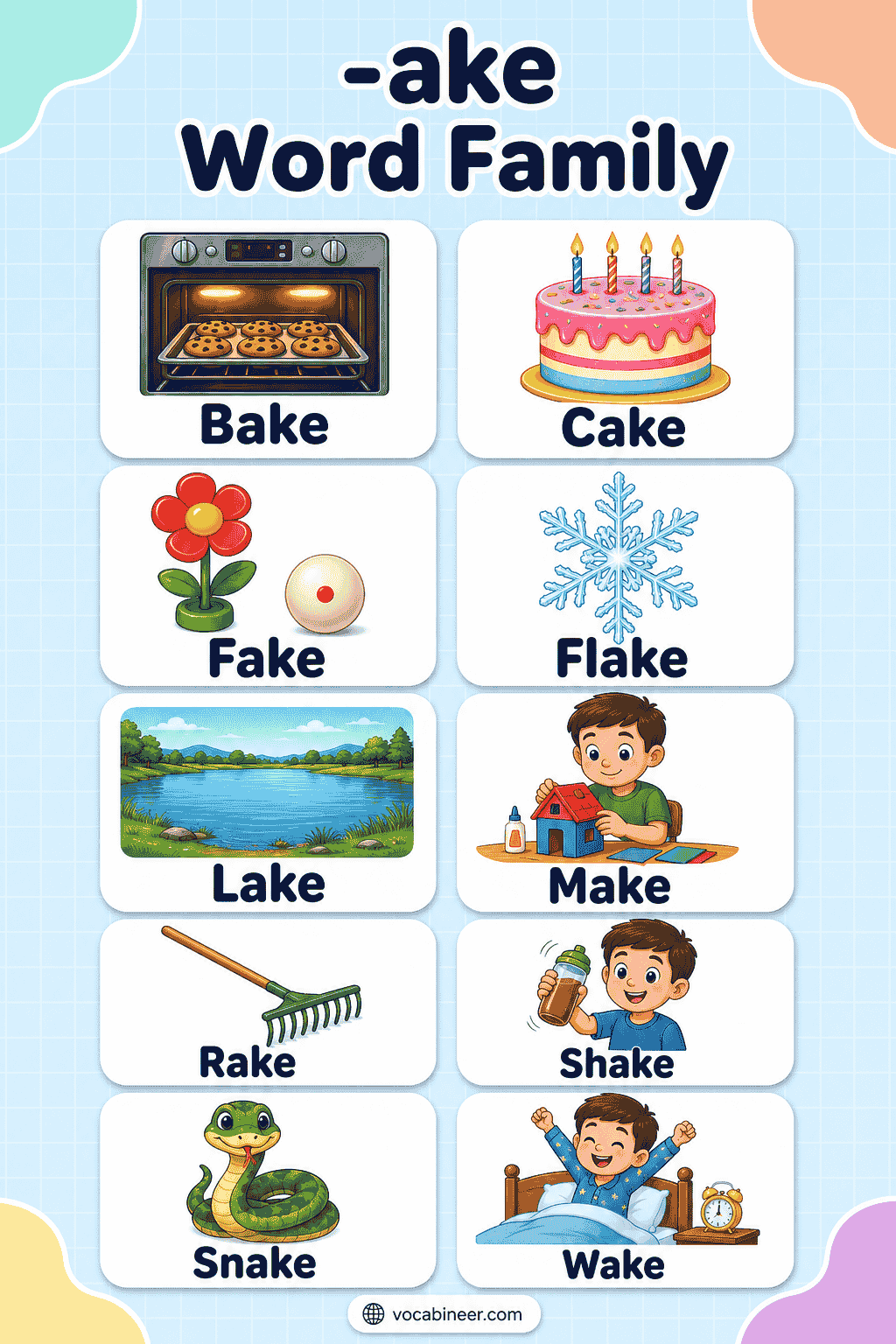
| Bake | To cook food in an oven | We will bake cookies today. |
| Cake | A sweet baked food | She made a birthday cake. |
| Fake | Not real | The flower looked real, but it was fake. |
| Lake | A large body of water surrounded by land | Ducks swam across the lake. |
| Make | To create or produce something | We will make a paper kite. |
| Rake | A garden tool used to gather leaves | Dad used a rake in the yard. |
| Take | To carry or move something | Please take your bag to class. |
| Wake | To stop sleeping | I wake up early for school. |
These words appear frequently in children’s books, classroom directions, and everyday conversations. Therefore, learners should practice them before moving to less familiar vocabulary.
Some words can work as more than one part of speech. For example, rake can name a garden tool or describe an action.
We used a rake.
We rake the leaves.
Understanding both uses helps children see how the same word can function differently in a sentence.
-ake Words with Blends and Digraphs
Some -ake words begin with consonant blends, while shake begins with the digraph sh.
| Word | Beginning pattern | Meaning | Example sentence |
|---|---|---|---|
| Brake | br blend | A device used to slow or stop movement | Press the brake before the stop sign. |
| Flake | fl blend | A small, thin piece | A snowflake landed on my coat. |
| Shake | sh digraph | To move quickly back and forth | Shake the bottle gently. |
| Snake | sn blend | A long, legless reptile | The snake moved through the grass. |
| Stake | st blend | A pointed post placed in the ground | We tied the plant to a stake. |
In brake, flake, snake, and stake, learners hear two consonant sounds at the beginning:
- /b/ + /r/
- /f/ + /l/
- /s/ + /n/
- /s/ + /t/
In contrast, the letters sh in shake work together to make one sound.
For blending practice, children can separate each word into two parts:
- br + ake
- fl + ake
- sh + ake
- sn + ake
- st + ake
Afterward, they should read each word again without pausing between the parts.
Less Common -ake Words
A few real -ake words appear less often in everyday speech, but they can expand a learner’s vocabulary.
Drake means a male duck.
A drake swam beside the female duck.
Quake means to shake strongly.
The ground began to quake during the earthquake.
Sake means purpose, benefit, or reason, especially in expressions such as for your sake or for the sake of safety.
We stayed inside for the sake of safety.
These words follow the same spelling pattern, but they need more explanation than familiar examples such as cake, lake, make, and take.
Names such as Jake and Blake also rhyme with the family. However, they are proper names rather than general vocabulary words, so they should not appear in the main phonics list.
Longer Words Containing -ake
Many longer words contain a complete -ake word or end with the same letter pattern.
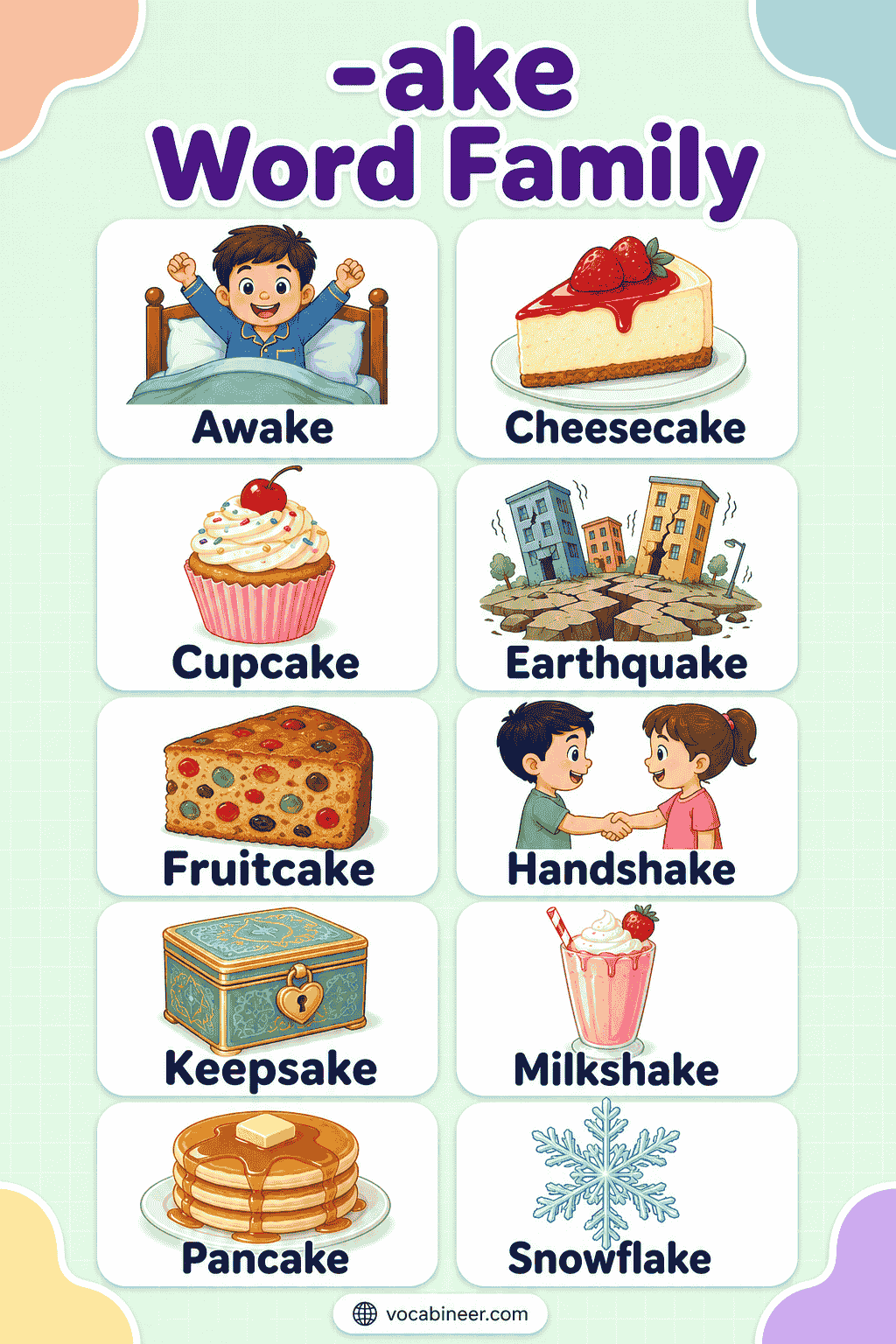
Awake means no longer sleeping.
I was still awake when the rain began.
Cupcake is a small cake baked in a paper cup.
She decorated the cupcake with pink frosting.
Earthquake is a sudden shaking of the ground.
The class practiced what to do during an earthquake.
Fruitcake is a cake made with dried or candied fruit.
Grandma served fruitcake during the holiday.
Keepsake is an object kept because it brings back a special memory.
The photograph is a family keepsake.
Milkshake is a cold drink made with milk and ice cream.
He ordered a strawberry milkshake.
Mistake is something done incorrectly.
I corrected the spelling mistake.
Namesake is a person or thing that shares a name with another.
The baby was her grandmother’s namesake.
Pancake is a flat, round cake cooked in a pan.
We ate pancakes for breakfast.
Remake means to make something again.
They decided to remake the model.
Retake means to take or do something again.
The student had to retake the test.
Snowflake is a small crystal of snow.
A snowflake melted on my glove.
Longer words become easier when children identify the smaller familiar word inside them:
- cup + cake
- fruit + cake
- milk + shake
- pan + cake
- snow + flake
Breaking words into smaller parts supports both pronunciation and spelling.
Brake and Break: What Is the Difference?
Brake and break sound the same, but they have different spellings and meanings.
| Word | Meaning | Example |
|---|---|---|
| Brake | A device or action used to slow or stop movement | Press the brake gently. |
| Break | To damage, separate, or pause | Do not break the glass. |
Use brake when talking about stopping a bicycle, car, train, or machine.
The driver pressed the brake.
Use break when something becomes damaged or separates into pieces.
Be careful not to break the toy.
The word break can also mean a short rest.
We took a ten-minute break.
Although the two words sound alike, the sentence meaning shows which spelling is correct.
Reading Practice with -ake Words
Short passages help children recognize the spelling pattern inside connected text.
A child helped her mother bake a cake. First, they had to make the batter. Then they placed the cake in the oven. While it baked, the child used a rake to gather leaves near the lake.
Ask learners to underline every word ending in -ake. Then have them read the passage again without pausing before the target words.
A second passage introduces blends and additional vocabulary:
A snake rested beside a wooden stake near the lake. Suddenly, the ground began to shake. A small flake of dirt fell from a rock, so the snake quickly moved away.
Use these questions to check understanding:
- What did the child help bake?
- What tool did the child use outside?
- Where did the snake rest?
- What began to shake?
- Why did the snake move away?
These questions help children understand the passage as well as read the target words accurately.
Activities for Learning the -ake Word Family
Simple, focused activities help learners remember the pattern and use the words correctly.
Build the words
Write -ake on a card or board. Then add different beginning letters:
b + ake = bake
c + ake = cake
l + ake = lake
m + ake = make
r + ake = rake
t + ake = take
w + ake = wake
Next, introduce blends and the sh digraph:
br + ake = brake
fl + ake = flake
sh + ake = shake
sn + ake = snake
st + ake = stake
Match words with pictures
Use pictures for:
- cake
- lake
- rake
- snake
- snowflake
Ask learners to place each written word beside the correct image.
Complete the sentences
Use this word bank:
bake, cake, lake, make, rake, take, wake
- We will ______ bread today.
- She made a birthday ______.
- Ducks swam in the ______.
- Let us ______ a paper boat.
- Dad used a ______ to gather leaves.
- Please ______ your notebook.
- I ______ up early for school.
Answers: bake, cake, lake, make, rake, take, wake
Sort short and longer words
Place the words into the correct groups:
cake, milkshake, rake, pancake, snake, snowflake, mistake, take
| Short words | Longer words |
|---|---|
| cake | milkshake |
| rake | pancake |
| snake | snowflake |
| take | mistake |
This activity helps children recognize the familiar spelling pattern inside multisyllable words.
Find the rhyming words
Ask learners to identify the words that rhyme:
- bake
- ball
- cake
- lake
- cat
- make
- rake
- sun
- take
Then read the rhyming chain aloud:
bake → cake → lake → make → rake → take
FAQs
The -ake ending usually contains the long a sound, as heard in bake, cake, lake, make, and take.
Common examples include bake, cake, fake, lake, make, rake, take, and wake.
Yes. Snake belongs to the family because it ends in -ake and rhymes with cake.
No. Ache ends in -ache, not -ake. Although it contains a similar vowel sound, it follows a different spelling pattern.
Children can build words with letter cards, read rhyming groups, match words with pictures, practice blends, complete sentences, and find -ake words in short passages.
Read More
- CVC Rhyming Words for Kids
- Preschool Vocabulary Words
- Short Vowel Words for Kids
- Long Vowel Words for Kids
- 300+ Kindergarten Words
- Sight Words for Kids