The -ale word family helps children recognize a useful long-a spelling pattern in words such as pale, sale, tale, scale, and whale. Once learners notice the shared ending, they can read new words more quickly, strengthen spelling, and connect similar sounds across a group of related words.
This lesson explains how the -ale pattern works, introduces common and less familiar words, gives clear meanings and examples, compares confusing homophones, and includes short reading and practice activities. It is suitable for kindergarten and first-grade phonics, early readers, English learners, parents, and teachers.
In This Page
What Is the -ale Word Family?
The -ale word family includes words that share the letters -ale and usually rhyme with sale.
In a word family, the beginning sound may change while the ending sound stays the same:
- b + ale = bale
- m + ale = male
- p + ale = pale
- s + ale = sale
- t + ale = tale
Because these words share a familiar ending, children do not need to sound out every letter separately each time. Instead, they can recognize -ale as one spelling unit and blend it with the beginning sound.
For example:
- /p/ + /ale/ = pale
- /s/ + /ale/ = sale
- /t/ + /ale/ = tale
This kind of pattern recognition supports smoother reading and more accurate spelling.
How the -ale Spelling Pattern Works
The letters -ale usually produce a long a sound followed by the l sound.
In words such as pale, sale, and tale, the final e is silent. However, it helps the earlier a make its long sound, as in the name of the letter A.
Compare these examples:
| Short-vowel word | Long-vowel word |
|---|---|
| pal | pale |
| tap | tape |
| mad | made |
Only pal and pale directly show the change within the -ale pattern. The other pairs demonstrate the same wider silent-e rule.
Teachers often call this the silent-e pattern. It may also be described as magic e or the vowel-consonant-e pattern.
When learners see a simple word ending in -ale, they can usually try the long-a pronunciation first:
- bale
- gale
- male
- pale
- sale
- tale
However, longer words may have additional syllables, so they require a little more attention.
Common -ale Words with Meanings and Examples
These common words provide the best starting point for reading, spelling, and vocabulary practice.
| Word | Meaning | Example sentence |
|---|---|---|
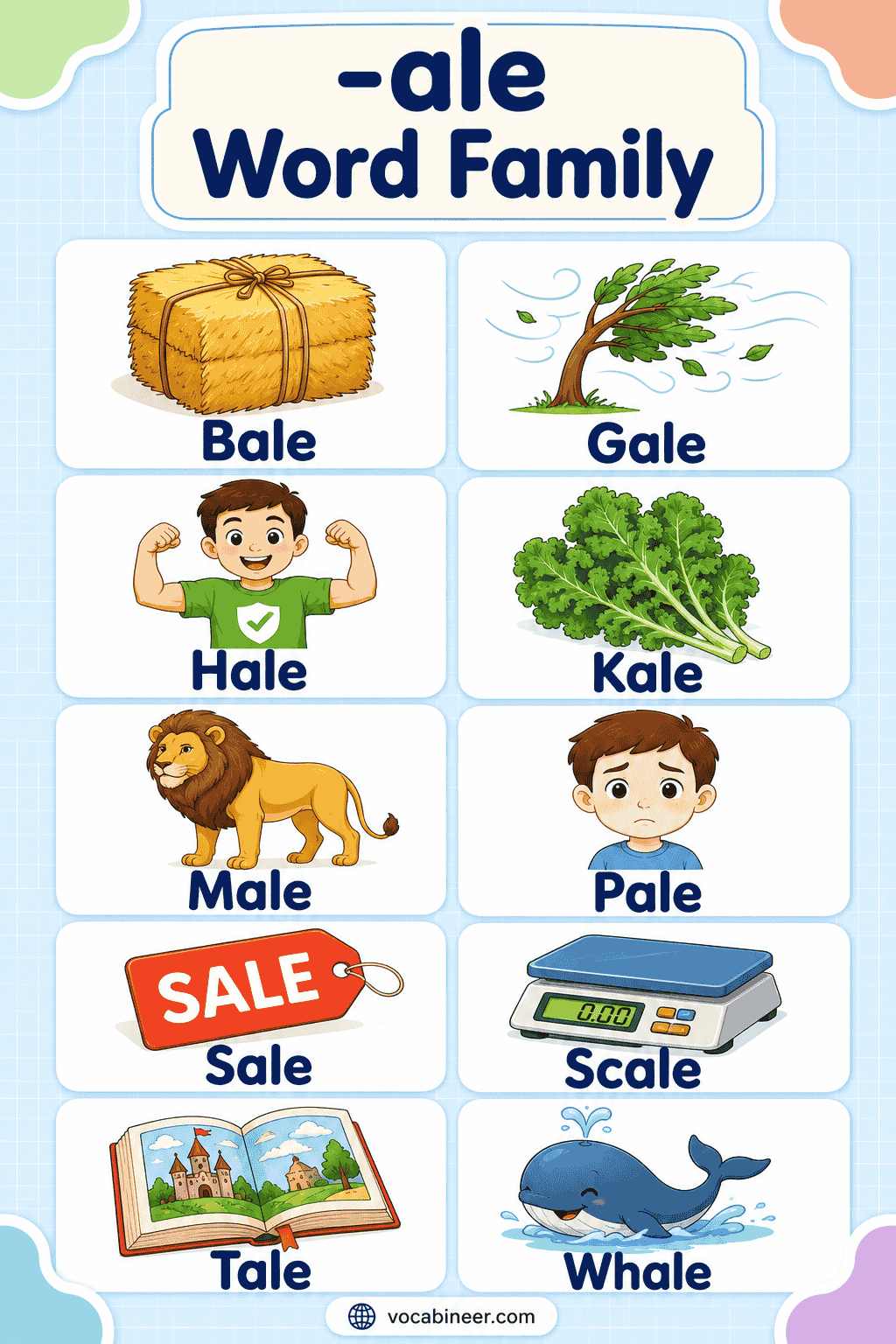
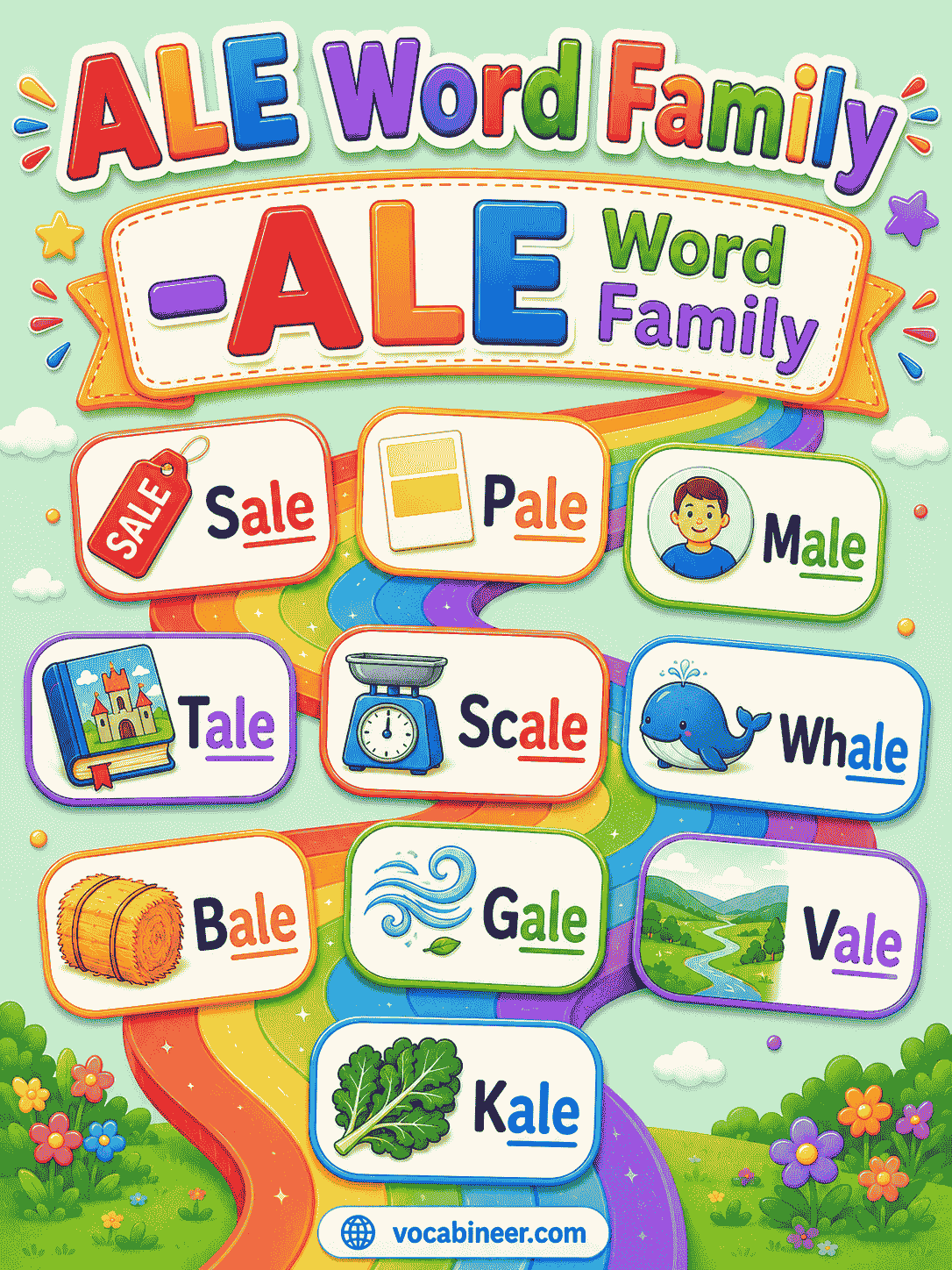
| Bale | A large bundle tied together | The farmer stacked a bale of hay. |
| Gale | A very strong wind | A gale shook the trees near the coast. |
| Kale | A dark green leafy vegetable | We added fresh kale to the soup. |
| Male | A boy, man, or male animal | The male bird has bright feathers. |
| Pale | Light in color | She wore a pale yellow sweater. |
| Sale | A time when items cost less | The store is having a weekend sale. |
| Scale | A tool used to measure weight | Put the apples on the scale. |
| Stale | No longer fresh | The bread became stale overnight. |
| Tale | A story | Grandpa told us an exciting tale. |
| Whale | A very large sea mammal | A whale rose above the water. |
Children will often recognize sale, tale, pale, scale, stale, and whale first because these words appear more often in everyday reading.
Some words also have more than one meaning. For example, scale can mean a tool that measures weight, but it can also refer to one of the small hard plates covering a fish or reptile. Beginners should learn the most familiar meaning first before exploring additional uses.
Less Common -ale Words
A few real -ale words appear less often in everyday conversations, but they can still help expand vocabulary.
Hale means healthy and strong, especially when describing an older person.
Grandpa remained hale and active.
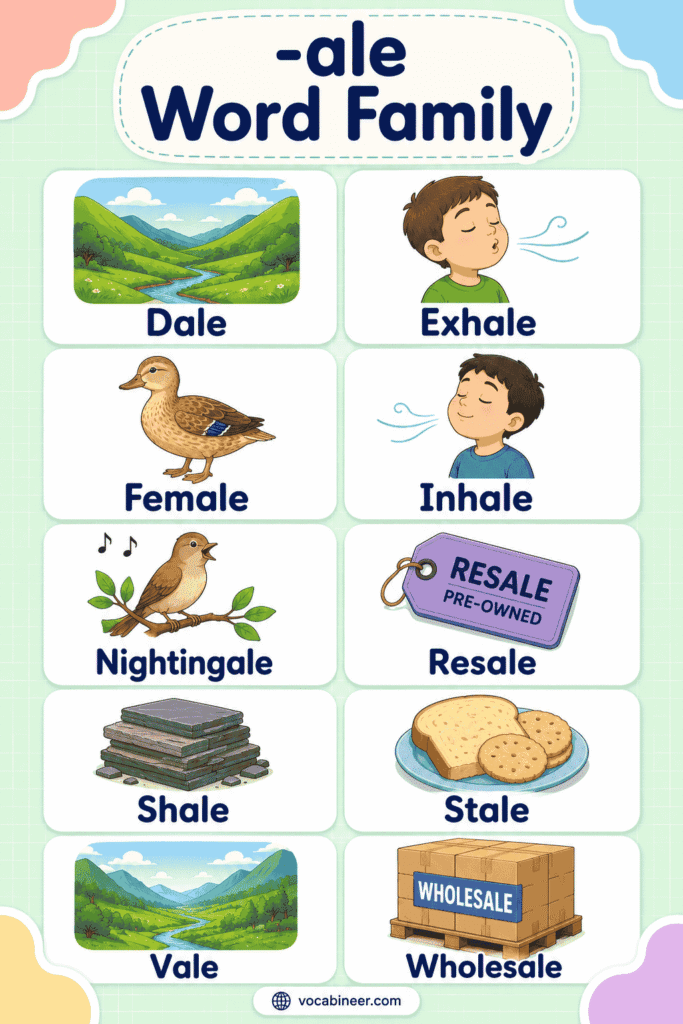
Vale means a valley, especially in poetry or formal writing.
Sheep grazed in the green vale.
These words rhyme with sale and belong to the same sound pattern. However, they should usually be taught after children master more familiar examples such as pale, tale, sale, and whale.
Longer Words Containing -ale
Some longer words contain or end with the letters -ale, although they are not always taught as simple one-syllable word-family words.
Exhale means to breathe air out.
Exhale slowly after taking a deep breath.
Female describes a girl, woman, or female animal.
The female duck stayed near the nest.
Inhale means to breathe air in.
Inhale gently through your nose.
Resale means selling something again after it has already been bought.
The bike was cleaned before resale.
Wholesale refers to selling goods in large quantities, often to stores or businesses.
The shop buys fruit at wholesale prices.
Tattletale is an informal word for someone who repeatedly tells an adult about another person’s behavior.
The teacher encouraged children to report serious problems without calling anyone a tattletale.
These words contain a recognizable -ale spelling, but their syllable patterns are more complex. Therefore, learners should master short words such as sale, pale, and tale before moving to these longer examples.
-ale Words and Their Homophones
Several -ale words have homophones. Homophones sound the same but have different spellings and meanings.
| -ale word | Homophone | Difference |
|---|---|---|
| Bale | bail | A bale is a tied bundle; bail has different legal or practical meanings |
| Male | Male describes a boy, man, or animal; mail means letters and packages | |
| Pale | pail | Pale means light in color; a pail is a bucket |
| Sale | sail | A sale involves selling; a sail helps move a boat |
| Tale | tail | A tale is a story; a tail is part of an animal’s body |
| Whale | wail | A whale is a sea mammal; wail means to cry loudly |
Sentence pairs make these differences easier to remember.
- The wall is pale blue.
- She filled the pail with water.
- The store has a sale today.
- The wind filled the boat’s sail.
- We read a fairy tale.
- The puppy wagged its tail.
- A whale swam beside the boat.
- The baby began to wail.
Children should look at the sentence meaning rather than relying only on sound. Although each pair sounds alike, the spelling changes because the words have different meanings.
Reading Practice with -ale Words
Short passages help learners recognize the spelling pattern inside connected sentences.
A pale whale swam near the sailboat. Soon, a strong gale moved across the water, so the boat returned to shore. Later, the children wrote a tale about the whale they had seen.
Ask learners to find the words that contain -ale. Then have them read the passage again without pausing before each target word.
A second passage can introduce food and farm vocabulary:
A farmer placed a bale of hay near the barn. Beside it, a basket of kale sat on a scale. After finishing his work, the farmer drove to a market sale.
Use these questions for quick comprehension practice:
- What animal swam near the boat?
- What kind of wind crossed the water?
- What did the children write?
- What did the farmer place near the barn?
- Which green vegetable appeared in the passage?
These questions connect phonics practice with meaning, which helps children understand rather than simply repeat the words.
Activities for Learning the -ale Word Family
A few focused activities can strengthen reading, spelling, and word recognition.
Build the words
Write -ale on a card or board. Then add different beginning letters or blends:
b + ale = bale
p + ale = pale
s + ale = sale
t + ale = tale
wh + ale = whale
This activity helps children see which part changes and which part remains the same.
Match words with pictures
Use simple pictures for:
- bale
- kale
- scale
- whale
- sale
Ask learners to match each picture with the correct written word.
Complete the sentences
Use this word bank:
sale, stale, scale, tale, whale
- The bread is ______.
- We saw a blue ______.
- Put the bag on the ______.
- The shop is having a ______.
- Dad told us a funny ______.
Answers: stale, whale, scale, sale, tale
Match the homophones
Ask children to connect each word with its sound-alike partner:
- male — mail
- pale — pail
- sale — sail
- tale — tail
- whale — wail
After matching them, learners can write one sentence for each word to show the difference in meaning.
FAQs
The -ale ending usually has a long a sound followed by the l sound, as in sale, pale, tale, and whale.
Useful examples include bale, gale, kale, male, pale, sale, scale, stale, tale, and whale.
Yes. Ale is a type of alcoholic drink. However, it is usually not used as the main vocabulary example in lessons for young children.
Not always. Short words such as sale and tale clearly share the same rhyme. Longer words such as female and wholesale contain the same letters but have more complex syllable patterns.
They can build words with letter cards, read rhyming groups, match words with pictures, compare homophones, complete short sentences, and practice the words in simple reading passages.
Read More
- CVC Rhyming Words for Kids
- Preschool Vocabulary Words
- Short Vowel Words for Kids
- Long Vowel Words for Kids
- 300+ Kindergarten Words
- Sight Words for Kids