

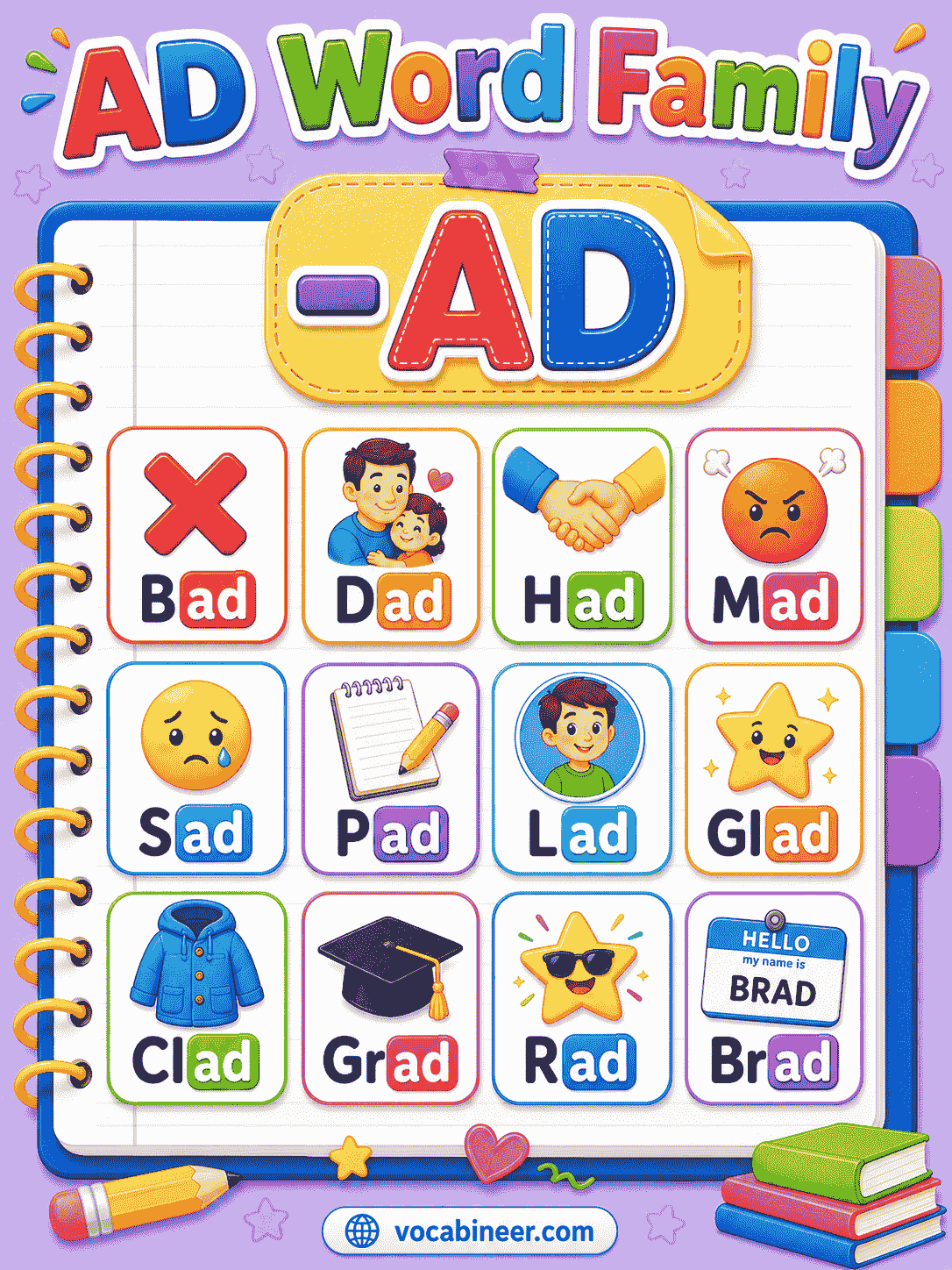
The -ad word family includes words that share the same -ad ending and usually have the same short a sound. Words such as bad, dad, had, mad, pad, and sad are useful for children who are beginning to blend sounds and read simple words.
Learning these words together helps young readers recognize spelling patterns instead of decoding every word from the beginning. This lesson introduces easy -ad words, meanings, picture ideas, sentences, a short reading story, and simple phonics practice.
In This Page
What Is the -ad Word Family?
A word family is a group of words with the same ending letters and a similar ending sound. In the -ad family, the letters a and d stay together while the beginning sound changes.
For example:
- b + ad = bad
- d + ad = dad
- h + ad = had
- m + ad = mad
- p + ad = pad
- s + ad = sad
The letter a makes its short sound, as in apple, while d provides the final sound. Together, the ending -ad is pronounced like the end of bad.
Most easy -ad words are CVC words:
- C means consonant;
- V means vowel;
- C means consonant.
The word mad, for example, follows the pattern m-a-d. Once children can read one -ad word, they can often decode several others by changing only the first sound.
How to Make -ad Words
Children can build -ad words by placing a consonant or consonant blend before the shared ending.
Start with the ending:
-ad
Next, add a beginning sound:
| Beginning | Ending | Complete word |
|---|---|---|
| b | ad | bad |
| d | ad | dad |
| f | ad | fad |
| h | ad | had |
| l | ad | lad |
| m | ad | mad |
| p | ad | pad |
| s | ad | sad |
| t | ad | tad |
Ask children to say the sounds separately before blending them:
/m/ + /ad/ = mad
/p/ + /ad/ = pad
/s/ + /ad/ = sad
This activity helps children notice that the first sound changes, but the ending remains the same.
Easy -ad Words for Kids
The core -ad family contains a small set of simple rhyming words. Each entry below includes an easy meaning and a sentence.
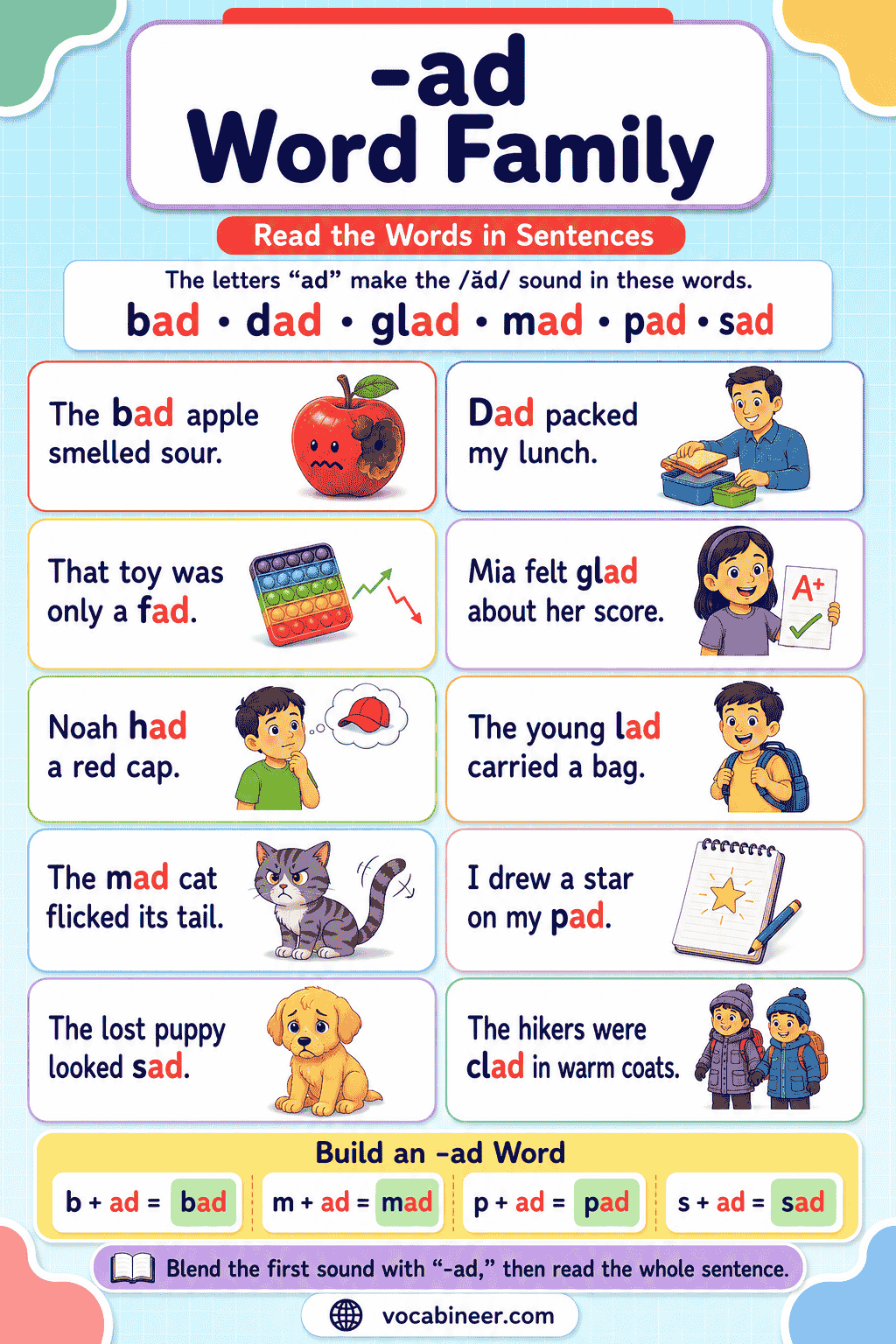
Bad – Not good, pleasant, or acceptable.
The milk has a bad smell.
Dad – A father.
My dad reads a book to me.
Fad – Something that becomes popular for a short time.
That dance became a fad.
Had – The past form of have.
Sam had a red bag.
Lad – A boy or young man.
The lad sat beside his dad.
Mad – Angry or upset.
Ben felt mad when his toy broke.
Pad – A soft, flat, or protective item; it can also mean a writing pad.
Dad wrote the note on a pad.
Sad – Unhappy.
The child felt sad after losing the ball.
Tad – A small amount.
Please add a tad more water.
These words share the same ending sound, so they rhyme:
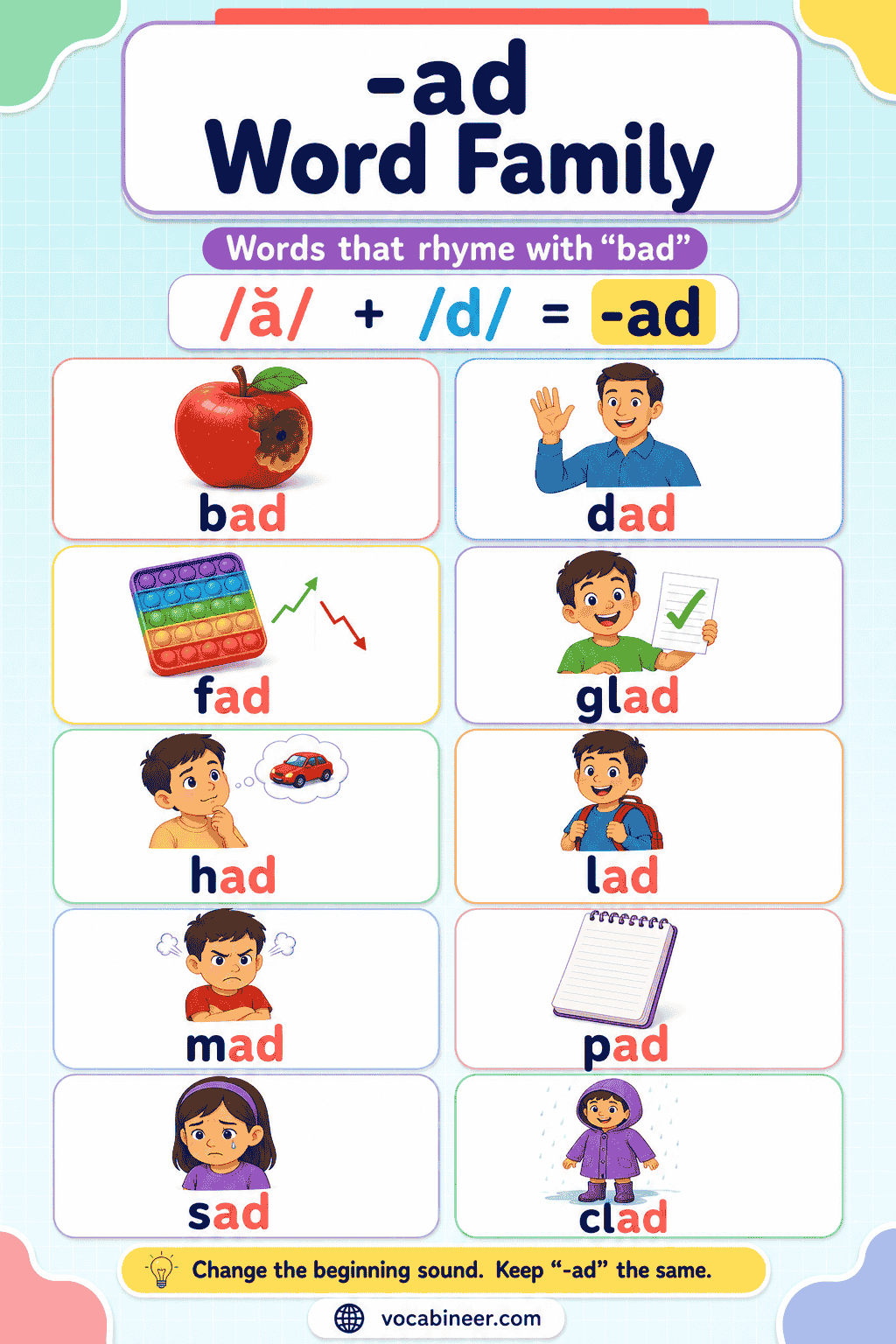
bad, dad, fad, had, lad, mad, pad, sad, tad
Although all nine words are real, some are more familiar to young children than others. Bad, dad, had, mad, pad, and sad are usually the easiest words to teach first.
-ad Words with Beginning Blends
After reading simple CVC words, children can practice -ad words that begin with consonant blends.
A consonant blend contains two consonants whose individual sounds can still be heard. The ending -ad remains unchanged.
Clad – Dressed or covered in something.
The hills were clad in snow.
The word begins with the cl blend:
cl + ad = clad
Glad – Happy or pleased.
I am glad you came.
The word begins with the gl blend:
gl + ad = glad
These words follow a CCVC structure:
- clad = c-l-a-d
- glad = g-l-a-d
Because two consonants appear before the vowel, blend words are slightly more difficult than simple words such as bad and sad.
-ad Words with Pictures and Meanings
Pictures can help children connect each spelling pattern with a person, object, action, or feeling.
| -ad word | Simple meaning | Helpful picture idea |
|---|---|---|
| Bad | Not good | Spoiled food or a broken toy |
| Dad | A father | A father standing with a child |
| Fad | A short-lived trend | A popular toy that everyone wants |
| Had | Owned or experienced in the past | A child who had a balloon |
| Lad | A boy | A smiling young boy |
| Mad | Angry | A child with an angry expression |
| Pad | A soft piece or writing block | A writing pad and pencil |
| Sad | Unhappy | A child with a tearful face |
| Tad | A small amount | A tiny spoonful of something |
| Clad | Dressed or covered | A person clad in warm clothes |
| Glad | Happy or pleased | A smiling child with raised hands |
Concrete words such as dad and pad are easy to illustrate. However, words such as had, bad, and glad need clear situations because they describe an action, condition, or feeling.
-ad Word Family Sentences
Short sentences allow children to practice -ad words in context. Begin with one target word in each sentence before moving to sentences containing several family words.
- Dad has a writing pad.
- The lad sat on the mat.
- Mia felt sad.
- Ben was mad.
- I am glad to see Dad.
- That was a bad plan.
- We had a fun day.
- Add a tad more milk.
- Dad had a red bag.
- The lad felt glad.
- Sam had a small pad.
- The sad child hugged Dad.
- I am glad the rain stopped.
- Dad was not mad.
- The pad fell from the desk.
Children can underline each -ad word after reading the sentences aloud. They can also circle the first letter and box the shared -ad ending.
Short -ad Word Family Story
A short passage gives children repeated exposure to the target pattern while keeping the reading manageable.
Dad and the Sad Lad
A lad named Sam sat with Dad. Sam was sad because he had lost his drawing pad.
Dad looked in the red bag. The pad was not there. Next, they checked under the bed.
Dad found the pad beside a box. Sam was glad. He hugged Dad and began to draw.
Story Words
The passage includes these -ad family words:
- lad;
- Dad;
- sad;
- had;
- pad;
- glad.
Reading Questions
Why was Sam sad?
He could not find his drawing pad.
Where did Dad find the pad?
Dad found it beside a box.
How did Sam feel at the end?
He felt glad.
Longer Words with -ad
Some longer words contain an -ad family word as a complete word part. These words are useful for children who have already mastered the basic pattern.
Notepad – A small book of paper used for writing notes.
I wrote the address in my notepad.
Keypad – A set of buttons with numbers or symbols.
She entered the code on the keypad.
Kneepad – Protective padding worn over the knee.
He wore a kneepad while skating.
Launchpad – A platform from which a rocket is launched.
The rocket stood on the launchpad.
Lily Pad – A floating leaf of a water lily.
The frog rested on a lily pad.
Mouse Pad – A flat surface used beneath a computer mouse.
The mouse moved smoothly across the mouse pad.
Ironclad – Completely secure or impossible to dispute; historically, it also described an armored warship.
They created an ironclad agreement.
These longer words should not replace the beginner list. Instead, they work best as extension vocabulary because they contain additional syllables or word parts.
Words such as nomad and doodad end with the letters ad, but they do not fit the basic beginner pattern as neatly. Their stress and pronunciation may differ, so they should be taught separately rather than mixed into the core rhyming list.
-ad Word Family Practice
The following activities reinforce reading, spelling, blending, and meaning without overwhelming early learners.
Add the Beginning Sound
Complete each word by adding the missing first letter.
- __ad — a father
- __ad — unhappy
- __ad — angry
- __ad — not good
- __ad — a writing block
- __ad — the past form of have
Answers: dad, sad, mad, bad, pad, had
Match the Words with Their Meanings
Match each word with the correct meaning.
| Word | Meaning |
|---|---|
| Dad | A. Happy or pleased |
| Sad | B. A father |
| Glad | C. A small amount |
| Tad | D. Unhappy |
| Pad | E. A flat or soft item |
Answers: Dad—B, Sad—D, Glad—A, Tad—C, Pad—E
Complete the Sentences
Choose from bad, Dad, had, mad, pad, sad, or glad.
- I am ______ to see you.
- Mia ______ a blue bag.
- The boy felt ______ when his kite tore.
- ______ wrote a note.
- The note was on a ______.
- Ben was ______ when the game ended.
- That apple has a ______ spot.
Answers: glad, had, sad, Dad, pad, mad, bad
Sort CVC and Blend Words
Place each word in the correct group:
bad, clad, dad, glad, mad, pad, sad
| CVC words | Words with beginning blends |
|---|---|
| bad | clad |
| dad | glad |
| mad | |
| pad | |
| sad |
Build New Words
Change the first letter to form a new -ad word.
- Change b in bad to d.
- Change d in dad to m.
- Change m in mad to p.
- Change p in pad to s.
- Change s in sad to h.
Answers: dad, mad, pad, sad, had
Write an -ad Word
Ask children to write:
- one word naming a person;
- one word describing anger;
- one word describing unhappiness;
- one word meaning happy;
- one word naming something used for writing.
Possible answers are dad, mad, sad, glad, and pad.
FAQs
Common words include bad, dad, fad, had, lad, mad, pad, sad, and tad. Clad and glad also belong to the family but begin with consonant blends.
The ending usually contains the short a sound followed by d, as heard at the end of bad and sad.
Many basic -ad words are CVC words, including bad, dad, had, mad, pad, and sad. Clad and glad are CCVC words because they begin with two consonants.
No. Words such as bad, sad, and glad rhyme, but longer words may have different stress or pronunciation patterns. They should not automatically be grouped into the beginner phonics family.
Children can blend sounds, match pictures, change beginning letters, read short sentences, complete missing-letter activities, and practice with a decodable story.
Read More
- CVC Rhyming Words for Kids
- Preschool Vocabulary Words
- Short Vowel Words for Kids
- Long Vowel Words for Kids
- 300+ Kindergarten Words
- Sight Words for Kids