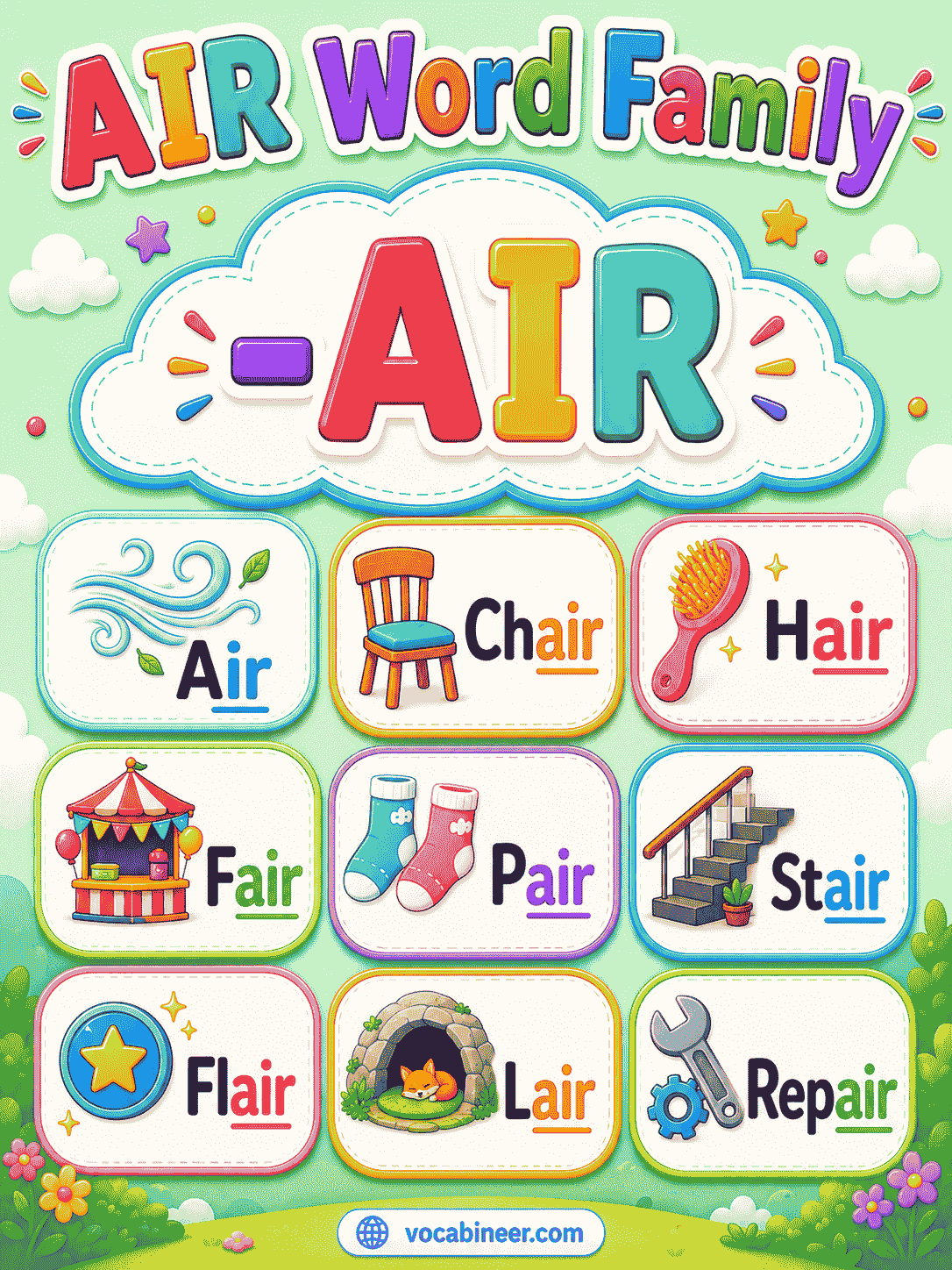
The -air word family helps children recognize a useful spelling pattern in words such as chair, fair, hair, pair, and stair. These words share a similar ending sound, so learners can read, spell, and remember them more easily once they notice the pattern.
Unlike -ale and -ake, the -air pattern does not use silent e. Instead, the letters air form a vowel-r spelling that produces the sound heard in fair and hair. This lesson introduces common words, longer vocabulary, homophones, alternate spellings, reading practice, and simple activities for early learners.
In This Page
What Is the -air Word Family?
The -air word family includes words that contain or end with the letters air and share the sound heard in fair.
The word air represents the target sound by itself. Other words add a beginning sound or letter group:
- ch + air = chair
- f + air = fair
- h + air = hair
- p + air = pair
- st + air = stair
When children recognize air as one familiar spelling unit, they can blend the beginning sound with the shared ending instead of reading every letter separately.
For example:
- /ch/ + /air/ = chair
- /p/ + /air/ = pair
- /st/ + /air/ = stair
Recognizing this pattern supports smoother reading, stronger spelling, and faster word recognition.
How the Air Sound Works
The letters air usually form a vowel sound influenced by the letter r. Teachers may describe this as an r-controlled vowel or a vowel-r spelling pattern.
In most American English accents, these words share the same ending sound:
- air
- chair
- fair
- hair
- pair
- stair
The -air pattern is different from a silent-e pattern. There is no final e changing the vowel sound. Instead, the letters a, i, and r work together as a spelling unit.
Children should also know that the same or a very similar sound can appear with other spellings. For example:
- air in fair
- are in care
- ear in bear
Because several spellings can represent a similar sound, learners must pay attention to the whole word rather than relying only on pronunciation.
Common -air Words with Meanings and Examples
These words provide the best starting point because they are useful, easy to picture, and common in everyday reading.
| Word | Simple meaning | Example sentence |
|---|---|---|
| Air | The invisible gases around us | Cool air came through the window. |
| Chair | A seat for one person | Please sit on the wooden chair. |
| Fair | Reasonable, equal, or just | The teacher made a fair decision. |
| Hair | Strands that grow on the head or body | She brushed her long hair. |
| Pair | Two matching or related things | I bought a pair of shoes. |
| Stair | One step in a staircase | He stood on the bottom stair. |
| Flair | Natural talent or distinctive style | She has a flair for painting. |
| Lair | A wild animal’s resting or hiding place | The fox returned to its lair. |
The first six words are the most suitable for beginners. Flair and lair are correct examples, but they are less common and may need additional explanation.
Different Meanings of Fair
The word fair has several meanings, so the surrounding sentence helps readers understand it.
Fair can mean reasonable or equal.
The rules were fair to everyone.
It can also describe light coloring.
The child has fair hair.
In addition, a fair can be an outdoor event with rides, games, animals, or food.
Our family visited the county fair.
Pair as a Noun and a Verb
The word pair often names two things that belong together.
I need a pair of gloves.
It can also act as a verb meaning to place two people or things together.
The teacher will pair the students for the activity.
Learning both uses helps children understand how one word can work differently in a sentence.
Longer Words Built from -air Words
Many longer words contain a familiar base word such as chair, hair, or stair.
| Longer word | Base word | Meaning |
|---|---|---|
| Armchair | chair | A comfortable chair with supports for the arms |
| Hairbrush | hair | A brush used for arranging hair |
| Haircut | hair | The act or style of cutting hair |
| Hairpin | hair | A small pin used to hold hair in place |
| Staircase | stair | A complete set of stairs |
| Upstairs | stair | On or toward a higher floor |
| Downstairs | stair | On or toward a lower floor |
| Wheelchair | chair | A chair with wheels used for mobility |
Children can make these words easier to read by finding the smaller word inside them:
- arm + chair = armchair
- hair + brush = hairbrush
- stair + case = staircase
- wheel + chair = wheelchair
This strategy helps learners break longer words into manageable parts.
Longer Words Ending in -air
A few longer words end with the same letters.
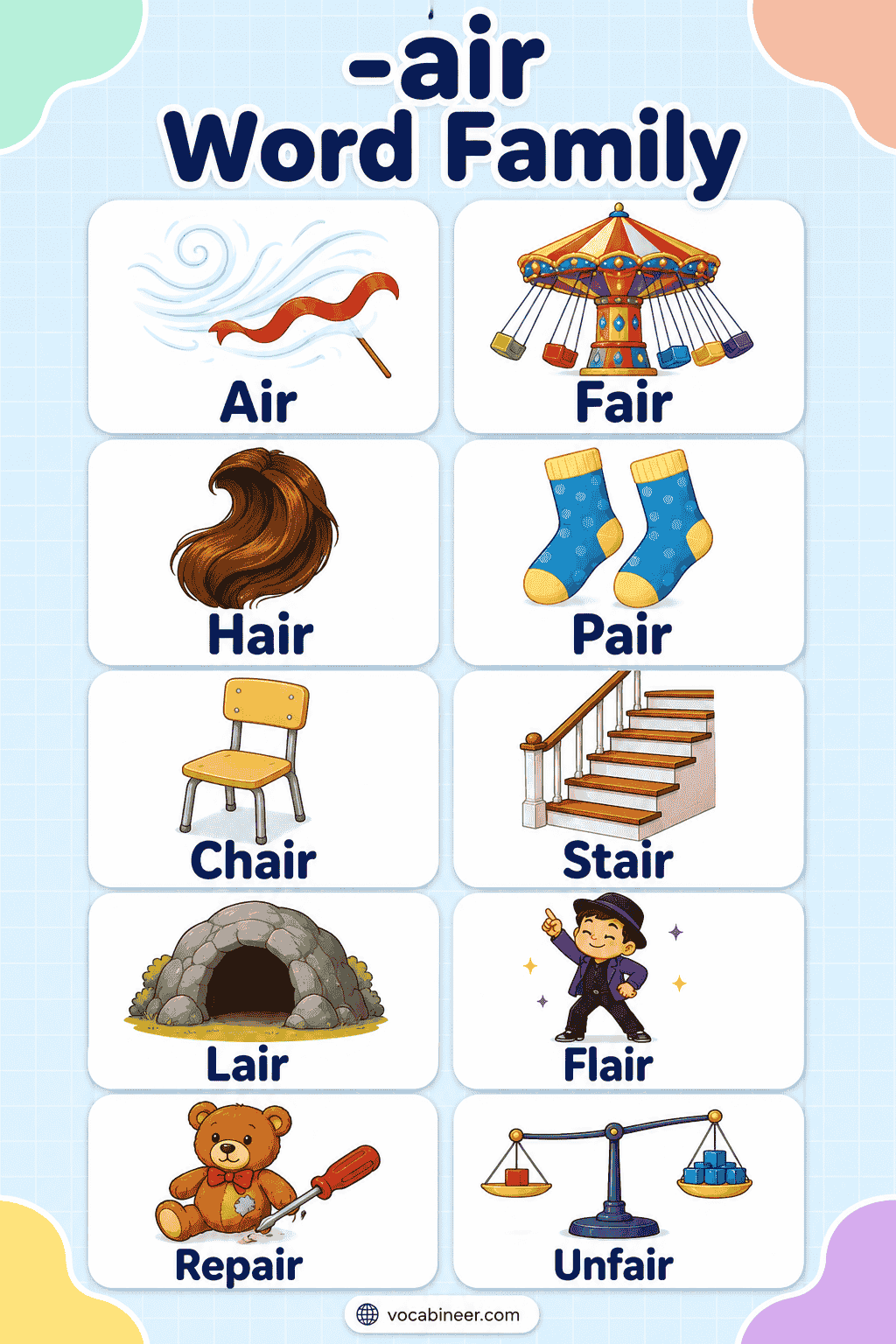
Repair means to fix something that is damaged.
Dad will repair the broken chair.
Unfair means not reasonable, equal, or just.
It was unfair to blame only one student.
Affair can mean an event, matter, or situation.
The community picnic was a cheerful affair.
Impair means to weaken or damage something.
Thick fog can impair a driver’s vision.
For younger learners, repair and unfair are the most useful. Affair and impair are better treated as advanced vocabulary.
Words Beginning with the Standalone Word Air
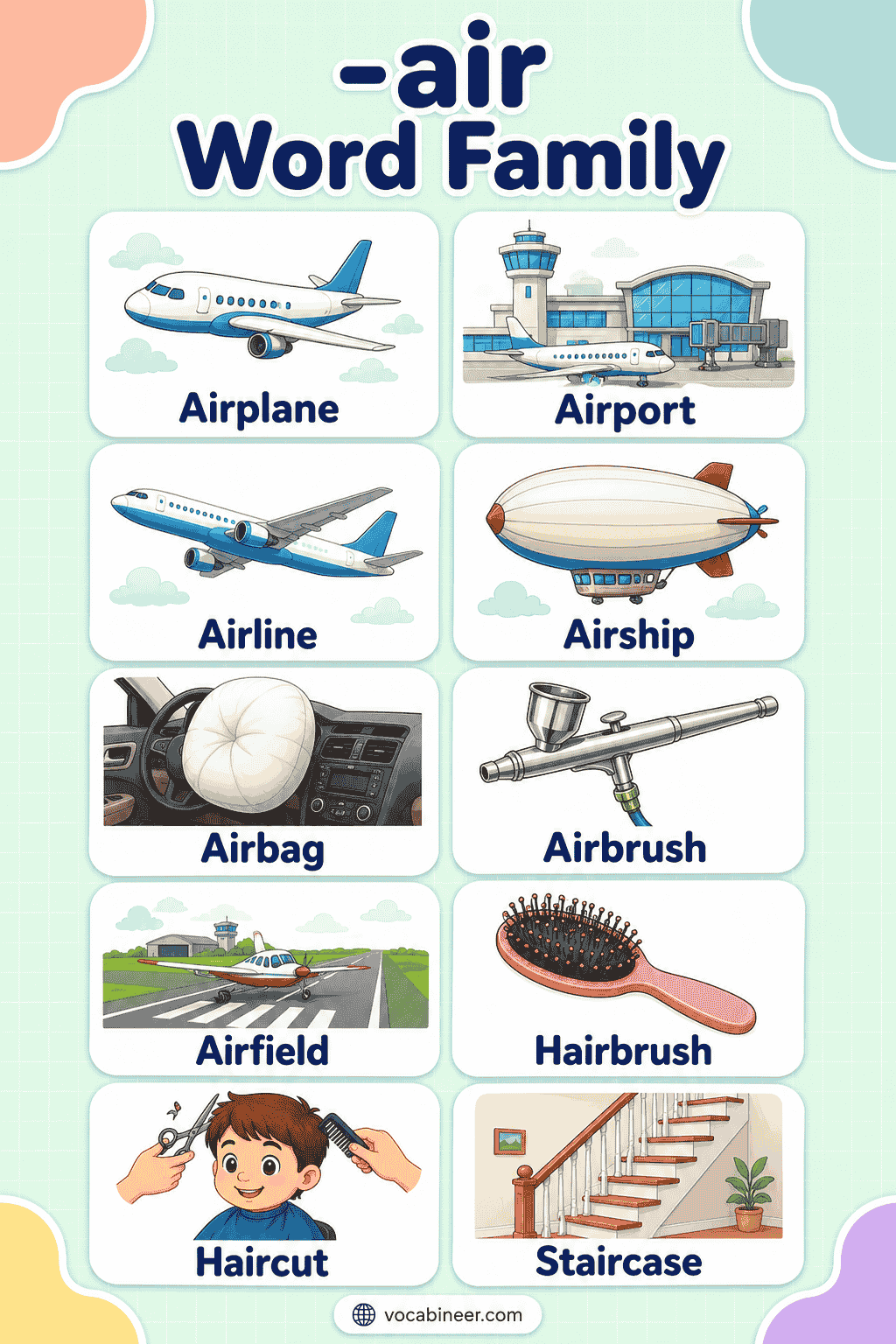
Some compound words begin with the complete word air.
| Word | Meaning | Example sentence |
|---|---|---|
| Airplane | A powered flying vehicle | The airplane flew above the clouds. |
| Airport | A place where airplanes arrive and depart | We arrived at the airport early. |
| Airline | A company that carries passengers by airplane | The airline changed our flight time. |
These words contain the standalone word air, but the complete words do not rhyme with fair in the same way that chair and hair do.
For example:
- air + plane = airplane
- air + port = airport
- air + line = airline
More advanced examples include airfare, airship, and airspace, but they are not necessary for a basic phonics lesson.
-air Words and Their Homophones
Several -air words have homophones. Homophones sound the same but have different spellings and meanings.
| -air word | Homophone | Difference |
|---|---|---|
| Air | heir | Air surrounds us; an heir receives property, money, or a title |
| Fair | fare | Fair can mean reasonable; fare can mean the cost of a trip |
| Hair | hare | Hair grows on the body; a hare is an animal similar to a rabbit |
| Pair | pear | A pair means two things; a pear is a fruit |
| Stair | stare | A stair is a step; stare means to look for a long time |
| Flair | flare | Flair means talent or style; flare can mean to burn brightly |
Sentence pairs make the differences easier to understand:
- Fresh air entered the room.
- The prince was the heir to the throne.
- The game was fair.
- The bus fare was three dollars.
- She brushed her hair.
- A hare ran across the field.
- I bought a pair of boots.
- He ate a ripe pear.
- She stepped onto the first stair.
- It is rude to stare at people.
The word pair also has another homophone, pare, which means to trim or cut away an outer layer.
Dad used a small knife to pare the apple.
Learners should focus on meaning because sound alone cannot reveal the correct spelling.
Air, Are, and Ear Spelling Patterns
The spellings air, are, and ear can represent the same or a similar sound in many American English words.
| air spelling | are spelling | ear spelling |
|---|---|---|
| fair | care | bear |
| hair | dare | pear |
| pair | share | wear |
| stair | spare | tear meaning “to rip” |
| chair | square | — |
These words may sound alike, but they do not belong to one spelling family. Each group must be practiced separately.
Words Spelled with Air
- chair
- fair
- hair
- pair
- stair
Words Spelled with Are
- care
- dare
- share
- spare
- square
Words Spelled with Ear
- bear
- pear
- wear
- tear meaning “to rip”
The letters ear can represent several different sounds. For example, tear meaning “to rip” can rhyme with air, while tear meaning “a drop from the eye” rhymes with near.
Because pronunciation does not always reveal the spelling, word sorting and repeated reading can help learners remember each pattern.
Reading Practice with -air Words
Short passages help children recognize target words in complete sentences.
Read the -air Words
A child placed a pair of shoes beside a chair. Then she brushed her hair and walked down each stair. Before leaving, she opened the window and enjoyed the cool air.
Ask learners to underline every word containing air. Afterward, have them read the passage again at a natural pace.
Use these questions to check understanding:
- What did the child place beside the chair?
- What did she brush?
- Where did she walk?
- What came through the window?
Compare Similar Sounds
A fox left its lair and moved toward the county fair. It stopped near a wooden chair and stared at a pear on the table. A cool breeze moved through the air, so the fox quickly ran away.
This passage mixes air, are, and ear spellings. Ask children to find:
- words spelled with air;
- the word spelled with ear;
- the word stared, which contains are.
This activity helps learners connect pronunciation with spelling and meaning.
Activities for Practicing the Air Sound
Focused activities help children read, spell, and use the words correctly.
Build the words
Write air on a card or board. Then add beginning letters or groups:
ch + air = chair
f + air = fair
h + air = hair
p + air = pair
st + air = stair
fl + air = flair
l + air = lair
Read the words slowly first, then repeat them at a natural pace.
Match words with pictures
Use clear pictures for:
- chair
- hair
- a pair of shoes
- stair
- a fox near its lair
Ask learners to place each written word beside the correct image.
Complete the sentences
Use this word bank:
air, chair, fair, hair, pair, stair
- Please sit on the ______.
- She brushed her ______.
- I bought a ______ of socks.
- Fresh ______ came through the door.
- The judge made a ______ decision.
- He stood on the bottom ______.
Answers: chair, hair, pair, air, fair, stair
Match the homophones
Connect each word with its sound-alike partner:
- air — heir
- fair — fare
- hair — hare
- pair — pear
- stair — stare
- flair — flare
After matching the words, ask learners to write one short sentence for each spelling.
Sort the spelling patterns
Place these words under air, are, or ear:
bear, chair, care, fair, hair, pear, share, stair, wear
| air | are | ear |
|---|---|---|
| chair | care | bear |
| fair | share | pear |
| hair | — | wear |
| stair | — | — |
This activity shows that similar sounds can have different spellings.
FAQs
In most American English words, air represents the vowel-r sound heard in fair, hair, pair, chair, and stair.
No. The -air pattern does not use silent e. The letters a, i, and r work together to represent the target sound.
Common examples include air, chair, fair, hair, pair, and stair.
They begin with the standalone word air, but the complete words do not rhyme with fair. Therefore, they are better taught as compound words.
Children can build words with letter cards, match words with pictures, compare homophones, sort air, are, and ear spellings, complete sentences, and read short passages containing the target pattern.
Read More
- CVC Rhyming Words for Kids
- Preschool Vocabulary Words
- Short Vowel Words for Kids
- Long Vowel Words for Kids
- 300+ Kindergarten Words
- Sight Words for Kids