

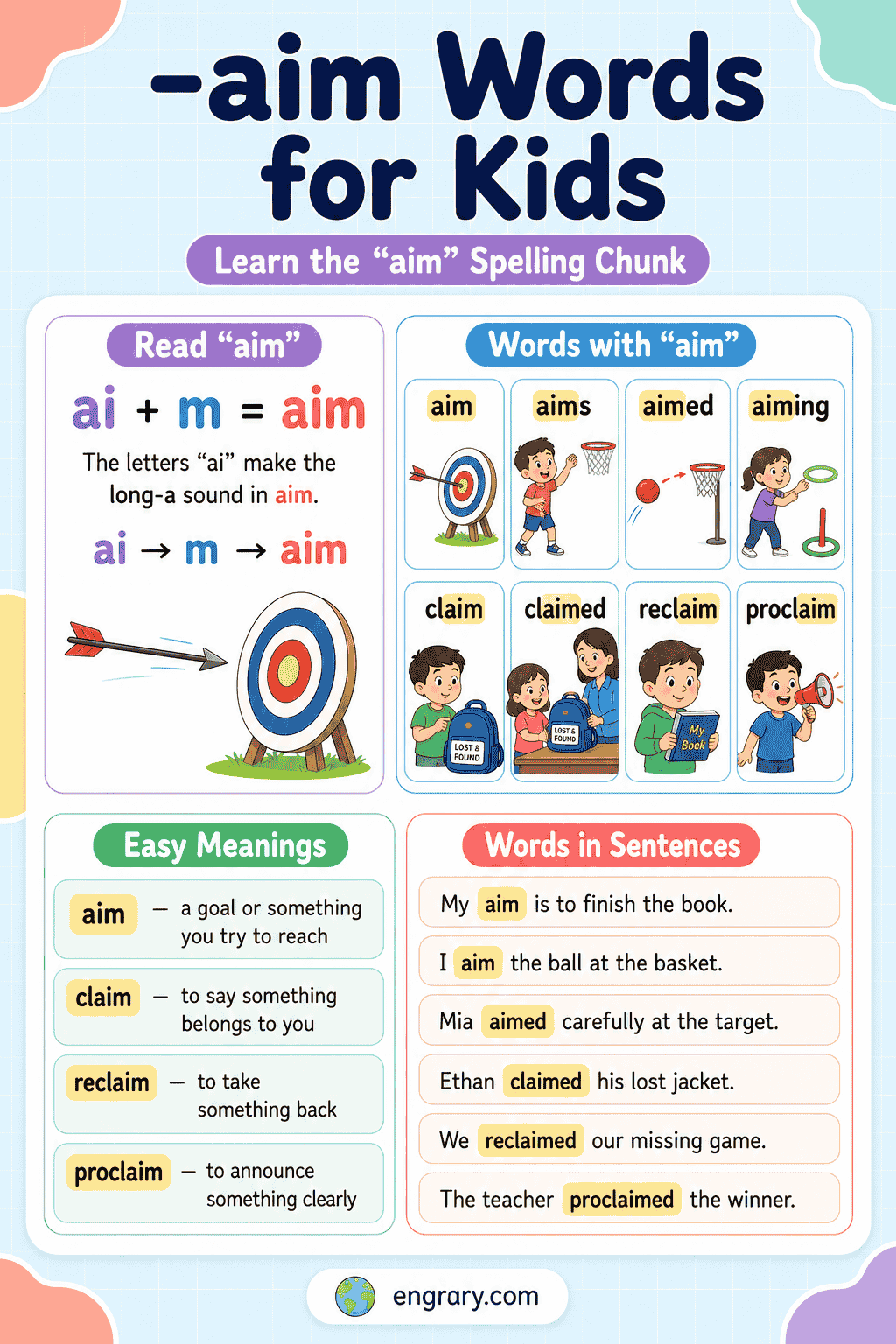
The -aim word family is a small long-a phonics family built around words such as aim, claim, and maim. In each word, the vowel team ai represents the long-a sound, while the final m completes the shared ending -aim.
Although this family has only a few common base words, it connects naturally to longer vocabulary such as exclaim, reclaim, proclaim, and disclaim. Learning the pattern helps students improve decoding, spelling, pronunciation, vocabulary, and reading fluency without confusing -aim with the more common -ain family.
In This Page
What Is the -aim Word Family?
The -aim word family contains words that share the ending -aim and the sound /eɪm/. The three most useful base words are:
- aim
- claim
- maim
These words rhyme because they end with the same spoken sound. However, the family remains much smaller than patterns such as -ain, -ake, or -ail.
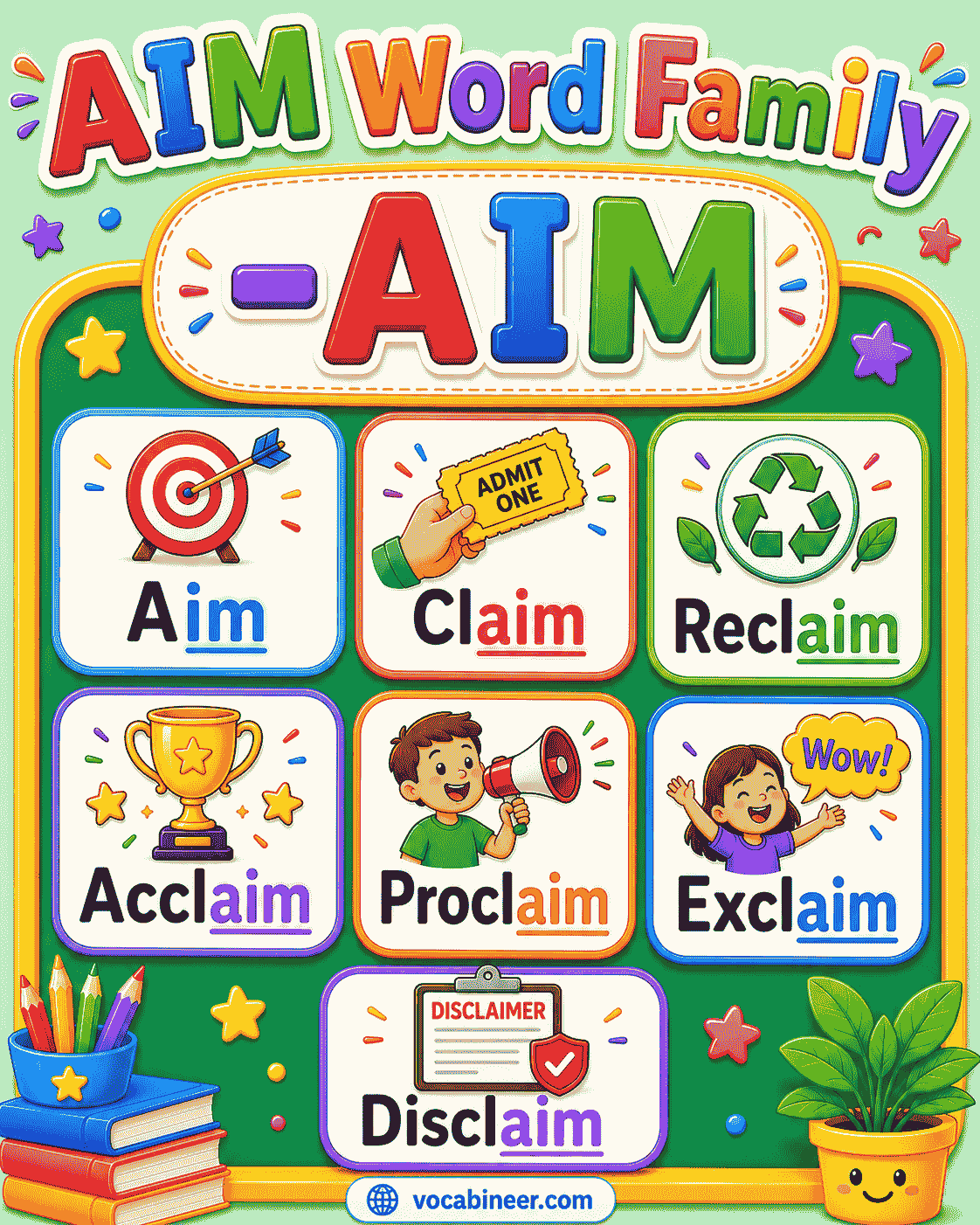
Longer words may also end in -aim, especially words formed from claim. Examples include exclaim, reclaim, proclaim, acclaim, and disclaim.
Not every word containing ai belongs to this family. For example, rain belongs to -ain, while mail belongs to -ail. The ending, not only the vowel team, determines the word family.
How the ai Vowel Team Works in -aim Words
The vowel team ai often represents the long-a sound heard in rain, sail, paint, and train. In -aim words, the same vowel team appears before the consonant m.
The ending can be read as:
ai = /ā/
m = /m/
-aim = /eɪm/
When learners recognize this chunk, they do not need to decode every letter separately each time. Instead, they can read the shared ending as one familiar unit.
For example:
- /ā/ + /m/ = aim
- /k/ + /l/ + /ā/ + /m/ = claim
- /m/ + /ā/ + /m/ = maim
This pattern makes aim and claim relatively easy to decode once children know the long-a sound of ai.
Common -aim Words
The core family contains only a few familiar words, so each one deserves a clear meaning and example.
Aim
To point, direct, or work toward a target or goal.
Example: Maya took careful aim before tossing the ball.
Claim
To say that something is true or that something belongs to you.
Example: Leo made a claim that the blue backpack was his.
Maim
To injure a person or animal seriously and permanently.
Example: The warning explained that the damaged machine could maim anyone who touched it.
Because maim has a serious and violent meaning, it is better suited to vocabulary explanation than light reading practice for young children.
Longer -aim Words and Their Prefixes
Several longer words end in -aim because they contain the base word claim. A prefix changes the meaning of the complete word, although learners still need to study each definition carefully.
| Word | Simple meaning | Example sentence |
|---|---|---|
| Acclaim | Public praise or strong approval | The young author received acclaim for her first book. |
| Declaim | To speak in a dramatic or formal way | The actor began to declaim the poem onstage. |
| Disclaim | To deny responsibility, ownership, or connection | The company may disclaim responsibility for misuse. |
| Exclaim | To speak suddenly or with strong emotion | “That was amazing!” Noah exclaimed. |
| Proclaim | To announce something publicly or officially | The mayor proclaimed Friday a community holiday. |
| Reclaim | To take back, recover, or make usable again | Volunteers helped reclaim the abandoned garden. |
| Counterclaim | A claim made in response to another claim | The defendant filed a counterclaim in court. |
| Quitclaim | A legal transfer of a person’s interest in property | The attorney prepared a quitclaim deed. |
The most useful longer words for general learners are acclaim, disclaim, exclaim, proclaim, and reclaim. By contrast, declaim, counterclaim, and quitclaim are more advanced or specialized.
How prefixes affect claim
Prefixes can offer clues about meaning:
| Prefix | Word | Meaning clue |
|---|---|---|
| ac- | acclaim | praise or approval |
| dis- | disclaim | deny or separate from |
| ex- | exclaim | speak out |
| pro- | proclaim | announce forward or publicly |
| re- | reclaim | claim again or take back |
| counter- | counterclaim | respond with an opposing claim |
These clues support vocabulary learning, but they do not replace a full definition. For instance, students should not assume that every prefixed form can be understood by translating each part literally.
-aim Words with -s, -ed, and -ing
The base words can take common endings to show number, tense, or an ongoing action.
| Base word | -s form | -ed form | -ing form |
|---|---|---|---|
| aim | aims | aimed | aiming |
| claim | claims | claimed | claiming |
| maim | maims | maimed | maiming |
When -ed is added, the spelling keeps the full base word:
- aim → aimed
- claim → claimed
- maim → maimed
For the -ing form, the final e does not need to be removed because these words do not end in silent e:
- aim → aiming
- claim → claiming
- maim → maiming
Longer words follow the same general pattern:
- exclaim → exclaimed → exclaiming
- reclaim → reclaimed → reclaiming
- proclaim → proclaimed → proclaiming
Comparing -aim and -ain Words
The -aim and -ain families both usually contain the long-a sound, so learners may confuse them. Their final consonants are different.
| -aim words | -ain words |
|---|---|
| aim | rain |
| claim | chain |
| maim | pain |
| acclaim | explain |
| reclaim | remain |
The -aim family ends with m, while the -ain family ends with n.
Compare the sounds carefully:
- aim ends with /m/
- rain ends with /n/
- claim ends with /m/
- chain ends with /n/
The words may rhyme closely, but they do not share the same spelling family.
Aim and main
Aim and main are especially easy to confuse in spelling.
- aim means to direct something toward a target or goal;
- main means most important or principal.
Example: Our main aim is to finish the project on time.
Both words contain the long-a sound, yet aim belongs to -aim and main belongs to -ain.
Claim and chain
These words also sound similar:
- claim means to state that something is true or belongs to someone;
- chain is a series of connected metal links.
Example: Nora made a claim about the missing chain.
Paying attention to the final consonant helps learners spell each word correctly.
How to Blend and Read -aim Words
Blending combines separate sounds to form a complete word. Start with the shared ending and then add the beginning sound or consonant blend.
Read aim
Say the two sounds slowly:
/ā/ + /m/
Blend them:
aim
Read claim
Separate the opening blend from the ending:
/cl/ + /aim/
Blend the parts:
claim
Students may also stretch the sounds more fully:
/k/ + /l/ + /ā/ + /m/
Read maim
Break the word into:
/m/ + /aim/
Blend the sounds:
maim
Read longer words by syllables
Longer words are easier when divided into meaningful spoken parts:
- ex + claim
- re + claim
- pro + claim
- dis + claim
- ac + claim
After reading each part, blend the complete word smoothly.
For example:
re + claim → reclaim
This method supports decoding without suggesting that every prefix always provides a complete definition by itself.
-aim Word Family Sentences
Short sentences help learners connect spelling, pronunciation, and meaning.
- My aim is to read twenty books this year.
- Take careful aim before throwing the beanbag.
- Ava claimed the red marker as her own.
- The traveler made a claim for the lost suitcase.
- Experts acclaim the film for its strong story.
- “We won!” the players exclaimed.
- The town will proclaim the winner tomorrow.
- Workers hope to reclaim the empty lot.
- The label may disclaim responsibility for improper use.
- The lawyer prepared a counterclaim.
These examples show that the family includes both beginner-friendly words and more advanced academic, legal, or formal vocabulary.
Short Reading Practice with -aim Words
Read the passage and notice each word ending in -aim.
The Community Garden
Our class had one clear aim: to improve an empty piece of land beside the school. Some people claimed that nothing would grow there, but our teacher encouraged us to try.
First, we removed trash and added fresh soil. Then we planted flowers, herbs, and vegetables. When the first green shoots appeared, Mia began to exclaim, “The garden is growing!”
By spring, the project had helped reclaim the unused space. Parents and teachers gave the class great acclaim for its hard work.
Reading questions
What was the class’s aim?
The class wanted to improve the empty land beside the school.
What did some people claim?
They claimed that nothing would grow there.
Why did the class receive acclaim?
The students received praise because they transformed the unused area into a garden.
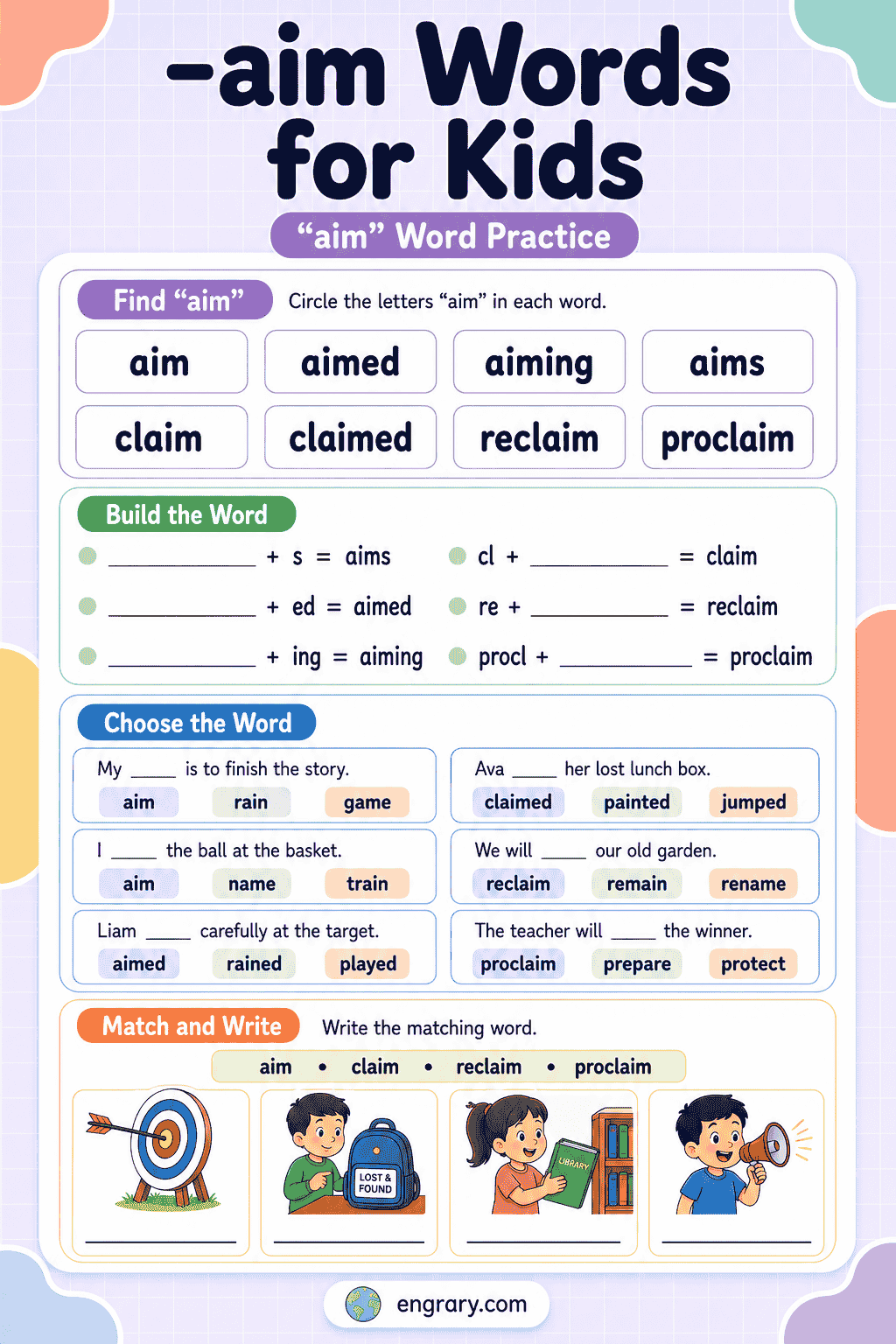
Activities for Practicing the -aim Pattern
Focused practice helps learners recognize the spelling pattern without mixing it with unrelated long-a families.
Sort -aim and -ain words
Place each word in the correct group:
aim, rain, claim, chain, maim, pain, reclaim, remain
| -aim | -ain |
|---|---|
| aim | rain |
| claim | chain |
| maim | pain |
| reclaim | remain |
Complete the sentence
Choose aim, claim, exclaim, or reclaim.
- Our main ______ is to clean the playground.
- Ben made a ______ that the jacket belonged to him.
- “Look at that rainbow!” Mia began to ______.
- The community hopes to ______ the unused building.
Answers:
- aim
- claim
- exclaim
- reclaim
Match each word to its meaning
| Word | Meaning |
|---|---|
| acclaim | public praise |
| disclaim | deny responsibility or connection |
| proclaim | announce publicly |
| reclaim | recover or take back |
Build words from claim
Add the correct prefix:
- ex + claim = exclaim
- pro + claim = proclaim
- re + claim = reclaim
- dis + claim = disclaim
- counter + claim = counterclaim
Find the rhyme
Circle the word that rhymes with aim:
- aim — rain — sit
- claim — stone — game
- maim — book — flame
The activity also creates an opportunity to explain that rhyming words do not always belong to the same spelling family. Game rhymes with claim, but it does not end in -aim.
FAQs
The most common base words are aim, claim, and maim. Longer examples include acclaim, exclaim, proclaim, reclaim, and disclaim.
The vowel team ai represents the long-a sound /eɪ/, as heard in aim and claim.
No. Aim belongs to -aim, while rain belongs to -ain. They share the long-a sound but end with different consonants.
Yes. Claim is one of the main base words in the family and also appears inside longer words such as exclaim, reclaim, and proclaim.
Useful examples include acclaim, declaim, disclaim, exclaim, proclaim, reclaim, counterclaim, and quitclaim.
Read More
- CVC Rhyming Words for Kids
- Preschool Vocabulary Words
- Short Vowel Words for Kids
- Long Vowel Words for Kids
- 300+ Kindergarten Words
- Sight Words for Kids