

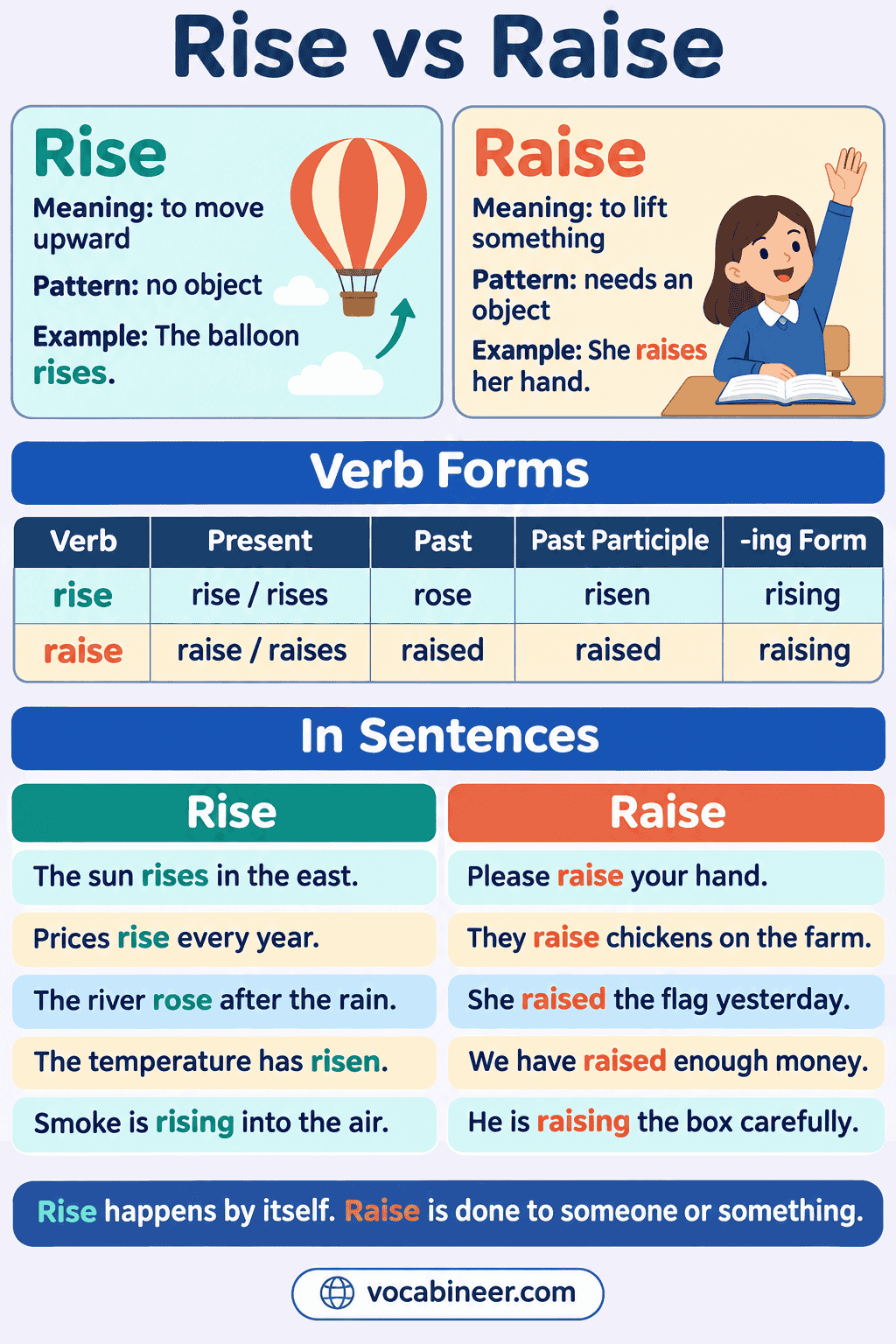
Rise and raise both describe upward movement, growth, or an increase. However, they follow different sentence patterns. Something rises independently, while someone or something raises an object by lifting it, increasing it, or causing it to develop.
The easiest way to choose correctly is to look for a direct object. Rise does not take one, whereas raise normally does. This guide explains that distinction and covers every major form, common meaning, price and percentage pattern, noun use, expression, and mistake involving these two verbs.
In This Page
Rise and Raise at a Glance
Use rise when the subject itself moves upward, increases, stands, or becomes more successful. In contrast, use raise when the subject causes someone or something else to move, increase, or develop.
| Rise | Raise |
|---|---|
| Means move upward, increase, stand, or become more important | Means lift, increase, or cause something to move upward |
| Intransitive verb | Transitive verb |
| Does not take a direct object | Normally requires a direct object |
| The subject experiences the change | The subject causes a change in an object |
| Prices rise. | Shops raise prices. |
| The flag rose. | The soldiers raised the flag. |
Complete Forms of Rise and Raise
| Verb | Base form | Third-person singular | Present participle | Past form | Past participle |
|---|---|---|---|---|---|
| Rise | rise | rises | rising | rose | risen |
| Raise | raise | raises | raising | raised | raised |
Rise is irregular, so its past form is rose and its past participle is risen. By contrast, raise is regular, so both its past form and past participle are raised. The form rised is not standard English.
The Causative Relationship
A helpful formula is:
Raise means cause someone or something to rise.
| Independent change with rise | Caused change with raise |
|---|---|
| The temperature rose. | The heater raised the temperature. |
| Prices rose last month. | The company raised prices last month. |
| Her voice rose. | She raised her voice. |
| The flag rose slowly. | The soldiers raised the flag. |
| Awareness rose. | The campaign raised awareness. |
The subject of rise undergoes the change. However, the subject of raise causes the object to change.
Something does not literally need to rise without a cause. For example, a company decision may cause prices to increase. Nevertheless, “Prices rose” leaves that cause outside the main subject–verb pattern, while “The company raised prices” states the cause directly.
Transitive and Intransitive Uses
| Rise | Raise |
|---|---|
| Intransitive | Transitive |
| No direct object follows | A direct object follows |
| Subject + rise | Subject + raise + object |
| Smoke rises. | Fire raises the temperature. |
| The river rose. | Rain raised the river level. |
| Costs have risen. | Suppliers have raised costs. |
A phrase can follow rise without becoming a direct object:
- Prices rose by 10%.
- The temperature rose to 35°C.
- Smoke rose from the chimney.
These phrases express an amount, final level, or source. They do not receive the verb’s action.
The Direct-Object Test
Use these steps whenever the correct verb feels unclear:
- Find the verb.
- Ask what? or whom? after it.
- If the sentence identifies something being lifted, increased, collected, introduced, or developed, use raise.
- If the subject itself moves or increases, use rise.
Examples:
- The company raised what? — prices. Therefore, raised is correct.
- Prices rose what? — no answer. Therefore, rose is correct.
- She raised what? — her hand. Therefore, raised is correct.
- The sun rose what? — no answer. Therefore, rose is correct.
Common Uses of Rise
Physical Upward Movement
Use rise when the subject moves upward:
- Smoke rises from the chimney.
- The balloon rose into the sky.
- The curtain is rising.
- Water levels have risen after the rain.
Numerical Increases
Amounts, levels, and measurements can rise:
- Prices rise when demand increases.
- Inflation rose last year.
- Interest rates have risen sharply.
- Sea levels are rising steadily.
- Blood pressure may rise during stress.
- Production rose by eight percent.
The Sun and Moon
- The sun rises in the east.
- The moon rose above the hills.
- The sun had risen before we left.
Standing and Getting Up
Rise can mean stand up or get out of bed, although this use can sound formal:
- Everyone rose when the judge entered.
- She rose from her chair.
- He rises early each morning.
- Please rise for the national anthem.
Dough and Baked Goods
- Leave the dough to rise.
- The bread rose well.
- The cake has not risen properly.
Status, Power, and Success
- She rose to the top of the company.
- The leader rose to power.
- He is a rising star.
- The organisation has risen in importance.
- She rose through the ranks quickly.
Challenges and Opposition
- The team rose to the occasion.
- She rose to the challenge.
- He rose above the criticism.
- The people rose against the ruler.
Common Uses of Raise
Lifting Objects and Body Parts
- Raise your hand.
- She raised the flag.
- He raised his eyebrows.
- Workers are raising the platform.
- The driver raised the barrier.
Increasing Amounts and Levels
- The bank raised interest rates.
- The heater raised the temperature.
- The new policy may raise production.
- Salt can raise blood pressure.
- Heavy rain has raised the river level.
Salaries, Prices, and Taxes
- The company raised its prices.
- Management has raised wages.
- They plan to raise taxes.
- The employer is raising the minimum salary.
- The landlord raised the rent.
Money and Fundraising
- The event raised money for the hospital.
- Volunteers are raising funds.
- The campaign has raised thousands of dollars.
Children and Animals
Raise can mean care for someone or something during growth and development:
- They raised three children.
- She was raised by her grandparents.
- Farmers raise cattle.
- The family raises chickens.
This meaning does not describe literal upward movement, yet it remains transitive because a child or animal receives the action.
Questions, Issues, and Concerns
- She raised an important question.
- The report raises several concerns.
- He raised the issue during the meeting.
- They raised an objection.
Awareness, Standards, and Expectations
- The campaign raised awareness.
- The school has raised its standards.
- The announcement raised expectations.
- The news raised our hopes.
- The new record raised the bar for future competitors.
- The investment raised the stakes.
Voices, Alarms, and Reactions
- Do not raise your voice.
- The guard raised the alarm.
- The decision raised eyebrows.
- The audience raised a cheer.
Present Forms of Rise and Raise
| Subject | Rise | Raise |
|---|---|---|
| I | rise | raise |
| You | rise | raise |
| We | rise | raise |
| They | rise | raise |
| He, she, it | rises | raises |
Compare plural and singular subjects:
- Prices rise during shortages.
- The price rises during shortages.
- Companies raise prices.
- The company raises prices every January.
Past Forms of Rise and Raise
| Intended meaning | Past form | Example |
|---|---|---|
| Moved upward or increased | rose | Prices rose yesterday. |
| Caused an object to move or increase | raised | The shop raised prices yesterday. |
Use rose as the simple past of rise:
- The sun rose at six.
- Temperatures rose during the afternoon.
- She rose from her seat.
Use raised as the simple past of raise:
- They raised the flag.
- The company raised salaries.
- He raised an important concern.
Do not use rised. The sentence “Prices rised” should be “Prices rose.”
Past Participles of Rise and Raise
| Risen | Raised |
|---|---|
| Past participle of rise | Past participle of raise |
| Follows have, has, or had | Follows have, has, or had in perfect constructions |
| Does not take a direct object | Takes a direct object in active use |
| Prices have risen. | The company has raised prices. |
| The sun had risen. | They had raised the flag. |
| Water levels have risen. | Rain has raised water levels. |
The simple past and past participle cannot normally replace each other:
- Correct: Prices rose yesterday.
- Correct: Prices have risen this year.
- Incorrect: Prices risen yesterday.
- Incorrect: Prices have rose this year.
Auxiliary and Modal Patterns
| Structure | Rise | Raise |
|---|---|---|
| Modal + base form | Prices may rise. | Shops may raise prices. |
| Be + present participle | Prices are rising. | Shops are raising prices. |
| Have + past participle | Prices have risen. | Shops have raised prices. |
| Simple past | Prices rose. | Shops raised prices. |
After a modal verb such as can, may, might, should, or will, use the base form:
- Temperatures may rise.
- The bank may raise interest rates.
Rising and Raising
| Rising | Raising |
|---|---|
| Present participle of rise | Present participle of raise |
| Describes independent movement or increase | Describes causing an object to move or increase |
| Prices are rising. | Shops are raising prices. |
| The sun is rising. | They are raising the flag. |
| Her voice is rising. | She is raising her voice. |
Participial Modifiers
Both forms can modify nouns:
| Rising | Raised |
|---|---|
| rising prices | raised prices |
| rising temperatures | raised temperatures |
| a rising star | raised eyebrows |
| rising water | a raised platform |
| rising demand | raised voices |
Rising prices are currently increasing. Raised prices have been increased by someone or something.
Price and Percentage Patterns
The prepositions by, to, and from express different parts of a numerical change.
| Pattern | Example | Meaning |
|---|---|---|
| rise by + amount | Prices rose by 10%. | Size of the change |
| rise to + final level | Prices rose to $110. | Final amount |
| rise from + starting level | Prices rose from $100. | Original amount |
| rise from X to Y | Prices rose from $100 to $110. | Starting and final amounts |
| raise + object + by | The shop raised prices by 10%. | Size of the caused change |
| raise + object + to | The shop raised prices to $110. | Caused final amount |
| raise + object + from X to Y | The shop raised prices from $100 to $110. | Complete caused change |
The same patterns apply to salaries, rents, temperatures, interest rates, production, and other measurable values.
Salary and Pay Patterns
| Independent change | Caused change |
|---|---|
| My salary rose last year. | The company raised my salary. |
| Wages have risen. | Management has raised wages. |
| Salaries are rising. | Employers are raising salaries. |
As nouns, pay rise is especially common in British English, while raise is especially common in American English:
- She received a pay rise.
- She received a raise.
- He asked for a raise.
- The company gave employees a raise.
Questions, Negatives, and Commands
After do, does, or did, use the base form.
| Structure | Rise | Raise |
|---|---|---|
| Present question | Do prices rise every year? | Do shops raise prices every year? |
| Past question | Did prices rise? | Did the shop raise prices? |
| Present negative | Prices do not rise every year. | The shop does not raise prices every year. |
| Past negative | Prices did not rise. | The shop did not raise prices. |
Commands commonly use raise because the speaker directs someone to act on an object:
- Raise your hand.
- Raise the flag.
- Do not raise your voice.
However, rise can appear in formal commands:
- Rise and face the court.
- Rise to your feet.
Active and Passive Patterns
Because raise is transitive, it can form passive sentences. Intransitive rise cannot normally do so.
| Rise | Raise |
|---|---|
| The flag rose slowly. | The soldiers raised the flag. |
| No object appears | The flag is the direct object |
| No corresponding passive form | The flag was raised. |
| Prices rose. | The company raised prices. |
| Describes the change | Prices were raised. |
“Prices rose” reports an increase without grammatically naming the cause. “Prices were raised” signals that an outside agent caused the increase, even if the sentence does not identify that agent.
Rise and Raise as Nouns
| Word | Verb use | Noun use |
|---|---|---|
| Rise | Prices rise every year. | There was a rise in prices. |
| Raise | The company will raise salaries. | She received a raise. |
Noun Patterns with Rise
Use a rise in before the thing that increases:
- a rise in prices
- a rise in temperature
- a rise in demand
- a rise in production
Use the rise of for the growth, development, or increasing importance of a person, organisation, movement, or phenomenon:
- the rise of the company
- the rise of online learning
- the rise of a political leader
Common modifiers include sharp, steady, gradual, and sudden:
- a sharp rise in prices
- a steady rise in demand
- a sudden rise in temperature
The transitive object rule applies to the verb raise, not to the noun. Therefore, “She received a raise” is complete without a direct object.
Rise and Arise
| Rise | Arise |
|---|---|
| Move upward, increase, stand, or become important | Begin, occur, or come into existence |
| rise–rose–risen | arise–arose–arisen |
| Prices rose. | A problem arose. |
| She rose from her chair. | Several questions arose. |
| The sun has risen. | A difficulty has arisen. |
In ordinary modern English, arise generally refers to the beginning of a problem, need, question, or situation rather than physical upward movement.
Opposites of Rise and Raise
| Upward or increasing meaning | Opposite meaning |
|---|---|
| Prices rise. | Prices fall. |
| The temperature rose. | The temperature fell. |
| The company raises prices. | The company lowers prices. |
| The heater raised the temperature. | The air conditioner lowered the temperature. |
This pairing reinforces the grammar: rise matches intransitive fall, while transitive raise matches lower.
Pronunciation of Rise and Raise
- Rise is pronounced /raɪz/, with the vowel sound in my.
- Raise is pronounced /reɪz/, with the vowel sound in day.
- Rose rhymes with nose.
- Risen is commonly pronounced /ˈrɪzən/.
Both rise and raise end with a /z/ sound.
Common Expressions with Rise
Rise sharply
Increase quickly: “Prices rose sharply.”
Rise steadily
Increase at a consistent rate: “Demand is rising steadily.”
Rise above
Overcome a difficulty or refuse to be affected by it: “She rose above the criticism.”
Rise to power
Become politically or socially powerful: “The leader rose to power quickly.”
Rise to fame
Become famous: “The actor rose to fame in the 1990s.”
Rise to the occasion
Respond successfully to a difficult situation: “The team rose to the occasion.”
Rise through the ranks
Advance through levels of an organisation: “She rose through the ranks.”
Common Expressions with Raise
Raise a hand
Lift a hand, often to ask or answer a question.
Raise awareness
Increase public knowledge or understanding.
Raise money or funds
Collect money for a purpose.
Raise a question or issue
Introduce a subject for discussion.
Raise an objection
State disagreement or opposition.
Raise hopes or expectations
Cause people to feel more hopeful or expect more.
Raise eyebrows
Cause surprise or disapproval.
Raise the alarm
Warn people about danger.
Raise the bar
Increase a standard or expectation.
Raise the stakes
Increase the risk, importance, or potential reward.
Common Mistakes with Rise and Raise
| Incorrect | Correct | Explanation |
|---|---|---|
| Prices raised yesterday. | Prices rose yesterday. | Prices increased; no agent acts on an object. |
| The company rose its prices. | The company raised its prices. | Raise takes the object prices. |
| Prices have raised sharply. | Prices have risen sharply. | Use the past participle of rise. |
| The shop has risen prices. | The shop has raised prices. | Use raised when an agent increases an object. |
| Temperatures rised. | Temperatures rose. | The past form of rise is rose. |
| The sun raised at six. | The sun rose at six. | The sun moves upward without an object. |
| She rose her hand. | She raised her hand. | Her hand is the direct object. |
| The campaign rose awareness. | The campaign raised awareness. | Awareness receives the caused increase. |
| Did prices rose? | Did prices rise? | Use the base form after did. |
| Did they raised taxes? | Did they raise taxes? | Use the base form after did. |
| My salary was risen. | My salary rose. | Intransitive rise does not normally form a passive. |
| They raised against the ruler. | They rose against the ruler. | Rise against means rebel or resist. |
A Simple Method for Choosing the Correct Verb
Use this process whenever rise and raise cause uncertainty:
- Identify what changes. Find the person, object, amount, or level that moves upward or increases.
- Check the subject. If the subject itself changes, choose rise.
- Look for a direct object. If the subject causes another thing to change, choose raise.
- Check the tense. Use rose for the simple past and risen after have, has, or had.
- Check auxiliaries. Use rising or raising after a continuous form of be and the base forms after modal verbs.
- Check the voice. Passive constructions use raised, not risen.
- Check measurements. Use by for the amount of change, to for the final level, and from for the starting level.
- Check the word class. Decide whether rise or raise functions as a verb or noun.
The following formula provides a quick final check:
| Intended meaning | Verb family |
|---|---|
| Move or increase | rise–rose–risen–rising |
| Cause something to move or increase | raise–raised–raised–raising |
| Begin or occur | arise–arose–arisen |
FAQs
As a verb, raise is transitive and normally requires an object. For example, “The company raised prices” includes prices as the object. However, the noun raise does not follow this rule, as in “She received a raise.”
Prices rise when the sentence describes the increase itself: “Prices rose by 10%.” A company raises prices when the sentence identifies the agent causing the increase.
The past form of rise is rose, as in “Temperatures rose.” The past form of raise is raised, as in “The heater raised the temperature.” The form rised is incorrect.
Risen is the past participle of rise and does not take an object: “Prices have risen.” Raised is the past participle of raise and takes an object in active use: “The company has raised prices.”
Rise usually means move upward, increase, stand, or become more important. Arise usually means begin, occur, or come into existence. Therefore, prices rise, but problems arise.
Final Summary
Use rise when the subject itself moves upward, increases, stands, or becomes more important. Its main forms are rise, rises, rising, rose, and risen. Use raise when the subject lifts, increases, develops, or introduces an object. Its forms are raise, raises, raising, and raised.
The fastest test is to look for a direct object. Prices rise, but companies raise prices. A voice rises, but a person raises a voice. Once you identify who experiences the change and who causes it, choosing the correct verb becomes much easier.
Read More
- Verbs in English
- Action Verbs
- Regular Verbs
- Irregular Verbs
- Transitive and Intransitive verbs
- Finite and Non-finite verbs
- Principal Parts of Verbs
- Forms of Verbs