

Learning fruit tree names in English helps students, gardeners, farmers, and nature lovers identify trees and understand the fruits they produce. Fruit-bearing plants in this list include familiar orchard trees, tropical trees, citrus trees, fruit palms, and nut-producing trees.
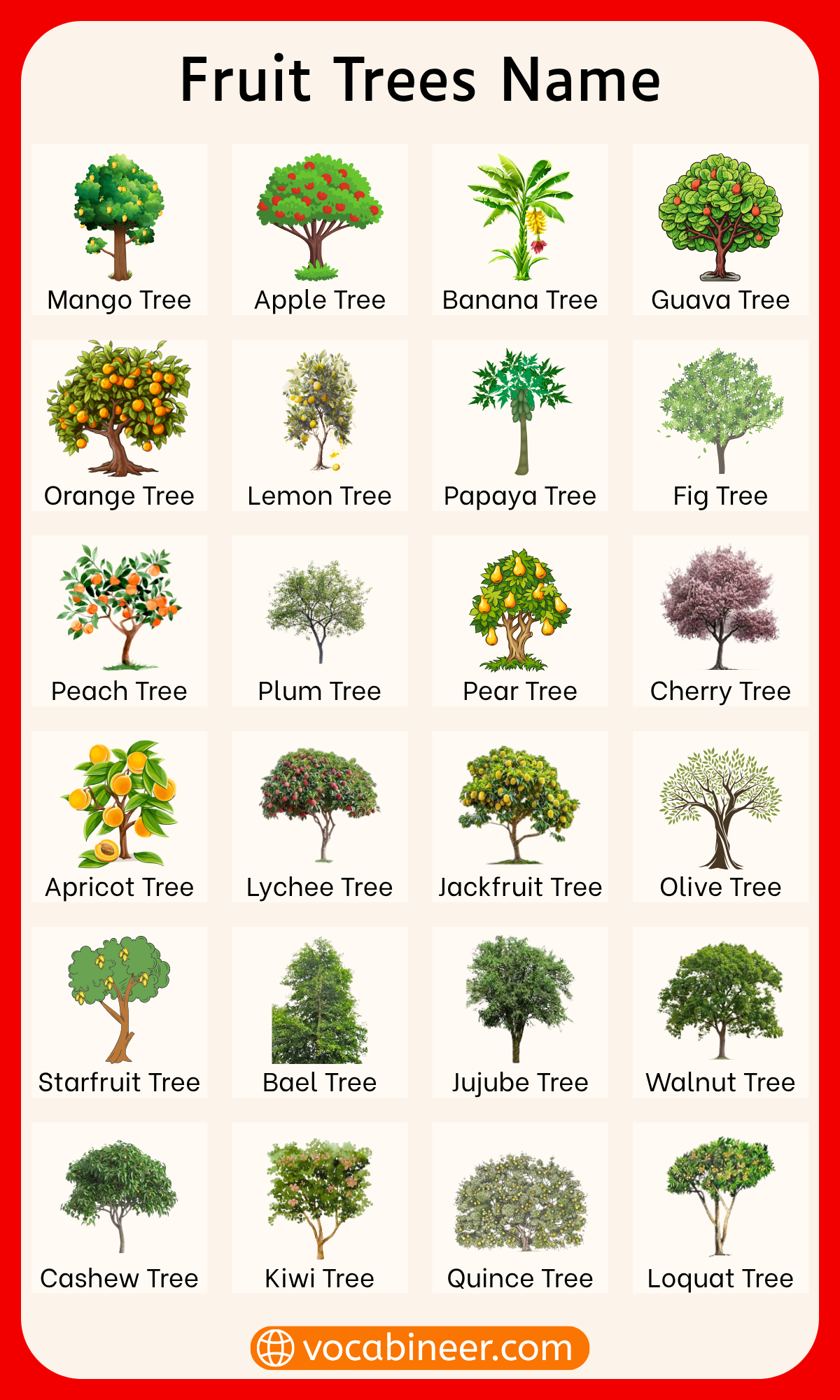
This article covers 50 fruit tree names with pictures, grouped by type to make them easier to learn and compare. Each name also includes a simple recognition clue so you can connect the tree with its fruit, leaves, canopy, or growth habit.
In This Page
Popular Fruit Trees and Their Most Recognizable Features
Fruit trees differ in height, leaf shape, bark, flowers, and the fruits they produce. Learning these visible features helps children and English learners recognize common fruit trees more easily in gardens, farms, orchards, and natural settings.
Apple Tree
An apple tree has a rounded canopy, oval green leaves, and white to pink spring blossoms. Its most recognizable feature is the clusters of apples that develop on the branches.
Mango Tree
A mango tree has a broad spreading crown and long, narrow, glossy leaves. Large bunches of green, yellow, or reddish mangoes make it easy to identify.
Orange Tree
An orange tree has dense evergreen foliage, fragrant white flowers, and round orange fruits. Its glossy leaves and bright citrus fruit stand out clearly.
Lemon Tree
A lemon tree has glossy green leaves, fragrant white flowers, and yellow oval fruits. Many varieties also have small thorns on the branches.
Peach Tree
A peach tree has long narrow leaves and pink blossoms that appear before or with new foliage. Its fuzzy round fruits are its clearest feature.
Pear Tree
A pear tree usually has oval glossy leaves and clusters of white flowers. The familiar pear-shaped fruits hang from short stems.
Cherry Tree
A cherry tree becomes especially recognizable when covered with white or pink blossoms in spring. Later, small round red or dark cherries appear on the branches.
Plum Tree
A plum tree has oval leaves, pale spring flowers, and smooth round fruits. Depending on the variety, the plums may appear purple, red, yellow, or green.
Apricot Tree
An apricot tree has rounded leaves and delicate white or pinkish flowers. Its small orange fruits have soft skin and a central stone.
Fig Tree
A fig tree has large deeply lobed leaves that create a distinctive tropical-looking canopy. Pear-shaped figs grow directly along the branches.
Pomegranate Tree
A pomegranate tree or shrub has narrow glossy leaves and bright red-orange flowers. Round fruits with a crown-like tip make it especially easy to recognize.
Guava Tree
A guava tree has smooth or peeling bark and broad oval leaves with visible veins. Its round or pear-shaped green fruits contain fragrant flesh.
Papaya Tree
A papaya tree has a tall soft trunk topped by a cluster of very large deeply divided leaves. Large oval fruits grow close to the trunk below the leaves.
Coconut Palm
A coconut palm has a tall slender trunk and a crown of long feather-like fronds. Large coconuts grow in clusters near the top.
Date Palm
A date palm has a tall trunk and long arching fronds with many narrow leaflets. Dense bunches of dates hang below the crown.
Avocado Tree
An avocado tree has broad green leaves and a dense rounded canopy. Pear-shaped green or dark fruits hang individually or in small groups.
Mulberry Tree
A mulberry tree has broad leaves that may vary in shape on the same tree. Small elongated berries change from pale colors to red, purple, or black as they ripen.
Olive Tree
An olive tree has a gnarled trunk and narrow gray-green leaves. Small oval green fruits gradually darken to purple or black as they mature.
Persimmon Tree
A persimmon tree has broad leaves that may turn colorful in autumn. Bright orange fruits often remain visible even after many leaves fall.
Lychee Tree
A lychee tree has a dense evergreen crown with glossy compound leaves. Clusters of round red fruits with rough textured skin make it easy to identify.
Fruit Tree Names Grouped by Type
Fruit-bearing trees can be grouped by the kinds of fruits they produce, the climates they prefer, or their general growth form. The sections below organize all 50 names into practical categories.
Common Orchard Fruit Trees
These trees commonly grow in orchards and temperate gardens.
Apple Tree
Apple trees develop spreading branches, oval leaves, and spring blossoms that later produce apples.
Pear Tree
An upright growth habit and glossy green leaves make many pear trees easy to recognize. Their fruits range from rounded forms to the familiar narrow-necked pear shape.
Peach Tree
Narrow leaves and pink spring blossoms appear before fuzzy stone fruits begin to develop.
Plum Tree
Smooth-skinned stone fruits grow in shades of green, yellow, red, purple, and almost black.
Cherry Tree
Spring blossoms cover the branches before small round cherries develop on slender stems.
Apricot Tree
Orange-yellow stone fruits with soft skin grow among rounded green leaves.
Nectarine Tree
Nectarine trees closely resemble peach trees, but their fruits develop smooth rather than fuzzy skin.
Quince Tree
Fragrant golden-yellow fruits with apple- or pear-like shapes make quince trees easy to identify when fruiting.
Citrus Fruit Trees
Citrus trees usually have evergreen leaves, fragrant blossoms, and juicy segmented fruits.
Orange Tree
Glossy evergreen leaves surround round orange fruits that develop after fragrant white blossoms.
Lemon Tree
Yellow oval fruits grow among shiny evergreen leaves, often alongside strongly scented blossoms.
Lime Tree
Small green to yellow citrus fruits develop among dense evergreen foliage and contain sharply acidic juice.
Grapefruit Tree
Large round citrus fruits have thick rinds and pale yellow, pink, or red flesh.
Mandarin Tree
Small easy-peeling citrus fruits grow among compact evergreen foliage and contain sweet juicy segments.
Pomelo Tree
Very large citrus fruits develop with thick rinds and substantial white pith around segmented flesh.
Kumquat Tree
Small oval or round orange fruits grow densely on compact trees, and people often eat the peel with the flesh.
Citron Tree
Large fragrant fruits with thick, uneven rinds contain relatively little pulp compared with most citrus fruits.
Calamondin Tree
Small round orange fruits resemble miniature mandarins but have a noticeably tart flavor.
Tropical Fruit Trees
Warm tropical and subtropical climates support many evergreen fruit trees with distinctive fruits and foliage.
Mango Tree
A broad dense canopy of long narrow leaves gives mango trees their familiar evergreen appearance.
Guava Tree
Smooth or peeling bark and rounded green leaves surround round or pear-shaped fruits.
Jackfruit Tree
Enormous rough-skinned fruits often grow directly from the trunk and major branches.
Breadfruit Tree
Large deeply divided leaves surround round green fruits with textured skin.
Lychee Tree
Dense evergreen crowns carry hanging clusters of small red fruits with rough skin.
Longan Tree
Longan trees resemble lychee trees but produce smaller brown fruits in dense clusters.
Rambutan Tree
Clusters of red, yellow, or orange fruits develop with soft hair-like projections covering the rind.
Durian Tree
Large heavy fruits have thick green-brown shells covered with sharp spines.
Mangosteen Tree
Thick glossy leaves surround round purple fruits with pale segmented flesh inside.
Sapodilla Tree
Rough brown oval fruits develop soft, sweet flesh when fully ripe.
Starfruit Tree
Yellow-green ridged fruits hang from the branches and form star shapes when cut crosswise.
Soursop Tree
Large green fruits covered with soft spines contain creamy white flesh and dark seeds.
Custard Apple Tree
Green fruits with segmented surfaces open to reveal soft creamy flesh around several dark seeds.
Tamarind Tree
Long brown pods develop among fine compound leaves and contain sticky sweet-sour pulp.
Cacao Tree
Large colorful pods grow directly from the trunk and mature branches, making cacao trees especially easy to recognize.
Black Sapote Tree
Round green fruits develop soft dark-brown flesh when ripe, giving black sapote its distinctive appearance.
Mediterranean and Warm-Climate Fruit Trees
These trees grow well in warm, dry, Mediterranean, or subtropical regions.
Fig Tree
Large deeply lobed leaves surround soft fruits that grow close to the branches.
Olive Tree
Narrow silvery-green leaves form airy canopies around small oval fruits that mature from green to dark purple or black.
Pomegranate Tree
Red-orange flowers appear before round fruits with tough skin and many juicy seeds.
Persimmon Tree
Bright orange fruits often remain visible on the branches after many leaves have fallen.
Loquat Tree
Large leathery leaves surround clusters of small yellow-orange fruits.
Jujube Tree
Small oval fruits change from green to reddish-brown as they ripen.
Carob Tree
Long dark pods develop among evergreen leaves and contain sweet pulp around hard seeds.
Fruit Palms
Fruit palms have a different structure from broadleaf trees but fit naturally into everyday fruit-tree vocabulary.
Coconut Tree
Tall slender trunks support large feather-like fronds and clusters of coconuts near the crown.
Date Palm
Heavy bunches of dates hang beneath large arching fronds on tall upright palms.
Açaí Palm
Dense clusters of small dark-purple fruits develop beneath a tall crown of palm leaves.
Peach Palm
Orange, yellow, or red fruits grow in clusters and contain firm starchy flesh.
Nut-Producing Trees
These trees produce edible nuts or seeds commonly grouped with dry fruits in everyday food vocabulary.
Almond Tree
Pale pink or white blossoms appear before green hulls develop around almond seeds.
Walnut Tree
Broad crowns produce round green outer husks that contain hard-shelled walnuts.
Pistachio Tree
Clusters of small fruits develop around the familiar pistachio seeds.
Pecan Tree
Tall trees produce elongated nuts enclosed inside green husks.
Cashew Tree
Colorful cashew apples form with curved cashew nuts attached beneath them.
Hazelnut Tree
Hazelnuts grow on small trees or large shrubs and develop inside leafy husks.
Fruit Tree vs. Fruit Plant
Not every plant that produces fruit is a tree. Growth form provides an easy way to understand the difference.
| Growth Type | Examples | Main Feature |
|---|---|---|
| Tree | Mango, Apple, Guava | Woody trunk and branches |
| Palm | Coconut, Date | Upright trunk topped with large fronds |
| Herbaceous Plant | Banana, Papaya | Soft non-woody stem |
| Vine | Grape, Kiwi, Passion Fruit | Climbs or trails along supports |
| Cactus | Dragon Fruit | Fleshy cactus stems |
| Low-Growing Plant | Strawberry, Watermelon | Grows close to the ground |
This distinction explains why many familiar fruits do not belong in a strict fruit-tree list.
Fruits That Do Not Grow on Trees
Many common fruits come from other kinds of plants rather than true trees.
Banana
Bananas grow on giant herbaceous plants rather than woody trees.
Papaya
Papaya grows on a tall herbaceous plant with a soft trunk-like stem, even though people often call it a tree.
Grape
Grapes develop on climbing vines.
Kiwi
Kiwifruit grows on vigorous woody vines rather than trees.
Pineapple
Pineapples develop on low herbaceous plants with stiff leaves.
Strawberry
Strawberries grow on small low plants close to the ground.
Watermelon
Watermelons develop along trailing vines.
Dragon Fruit
Dragon fruit grows on climbing cactus stems.
FAQs
Apple tree, mango tree, orange tree, pear tree, peach tree, guava tree, fig tree, cherry tree, lemon tree, and pomegranate tree are common examples.
Apples, mangoes, oranges, pears, peaches, plums, cherries, guavas, figs, avocados, lychees, jackfruits, and many other fruits grow on trees.
No. Banana plants are giant herbaceous plants rather than true woody trees, although people often call them banana trees in everyday speech.
Papaya is botanically a large herbaceous plant with a trunk-like stem, not a true woody tree.
Bananas, grapes, kiwi, pineapple, strawberries, watermelon, passion fruit, and dragon fruit grow on herbs, vines, cacti, or low plants rather than trees.
Read More
