

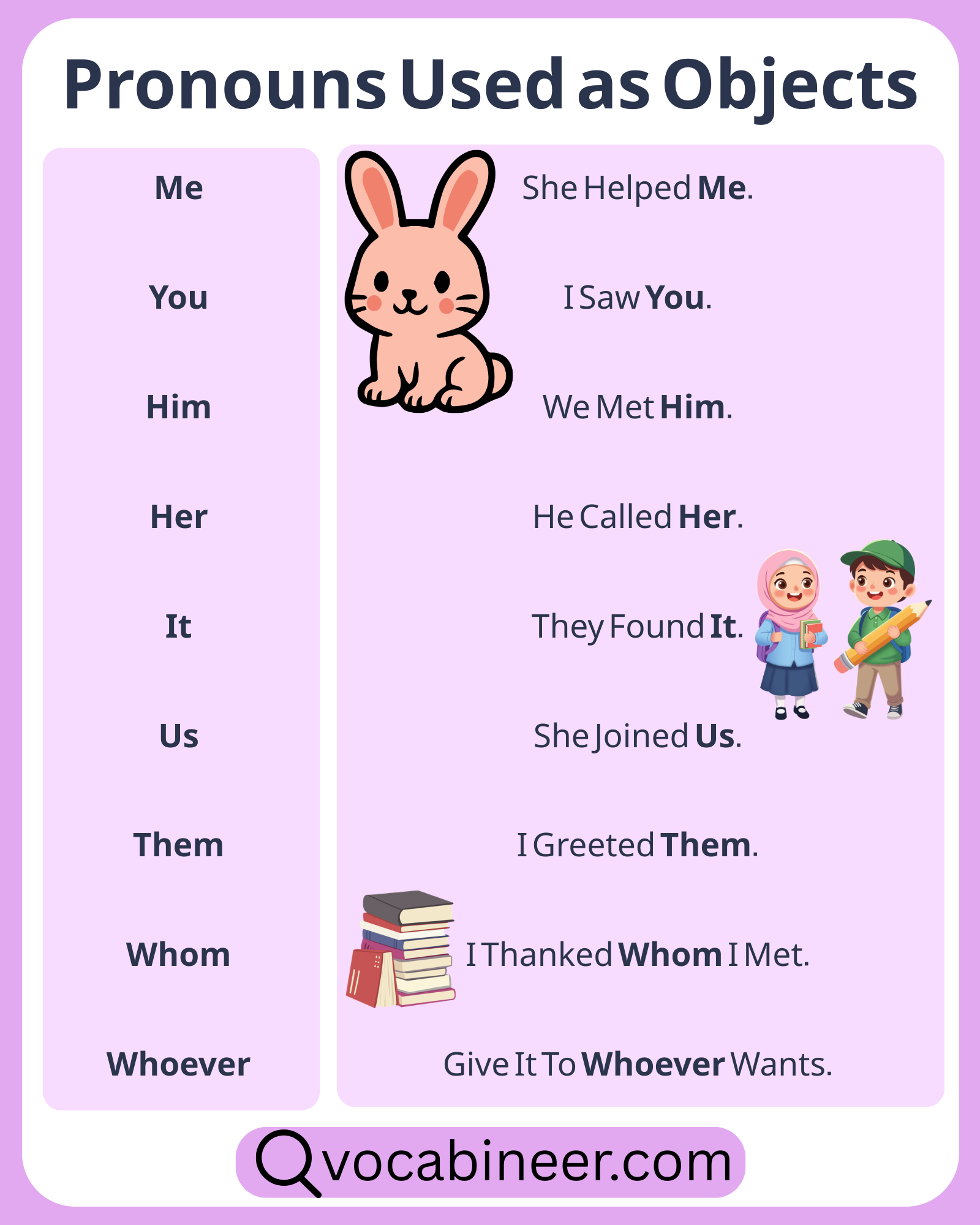
Object pronouns are pronouns that receive the action in a sentence. The main object pronouns in English are me, you, him, her, it, us, and them. We use them when someone or something receives an action.
For example, instead of saying “I called Jack,” we can say “I called him.” Here, him replaces Jack and receives the action of the verb called. Object pronouns also come after prepositions, such as with me, for her, and to them.
In This Page
What Are Object Pronouns?
Object pronouns are pronouns used as the object of a verb or preposition. They usually receive the action instead of doing the action.
Examples:
- She helped me.
- I called you.
- We saw him.
- The teacher praised her.
- I found it.
- They invited us.
- I met them.
In these sentences, the object pronouns come after verbs and show who or what receives the action.
Object Pronouns List
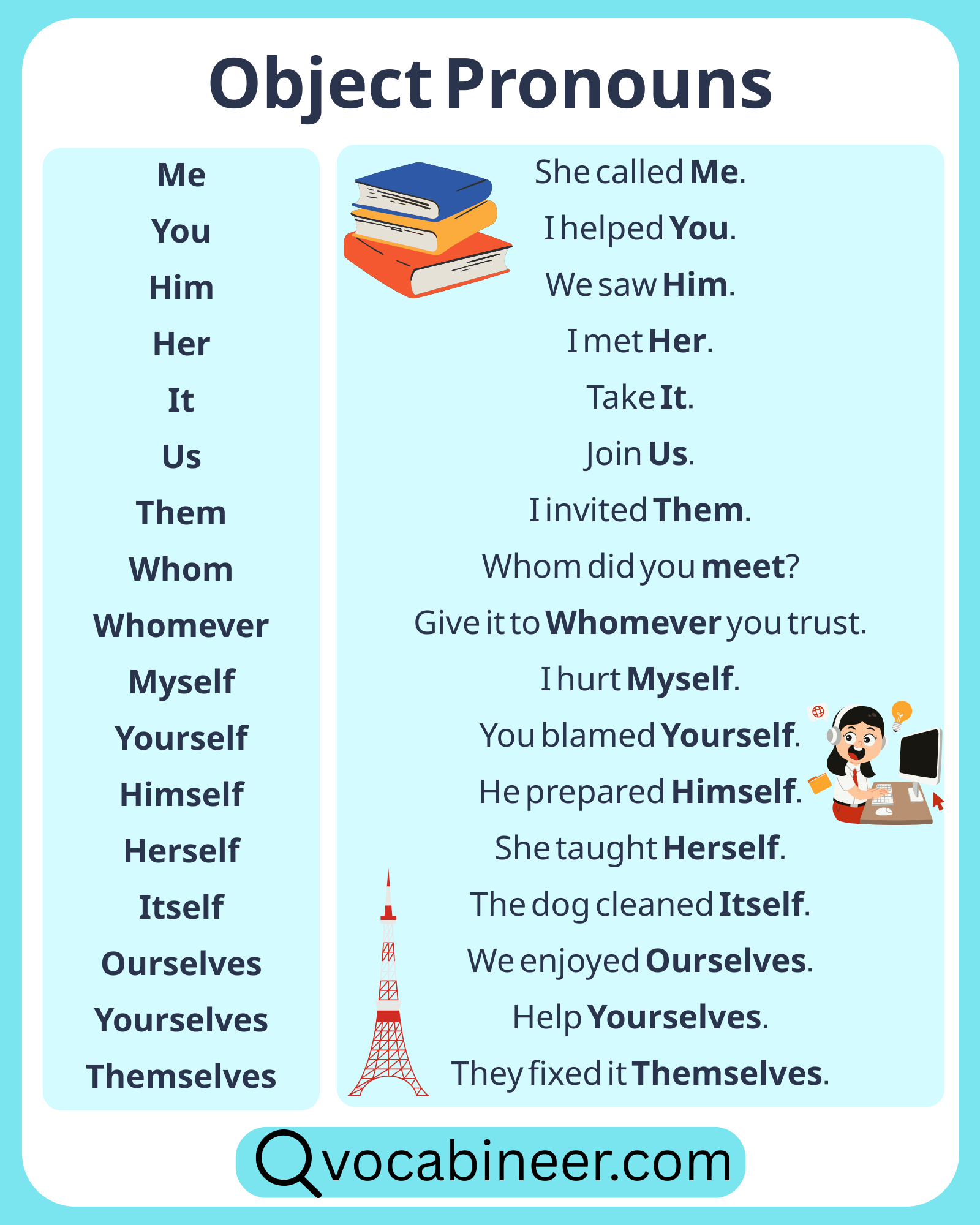
Here is the main list of object pronouns in English:
- Me
- You
- Him
- Her
- It
- Us
- Them
The pronouns you and it have the same form as subject pronouns and object pronouns.
Examples:
- You are kind. / I called you.
- It is broken. / I fixed it.
Object Pronouns Chart
| Subject Pronoun | Object Pronoun | Example |
|---|---|---|
| I | me | She helped me. |
| you | you | I called you. |
| he | him | I saw him. |
| she | her | We invited her. |
| it | it | I found it. |
| we | us | They helped us. |
| they | them | I met them. |
This chart shows the difference between subject pronouns and object pronouns. Subject pronouns do the action, while object pronouns receive the action.
How to Use Object Pronouns
Use object pronouns when the pronoun receives the action or comes after a preposition.
Examples:
- I helped him.
- She called me.
- We invited them.
- The gift is for her.
- Come with us.
- I am talking to you.
A simple way to find an object pronoun is to ask: Who or what receives the action?
Examples:
- She helped me.
Who did she help? Me. - I saw him.
Who did I see? Him. - We found it.
What did we find? It.
Object Pronouns After Verbs
Object pronouns often come after action verbs. They show who or what receives the action.
Examples:
- Help me.
- I saw him.
- We invited them.
- She called you.
- He found it.
- The teacher praised us.
- I asked her.
More examples:
- The coach trained them.
- Dad helped me.
- We thanked her.
- They called us.
- I visited him yesterday.
Simple rule:
Use object pronouns after verbs when the pronoun receives the action.
Object Pronouns After Prepositions
Object pronouns also come after prepositions. Common prepositions include to, for, with, about, near, beside, between, from, and at.
Examples:
- Come with me.
- Sit beside her.
- This gift is for him.
- I am talking to you.
- The story is about them.
- She stood near us.
- The letter is from me.
- The secret is between you and me.
Simple rule:
After a preposition, use an object pronoun.
Subject Pronouns vs Object Pronouns
Subject pronouns do the action. Object pronouns receive the action.
| Use | Subject Pronouns | Object Pronouns |
|---|---|---|
| Job | Do the action | Receive the action |
| Position | Usually before the verb | Usually after a verb or preposition |
| Examples | I, he, she, we, they | me, him, her, us, them |
Examples:
- I called him.
- She helped me.
- They invited us.
- We saw them.
- He thanked her.
In each sentence, the subject pronoun does the action, and the object pronoun receives it.
Direct and Indirect Object Pronouns
Object pronouns can work as direct objects, indirect objects, or objects of prepositions.
| Object Type | Meaning | Example |
|---|---|---|
| Direct object | Receives the action directly | I saw him. |
| Indirect object | Receives something | The teacher gave us homework. |
| Object of preposition | Comes after a preposition | I sat near her. |
More examples:
Direct object
- We called them.
- She helped me.
- I found it.
Indirect object
- She sent me a message.
- The coach gave us advice.
- I bought her a gift.
Object of preposition
- This letter is for you.
- I walked with him.
- The answer came from them.
Common Subject and Object Pronoun Pairs
Some subject and object pronouns are easy to confuse. This table shows the difference.
| Pair | Difference | Example |
|---|---|---|
| I vs Me | I does the action; me receives it. | I called him. / He called me. |
| He vs Him | He does the action; him receives it. | He helped us. / We helped him. |
| She vs Her | She does the action; her receives it. | She saw me. / I saw her. |
| We vs Us | We does the action; us receives it. | We invited them. / They invited us. |
| They vs Them | They do the action; them receive it. | They called us. / We called them. |
A simple rule is: use the subject form before the verb when it does the action, and use the object form after a verb or preposition.
Between You and Me
The correct phrase is between you and me, not between you and I.
Correct:
- Between you and me, this is hard.
- This secret is between you and me.
- The matter stayed between her and me.
Incorrect:
- Between you and I.
Why? Between is a preposition, and prepositions need object pronouns. Since me is an object pronoun, between you and me is correct.
Object Pronouns in Commands and Short Sentences
Object pronouns are common in short everyday sentences and commands.
Examples:
- Help me.
- Call him.
- Ask her.
- Tell them.
- Listen to us.
- Come with me.
- Give it to her.
- Wait for them.
- Look at it.
- Sit beside me.
These short sentences are useful in daily conversation because object pronouns often come right after verbs or prepositions.
Common Mistakes with Object Pronouns
Learners often confuse subject pronouns and object pronouns. Here are common mistakes and correct forms.
| Incorrect | Correct |
|---|---|
| I called he. | I called him. |
| She helped I. | She helped me. |
| The teacher praised we. | The teacher praised us. |
| I saw they. | I saw them. |
| Come with I. | Come with me. |
| Between you and I. | Between you and me. |
| Give it to she. | Give it to her. |
| They invited we. | They invited us. |
| I talked to he. | I talked to him. |
| The gift is for they. | The gift is for them. |
A simple way to avoid these mistakes is to check the pronoun’s position. If it comes after a verb or preposition, use an object pronoun.
Quick Rules to Remember
| Rule | Example |
|---|---|
| Use object pronouns after verbs. | She helped me. |
| Use object pronouns after prepositions. | Come with us. |
| Use me, not I, as an object. | He called me. |
| Use him, not he, as an object. | I saw him. |
| Use her, not she, as an object. | I helped her. |
| Use us, not we, as an object. | They invited us. |
| Use them, not they, as an object. | I met them. |
Simple reminders:
- I does the action; me receives it.
- He does the action; him receives it.
- She does the action; her receives it.
- We does the action; us receives it.
- They do the action; them receive it.
FAQs
Object pronouns are pronouns that receive the action or come after a preposition. Examples include me, you, him, her, it, us, and them.
Examples of object pronouns are me, you, him, her, it, us, and them. Example sentences include “She helped me,” “I called him,” and “They invited us.”
Subject pronouns do the action, such as I, he, she, we, and they. Object pronouns receive the action, such as me, him, her, us, and them.
Use me when the pronoun receives the action or comes after a preposition. For example, say “She called me” and “Come with me.”
The correct phrase is between you and me. The word between is a preposition, so it takes the object pronoun me.
Summary
Object pronouns receive the action in a sentence or come after prepositions. The main object pronouns in English are me, you, him, her, it, us, and them.
Use object pronouns after verbs, as in “She helped me,” and after prepositions, as in “Come with us.” Learning object pronouns helps you avoid common mistakes like I called he, come with I, and between you and I.
Read More
- List of Pronouns in English
- Subject Pronouns in English
- First Person Pronouns in English
- Pronouns for Kids in English
- Interrogative Pronouns in English