Light cream pours smoothly into coffee, while heavy cream forms firm, airy peaks after whipping. Sour cream sits in a thick tangy dollop, whereas clotted cream has a dense, pale-yellow surface created by gentle heating and cooling.
These types of cream differ by milk-fat level, thickness, whipping ability, culturing, preparation, and regional naming. Learning those differences makes it easier to choose cream for coffee, sauces, soups, baking, desserts, and recipes from different countries.
In This Page
Dairy Cream, Milk Fat, and Whipping Ability
Dairy producers separate cream from milk to collect its fat-rich portion. In the United States, products generally need at least 18% milk fat to qualify as standardized cream.
Milk fat affects richness, thickness, and whipping performance. Lower-fat products pour easily and lighten coffee or sauces, while higher-fat creams can trap enough air to create whipped peaks.
Cream may appear as:
- a thin liquid for coffee
- a rich liquid for sauces
- a whipping cream for desserts
- a thick cultured product
- a dense regional cream
- an aerated whipped topping
Half-and-half commonly sits beside cream in U.S. grocery stores. However, it combines milk and cream and contains less fat than products legally identified simply as cream.
Several labels can describe the same carton. For example, ultra-pasteurized heavy whipping cream identifies the heat treatment, milk-fat grade, and whipping function of one product rather than three separate cream types.
U.S. Cream Types by Milk-Fat Level
American cream names follow a clear fat-based order. As the milk-fat level rises, the liquid generally becomes richer and gains a stronger ability to support whipped foam.
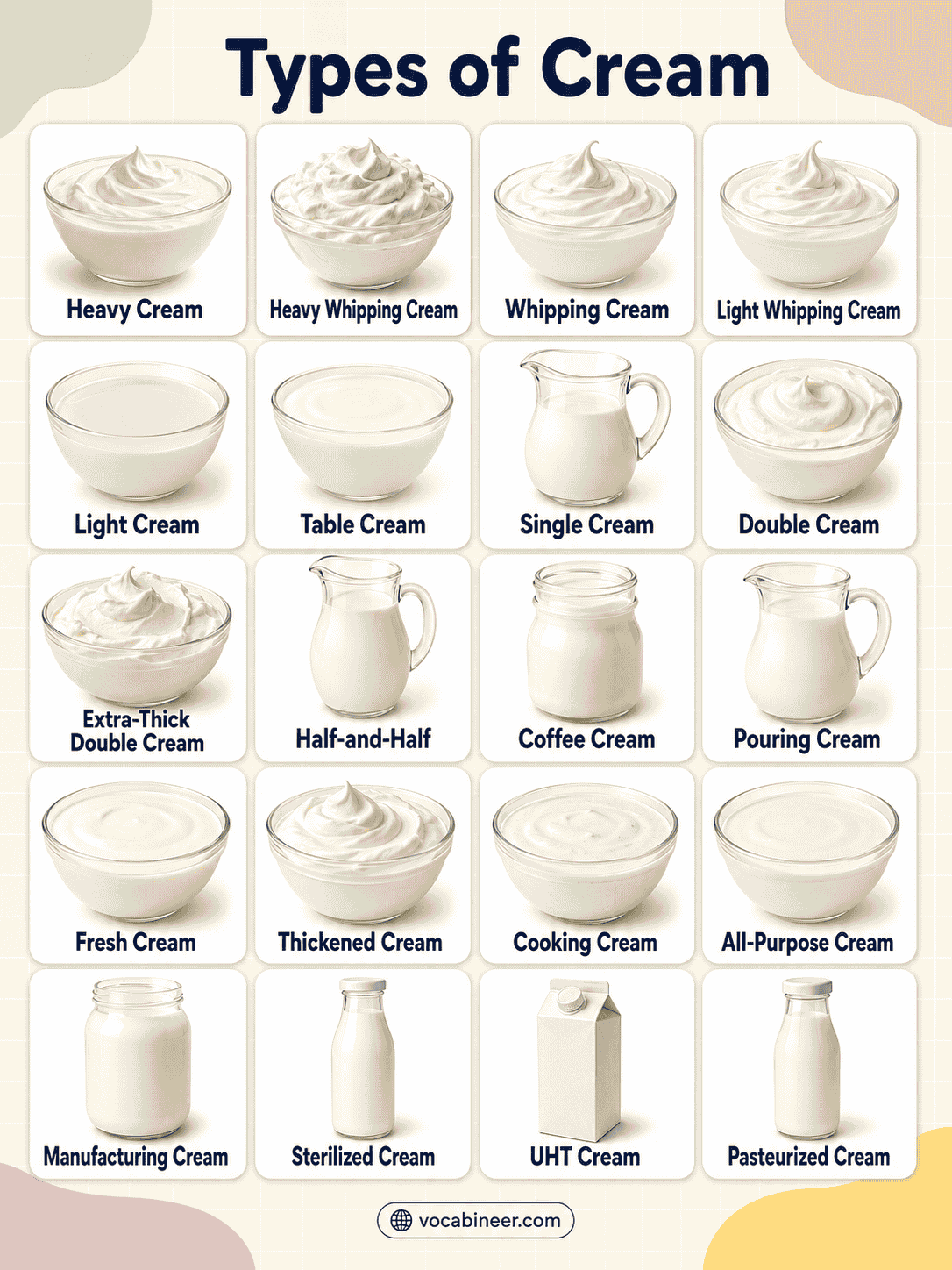
Half-and-Half combines milk and cream and contains 10.5% to less than 18% milk fat. It has a thin, smooth consistency and commonly goes into coffee, soups, sauces, and lighter dishes. Because it contains too little fat, it does not form a stable whip.
Light Cream, also called coffee cream or table cream, contains 18% to less than 30% milk fat. It tastes richer than half-and-half and still pours easily, although it usually lacks enough fat for dependable whipping.
Whipping Cream, also called light whipping cream, contains 30% to less than 36% milk fat. It can form a soft, light foam, but its peaks may not remain as firm as those produced by heavier cream.
Heavy Cream, also called heavy whipping cream, contains at least 36% milk fat. Its higher fat level creates a fuller texture and supports firmer, more stable peaks.
Heavy cream works well in rich sauces, creamy soups, whipped toppings, ganache, custards, and baked desserts. Meanwhile, whipping cream suits preparations that need a lighter whipped texture.
Heavy cream and heavy whipping cream name the same U.S. cream grade. Likewise, whipping cream and light whipping cream should not appear as two unrelated products.
Half-and-Half, Light Cream, Whipping Cream, and Heavy Cream Compared
| Product | Milk-fat level | Typical texture | Whipping ability |
|---|---|---|---|
| Half-and-Half | 10.5% to under 18% | Thin and pourable | Does not form a stable whip |
| Light Cream | 18% to under 30% | Smooth and pourable | Usually unreliable for whipping |
| Whipping Cream | 30% to under 36% | Rich liquid cream | Forms a lighter whip |
| Heavy Cream | At least 36% | Fuller and richer | Forms firmer peaks |
Milk fat helps surround and support the air bubbles created during whipping. Therefore, heavy cream usually forms a stronger foam than ordinary whipping cream.
Cold cream also whips more effectively than warm cream. Chilling the cream, bowl, and beaters helps the fat remain firm enough to support the expanding structure.
Whipped Cream Types and Forms
Whipping cream and heavy cream begin as liquid ingredients. Whipped cream is the airy finished product created when someone beats suitable liquid cream and incorporates air.
Whipped Cream has a light texture and forms soft, medium, or firm peaks depending on the fat level and whipping time. Bakers and cooks use it on pies, cakes, hot chocolate, fruit, puddings, and other desserts.
Sweetened whipped cream includes sugar, while flavored versions may contain vanilla, cocoa, coffee, citrus zest, spices, or extracts. These are variations of whipped cream rather than separate liquid dairy grades.
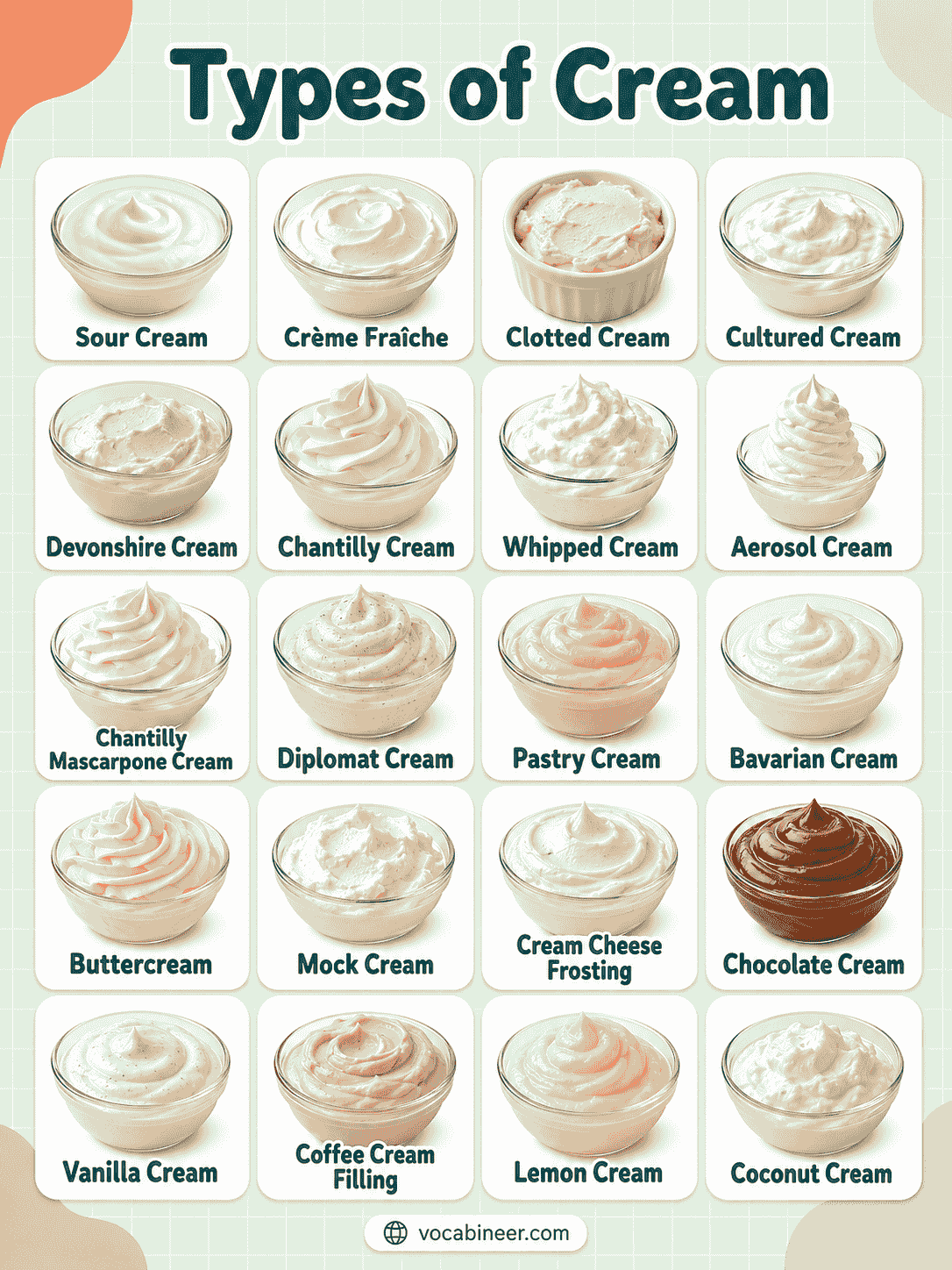
Chantilly Cream 🔊 /ʃænˈtɪli/ commonly means sweetened whipped cream flavored with vanilla. Although culinary usage varies, English-language recipes usually use the name for an elegant whipped topping.
Aerosol or Pressurized Whipped Cream comes in a sealed dispenser. The cream expands into an airy swirl when pressure forces it through the nozzle.
Some pressurized products contain dairy cream, while others use plant fats or mixed ingredients. Therefore, the package description and ingredient list matter more than the appearance of the white swirl.
Whipping cream too long changes its texture. At first, the peaks become firmer; later, the cream turns grainy as the fat begins gathering into larger particles.
Cultured Cream Types
Cultured creams develop tanginess through the action of suitable microorganisms. During fermentation, the cream becomes more acidic and often thickens.
Some commercial soured products use added food acids instead of relying entirely on fermentation. Although both methods can produce tangy cream, the process and final character may differ.
Sour Cream has a thick, spoonable texture and a noticeable tang. It usually appears as a matte white dollop and commonly accompanies baked potatoes, tacos, dips, soups, cakes, and savory sauces.
In the United States, regular sour cream generally begins with cream that contains at least 18% milk fat. Reduced-fat and fat-free versions follow different formulations and may include additional thickening ingredients.
Crème Fraîche 🔊 /krɛm frɛʃ/ is a rich cultured cream with a smooth, glossy appearance and a milder tang than typical sour cream. Its higher richness and gentler acidity often make it less likely to curdle in warm dishes, although results depend on the product and cooking method.
Mexican Crema is a cultured or soured cream associated with Mexican cooking. Compared with standard U.S. sour cream, it commonly has a thinner, more pourable consistency.
Cooks often drizzle Mexican crema over tacos, enchiladas, soups, roasted vegetables, and beans. Commercial products may use names such as crema mexicana, crema fresca, or Mexican-style crema, and their ingredients can vary.
Smetana 🔊 /smɛˈtɑːnə/ is a cultured cream product used in parts of Central and Eastern Europe. Some versions pour easily, while others resemble a thick, rich sour cream.
Because smetana varies by country and manufacturer, it should not receive one universal milk-fat percentage or texture description.
Sour Cream, Crème Fraîche, Mexican Crema, and Smetana Compared
| Cream product | Main character | Typical texture | Recognition clue |
|---|---|---|---|
| Sour Cream | Sharply tangy | Thick and spoonable | Matte white dollop |
| Crème Fraîche | Rich and mildly tangy | Thick and glossy | Smooth, glossy spoonful |
| Mexican Crema | Mild cultured flavor | Thin and pourable | Drizzle from a spoon or bottle |
| Smetana | Regional cultured cream | Pourable to thick | Similar to rich sour cream |
Sour cream usually brings the sharpest familiar tang. By comparison, crème fraîche tastes richer and milder, while Mexican crema flows more easily.
British and Regional Cream Types
British recipes use cream names that do not line up perfectly with American categories. Although a U.S. product may perform a similar role, the fat content and consistency may still differ.
Traditional products such as malai and kaymak also deserve their own names. People sometimes compare them with clotted cream, but they come from separate dairy traditions.
Single Cream is a light British pouring cream used in coffee, sauces, and desserts. U.S. light cream offers the closest broad comparison, although the two names do not guarantee identical fat levels.
Single cream pours easily but usually does not whip into stable peaks. Therefore, it cannot replace heavy cream in recipes that depend on a strong whipped structure.
Whipping Cream in Britain contains enough fat to whip into a soft topping. However, British and U.S. products sold as whipping cream may follow different regional standards.
When adapting a recipe, checking the package’s fat percentage gives more reliable guidance than assuming the two terms always match.
Double Cream is a very rich British cream that feels noticeably thicker than ordinary U.S. heavy cream. It can pour slowly, whip quickly, and create dense, rich peaks.
U.S. heavy cream often serves as the nearest widely available substitute. Even so, the finished sauce or whipped topping may feel lighter because double cream commonly contains more fat.
Clotted Cream has a dense, spoonable texture created through gentle heating and slow cooling. Its pale cream or yellow surface may look rippled, crusted, or slightly wrinkled.
Unlike whipped cream, clotted cream does not depend on incorporated air. People traditionally serve it with scones and jam in British cream-tea settings.
The term Devonshire cream commonly refers to clotted cream or a product associated with that regional tradition. It should not automatically count as another independent type.
Malai 🔊 /məˈlaɪ/ is the rich cream layer that forms on heated and cooled milk in South Asian dairy traditions. Cooks collect it from the surface as a soft skin, thick layer, or folded creamy mass.
Malai may come from cow or buffalo milk, and its thickness depends on the milk and preparation. It is not an exact synonym for packaged heavy cream.
Kaymak 🔊 /ˈkaɪmæk/ is a rich dairy product associated with Türkiye, the Balkans, the Middle East, and nearby areas. It commonly has a thick, folded, layered, or lightly crusted texture.
Kaymak often receives comparisons with clotted cream because both are rich and spoonable. Nevertheless, their traditional methods, milk sources, textures, and regional identities can differ.
Fresh, Cooking, and Thickened Cream
Some cream packages use names that describe marketing, intended use, or added texture rather than one universal fat category.
Fresh Cream is a broad market term commonly used for liquid dairy cream. Its milk-fat level, heat treatment, storage requirements, and whipping ability vary by country and product.
A carton labeled fresh cream may contain light pouring cream, whipping cream, or another locally familiar grade. Consequently, buyers should check the fat percentage and whipping instructions instead of assuming it means heavy cream.
Cooking Cream is a commercial label for cream or a cream-based product intended for heated dishes. Manufacturers may select a particular fat level or add stabilizers to help the product work in soups, curries, casseroles, and pasta sauces.
Some cooking creams resist splitting during heating but remain too low in fat to whip successfully. A product designed for sauces may therefore fail as a dessert topping.
Thickened Cream is a commercial product widely recognized in Australia and some other markets. It may contain gelatin, gums, or other approved thickeners that improve body and whipping performance.
Unlike malai or kaymak, thickened cream is not a traditional collected cream layer. Its formula depends on the manufacturer and regional market.
Processing and Storage Labels on Cream
Processing labels explain how manufacturers treat and package cream. They do not create additional milk-fat grades.
Pasteurized Cream receives controlled heat treatment to reduce harmful microorganisms. Most refrigerated dairy cream sold in the United States undergoes pasteurization.
Ultra-Pasteurized Cream receives a higher heat treatment that extends its refrigerated life. However, ultra-pasteurized cream still usually requires refrigeration unless the package specifically identifies it as shelf-stable.
UHT Cream, or ultra-high-temperature cream, receives intense heat treatment and sterile packaging. Some unopened packages can remain at room temperature, although storage after opening depends on the manufacturer’s directions.
Shelf-Stable Cream describes cream packaged for storage without refrigeration before opening. Sterile processing and sealed packaging make that storage possible.
Homogenized Cream undergoes mechanical treatment that distributes fat globules more evenly through the liquid. Homogenization describes physical processing rather than richness or milk-fat percentage.
Dry Cream, sometimes sold or described as cream powder, has had much of its water removed. The resulting pale dairy powder appears in dry mixes, beverages, baking products, and food manufacturing.
Not every product marketed as cream powder has the same dairy content or formulation. Buyers should check the ingredient list rather than assuming every powder matches standardized dry cream.
Foods Commonly Mistaken for Dairy Cream
Several products contain the word cream even though they are not basic dairy cream grades.
Coffee Creamer differs from coffee cream. Coffee cream is another U.S. name for light dairy cream, while coffee creamer may contain dairy ingredients, plant oils, sweeteners, flavors, emulsifiers, or gums.
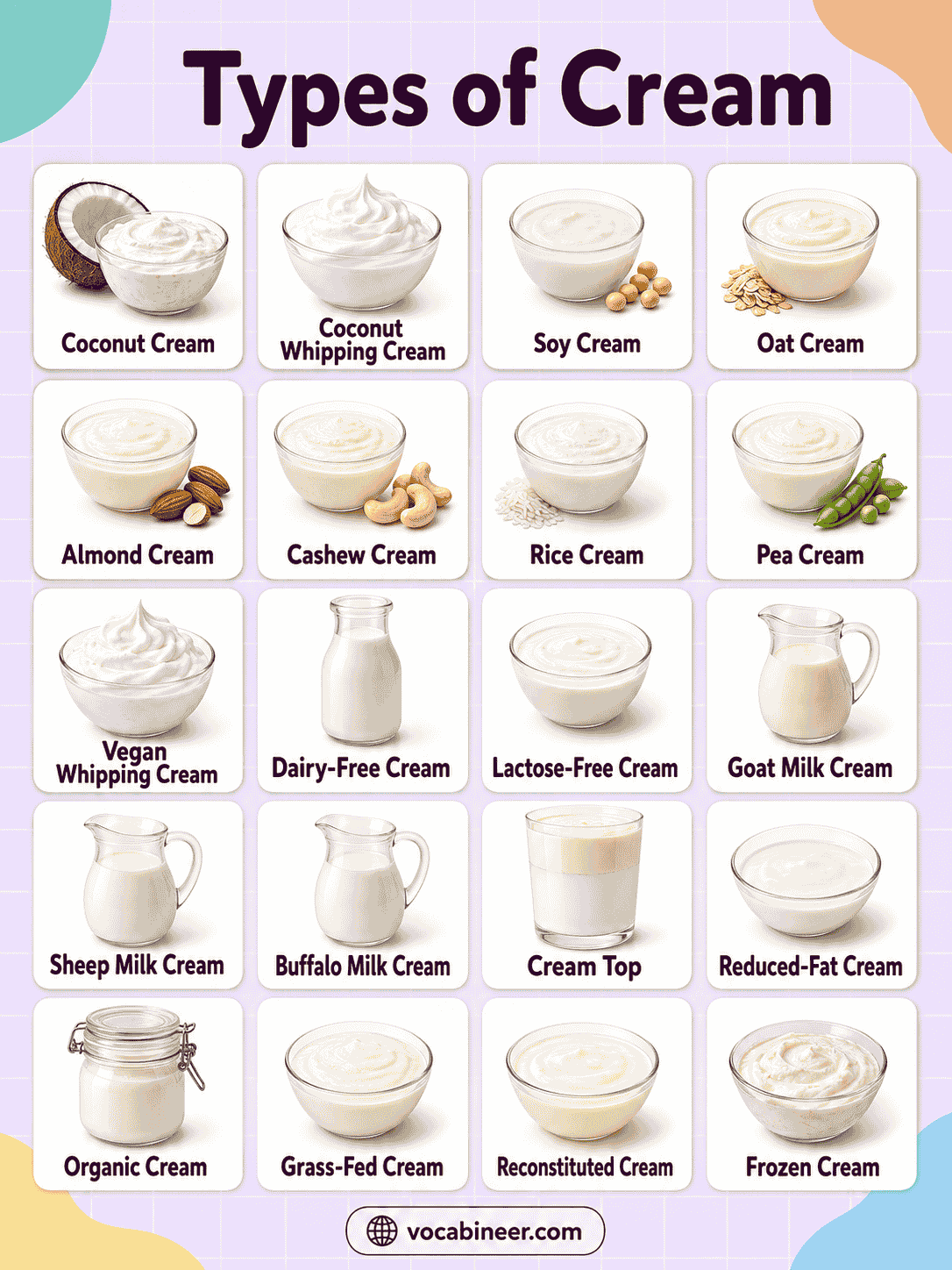
Coconut Cream comes from coconut rather than animal milk. It has a rich, thick consistency, but it belongs to the plant-based food category.
Oat, soy, almond, and other plant-based cream alternatives may imitate the texture or cooking function of dairy cream. Their ingredients and whipping performance vary widely.
Pastry Cream is a cooked custard filling usually made from milk, egg yolks, sugar, and starch. Despite its name, it is not a liquid dairy cream grade.
Other pastry fillings may combine pastry cream with whipped cream, butter, gelatin, or meringue. These belong to dessert and baking terminology rather than a basic list of dairy creams.
Cream Cheese is a soft fresh cheese. Similarly, mascarpone belongs to the cheese family even though it has a rich, creamy texture.
Buttercream is a frosting or filling made from fat and sugar. Depending on the style, the recipe may use butter, shortening, egg whites, syrup, or other ingredients.
Ice Cream is a frozen dessert that may contain dairy cream. Freezing, churning, sweetening, and flavoring turn it into a separate dairy product.
Cream of Tartar is an acidic baking ingredient with no dairy cream. Bakers use it to stabilize egg whites and support specific baking reactions.
FAQs
Common U.S. products include light cream, whipping cream, and heavy cream. Closely related products and forms include half-and-half, whipped cream, sour cream, crème fraîche, single cream, double cream, clotted cream, Mexican crema, smetana, malai, and kaymak.
Yes. In American English, both names describe the same standardized cream grade containing at least 36% milk fat.
Whipping cream is a liquid dairy cream that contains enough fat to trap air. Whipped cream is the light, aerated product created after beating suitable cream.
Sour cream usually has a sharper tang and a thick matte appearance. Crème fraîche commonly tastes richer and milder and has a smoother, glossier texture.
Heavy cream is a U.S. cream grade containing at least 36% milk fat. British double cream is generally richer and thicker, so heavy cream is the nearest common American comparison rather than an exact equivalent.
Read More