Strawberry jam spreads in a bright red layer filled with soft fruit pulp, while blackberry jam looks darker and often reveals tiny seeds. Apricot jam usually glows golden-orange, and fig jam carries hundreds of fine seeds through a thick amber or purple-brown spread.
These types of jam differ by source fruit, natural color, pulp, seeds, sweetness, acidity, preparation, and finished texture. The main sections focus on genuine fruit jams, while later sections clarify seedless jam, freezer jam, jelly, preserves, marmalade, fruit butter, chutney, and other related spreads.
In This Page
Jam Definition, Ingredients, and Texture
Jam is a thick, spreadable food made mainly from crushed, chopped, ground, or mashed fruit. Because it retains fruit pulp, jam normally looks opaque and fruit-rich rather than clear and glasslike.
Sugar commonly adds sweetness while also supporting color, texture, gel formation, and preservation. Meanwhile, natural fruit acids balance the flavor and help pectin form the soft structure associated with jam.
Pectin is a natural substance found in fruit. Some fruits provide enough natural pectin for suitable jam methods, while other preparations use commercial powdered or liquid pectin to help the spread set.
Apples, currants, cranberries, citrus fruits, and quince generally contain more natural pectin than very ripe strawberries, peaches, or similar soft fruits. However, the amount still varies with the fruit variety, ripeness, and preparation method.
Jam may contain tiny seeds, soft skins, fibrous pulp, or small fruit pieces. Even so, it should remain easy to spread rather than becoming as firm as fruit paste or as loose as fruit sauce.
Jelly differs from jam because jelly relies mainly on strained fruit juice. As a result, jelly usually looks clearer, feels smoother, and contains no visible fruit pulp.
Jam Names by Fruit, Texture, and Preparation
A jam name may identify the main fruit, but additional words can describe seeds, sugar, pectin, preparation, or storage.
For example, seedless reduced-sugar raspberry freezer jam is one spread with several accurate descriptions:
- Raspberry identifies the source fruit.
- Seedless means the noticeable seeds have been removed.
- Reduced-sugar describes the formulation.
- Freezer jam identifies the preparation and storage style.
Therefore, fruit names and preparation terms should not be treated as unrelated varieties. Strawberry jam may also be cooked, seedless, reduced-sugar, refrigerated, or made without added pectin.
The main naming features include:
- source fruit
- fruit combination
- pulp and seed treatment
- sugar level
- pectin method
- cooking process
- storage style
Fruit remains the clearest feature for everyday vocabulary and visual identification. Preparation and package terms provide additional information about the same product.
Berry and Mixed-Berry Jams
Berry jams commonly appear red, purple, blue-purple, or nearly black. Since several varieties share similar colors, the source fruit, seeds, skins, pulp, and flavor provide stronger recognition clues.
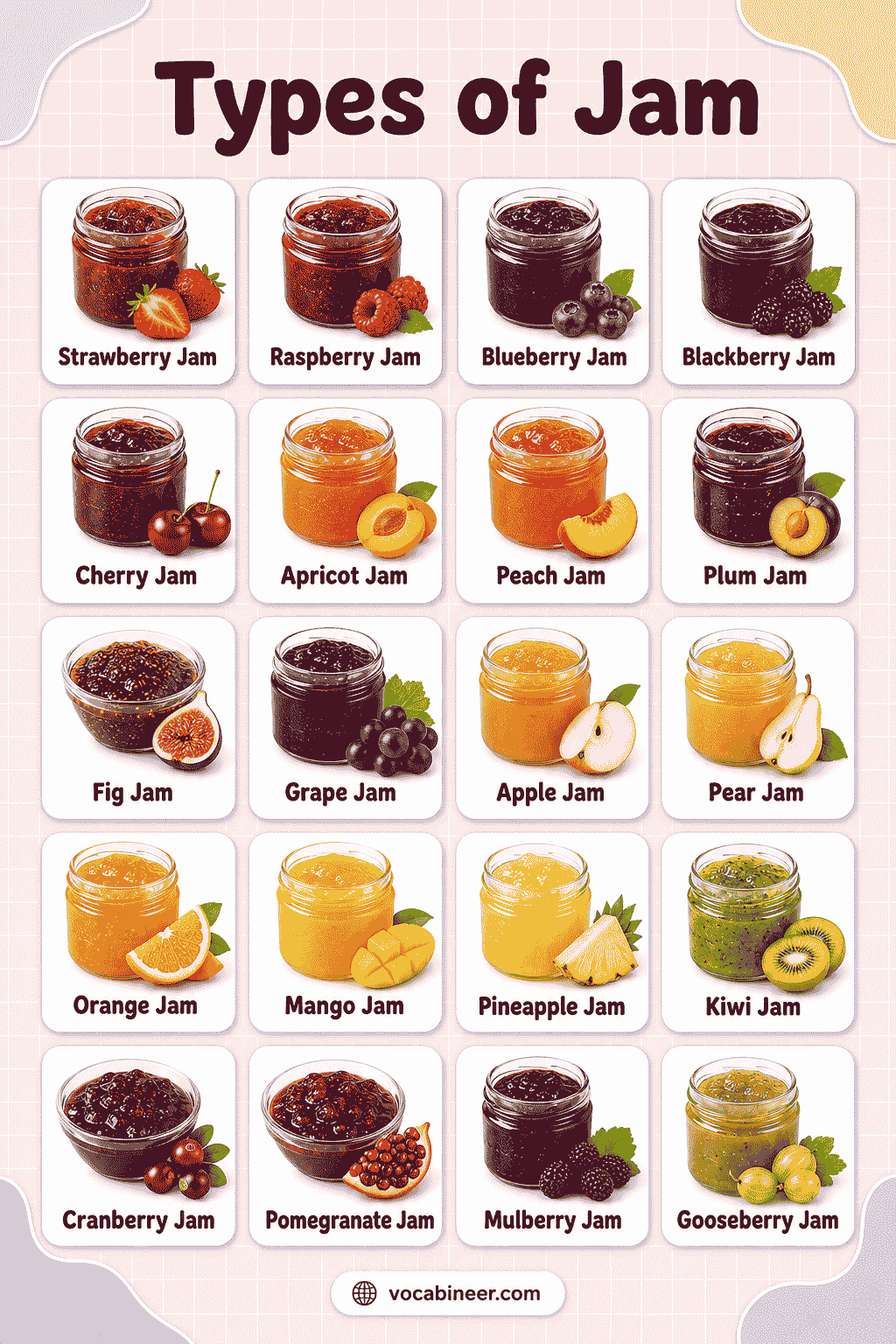
Strawberry Jam has a bright or deep red color with soft strawberry pulp and tiny pale seeds. Its familiar sweet-tart flavor works well on toast, biscuits, pancakes, scones, and sandwiches.
Raspberry Jam usually appears deep red and contains many fine seeds unless the fruit has been strained. Compared with strawberry jam, it often tastes sharper and feels more noticeably seedy.
Blackberry Jam has a dark red-purple or nearly black color with dense berry pulp. Small seeds may remain throughout the spread, while the flavor combines sweetness with a rich earthy tartness.
Blueberry Jam commonly looks dark blue-purple and may show pieces of blueberry skin. Its texture can range from smooth and glossy to softly chunky, depending on how thoroughly the berries are crushed.
Cranberry Jam has a deep ruby-red color and a strongly tart fruit flavor. Cranberries naturally contain substantial pectin, so the finished spread can develop a firm, thick body.
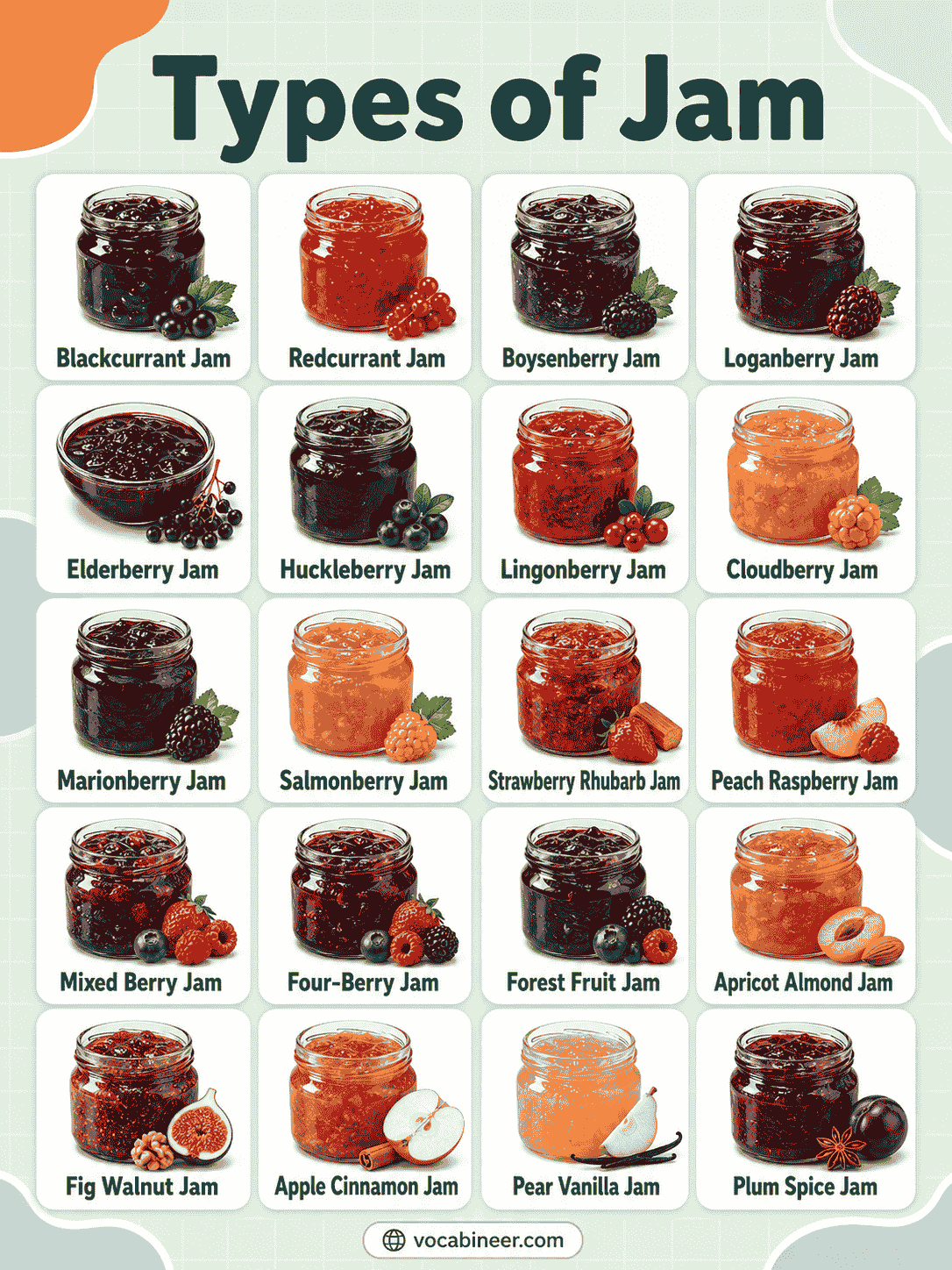
Black Currant Jam uses dark purple-black currants and usually has an intense tart flavor. It may look nearly black inside the jar but spread into a rich purple-red layer.
Red Currant Jam has a bright ruby color and a sharp, refreshing tartness. Unlike clear red currant jelly, the jam retains fruit pulp and appears more opaque.
Gooseberry Jam may look pale green, yellow-gold, pink, or reddish, depending on the gooseberry variety. Its distinctive tartness gives the spread a bright flavor that balances the added sweetness.
Boysenberry Jam uses boysenberries, which are related to blackberries and raspberries. The jam usually has a deep burgundy-purple color, fine seeds, and a sweet-tart berry flavor.
Elderberry Jam has a dark purple-black appearance and a rich berry flavor. Because elderberries are small and deeply colored, the finished spread often looks dense and glossy.
Mulberry Jam can appear red, purple, or almost black, depending on the fruit. It usually has a mild sweetness with soft berry pulp and many tiny seeds.
Lingonberry Jam uses small red northern berries with a noticeably tart flavor. The spread often remains slightly loose and fruit-forward, making it useful with both sweet and savory foods.
Cloudberry Jam has a golden-orange or amber color. Cloudberries bring a distinctive sweet-tart flavor, and the jam may contain small seeds similar to those found in raspberries.
Huckleberry Jam commonly appears deep purple or blue-black. Its flavor resembles blueberry with a sharper wild-berry character, while bits of skin may remain visible.
Mixed Berry Jam combines several berries, such as strawberries, raspberries, blackberries, blueberries, or currants. It usually appears deep red-purple and may contain more than one kind of seed, skin, or pulp.
Strawberry-Rhubarb Jam combines sweet strawberry pulp with tart rhubarb stalks. Its color generally remains red, while the rhubarb adds brightness and soft fibrous texture.
Stone-Fruit Jams
Stone fruits contain one central pit, or stone, that producers remove before crushing or chopping the flesh. Their jams often have smooth pulp, warm colors, and fewer noticeable seeds than berry jams.
Cherry Jam commonly has a deep red or burgundy color with soft cherry pulp. Sweet cherries create a rich mellow flavor, while other varieties may produce a brighter tartness.
Sour Cherry Jam uses naturally tart cherries and usually has a vivid red color. Its sharper flavor distinguishes it from jam made with sweeter cherry varieties.
Apricot Jam is generally golden-yellow or orange with a smooth, glossy appearance. Gentle tartness balances its sweetness, making it popular on bread, pastries, and glazed baked foods.
Peach Jam has a pale yellow-orange or warm peach color with delicate fruit pulp. Small soft pieces may remain, although the texture often feels smoother than cherry or plum jam.
Nectarine Jam resembles peach jam but uses smooth-skinned nectarines. It commonly has a golden-orange color and a fragrant sweet-tart flavor.
Plum Jam can range from red-purple to dark amber, depending on the plum variety. Cooked skins may deepen the color, while the flavor can be sweet, tangy, or pleasantly sharp.
Damson Jam uses small dark damson plums, which have a naturally tart and slightly astringent flavor. The finished jam usually appears deep purple-red with a rich plum character.
Greengage Jam comes from green or yellow-green greengage plums. Despite the pale fruit color, the jam usually develops a warm yellow-gold shade and a rich honeyed flavor.
Orchard, Tree, and Vine-Fruit Jams
These fruits produce noticeably different skins, seeds, pulp, and natural pectin levels. Several also create jelly, fruit butter, preserves, or paste, so accurate naming helps prevent confusion.
Fig Jam contains crushed or finely chopped figs with many tiny edible seeds. Its color may be amber, golden-brown, reddish-purple, or deep brown, depending on the fig variety.
Grape Jam uses crushed grapes or grape pulp, creating an opaque and textured spread. Grape jelly, by contrast, uses strained juice and has a clearer, smoother appearance.
Apple Jam contains cooked apple pulp in a soft gelled spread. It may appear pale gold, amber, or lightly spiced, but it should not resemble the dark, completely smooth paste known as apple butter.
Pear Jam has a pale gold or amber color with a delicate fruit flavor. Finely chopped pear can give the spread a soft, slightly grainy texture.
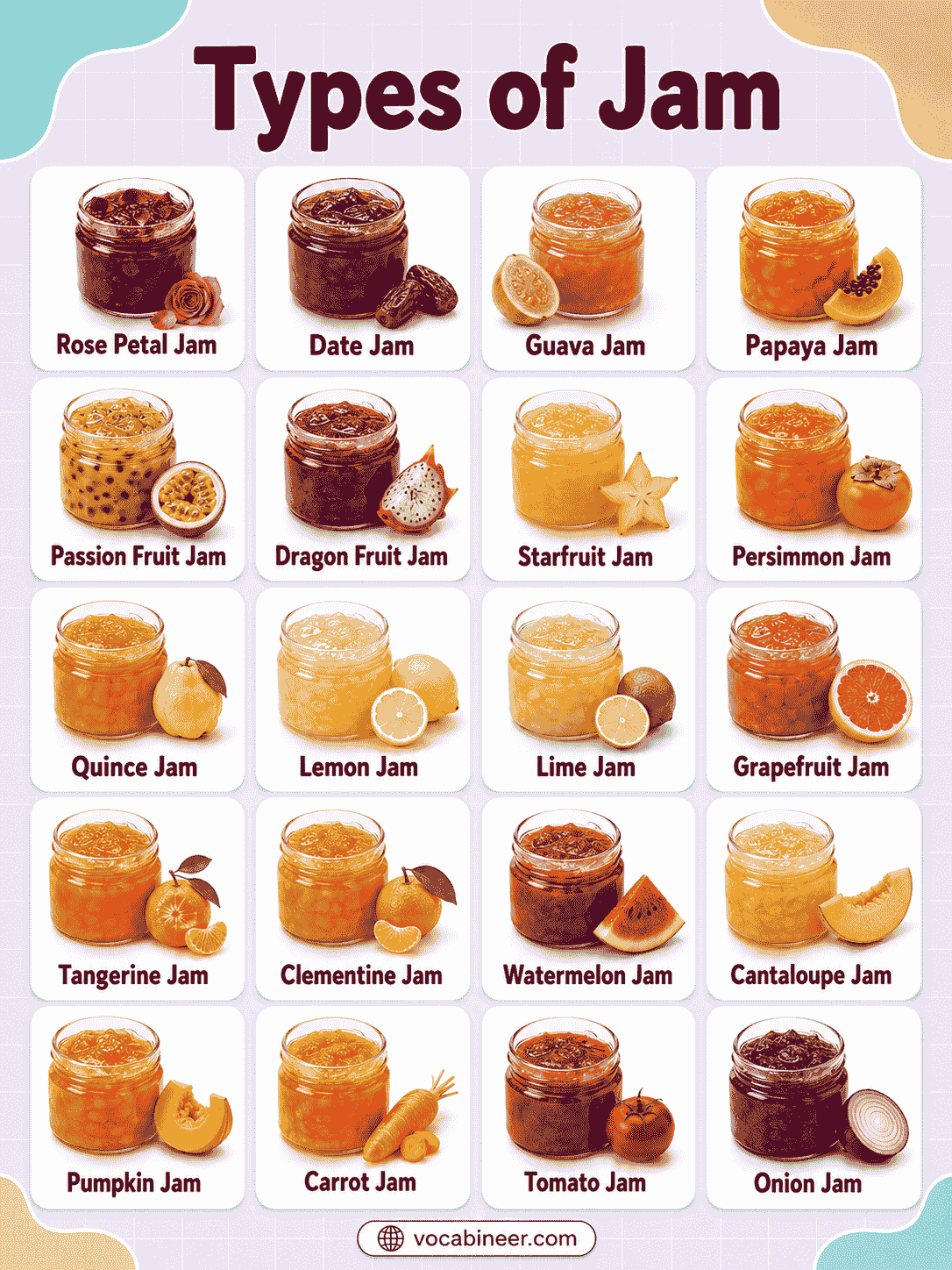
Quince Jam uses quince 🔊 /kwɪns/, a firm aromatic fruit that softens and becomes fragrant during cooking. The jam may turn golden, amber, orange-red, or rosy while remaining soft enough to spread.
Pomegranate Jam commonly has a ruby-red or burgundy color with a sweet-tart flavor. Depending on the method, it may retain fruit pulp while excluding the hard inner seeds.
Persimmon Jam usually appears orange-gold or deep amber. Ripe persimmon gives it a smooth texture and mellow honeylike sweetness.
Date Jam uses softened dates to create a dark brown, thick fruit spread. It has a naturally rich sweetness and a dense texture, although it should remain softer than a firm date paste.
Tropical-Fruit Jams
Tropical fruits create fragrant jams with bright colors and distinctive pulp. Their natural fibers, seeds, and aromas provide better identification clues than a generic yellow or orange jar.
Mango Jam usually has a smooth golden-yellow or orange color. Ripe mango gives the spread a rich tropical sweetness, while acidity keeps the flavor balanced.
Pineapple Jam has a bright yellow-gold appearance with lightly fibrous pulp. Visible fruit strands and a sharp sweet-tart flavor separate it from smoother mango jam.
Guava Jam may appear pink-red, coral, amber, or golden, depending on the guava variety. It has a fragrant flavor and may contain small seeds unless producers remove them.
Passion Fruit Jam commonly appears golden-yellow or orange and may contain dark edible seeds. Its highly aromatic tartness gives the spread a strong tropical character.
Papaya Jam usually has a warm orange or reddish-orange color with a smooth, soft texture. Its mild sweetness allows citrus juice or spice to become noticeable in some preparations.
Kiwi Jam has a green, yellow-green, or golden appearance with many tiny black seeds. Its bright acidity and speckled texture make it easy to distinguish visually.
Lychee Jam is generally pale gold, translucent cream, or light amber. The fruit provides a delicate floral aroma and a soft smooth texture.
Rhubarb and Mixed-Fruit Jams
Some widely recognized jams use a nonfruit ingredient in culinary terms or combine several fruits into one balanced spread.
Rhubarb Jam uses chopped rhubarb stalks, which soften into a smooth fibrous mixture during cooking. Its color may range from greenish-gold to pink-red, while the flavor remains strongly tart.
Mixed Fruit Jam combines several fruits rather than several berries alone. Common mixtures may include apple, peach, plum, pineapple, mango, or berries, depending on the product.
A mixed fruit jam should still maintain a spreadable fruit-pulp texture. Products containing several fruits plus nuts, raisins, citrus peel, or other additions may fit the traditional idea of a conserve more closely.
Cooked, Freezer, and Refrigerator Jam Styles
These names describe preparation and storage rather than source fruit. Strawberry, raspberry, peach, mango, or another jam may fit any of these styles when producers use the appropriate method.
Cooked Jam develops through heating fruit with sugar and, when needed, pectin or acid. Cooking softens the fruit, concentrates the flavor, and creates the familiar gelled texture of many traditional jams.
Freezer Jam commonly uses crushed fruit with little or no cooking of the fruit itself. It often has a brighter color and fresher fruit flavor but requires freezer or refrigerator storage.
Refrigerator Jam is a quick fruit spread intended for cold storage. It may be cooked or uncooked, although it does not receive the tested processing required for ordinary pantry storage.
Cooked, Freezer, and Refrigerator Jam Compared
| Jam style | Main preparation | Storage form | Typical character |
|---|---|---|---|
| Cooked jam | Fruit mixture receives cooking | Depends on tested processing and packaging | Deeper cooked-fruit flavor |
| Freezer jam | Fruit receives little or no cooking | Freezer or refrigerator | Brighter, fresher fruit character |
| Refrigerator jam | Quick spread prepared for cold storage | Refrigerator | Soft texture and shorter storage |
Preparation and storage safety depend on the recipe, acidity, ingredients, packaging, and processing method. General descriptions should never replace tested food-preservation instructions.
Seedless Jam, Sugar Levels, and Pectin Use
These terms describe formulation rather than source fruit. As a result, they can overlap with berry, stone-fruit, orchard, or tropical jams.
Seedless Jam has had noticeable seeds removed, often by passing softened fruit through a sieve or food mill. Fruit pulp may remain, so seedless jam is not automatically jelly.
Reduced-Sugar Jam contains less sugar than a comparable regular product. Because sugar affects sweetness, texture, color, setting, and storage, the formulation may require adjusted ingredients or pectin.
Low-Sugar Jam uses a recipe or commercial formulation designed to create a less sweet spread. The name describes sugar level rather than fruit or preparation style.
No-Sugar-Added Fruit Spread contains no added sugar or sweetening ingredient according to its formulation and label. However, the fruit still contains naturally occurring sugars.
Jam with Added Pectin uses commercial pectin to support gel formation. This method can help produce a reliable texture with fruits that provide less natural pectin.
Jam without Added Pectin depends on natural fruit pectin, acidity, sugar balance, and cooking. It does not mean the product contains no pectin because the fruit supplies pectin naturally.
Simply removing sugar from a traditional jam formula can change the texture, gel, color, and storage requirements. Suitable reduced-sugar products use recipes or formulations designed for that purpose.
Jam, Jelly, Preserves, and Marmalade
Jam, jelly, preserves, and marmalade often appear beside one another in stores. Nevertheless, they differ in the fruit form, texture, and visible structure.
| Product | Main fruit form | Typical texture | Recognition clue |
|---|---|---|---|
| Jam | Crushed or chopped fruit | Thick and spreadable | Opaque pulp, seeds, or small pieces |
| Jelly | Strained fruit juice | Clearer and firmer | No visible fruit pulp |
| Preserves | Whole fruit or larger pieces | Thick syrup or soft gel | Recognizable fruit pieces |
| Marmalade | Citrus juice and peel | Jellylike | Visible citrus-peel strips |
Jam retains fruit pulp, giving it an opaque and softly textured appearance. Tiny seeds, skins, fibers, or small pieces may remain.
Jelly relies mainly on strained fruit juice. Consequently, it appears clearer, feels smoother, and contains no visible pulp.
Preserves commonly contain larger or more recognizable fruit pieces than jam. However, commercial labels and legal usage may overlap, so the terms do not always follow one absolute boundary.
Marmalade uses citrus juice and peel in a translucent, jellylike base. Visible strips of orange, lemon, lime, or grapefruit peel provide the clearest recognition clue.
Grape jam and grape jelly demonstrate the distinction clearly. Grape jam looks opaque because it contains pulp, whereas grape jelly forms a smooth clear gel from strained juice.
Likewise, seedless raspberry jam can remain opaque and fruit-rich after producers remove the seeds. The product does not become jelly unless it relies mainly on strained juice.
Fruit Spreads Often Confused with Jam
Several sweet fruit products resemble jam when served in a jar or spread on bread. Their ingredients, textures, and preparation methods place them in different categories.
Fruit Butter and Fruit Curd
Fruit butter is a smooth, concentrated spread made by cooking fruit pulp until it becomes thick. Despite the name, fruit butter does not contain dairy butter; the word describes its soft spreadable consistency.
Apple butter is the best-known example. It normally appears darker, smoother, and more concentrated than apple jam.
Fruit curd commonly combines fruit juice or flavor with eggs, dairy butter, and sugar. Lemon curd has a rich creamy texture that differs clearly from fruit-pulp jam.
Other curds may use lime, orange, passion fruit, or berries. Since eggs and butter shape their structure, fruit curds should not enter a list of jam varieties.
Conserve, Compote, and Chutney
A conserve often combines several fruits and may include raisins, nuts, citrus, or coconut. Although it can resemble chunky jam, its mixed ingredients create a distinct traditional spread.
A compote usually contains whole fruit or large pieces cooked in syrup. It remains looser and more sauce-like than jam and often serves as a topping.
A chutney may combine fruit or vegetables with vinegar, sugar, spices, onions, ginger, or other savory ingredients. Its flavor may be sweet, tangy, spicy, or savory.
Mango jam emphasizes sweet mango pulp in a spreadable fruit gel. Mango chutney, by contrast, commonly contains acid, spices, and savory ingredients.
Savory Jams and Jam-Style Spreads
Some culinary products use the word jam because they have a thick, spoonable consistency. They do not all follow the classic sweet fruit-jam model.
Onion Jam slowly cooks onions with sugar, acid, or both until they become dark, soft, and spreadable. It usually functions as a savory condiment.
Tomato Jam combines tomatoes with sugar, acid, and seasonings to produce a sweet-savory spread. Although tomato is botanically a fruit, tomato jam commonly serves as a condiment rather than a breakfast fruit jam.
Chili Jam uses chili peppers with sugar and acid to create a sticky sweet-spicy spread or sauce. Its consistency may resemble a thin jam, glaze, or relish.
Bacon Jam contains cooked bacon with ingredients such as onions, sugar, coffee, or vinegar. It is a jam-style meat condiment rather than a genuine fruit jam.
Coconut Jam, often associated with kaya, commonly contains coconut milk, eggs, and sugar. Its creamy custard-like formulation separates it from crushed-fruit jam.
Foods Filled or Topped with Jam
Many baked foods, snacks, and sandwiches contain jam. However, the completed food is not another variety of jam.
A jam tart holds jam inside a pastry shell, while a jam doughnut contains jam inside fried dough. In each case, the spread functions as a filling.
A jam-filled cookie places jam between cookie layers or inside a shaped center. Similarly, a thumbprint cookie holds a small amount of jam in an indentation.
A Swiss roll with jam spreads jam across a thin cake before rolling it. Meanwhile, a jam sandwich places the spread between slices of bread.
A peanut butter and jam sandwich combines two spreads. In American usage, peanut butter and jelly is more familiar, although jam can replace jelly.
FAQs
Widely recognized varieties include strawberry, raspberry, blackberry, blueberry, cherry, apricot, peach, plum, fig, grape, apple, mango, pineapple, guava, and mixed berry jam.
Jam contains crushed, chopped, ground, or mashed fruit and normally retains pulp. Jelly uses strained fruit juice, giving it a clearer, smoother, and firmer texture.
No. Seedless jam may still contain fruit pulp after the seeds have been removed. Jelly depends mainly on strained fruit juice and contains no visible pulp.
No. Some jams set with natural fruit pectin, sugar, acid, and cooking. Other preparations use commercial pectin to create a dependable gel.
Jam commonly contains crushed or chopped fruit, while preserves usually contain larger or more recognizable fruit pieces. Commercial labeling may sometimes overlap.
Read More
- Healthy Foods Name
- Bakery Items Names
- Types of Biscuits
- Sour Food Names
- Sweet Food Names
- Salty Food Names