

A spoonful of regular yogurt feels smooth and lightly tangy, while Greek yogurt forms a thick mound that holds its shape. Other varieties may pour from a bottle, set firmly inside a glass pot, or reveal a bright layer of fruit beneath the surface.
These types of yogurt differ by production method, texture, milk source, fat level, flavor, and package label. Because several descriptions can apply to one product, learning what each name means makes yogurt easier to recognize in stores, recipes, restaurant menus, and pictures.
In This Page
Yogurt Definition, Cultures, and Basic Texture
Yogurt is a cultured dairy food made from animal milk. Producers add yogurt cultures to milk, and those microorganisms convert part of the milk sugar into lactic acid. As a result, the milk develops a tangy flavor and a thicker texture.
Cow’s milk provides the familiar base for most yogurt sold in the United States. However, goat, sheep, and buffalo milk can also produce yogurt with distinctive flavors and textures.
Several factors influence the finished product, including the milk source, fat level, culture, temperature, concentration method, and handling process. Therefore, yogurt may feel smooth, firm, creamy, dense, pourable, or lightly gelled.
Plain yogurt does not need fruit, vanilla, or added sweetness. Flavored varieties, by contrast, may contain fruit preparations, sweeteners, extracts, spices, or other ingredients.
How Yogurt Types Are Classified
Yogurt names often describe different features rather than completely separate products. One word may identify texture, while another describes fat content, flavor, milk source, lactose treatment, or culture status.
For example, one container might hold plain whole-milk Greek yogurt with live cultures. Each term provides different information:
- Plain identifies the flavor.
- Whole-milk describes the fat level.
- Greek identifies the thick, concentrated style.
- Live cultures describes the culture status on the label.
Another product could be lactose-free strawberry drinkable yogurt. In that case, the name explains lactose treatment, flavor, and serving form.
The main yogurt classifications include:
- production method
- finished texture
- regional style
- milk-fat level
- animal-milk source
- lactose treatment
- flavor or fruit arrangement
- culture and protein labels
Because these categories overlap, one yogurt may belong to several groups at the same time.
Types of Yogurt by Texture and Production Method
Production strongly affects whether yogurt feels firm, loose, smooth, thick, or pourable. These names describe how producers culture, handle, concentrate, or package the yogurt.
Regular yogurt is the familiar spoonable style that usually feels smoother and less concentrated than Greek yogurt or skyr. It may be plain or flavored and can contain whole, low-fat, or nonfat milk.
Producers culture and thicken set yogurt inside its final container. Its surface usually remains firm and undisturbed until someone inserts a spoon.
Producers make stirred yogurt in a larger vessel and stir it before packaging. Consequently, it has a smoother, looser, and more uniform consistency than set yogurt.
Strained yogurt loses part of its liquid whey or undergoes another concentration process. This treatment creates a thicker body that often holds its shape on a spoon.
Greek yogurt is a dense, concentrated yogurt style with a thick and creamy texture. Producers may remove whey or use another concentration method, so commercial techniques can vary.
Greek-style yogurt has a thick consistency similar to Greek yogurt. However, manufacturers may use different concentration methods, milk solids, or other ingredients to create that texture.
Drinkable yogurt has a thinner, pourable consistency and commonly comes in a bottle. It remains yogurt, but its looser texture makes it easier to drink than ordinary spoonable varieties.
Set, Stirred, Strained, and Drinkable Yogurt Compared
| Yogurt form | Production method | Finished texture | Visual clue |
|---|---|---|---|
| Set yogurt | Cultured in its final container | Firm and lightly gelled | Smooth, unbroken top |
| Stirred yogurt | Stirred before packaging | Smooth and loosened | Even texture throughout |
| Strained yogurt | Concentrated by removing whey or liquid | Thick and dense | Mound holds its shape |
| Drinkable yogurt | Prepared with a thinner consistency | Pourable and fluid | Bottle or drinking glass |
Set and stirred yogurt mainly differ in how producers handle them before packaging. Meanwhile, strained yogurt changes through concentration, and drinkable yogurt uses a thinner final formulation.
Regional Yogurt Styles and Their Differences
Several yogurt names come from regional dairy traditions or modern grocery labeling. Because manufacturers adapt these styles, ingredients and production methods may vary between brands.
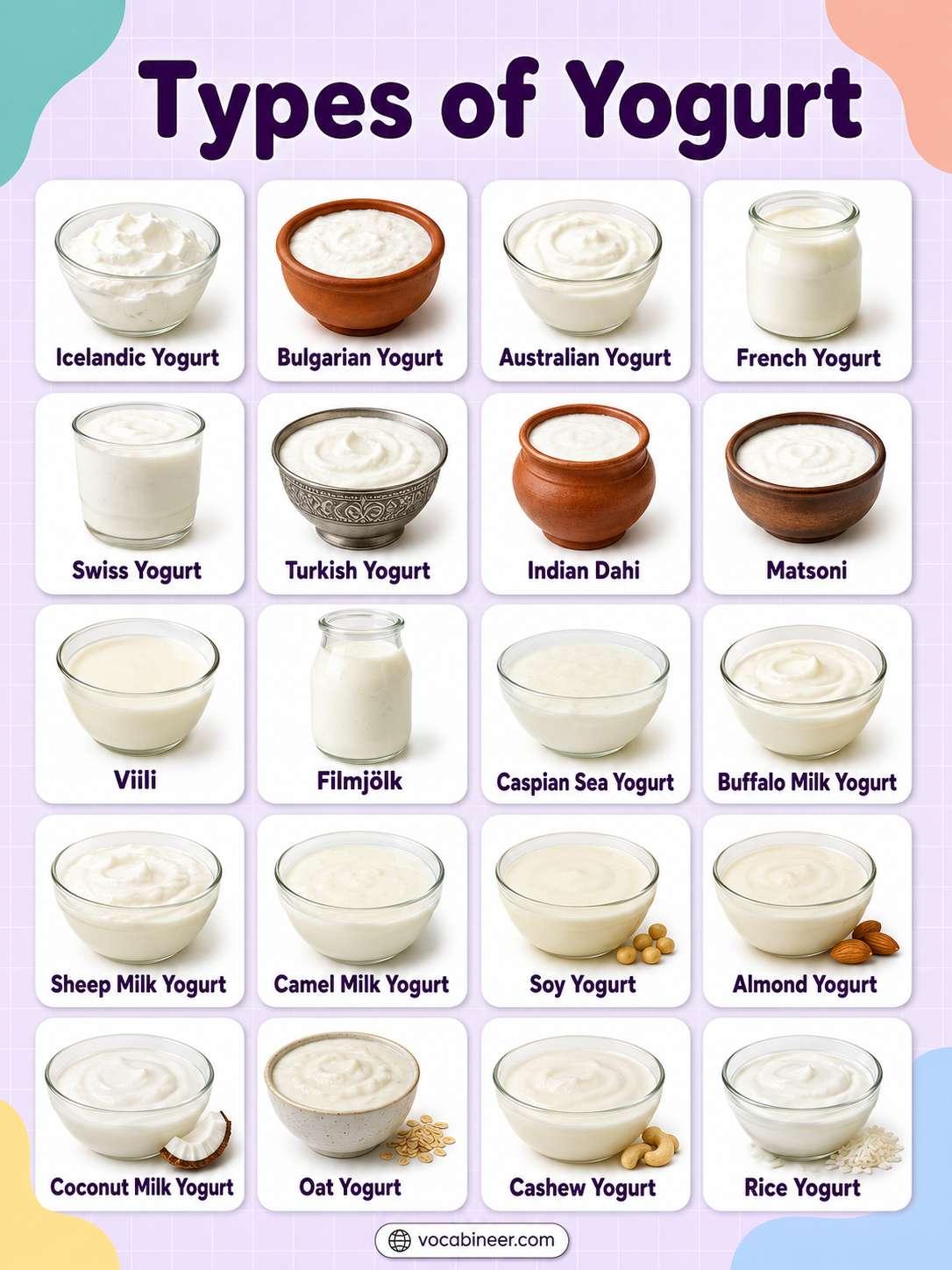
Skyr 🔊 /skɪr/ is a thick Icelandic cultured dairy product commonly sold beside yogurt. It has a dense, smooth body and usually holds its shape firmly on a spoon.
Australian-style yogurt commonly has a rich, creamy, and relatively thick texture. Although many versions remain unstrained, individual formulas differ.
Producers often culture and set French-style yogurt inside an individual container, sometimes made of glass. Its firm, undisturbed surface connects it closely with the broader set-yogurt category.
Balkan-style yogurt commonly has a firm body, tangy flavor, and set-style texture. It usually holds its shape more strongly than loose stirred yogurt.
These names describe recognizable traditions or commercial styles rather than universal formulas. Therefore, readers should consider the product description, texture, and package label instead of assuming that every brand follows one identical method.
Yogurt Types by Fat Level and Lactose Treatment
Some yogurt names describe milk fat or lactose processing rather than texture. These labels can overlap with Greek, regular, flavored, strained, or drinkable yogurt.
Whole-milk yogurt is made with whole milk and commonly has a rich, creamy mouthfeel. However, its exact thickness still depends on production and concentration.
Low-fat yogurt contains less milk fat than whole-milk yogurt. It may feel loose or thick depending on the milk solids, straining method, and other ingredients.
Nonfat yogurt, also called fat-free yogurt, contains very little milk fat. Nevertheless, concentration or added milk solids may give it a dense texture.
Lactose-free yogurt usually begins with animal milk, but producers remove lactose or use lactase to break it down. It remains a dairy food and may still contain milk proteins.
Fat content does not automatically determine texture. For example, nonfat Greek yogurt can feel much thicker than whole-milk regular yogurt because concentration and fat level describe different features.
Yogurt Types by Animal Milk Source
Most yogurt in American grocery stores comes from cow’s milk. Other animal milks, however, create products with their own flavors, textures, and regional traditions.
Goat milk yogurt comes from goat milk and often has a noticeably tangy or earthy flavor. Its texture may range from loose and spoonable to thick and strained.
Sheep milk yogurt uses rich sheep milk, which naturally contains a high level of milk solids. As a result, the yogurt often feels creamy and full-bodied.
Buffalo milk yogurt comes from water buffalo milk and commonly develops a rich, dense texture. It appears in several regional dairy traditions.
Milk source does not determine one fixed flavor or production method. For instance, goat milk yogurt may also be plain, whole-milk, strained, flavored, or drinkable.
Pictures cannot always reveal the animal source accurately. Product labels and captions usually provide more reliable identification than color alone.
Plain, Flavored, and Fruit Yogurt Types
Flavor terms describe what producers add to yogurt and how they arrange those ingredients. They do not explain whether the product is Greek, regular, low-fat, whole-milk, or lactose-free.
Plain yogurt has no added characterizing flavor such as strawberry, chocolate, or vanilla. It may still taste naturally tangy and can belong to several texture or fat-level categories.
Flavored yogurt contains an added flavor such as vanilla, honey, coffee, chocolate, or spice. The flavor may come from extracts, syrups, sweeteners, or other ingredients.
Blended fruit yogurt contains fruit or fruit preparation mixed throughout the yogurt. Therefore, its color and texture usually appear consistent from the top to the bottom of the cup.
Fruit-on-the-bottom yogurt keeps a visible fruit layer beneath the yogurt. The eater usually stirs the layers together before eating.
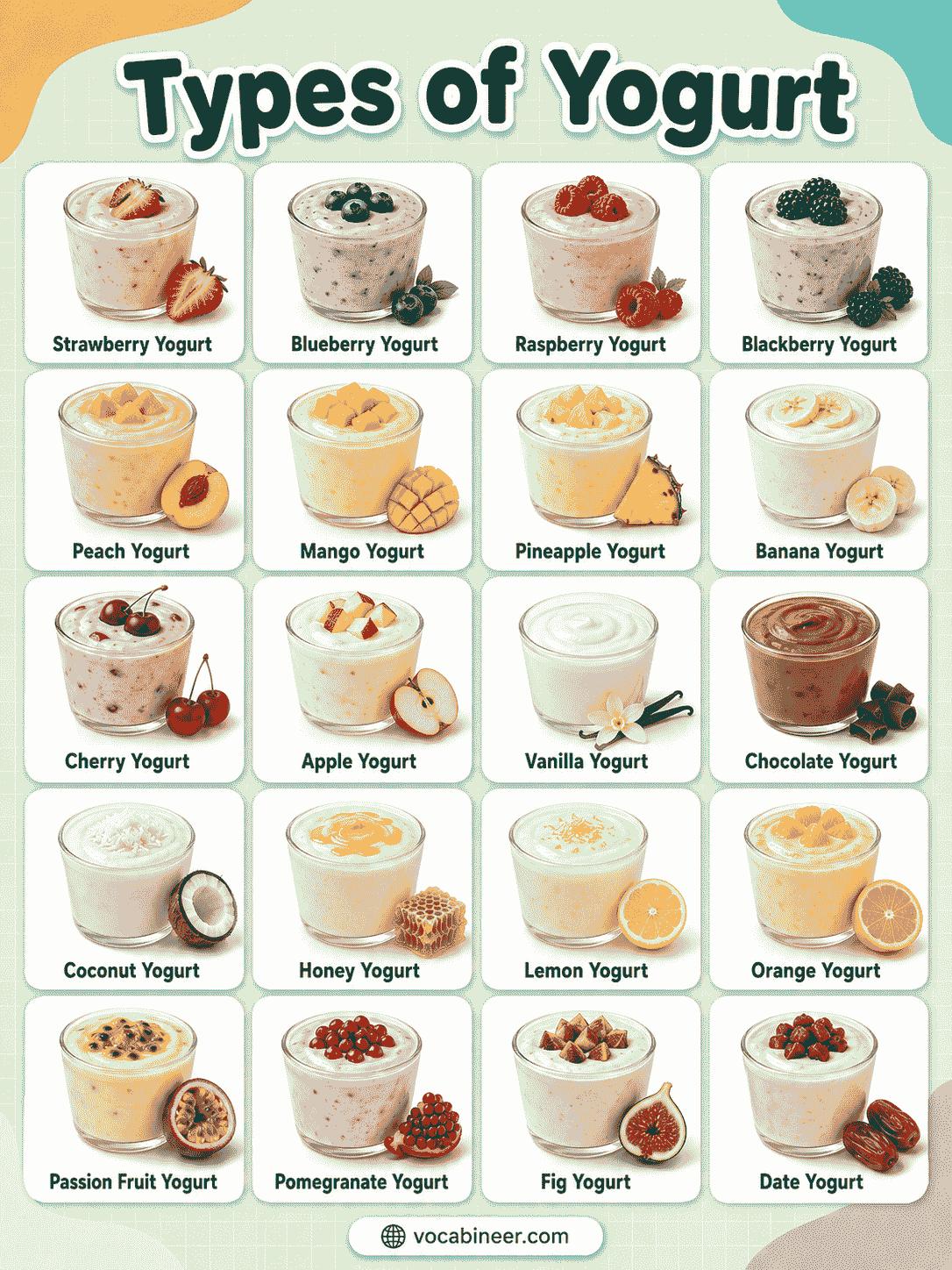
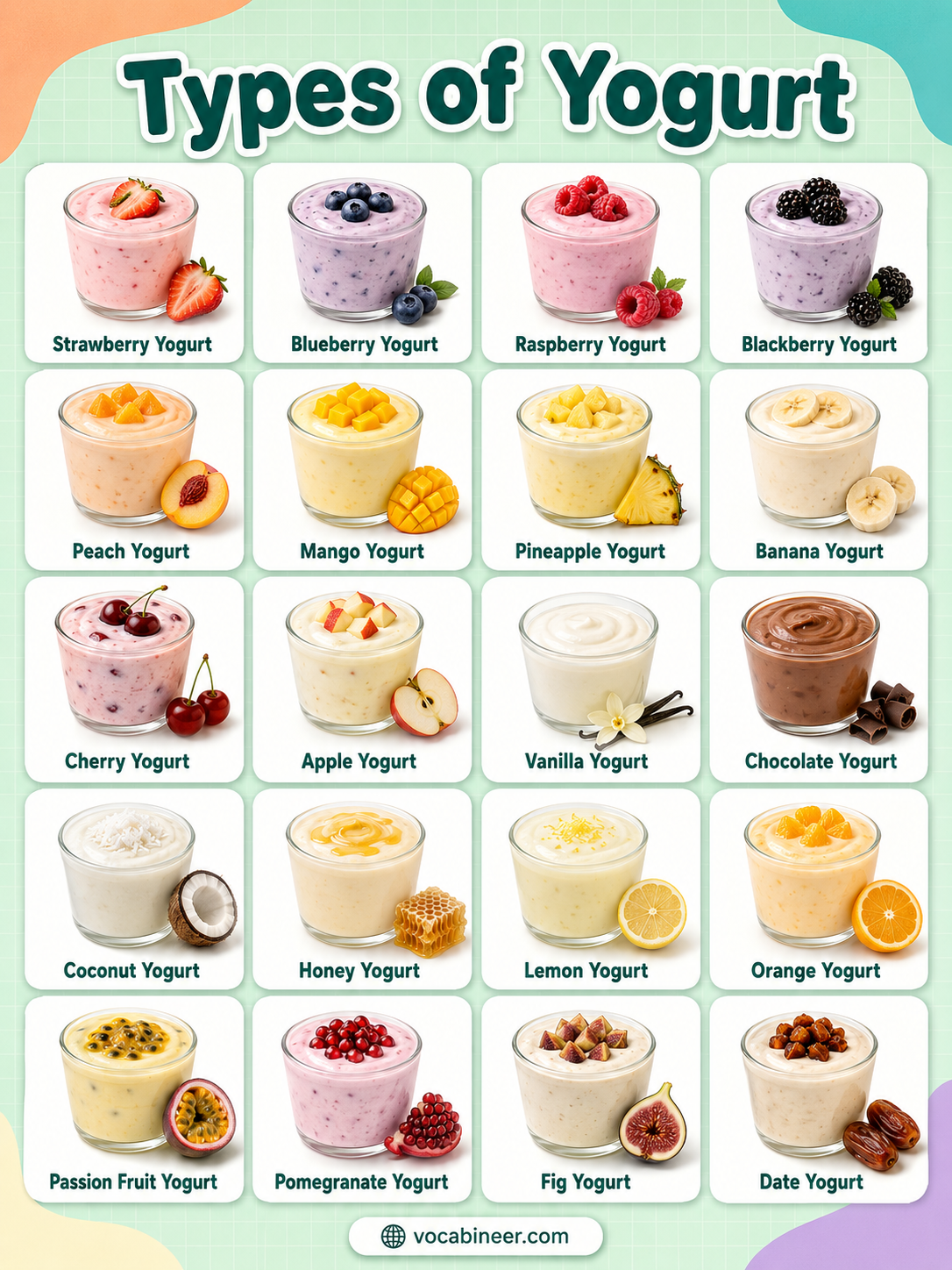
Individual fruit flavors should not be counted as completely separate yogurt production styles. Strawberry, blueberry, mango, peach, cherry, and raspberry yogurt are flavor variations within the broader flavored-yogurt category.
Yogurt Labels for Cultures, Probiotics, and Protein
Package labels may describe culture status, heat treatment, or protein content. These terms provide useful information, but they do not automatically create new yogurt styles.
The phrase live and active cultures indicates that the product contains living yogurt cultures when the manufacturer applies the claim. However, the exact organisms and amounts may differ between products.
Probiotic yogurt contains live microorganisms that the manufacturer markets as probiotics. The strains, quantities, and product formulations vary, so the word probiotic should not function as a synonym for every yogurt.
Heat-treated after culturing means that the producer applied heat after fermentation. This process can deactivate the live cultures, so shoppers should read the package carefully.
High-protein yogurt describes a protein claim or formulation rather than one universal production method. Greek yogurt, skyr, concentrated yogurt, and products with added milk proteins may all carry high-protein labels.
Therefore, readers should check the actual container instead of assuming that every yogurt contains the same cultures, protein level, or nutritional profile.
Differences Among Thick and Strained Yogurt Products
Regular yogurt, Greek yogurt, skyr, and labneh may look similar in photographs, but their thickness, concentration, and typical uses differ.
| Product | Main form | Typical texture | Common use |
|---|---|---|---|
| Regular yogurt | Familiar spoonable yogurt | Smooth and moderately thick | Breakfasts, snacks, sauces |
| Greek yogurt | Concentrated yogurt style | Thick and creamy | Bowls, dips, cooking |
| Skyr | Icelandic cultured dairy product | Very dense and smooth | Breakfasts and snacks |
| Labneh | Heavily strained yogurt product | Spreadable and cheese-like | Spreads, dips, savory plates |
Regular Yogurt and Greek Yogurt
Regular yogurt usually has a smoother and looser body. Greek yogurt, by contrast, has a more concentrated texture that forms a thicker mound on a spoon.
Both products may be plain, flavored, whole-milk, low-fat, or nonfat. Therefore, Greek describes the style and texture rather than the flavor or fat content.
Greek Yogurt and Skyr
Greek yogurt and skyr both have dense, spoonable textures. However, skyr comes from an Icelandic cultured dairy tradition and often feels especially smooth and compact.
The two products may occupy the same grocery section, but they should not receive identical definitions. Brand formulas and production methods can also vary.
Greek Yogurt and Labneh
Greek yogurt remains spoonable, while labneh 🔊 /ˈlæbnə/ undergoes heavier straining and develops a spreadable consistency. People commonly serve labneh with olive oil, herbs, bread, or vegetables.
Although both products belong to the broader family of concentrated cultured dairy foods, labneh resembles a soft spread more than an ordinary breakfast yogurt.
Yogurt Terms Commonly Confused in English
Several yogurt-related terms overlap in appearance, serving form, or regional usage. Clear boundaries prevent inaccurate labels, translations, and pictures.
Regular Yogurt and Plain Yogurt
Regular yogurt commonly describes familiar spoonable yogurt that has not received heavy concentration. It usually feels looser than Greek yogurt or skyr.
Plain yogurt, meanwhile, describes flavor. A plain product contains no added characterizing flavor, but it may still be regular, Greek, nonfat, whole-milk, lactose-free, or made from goat milk.
Therefore, regular and plain are not opposites. A container can hold plain regular yogurt, while another can contain plain Greek yogurt.
Yogurt and Kefir
Kefir 🔊 /kəˈfɪr/ or /ˈkɛfɪr/ is a fermented milk drink with a thin, pourable consistency. It uses a different culture system from standard yogurt and often contains both bacteria and yeasts.
Drinkable yogurt may resemble kefir in a bottle or glass. However, the two products come from different fermentation traditions and should not function as exact synonyms.
Yogurt, Dahi, and Curd in American English
Dahi 🔊 /ˈdɑːhi/ is a traditional South Asian cultured milk food. In South Asian English, people may also call it curd.
American English normally uses yogurt for the spoonable cultured dairy food. By contrast, curds usually refers to solid pieces that form when milk coagulates during cheesemaking.
Because regional usage differs, treating dahi, yogurt, curd, and cheese curds as universal synonyms can produce inaccurate translations and pictures.
Refrigerated Yogurt and Frozen Yogurt
Refrigerated yogurt includes spoonable and drinkable cultured dairy products stored cold in cups, tubs, or bottles.
Frozen yogurt is a frozen dessert made with yogurt or cultured dairy ingredients. Freezing, sweetening, aeration, and serving methods create a product that differs from ordinary refrigerated yogurt.
Frozen yogurt may appear as a machine-dispensed swirl or a scoop. Therefore, it belongs more naturally with frozen desserts than with refrigerated yogurt styles.
Dairy Yogurt and Plant-Based Yogurt Alternatives
Dairy yogurt comes from animal milk. Lactose-free yogurt usually remains dairy because producers change or remove the lactose rather than replace the milk.
Plant-based yogurt alternatives use soy, coconut, almonds, oats, cashews, or other plant ingredients. Although they may resemble yogurt in texture and packaging, they do not belong to the animal-milk dairy category.
Common names include:
- Soy Yogurt Alternative
- Coconut Yogurt Alternative
- Almond Yogurt Alternative
- Oat Yogurt Alternative
- Cashew Yogurt Alternative
Lactose-free and dairy-free do not mean the same thing:
- Lactose-free yogurt may still contain dairy milk and milk proteins.
- Dairy-free yogurt alternative contains no dairy ingredients.
- Plant-based describes the ingredient source rather than one fixed texture or nutritional profile.
Because formulations differ, readers should always check ingredient and allergen labels.
Foods Made with Yogurt, Not Yogurt Types
Many drinks, sauces, dishes, snacks, and desserts use yogurt as an ingredient. However, they become separate prepared foods rather than new yogurt varieties.
Yogurt Drinks
Lassi is a South Asian drink made with yogurt and water or milk. Sweet, salted, fruit, and spiced versions exist.
Ayran is a savory yogurt drink commonly mixed with water and salt. Its thin consistency does not make it the same product as ordinary drinkable yogurt.
A yogurt smoothie blends yogurt with fruit, liquid, sweeteners, or other ingredients. Therefore, it belongs to prepared drinks rather than core yogurt styles.
Yogurt Sauces and Side Dishes
Raita combines yogurt with vegetables, herbs, spices, or fruit. People commonly serve it as a cooling side dish or condiment.
Tzatziki is a thick yogurt-based sauce that often includes cucumber, garlic, herbs, and olive oil. It functions as a sauce or dip rather than a yogurt type.
Yogurt dips and dressings combine yogurt with herbs, oils, seasonings, or other ingredients. Their final names describe prepared foods.
Yogurt Snacks and Desserts
A yogurt parfait layers yogurt with fruit, granola, nuts, or other ingredients. The complete layered dish does not represent another yogurt production method.
Yogurt bark freezes yogurt in a thin sheet with fruit, nuts, or toppings. It belongs to frozen snacks.
A yogurt popsicle freezes a yogurt mixture inside a mold. Although yogurt provides the base, the finished product functions as a frozen dessert.
A small amount of clear liquid on top of refrigerated yogurt is usually separated whey. Stirring often returns it to the yogurt, and this natural separation does not create a new yogurt type.
FAQs
Common types include regular, set, stirred, strained, Greek, Greek-style, drinkable, whole-milk, low-fat, nonfat, lactose-free, plain, blended fruit, and fruit-on-the-bottom yogurt.
Regular yogurt usually has a smoother and looser texture. Greek yogurt has a thicker, more concentrated body because producers remove whey or use another concentration method.
Skyr is a thick Icelandic cultured dairy product commonly sold and eaten like yogurt. However, its traditional production history differs from ordinary yogurt.
Yes. Lactose-free yogurt usually comes from animal milk, so it remains dairy even after producers remove or break down the lactose.
Kefir is a thinner fermented milk drink that uses a different culture system and often contains both bacteria and yeasts. Yogurt usually has a thicker body and relies on characteristic yogurt cultures.
Read More
- Baking Tools Name
- Healthy Foods Name
- Bakery Items Names
- Types of Biscuits
- Sour Food Names
- Sweet Food Names
- Salty Food Names