

English speakers usually arrange several adjectives before a noun in a familiar order. For example, we say a beautiful small Italian leather bag, not a leather Italian small beautiful bag. The usual sequence helps descriptions sound natural and makes each detail easier to understand.
However, adjective order is a guide rather than a rigid formula. You do not need to use every category, and writers sometimes change the order for emphasis. This article explains the common pattern, shows how to use it in sentences, and covers commas, exceptions, and frequent mistakes.
In This Page
What Is the Order of Adjectives?
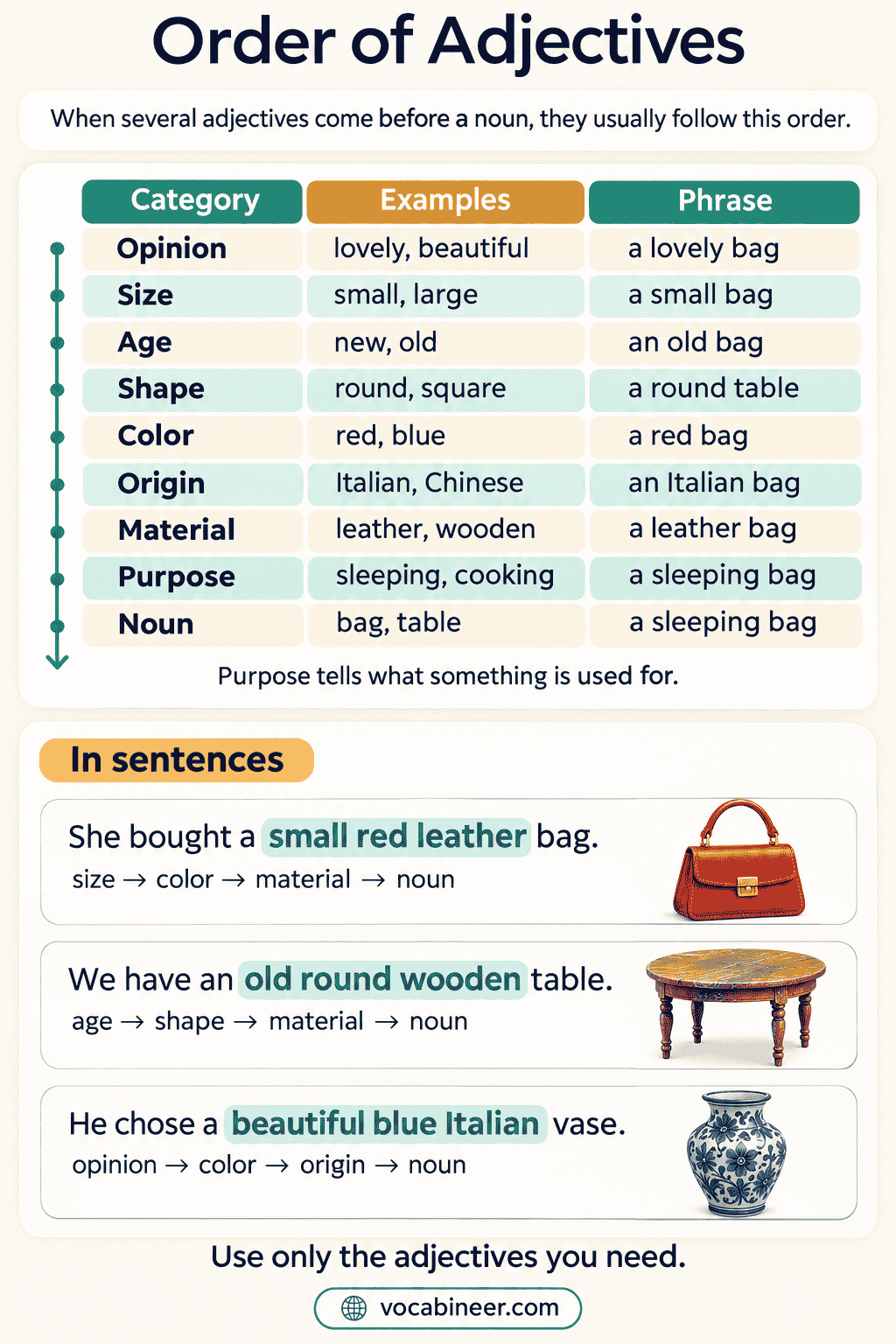
When two or more adjectives describe the same noun, English generally places them in this sequence:
Determiner or quantity → opinion → size → age → shape → color → origin → material → purpose or type → noun
For example:
a beautiful small old round blue Italian leather travel bag
The phrase begins with a determiner, a. It then describes the bag’s opinion, size, age, shape, color, origin, material, and purpose before naming the noun, bag.
That full sequence is only a model. Most phrases use just a few details:
- a small brown dog
- a lovely old house
- a round glass bowl
- a new Italian recipe
| Position | Category | Examples |
|---|---|---|
| Before descriptive adjectives | Determiner or quantity | a, the, my, three, several |
| 1 | Opinion | beautiful, useful, unusual |
| 2 | Size | small, large, tall |
| 3 | Age | new, old, ancient |
| 4 | Shape | round, square, narrow |
| 5 | Color | blue, dark green, pale red |
| 6 | Origin | Italian, Asian, Canadian |
| 7 | Material | leather, wooden, cotton |
| 8 | Purpose or type | travel, sleeping, cooking |
| Last | Noun | bag, bag, bag |
Words such as a, the, my, and three are usually classified as determiners or quantity words in modern grammar. Traditional lessons sometimes group them under adjective order because they appear before nouns and help identify or count them.
The Main Adjective Categories
Understanding what each category means makes the order easier to use.
Determiners and quantity words
Determiners identify a noun, while quantity words tell how many or how much:
- a jacket
- the jacket
- my jacket
- three jackets
- several jackets
They generally come before descriptive adjectives: three warm jackets, not warm three jackets.
Opinion adjectives
Opinion adjectives express a judgment or impression:
- a lovely garden
- an interesting book
- a useful tool
- an unusual design
When an opinion adjective appears with factual details, it usually comes first: a lovely old house.
Size adjectives
Size adjectives describe how large or small something is:
- a large suitcase
- a tiny bird
- a tall building
With other descriptive adjectives, size usually precedes age, shape, and color: a large old blue suitcase.
Age adjectives
Age adjectives say whether something is new, old, young, or ancient:
- a new phone
- an old bridge
- an ancient temple
They normally follow opinion and size: a beautiful small old house.
Shape adjectives
Shape adjectives describe form or outline:
- a round plate
- a square window
- a narrow path
They generally come after size and age: a small old round table.
Color adjectives
Color adjectives name a color or shade:
- a red scarf
- a pale blue wall
- a dark green coat
Color usually comes after opinion, size, age, and shape: a beautiful old round blue vase.
Origin adjectives
Origin adjectives tell where a person or thing comes from. They may refer to a country, region, or culture:
- Italian shoes
- Asian food
- Canadian maple syrup
Origin usually appears after color and before material: a blue Italian glass vase.
Material adjectives
Material adjectives describe what an object is made of:
- a wooden chair
- a cotton shirt
- a silver necklace
They usually come near the noun: a beautiful old wooden chair.
Purpose or type adjectives
Purpose or type words explain what a noun is for or what kind it is. They often sit directly before the noun:
- a sleeping bag
- a racing car
- a cooking pot
- a travel bag
In a lightweight black travel bag, travel tells the type or purpose of the bag, so it stands close to bag.
Adjective Order Examples
Here are phrases with two or three adjectives:
| Phrase | Order |
|---|---|
| a small brown dog | Size → color |
| a beautiful old house | Opinion → age |
| a large round glass bowl | Size → shape → material |
| a new black laptop | Age → color |
| a soft cotton shirt | Quality or texture → material |
| two elegant Italian leather shoes | Quantity → opinion → origin → material |
Longer phrases show more of the sequence. Read each one from left to right:
- a lovely little old cottage
- a large round wooden table
- a beautiful long red silk dress
- three comfortable new black running shoes
- an unusual small ancient stone carving
- a stylish pale blue French cotton jacket
Some phrases can vary depending on what the speaker wants to emphasize. Still, the usual sequence is a useful starting point.
Adjectives Before a Noun and After a Linking Verb
Adjectives often appear before the noun they describe. They can also follow linking verbs such as be, seem, look, and feel.
| Adjective before a noun | Adjective after a linking verb |
|---|---|
| a quiet room | The room is quiet. |
| a beautiful old house | The house looks beautiful and old. |
| a soft cotton shirt | The shirt feels soft. |
The adjective-order pattern is most noticeable when several adjectives appear together before a noun. After a linking verb, the order can be more flexible because the adjectives are not directly grouped before the noun.
Opinion and Fact Adjectives
Opinion adjectives usually come before factual descriptions. Opinion reflects a personal response, while factual adjectives give details such as age, color, origin, or material.
- a lovely old building
- an interesting French novel
- a beautiful blue scarf
- a useful small kitchen tool
For instance, lovely gives an opinion about the building, while old gives information about its age. Therefore, a lovely old building is the natural order.
Coordinate and Cumulative Adjectives
Some adjectives independently describe a noun. Others build a description in sequence.
| Type | How the adjectives relate | Example |
|---|---|---|
| Coordinate | Each adjective independently describes the noun | a bright, cheerful room |
| Cumulative | The adjectives build meaning in a particular order | a small wooden box |
Coordinate adjectives can often be joined with and: “a bright and cheerful room.” They may also take a comma. Cumulative adjectives usually do not: “a small wooden box,” not a small, wooden box.
A practical check is to try inserting and or reversing the adjectives:
- bright, cheerful room → “bright and cheerful room” sounds natural.
- small wooden box → “small and wooden box” sounds awkward, and reversing it to wooden small box sounds unnatural.
This test helps, but it is not mechanical. Meaning and emphasis can affect punctuation.
Using “And” Between Adjectives
Use and when two adjectives have equal importance or work together to describe the noun:
- She is a kind and generous neighbor.
- We entered a quiet and peaceful garden.
- It was a long and tiring journey.
Usually, do not use and between cumulative adjectives that follow the common sequence:
- Natural: a small wooden box
- Less natural: a small and wooden box
- Natural: a beautiful old house
- Less natural: a beautiful and old house, unless the writer intends to emphasize the qualities separately
When Adjective Order Can Change
The usual order is a strong tendency, but context can lead to variation.
Emphasis and contrast
A writer may move an adjective to highlight a contrast:
I asked for the blue small box, not the red one.
The standard order would normally be small blue box, but the speaker places blue first to stress the color. This kind of variation is possible, especially in speech, though it can sound marked.
Fixed expressions and familiar phrases
Some combinations become familiar as set phrases, so their order may not follow a simple rule. In addition, words that look like adjectives may form a compound expression with the noun, such as high school student or real estate agent.
Too many adjectives
A long string can be grammatically possible but difficult to read. Instead of writing:
She carried a beautiful small old round blue Italian leather travel bag.
You might write:
She carried a beautiful old leather bag from Italy, designed for travel.
The second sentence spreads the details across a phrase and a clause, which may feel clearer.
A Simple Way to Remember Adjective Order
The mnemonic OSASCOMP helps many learners remember the main descriptive sequence:
- Opinion
- Size
- Age
- Shape
- Color
- Origin
- Material
- Purpose
Determiners and quantity words usually come before OSASCOMP, and the noun follows the sequence.
For example:
a + beautiful + small + old + round + blue + Italian + leather + travel + bag
OSASCOMP is a memory aid, not a requirement to include every category. Use only the adjectives that add useful information.
Common Mistakes with Adjective Order
| Less natural or incorrect | Better form | Why |
|---|---|---|
| a leather Italian beautiful bag | a beautiful Italian leather bag | Opinion usually precedes origin and material. |
| a wooden small box | a small wooden box | Size usually comes before material. |
| a blue round bowl | a round blue bowl | Shape usually comes before color. |
| a small, wooden box | a small wooden box | Cumulative adjectives usually do not take a comma. |
| a beautiful, small, old, round, blue, Italian, leather bag | a beautiful small old round blue Italian leather bag | Do not add commas between cumulative adjectives. |
| a stylish black leather Italian jacket | a stylish black Italian leather jacket | Origin usually comes before material. |
| too many adjectives in one phrase | Keep the most helpful details | Overloaded descriptions can be hard to follow. |
Frequently Asked Questions
The usual order is opinion, size, age, shape, color, origin, material, and purpose, followed by the noun. Determiners and quantity words generally come before these adjectives: “three beautiful small blue bowls.”
No. Most phrases use only a few adjectives. Choose details that help describe the noun without making the sentence crowded.
Opinion adjectives usually come before factual descriptions: “a lovely old house” or “an interesting French book.”
Not always. Coordinate adjectives, such as bright and cheerful in “a bright, cheerful room,” may take a comma. Cumulative adjectives usually do not: “a small wooden box.”
Sometimes. Writers may vary the order to create a particular effect or highlight a detail. However, the usual sequence is the clearest choice for most everyday descriptions.
Conclusion
English usually places adjectives in this order: opinion, size, age, shape, color, origin, material, and purpose. Determiners and quantity words come first, while the noun comes last. Use only the details that matter, and phrases such as a beautiful small blue bag will sound clear and natural.
Read More