

“Three curious children opened the old box.” In this sentence, curious and old describe qualities, while three tells us how many children there were. Each word adds information that helps the reader picture the scene.
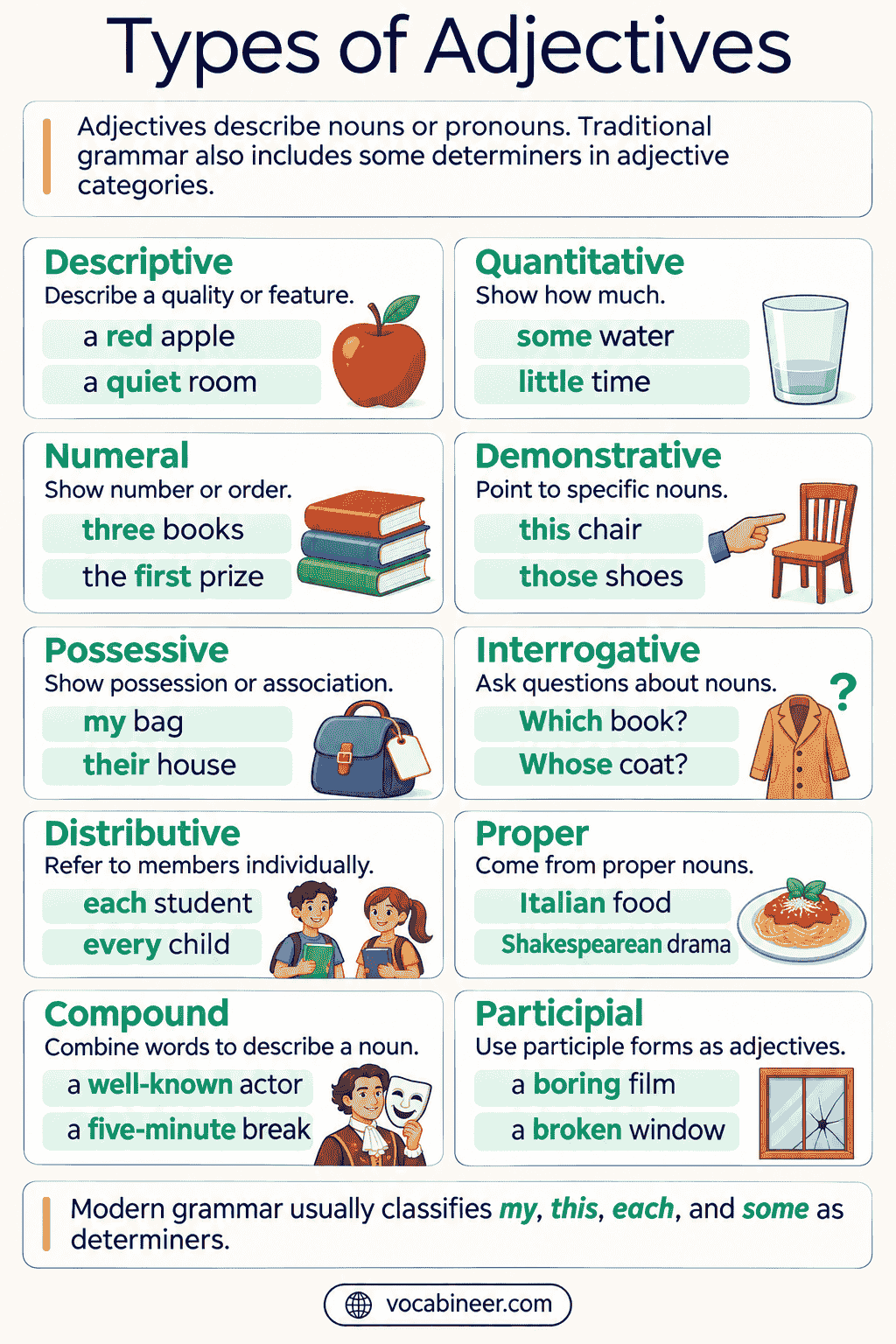
English grammar books group these words in different ways. Traditional school grammar presents several types of adjectives, including words that describe, count, point to, or show possession. This guide explains those familiar categories, shows how they work in sentences, and clarifies why modern grammar calls some of them determiners.
In This Page
What Is an Adjective?
An adjective describes a quality or characteristic associated with a noun or pronoun. It can appear before a noun or after a linking verb:
| Position | Example | What the adjective describes |
|---|---|---|
| Before a noun | a quiet room | The room |
| After a linking verb | The room is quiet. | The room |
| After a linking verb | They seem tired. | They |
Words such as quiet, tired, blue, and helpful are clear examples of adjectives. Words such as this, my, and each identify or limit a noun. Traditional school grammar often includes them among the types of adjectives; many modern grammars classify them as determiners instead. Both sets of terms appear in learning materials, so the distinction is useful to know.
Main Types of Adjectives
The table below presents eight categories commonly taught as types of adjectives. The labels describe what a word contributes to the noun.
| Traditional type | What it expresses | Example |
|---|---|---|
| Descriptive | A quality or characteristic | a bright room |
| Quantitative | An unspecified amount | some water |
| Numeral | A number or order | three books; the first chapter |
| Demonstrative | Which person or thing | this book |
| Possessive | Whose person or thing | her notebook |
| Interrogative | A question about a noun | which route? |
| Distributive | Members of a group considered individually | each student |
| Proper | A connection to a proper name | Italian food |
The middle six categories often function as determiners before nouns. Descriptive and proper adjectives belong more clearly to the adjective class. These categories give you a practical way to understand examples, even when your textbook uses different labels.
Descriptive Adjectives
Descriptive adjectives tell us about a quality such as size, color, shape, age, or opinion.
- Size: a small garden
- Color: a green door
- Shape: a round table
- Age: an old photograph
- Opinion: an interesting story
They can also follow a linking verb: “The garden looks beautiful.” Here, beautiful describes the garden.
Quantitative Adjectives
In traditional grammar, quantitative adjectives give an amount without stating an exact number. Common examples include some, much, little, and enough.
- We have some rice.
- There is little time left.
- They brought enough water.
Choose a word that fits the noun. Use many with plural count nouns (“many books”) and much with uncountable nouns (“much time”). In modern grammar, words such as some and many are commonly treated as quantifiers or determiners.
Numeral Adjectives
Numeral adjectives give an exact number or a place in a sequence.
| Kind | Purpose | Example |
|---|---|---|
| Cardinal | Tells how many | Four students arrived. |
| Ordinal | Tells which position | The fourth student arrived. |
Numbers before nouns are often called numeral determiners in modern grammar.
Demonstrative Adjectives
This, that, these, and those point to particular people or things. Their form depends on whether the noun is singular or plural.
| Near | Far | |
|---|---|---|
| Singular noun | this chair | that chair |
| Plural noun | these chairs | those chairs |
In “This chair is comfortable,” this appears before a noun. In “This is comfortable,” it stands alone as a pronoun.
Possessive Adjectives
My, your, his, her, its, our, and their show whose person or thing is being discussed:
- Our teacher is here.
- She forgot her notebook.
- The dog wagged its tail.
These words are also called possessive determiners. Do not confuse its, the possessive form, with it’s, a contraction of it is or it has.
Interrogative Adjectives
What, which, and whose can introduce questions about a noun:
- What book are you reading?
- Which road should we take?
- Whose bag is this?
The word comes before the noun it asks about. Compare “Which road is closed?” with “Which is closed?” In the second sentence, which stands alone.
Distributive Adjectives
Distributive words refer to members of a group one at a time. Common examples are each, every, either, and neither.
- Each child received a ticket.
- Every room has a window.
- Either route will take us there.
- Neither answer is correct.
Use a singular count noun after these words in the examples above: “each child,” not “each children.” Either and neither usually concern two alternatives.
Proper Adjectives
Proper adjectives come from proper names and usually begin with capital letters.
- Italian coffee
- African wildlife
- Shakespearean drama
They can refer to places, people, or other names. For example, Shakespearean connects the noun drama with Shakespeare.
Other Ways to Classify Adjectives
Some labels describe an adjective’s form or use rather than a separate type with a completely different meaning. These categories can overlap: beautiful is descriptive, and more beautiful is also comparative.
| Category | What it shows | Example |
|---|---|---|
| Comparative | A comparison | a taller building; a more useful tool |
| Superlative | The highest or lowest degree in a group | the tallest building; the most useful tool |
| Compound | Words working together as one modifier | a well-known writer |
| Participial | An -ing or -ed form used as an adjective | a boring film; a bored audience |
The -ing and -ed forms often have different meanings. A boring film causes boredom; a bored audience experiences it.
Where Adjectives Appear in a Sentence
An adjective commonly appears before a noun or after a linking verb such as be, seem, look, or feel.
| Position | Example | Explanation |
|---|---|---|
| Before a noun | She bought a new coat. | New directly modifies coat. |
| After a linking verb | Her coat looks new. | New describes coat through looks. |
| After an indefinite pronoun | We found something useful. | Useful follows something. |
| After a noun in certain phrases | The people responsible will respond. | Responsible follows the noun it describes. |
Not every adjective works equally well in every position. For example, elder is natural in “my elder brother,” while “my brother is elder” is generally unnatural; “my brother is older” is the usual choice.
When several adjectives appear before a noun, speakers tend to use a natural order: “a beautiful old wooden chair.” This is a useful pattern, though context and emphasis can affect the order.
Adjectives, Determiners, and Pronouns
A word’s role depends on how it works in the sentence. A determiner appears with a noun and helps identify or quantify it; a pronoun can stand in place of a noun phrase.
| Before a noun | Standing alone | Difference |
|---|---|---|
| This book is mine. | This is mine. | This is a determiner before book and a pronoun when it stands alone. |
| Her bag is here. | The bag is hers. | Her precedes a noun; hers stands alone. |
| Which bus is late? | Which is late? | Which introduces bus in the first question and stands alone in the second. |
| Some students left. | Some left. | Some quantifies students in the first sentence and stands alone in the second. |
Articles such as a, an, and the are determiners too. They are not usually included in the traditional eight-type list above. Words such as any, several, and few may also be grouped with quantifiers or determiners, depending on the grammar system used.
How to Identify an Adjective
Use the sentence, not just the word, to decide what role it plays:
- Find the noun or pronoun receiving extra information.
- Look at the word’s job. Does it describe a quality, as bright does in “a bright room”? Does it identify or quantify the noun, as this or three does?
- Check its position. A descriptive adjective may come before a noun or after a linking verb. A determiner usually comes before a noun.
- See whether it stands alone. In “This is bright,” this functions as a pronoun, while bright is an adjective.
This approach is more reliable than assuming a word always has the same label in every sentence.
Common Mistakes with Adjectives
| Incorrect | Correct | Why |
|---|---|---|
| This books are new. | These books are new. | Use these with a plural noun. |
| Each students has a pen. | Each student has a pen. | Each normally precedes a singular count noun. |
| The dog wagged it’s tail. | The dog wagged its tail. | Its shows possession. |
| My bag is more taller. | My bag is taller. | Do not add more to an adjective already marked with -er. |
| It was a bored movie. | It was a boring movie. | The movie causes boredom. |
| She has much books. | She has many books. | Use many with plural count nouns. |
| She sings beautiful. | She sings beautifully. | Use an adverb to describe how she sings. |
The last example highlights another distinction: “Her voice is beautiful” uses an adjective to describe voice, while “She sings beautifully” uses an adverb to describe the action.
Types of Adjectives in Sentences
These examples bring the traditional categories together in everyday contexts:
| Sentence | Highlighted word | Traditional category |
|---|---|---|
| The small house has a garden. | small | Descriptive |
| We need some milk. | some | Quantitative |
| Four friends came to dinner. | four | Numeral |
| Those shoes belong to Maya. | those | Demonstrative |
| Our teacher explained the lesson. | our | Possessive |
| Which road leads to the station? | which | Interrogative |
| Each child chose a book. | each | Distributive |
| They listened to French music. | French | Proper |
The category tells you what information the word adds. For words that identify or limit a noun, you may also encounter the label determiner.
Frequently Asked Questions
Traditional school grammar commonly lists descriptive, quantitative, numeral, demonstrative, possessive, interrogative, distributive, and proper adjectives. Modern grammars often classify several of these noun modifiers as determiners.
Traditional lessons may call them possessive and demonstrative adjectives. Many modern grammars call them determiners when they appear before nouns, as in “my bag” and “this chair.”
An adjective describes a noun or pronoun, while a pronoun can stand in for a noun phrase. For example, blue describes coat in “a blue coat.” In “This is mine,” this and mine stand alone as pronouns.
Yes. An adjective can follow an indefinite pronoun, as in “something interesting,” or appear after a noun in expressions such as “the people responsible.” Adjectives also follow linking verbs, as in “The people are responsible.”
Yes. The categories may describe different features of the same word. For example, beautiful is a descriptive adjective, while more beautiful is both descriptive and comparative.
Conclusion
Descriptive adjectives express qualities, while the traditional categories of quantitative, numeral, demonstrative, possessive, interrogative, and distributive adjectives help identify, count, or limit nouns. Proper adjectives connect nouns to names. Because grammar books use different labels, the best way to identify a type is to look at what the word does in its sentence.
Read More