

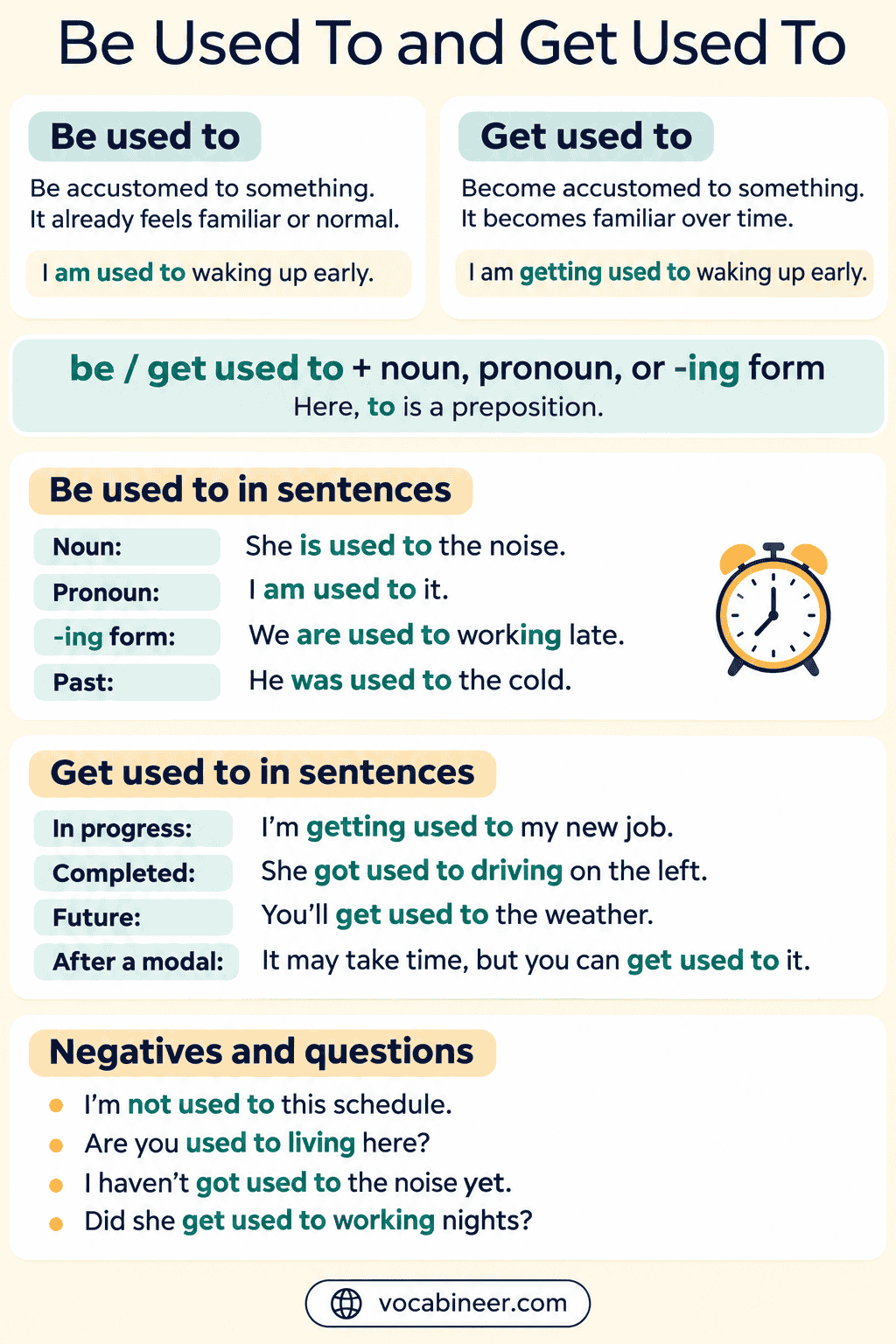
Starting a new job can feel difficult when you have to wake up earlier than usual. After a few weeks, the early mornings may feel less strange. You might say, “I’m getting used to waking up early.” Once the routine feels normal, you can say, “I’m used to waking up early.”
These expressions describe different stages of the same experience. Get used to describes the process of becoming familiar with something, while be used to describes a situation that already feels familiar. Both expressions work with nouns, pronouns, and -ing forms, but their meaning differs from the past-habit expression used to do.
In This Page
Meaning of Be Used To and Get Used To
Use be used to when something feels familiar because you have experienced it before. Use get used to when you are becoming familiar with it or have completed that adjustment.
| Expression | Meaning | Example |
|---|---|---|
| Be used to | Already find something familiar | I am used to the noise. |
| Get used to | Become familiar with something | I am getting used to the noise. |
| Got used to | Became familiar with something in the past | I got used to the noise after a month. |
Being used to something does not necessarily mean liking it. For example, “I’m used to the traffic” means the traffic is familiar; the speaker may still find it unpleasant.
How to Form Sentences
The main patterns are:
- Subject + form of be + used to + noun, pronoun, or -ing form
- Subject + form of get + used to + noun, pronoun, or -ing form
The words used to stay the same in these expressions. Change be or get to show the subject and time.
| Form | Be used to | Get used to |
|---|---|---|
| Affirmative | She is used to the cold. | She is getting used to the cold. |
| Negative | She isn’t used to the cold. | She isn’t getting used to the cold. |
| Question | Is she used to the cold? | Is she getting used to the cold? |
| Short answer | Yes, she is. / No, she isn’t. | Yes, she is. / No, she isn’t. |
Questions with get used to can also ask whether an adjustment is complete: “Did you get used to the new schedule?” or “Have you got used to the new schedule yet?”
What Comes After Used To?
In be used to and get used to, the word to is a preposition. Follow it with a noun, a pronoun, or an -ing form of a verb.
| What follows to | Example |
|---|---|
| Noun | They are used to the heat. |
| Pronoun | You will get used to it. |
| -ing form | I am used to working on weekends. |
If an action follows, use its -ing form: “She is getting used to driving in the city,” not “getting used to drive in the city.”
When to Use Be Used To
Be used to describes familiarity. It can refer to the present, the past, or the future.
| Time | Example | Meaning |
|---|---|---|
| Present | I am used to this keyboard. | It feels familiar now. |
| Past | We were used to the old timetable. | It felt familiar then. |
| Future | You will be used to the routine soon. | It will feel familiar later. |
The past form describes familiarity at a past time. It does not, by itself, tell us whether the situation still feels familiar now: “When I lived near the station, I was used to the train noise.”
Use the negative form when something still feels unfamiliar:
I am not used to eating dinner so late.
When to Use Get Used To
Get used to focuses on a change. The adjustment may be in progress, completed, or expected in the future.
| Stage | Example | Meaning |
|---|---|---|
| In progress | I am getting used to my new school. | It is becoming more familiar. |
| Completed in the past | He got used to the long commute. | It became familiar to him. |
| Completed by now | We have got used to the new system. | The adjustment has happened. |
| Expected later | You will get used to the early starts. | They should become familiar. |
In American English, have gotten used to is also common: “We have gotten used to the new system.” In British English, have got used to is common.
To describe difficulty adjusting, use can’t get used to: “I can’t get used to the noise at night.” This expresses an ongoing difficulty; it does not necessarily mean adjustment will never happen.
Choosing Between Be Used To and Get Used To
Think about whether you mean familiarity or change toward familiarity.
| Situation | Use get used to for adjustment | Use be used to for familiarity |
|---|---|---|
| A new work schedule | I’m getting used to starting at 7 a.m. | I’m used to starting at 7 a.m. |
| A colder climate | She’s getting used to the cold. | She’s used to the cold. |
| A new bus route | We’re getting used to taking the bus. | We’re used to taking the bus. |
A natural progression is: “The early shift felt difficult at first. I’m getting used to it now. Soon, I’ll be used to it.”
Be Used To and Get Used To Versus Past-Habit Used To
The expression used to + base verb has a different meaning: it describes a habit or state associated with the past, usually one that has changed.
| Expression | Meaning | What follows to | Example |
|---|---|---|---|
| Used to | A former habit or state | Base verb | I used to work nights. |
| Be used to | Familiarity | Noun, pronoun, or -ing form | I am used to working nights. |
| Get used to | Becoming familiar | Noun, pronoun, or -ing form | I am getting used to working nights. |
The difference matters even when the sentences look similar. “I used to live here” describes a former living situation. “I was used to living here” says that living here felt familiar at a particular time in the past.
Common Mistakes
| Incorrect | Correct | Reason |
|---|---|---|
| I am used to wake up early. | I am used to waking up early. | An action after be used to takes an -ing form. |
| She is getting used to drive. | She is getting used to driving. | An action after get used to takes an -ing form. |
| I use to the cold. | I am used to the cold. | The familiarity expression needs a form of be. |
| I used to working nights. | I used to work nights. | Past-habit used to takes a base verb. |
| I’m getting used to it, so I’m completely comfortable with it. | I’m getting used to it, but it still feels unfamiliar sometimes. | Getting used to can describe an adjustment still in progress. |
Everyday Examples
- Work: “I’m getting used to answering calls all day.”
- Weather: “Are you used to the rain here?” “Yes, I am.”
- Food: “She wasn’t used to spicy food when she moved here.”
- School: “The students will get used to their new timetable.”
- Travel: “I haven’t got used to driving on the left yet.”
- Technology: “Did your parents get used to the new phone?” “Yes, they did.”
Frequently Asked Questions
Be used to describes something that already feels familiar. Get used to describes the change that makes it familiar. For example, “I’m getting used to the new office” suggests an adjustment in progress, while “I’m used to the new office” suggests it now feels normal.
With be used to and get used to, to is a preposition, so an action that follows takes an -ing form: “I’m used to working late.” The separate past-habit expression takes a base verb: “I used to work late.”
Yes. “I was used to the noise” describes familiarity at a past time. “I got used to the noise” describes an adjustment that happened in the past.
No. It means that something becomes familiar or easier to handle. You can get used to a crowded commute and still dislike it.
Used to + base verb describes a former habit or state: “I used to wake up early.” Be used to + noun or -ing form describes familiarity: “I am used to waking up early.”
Conclusion
Use be used to for something that already feels familiar and get used to for the process of becoming familiar. Remember to use a noun, pronoun, or -ing form after both expressions: “At first, I wasn’t used to the new routine. Now I’m getting used to it.”
Read More
- Verbs in English
- Action Verbs
- Regular Verbs
- Irregular Verbs
- Transitive and Intransitive verbs
- Finite and Non-finite verbs
- Principal Parts of Verbs
- Forms of Verbs