

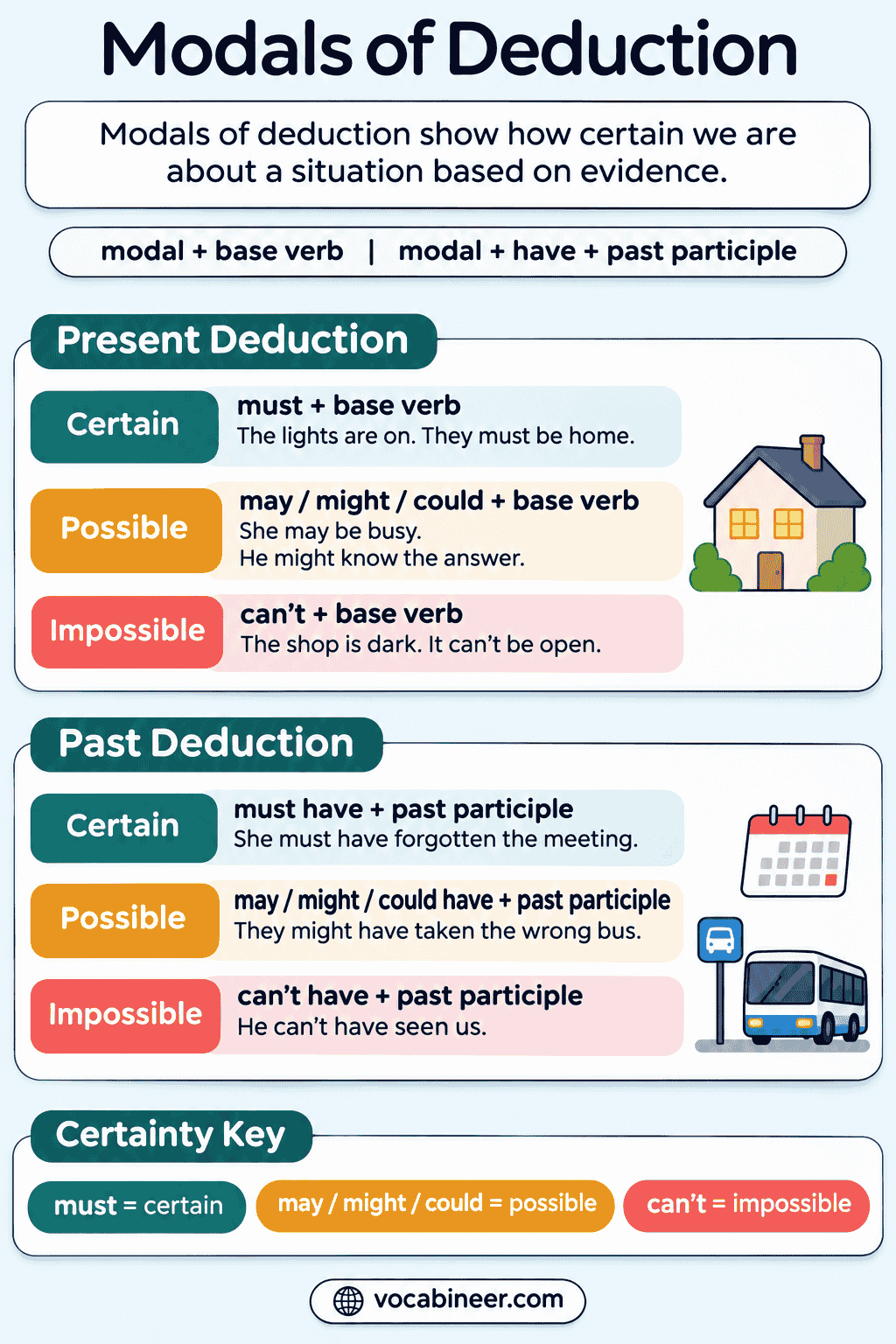
Modals of deduction are modal verbs that help us form conclusions, assumptions, and guesses from available evidence. Instead of presenting a statement as a confirmed fact, they show how certain the speaker feels. For example, “Sara must be at work” expresses a strong conclusion, whereas “Sara might be at work” presents her location as only one possibility.
The main modals used for deduction are must, may, might, could, can’t, and couldn’t. We can also use should when something is reasonably expected. The correct structure depends on whether the deduction concerns a present state, an action in progress, a completed past event, or a future possibility.
In This Page
Modals of Deduction at a Glance
The following table summarizes the central forms. These certainty levels are general descriptions rather than fixed mathematical percentages.
| Speaker’s judgement | Present form | Past form | Example |
|---|---|---|---|
| Strong positive conclusion | must + base verb | must have + past participle | She must have left. |
| Neutral possibility | may + base verb | may have + past participle | She may have left. |
| Cautious possibility | might + base verb | might have + past participle | She might have left. |
| One possible explanation | could + base verb | could have + past participle | She could have left. |
| Strong negative conclusion | can’t + base verb | can’t/couldn’t have + past participle | She can’t have left. |
| Expected result | should + base verb | should have + past participle | She should have arrived. |
Modal certainty depends on the evidence, context, tone, and speaker. Therefore, it is misleading to claim that each modal always represents one exact percentage of certainty.
Understanding Deduction in English
A deduction is a conclusion reached by interpreting evidence. The speaker may not know the fact directly, but the available information makes one explanation seem certain, possible, or impossible.
- The lights are off, so they must be asleep.
- Nobody is answering, so they might be out.
- Her car is outside, so she could be at home.
- She is currently abroad, so that can’t be her at the door.
In formal grammar, this use of modal verbs is called epistemic modality. It concerns knowledge, probability, and the speaker’s judgement about whether something is true. This meaning differs from deontic modality, which expresses obligation, permission, or prohibition.
| Epistemic meaning | Deontic meaning |
|---|---|
| She must be tired. — strong deduction | She must rest. — obligation |
| He may be inside. — possibility | He may enter. — permission |
| That can’t be true. — impossibility | You can’t enter. — lack of permission |
Context normally makes the intended meaning clear.
Strong Conclusions with Must
Use must when the evidence leads to a strong positive conclusion. The speaker feels highly confident, although the conclusion has not necessarily been confirmed.
Must with a Base Verb
Structure: Subject + must + base verb
- She must know the answer.
- He must need some help.
- This key must belong to Nadia.
- They must understand the problem.
Because know, need, belong, and understand usually describe states, they naturally follow must in the simple form.
Must Be with Nouns and Adjectives
Use must be before a noun or adjective.
- He must be the new manager.
- You must be exhausted after that journey.
- This must be the correct address.
- The children must be hungry.
Must Be with Locations
Use must be before a phrase describing location.
- They must be at home.
- Her keys must be in the car.
- The children must be upstairs.
- The documents must be on your desk.
The evidence should support the conclusion. For example, “Her car is outside, so she must be at home” explains why the speaker feels confident.
Possibility with May, Might, and Could
Use may, might, and could when something is possible but the evidence does not justify a strong conclusion.
| Modal | Typical use | Example |
|---|---|---|
| may | Neutral possibility | She may be at work. |
| might | Cautious possibility | She might be at work. |
| could | One possible explanation | She could be at work. |
These meanings frequently overlap. In many contexts, replacing one form with another changes the tone only slightly.
- The noise may be coming from upstairs.
- The noise might be coming from the street.
- The noise could be the washing machine.
- Ali may know where the file is.
- Sara might have the spare key.
- This mark could mean that the machine is damaged.
Although might can sound more cautious than may, it does not always express a measurably lower probability. Likewise, could introduces an available explanation rather than a fixed degree of certainty.
Strong Negative Conclusions with Can’t
Use can’t when the evidence strongly suggests that something is impossible or untrue.
Structure: Subject + can’t + base verb
- That can’t be true.
- He can’t know the answer; nobody has told him.
- This bag can’t belong to me.
- They can’t be at home because their car is gone.
- She can’t be the new teacher; I met the new teacher yesterday.
Cannot is the full form, while can’t is the usual contraction. Both can express a strong negative deduction.
Do not normally use mustn’t for this meaning. Mustn’t usually expresses prohibition.
| Form | Meaning | Example |
|---|---|---|
| can’t be | Strong negative deduction | He can’t be at home. |
| mustn’t be | Prohibition or a required negative state | The door mustn’t be left open. |
Negative Possibility with May Not and Might Not
Use may not or might not when something is possibly untrue or may not happen. These forms are weaker than can’t.
- He may not know about the change.
- She might not be at work today.
- They may not understand the instructions.
- The shop might not be open.
- This explanation may not be correct.
| Form | Meaning | Example |
|---|---|---|
| may not/might not | Possibly not true | He might not be home. |
| can’t | Strongly believed to be impossible | He can’t be home. |
| mustn’t | Prohibition | He mustn’t enter. |
The difference matters. “She might not be the manager” leaves the question open, whereas “She can’t be the manager” expresses a strong negative conclusion.
Deductions About Actions Happening Now
Use modal + be + verb-ing to make a deduction about an action in progress.
| Meaning | Structure | Example |
|---|---|---|
| Strong conclusion | must be + verb-ing | She must be working. |
| Possibility | may/might/could be + verb-ing | She might be working. |
| Strong negative conclusion | can’t be + verb-ing | She can’t be working. |
Examples:
- They must be waiting outside.
- He may be driving home.
- Sara could be studying in the library.
- The children can’t be sleeping because I can hear them.
- It might be raining in the mountains.
- Someone must be using the printer.
Compare the simple and continuous forms:
| Simple form | Continuous form |
|---|---|
| She must work nearby. — conclusion about a regular fact | She must be working. — conclusion about an action happening now |
| He might live in Karachi. — possible state | He might be staying in Karachi. — possible temporary activity |
| They can’t know the answer. — impossible state | They can’t be discussing the answer. — impossible current action |
Deductions About the Past
Use modal + have + past participle to make a deduction about a completed past event.
| Meaning | Structure | Example |
|---|---|---|
| Strong positive conclusion | must have + past participle | She must have forgotten. |
| Past possibility | may/might/could have + past participle | She might have forgotten. |
| Strong negative conclusion | can’t/couldn’t have + past participle | She can’t have forgotten. |
The modal does not change form. The auxiliary have is followed by the past participle, not the simple past form.
Must Have
Use must have + past participle when the evidence supports a strong conclusion about the past.
- He must have missed the train.
- They must have taken the wrong road.
- Someone must have moved the keys.
- It must have rained during the night.
- She must have received our message.
May Have, Might Have, and Could Have
These forms introduce possible explanations for a past event.
- She may have gone home.
- He might have misunderstood the question.
- They could have chosen another route.
- The email may have entered the spam folder.
- Someone might have left the window open.
Be careful with could have because it has two common meanings.
| Meaning | Example |
|---|---|
| Possible past explanation | The noise could have come from outside. |
| Unrealized opportunity or ability | We could have won, but we made too many mistakes. |
The surrounding context shows whether the speaker is making a deduction or describing something that was possible but did not happen.
Can’t Have and Couldn’t Have
Use these forms for strong negative conclusions about the past.
- She can’t have written this message.
- He couldn’t have seen us from that distance.
- They can’t have finished already.
- The parcel couldn’t have arrived yesterday because it was sent today.
- You can’t have forgotten the entire conversation.
In some contexts, couldn’t have can also describe past inability. Therefore, the evidence and surrounding sentence remain important.
Deductions About Past Actions in Progress
Use modal + have been + verb-ing for an activity that was probably or possibly in progress before or during a past moment.
- She must have been sleeping when we called.
- They might have been waiting for us.
- He could have been working late.
- You can’t have been listening.
- It may have been raining during the night.
- The children must have been playing outside.
| Completed past event | Past activity in progress |
|---|---|
| She must have written the report. | She must have been writing the report. |
| They might have waited outside. | They might have been waiting outside. |
| He can’t have driven the car. | He can’t have been driving the car. |
The perfect form focuses on completion or occurrence, whereas the perfect continuous form emphasizes duration or activity.
Expected Results with Should
Use should when something is reasonably expected based on plans, normal patterns, or available information. This meaning is usually weaker than a deduction with must.
- The train should arrive soon.
- She should be at home by now.
- The food should be ready.
- They should have received the package.
- The journey shouldn’t take more than an hour.
| Must | Should |
|---|---|
| Strong conclusion from evidence | Reasonable expectation |
| She must be home; her car is outside. | She should be home by six. |
| He must have arrived; his coat is here. | He should have arrived by now. |
The form should have + past participle can also express criticism or an unfulfilled duty, as in “You should have called.” Context distinguishes that meaning from an expected past result.
Present, Past, and Future Reference
Modal verbs do not always establish time by themselves. The following verb form and the surrounding context determine whether the deduction concerns the present, past, or future.
| Time reference | Structure | Example |
|---|---|---|
| Present state | modal + base verb | She might know. |
| Present action | modal + be + verb-ing | She might be working. |
| Past event | modal + have + past participle | She might have left. |
| Past continuing action | modal + have been + verb-ing | She might have been waiting. |
| Future possibility | may/might/could + base verb | She may arrive later. |
| Future expectation | should + base verb | She should arrive soon. |
Examples of future reference include:
- The weather may improve tomorrow.
- They might join us later.
- The meeting could finish early.
- The parcel should arrive on Monday.
These sentences express possibility or expectation rather than a conclusion about an action that has already happened.
Deduction in Passive Sentences
Use a passive structure when the action or result matters more than the person responsible.
| Time | Structure | Example |
|---|---|---|
| Present | modal + be + past participle | The door must be locked. |
| Past | modal + have been + past participle | The door must have been locked. |
| Present possibility | may/might be + past participle | The meeting might be cancelled. |
| Past impossibility | can’t have been + past participle | The email can’t have been sent yesterday. |
More examples:
- The documents may be stored upstairs.
- The window must have been broken during the storm.
- The payment might not have been processed.
- The message could have been deleted accidentally.
- This photograph can’t have been taken last year.
Asking About Possibility
Direct deduction questions rarely use must. Questions with could, might, can, or Do you think…? usually sound more natural.
- Could she be the new teacher?
- Might they have missed the bus?
- Can this be the correct address?
- Do you think he could have forgotten?
- Could the file have been deleted?
- Might she be waiting outside?
Once the speaker has considered the evidence, the response may use a stronger form:
- “Could she be at home?” — “Yes, she must be. Her car is outside.”
- “Might they have missed the train?” — “No, they can’t have missed it. I saw them board.”
Deduction and Obligation
The same modal can express different meanings. Therefore, pay attention to the main verb, context, and evidence.
| Form | Meaning | Example |
|---|---|---|
| must leave | Present obligation | I must leave now. |
| must be leaving | Present deduction | She must be leaving now. |
| had to leave | Past obligation | He had to leave early. |
| must have left | Past deduction | He must have left early. |
| mustn’t leave | Prohibition | You mustn’t leave the room. |
| can’t have left | Strong negative deduction | She can’t have left already. |
Had to is the ordinary past form used for obligation or necessity. Must have + past participle does not express past obligation; it expresses a present conclusion about a past event.
Compare:
- He had to work late. The situation required him to work.
- He must have worked late. The evidence makes the speaker believe that he worked late.
Deduction with Stative and Dynamic Verbs
Stative verbs describe states such as knowledge, possession, belief, preference, and understanding. They normally appear in simple forms. Dynamic verbs describe activities and can appear in continuous structures.
| Stative deduction | Dynamic deduction |
|---|---|
| She must know the answer. | She must be looking for the answer. |
| He might believe the story. | He might be reading the story. |
| This could belong to Ali. | Ali could be carrying it. |
| They can’t understand us. | They can’t be listening. |
Avoid continuous forms with stative verbs unless the verb has a special dynamic meaning in that context.
- Natural: She must understand the problem.
- Usually unnatural: She must be understanding the problem.
- Natural dynamic meaning: We must be seeing different versions of the document.
Evidence and Levels of Certainty
The modal changes when the evidence changes.
| Evidence | Deduction |
|---|---|
| Her car is outside and the lights are on. | She must be home. |
| The curtains are closed, but there is no other evidence. | She might be home. |
| She posted a photograph from another country this morning. | She can’t be home. |
| She normally returns before six. | She should be home soon. |
Consider another situation:
- The ground is wet. It may have rained.
- Dark clouds passed over the area. It must have rained.
- The sprinkler was running all night. It might not have rained.
- Official records show no rainfall. It can’t have rained.
Good deductions connect the modal to reasonable evidence. Without evidence, the sentence expresses speculation rather than a strong logical conclusion.
Adverbs with Deduction
Adverbs can adjust or reinforce the speaker’s level of confidence.
- She may possibly be at home.
- He could easily have forgotten.
- They must surely know the answer.
- The message probably can’t be genuine.
- Perhaps she might join us later.
However, some combinations sound repetitive. Because might already expresses possibility, “perhaps she might” may add unnecessary caution. In clear writing, use only the words that contribute useful meaning.
Common Mistakes
Using Mustn’t for a Negative Deduction
- Incorrect: He mustn’t be home.
- Correct: He can’t be home.
Mustn’t normally expresses prohibition, whereas can’t expresses a strong negative conclusion.
Adding To After a Modal
- Incorrect: She might to know.
- Correct: She might know.
Modal verbs are followed by the base form without to.
Using the Wrong Past Form
- Incorrect: He must left.
- Correct: He must have left.
Past deduction requires modal + have + past participle.
Using Had After a Modal
- Incorrect: They might had forgotten.
- Correct: They might have forgotten.
After a modal, use the base form have, not has or had.
Using a Simple Past Form Instead of a Past Participle
- Incorrect: She must have went home.
- Correct: She must have gone home.
The verb after have must be a past participle.
Writing Could Of Instead of Could Have
- Incorrect: She could of missed the train.
- Correct: She could have missed the train.
In speech, could have may sound like “could’ve,” but the correct written form contains have.
Confusing Maybe and May Be
| Maybe | May be |
|---|---|
| An adverb meaning “perhaps” | Modal verb plus be |
| Maybe she is tired. | She may be tired. |
Confusing Must Have and Had To
- Must have worked expresses a conclusion about the past.
- Had to work expresses a past obligation.
Treating Possibility as Fact
May, might, and could introduce possible explanations. They do not confirm that a statement is true.
Assigning Fixed Percentages
Avoid claiming that might always represents one exact percentage and may another. Their strength changes according to the evidence, speaker, context, and tone.
Choosing the Correct Form
| Intended meaning | Correct form |
|---|---|
| Strong present conclusion | must + base verb |
| Strong present negative conclusion | can’t + base verb |
| Present possibility | may/might/could + base verb |
| Strong conclusion about an action in progress | must be + verb-ing |
| Possible action in progress | may/might/could be + verb-ing |
| Strong past conclusion | must have + past participle |
| Past possibility | may/might/could have + past participle |
| Strong past negative conclusion | can’t/couldn’t have + past participle |
| Possible negative situation | may not/might not + base verb |
| Expected present or future result | should + base verb |
| Expected past result | should have + past participle |
Before choosing a form, ask three questions:
- How strong is the evidence?
- Is the conclusion positive, negative, or merely possible?
- Does the deduction concern a state, an action in progress, or a past event?
The answers normally lead to the correct modal and verb structure.
Key Points to Remember
- Modals of deduction express conclusions based on evidence.
- Use must for a strong positive conclusion.
- Use can’t for a strong negative conclusion.
- Use may, might, and could for possible explanations.
- Use may not and might not when something is possibly untrue.
- Use modal + be + verb-ing for an action happening now.
- Use modal + have + past participle for a past deduction.
- Use modal + have been + verb-ing for a past activity in progress.
- Mustn’t usually expresses prohibition, not negative deduction.
- Had to expresses past obligation, whereas must have expresses past deduction.
- Use should when something is reasonably expected.
- Do not assign fixed certainty percentages to individual modals.
FAQs
Modals of deduction are modal verbs used to express conclusions, assumptions, or possibilities based on evidence. Common forms include must, may, might, could, and can’t.
Must expresses a strong conclusion, while might presents something as one possible explanation. “She must be at work” sounds much more certain than “She might be at work.”
Can’t expresses a strong belief that something is impossible or untrue. Mustn’t usually expresses a rule or prohibition.
Use modal + have + past participle. For example, “She must have left,” “She might have left,” and “She can’t have left.”
Must have + past participle expresses a logical conclusion about a past event. Had to + base verb expresses a past obligation or necessity.
Conclusion
Modals of deduction allow speakers to express different levels of certainty without presenting every conclusion as a confirmed fact. Use must for strong positive conclusions, can’t for strong negative conclusions, and may, might, or could when several explanations remain possible.
The verb form establishes the time reference. Use a base verb for present states, be + verb-ing for current actions, and have + past participle for past deductions. Choosing the correct structure makes assumptions clearer, more accurate, and more natural.
Read More
- Verbs in English
- Action Verbs
- Regular Verbs
- Irregular Verbs
- Transitive and Intransitive verbs
- Finite and Non-finite verbs
- Principal Parts of Verbs
- Forms of Verbs