

The verb dare expresses courage, boldness, or willingness to do something difficult, frightening, or risky. In “Dare I ask what happened?” the speaker hesitates to ask. In “He dare not complain,” the subject lacks the courage to complain.
However, dare does not always follow the same grammar. It can function as a modal verb, a main verb, a transitive verb meaning “challenge,” or part of a fixed expression such as How dare you! This guide explains each use, shows when to is required or omitted, and compares formal structures with their conversational alternatives.
In This Page
Dare as a Modal Verb
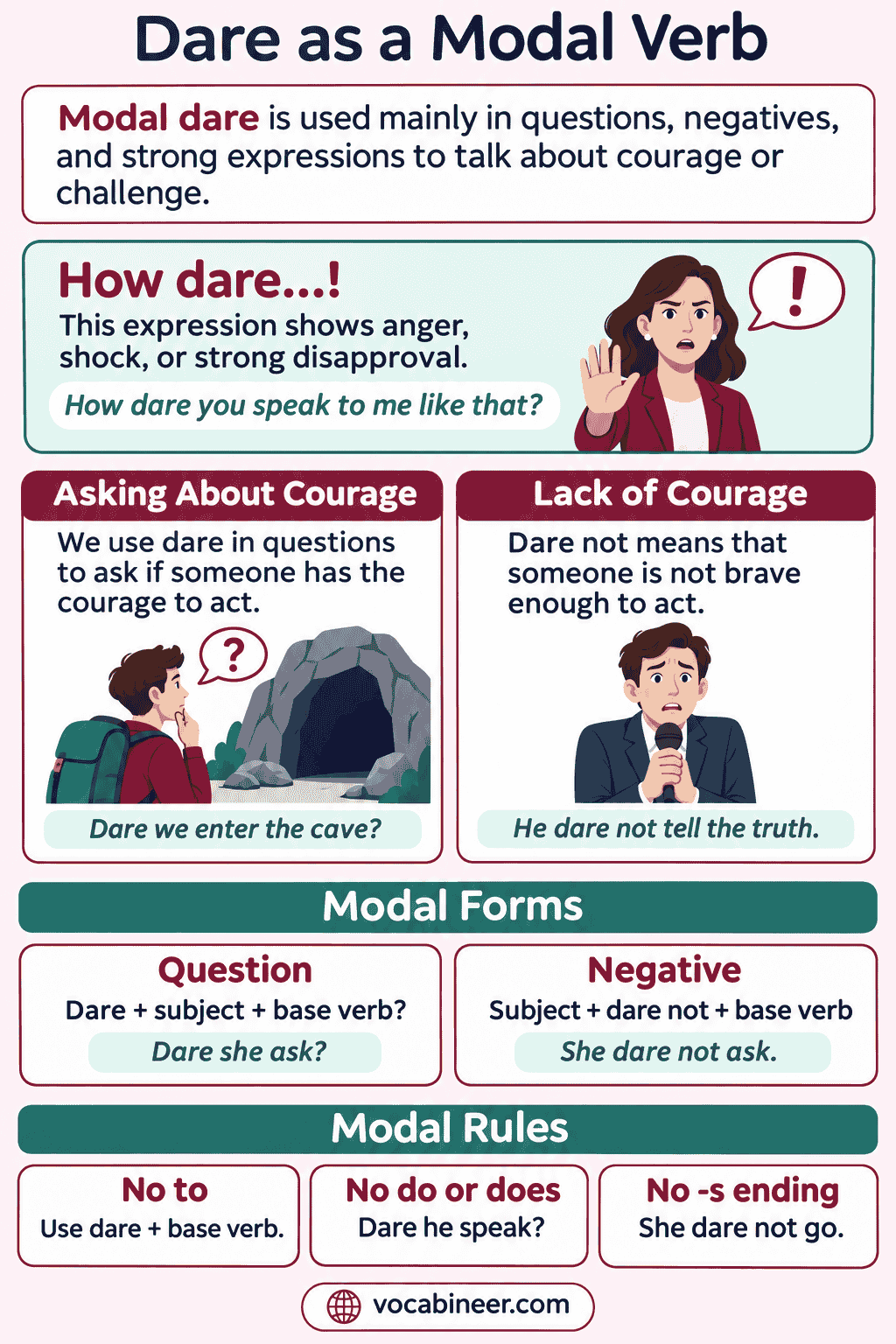
Modal dare means “to have enough courage to do something.” Grammarians often call it a semi-modal or marginal modal because it shares several features with modal auxiliaries but has a more limited range of use.
- Dare I ask your name?
- He dare not admit the truth.
- She daren’t look down.
- How dare you speak to me like that!
Modal dare appears mainly in questions, negative statements, exclamations, and other contexts with a negative or limiting meaning. Ordinary affirmative sentences usually use dare as a main verb instead.
Main Features of Modal Dare
Modal dare generally follows these rules:
- It has the same form with every subject in present-time modal constructions.
- It does not take -s with he, she, or it.
- It takes a base verb without to.
- It forms negatives with not.
- It forms questions by appearing before the subject.
- It does not require do, does, or did.
- It appears mainly in negative, interrogative, and exclamative contexts.
- It often sounds formal, literary, dramatic, or old-fashioned outside fixed expressions.
Compare its unchanged present form:
- I dare not ask.
- She dare not ask.
- They dare not ask.
Sentence Structures with Modal Dare
| Sentence type | Structure | Example |
|---|---|---|
| Negative | Subject + dare not + base verb | He dare not object. |
| Contracted negative | Subject + daren’t + base verb | She daren’t ask. |
| Question | Dare + subject + base verb? | Dare we continue? |
| Wh-question | Question word + dare + subject + base verb? | How dare he speak like that? |
| Past formal negative | Subject + dared not + base verb | She dared not look. |
In modal constructions, the following verb remains in its base form without to:
- Correct: He dare not speak.
- Incorrect: He dare not speaks.
- Incorrect: He dare not to speak.
Negative Statements with Dare Not
Use dare not or daren’t when someone lacks the courage to perform an action or refuses to risk it.
- I dare not ask her.
- He dare not admit the truth.
- She daren’t look down.
- They dare not challenge the decision.
- We daren’t enter without permission.
Daren’t is the contraction of dare not. It requires an apostrophe and appears more often in British English than in everyday American English.
Negative and Limiting Contexts
Modal dare can also follow negative subjects and expressions that restrict the number of people willing to act.
- Nobody dare question the decision.
- No one dare interrupt her.
- Not a single person dare complain.
- Few people dare challenge the rule.
The first three examples strongly favor a modal-like interpretation because the subject creates a negative context. With few people, modern speakers may also use the main-verb form few people dare to challenge the rule.
Questions with Modal Dare
Place modal dare before the subject to form a question. Do not add do or does.
- Dare I ask your name?
- Dare we enter the room?
- Dare she question the decision?
- Dare he challenge the champion?
- Why dare they complain?
These questions are correct, but they often sound formal, dramatic, or hesitant. Everyday English commonly uses main verb dare with do-support.
| Modal construction | Main-verb alternative |
|---|---|
| Dare I ask? | Do I dare to ask? |
| Dare she tell him? | Does she dare to tell him? |
| Dare we continue? | Do we dare to continue? |
| Why dare he object? | Why does he dare to object? |
Rhetorical Questions
Some questions with modal dare emphasize an attitude rather than request information.
- Dare I ask what happened?
- Dare we hope for a better result?
- Who dare question the king?
- Dare I suggest another solution?
Depending on the context, these questions can express hesitation, disbelief, politeness, or dramatic emphasis.
Short Answers
- Dare I ask? — Yes, you may.
- Dare we enter? — No, we daren’t.
- Dare he object? — No, he dare not.
Affirmative short answers with modal dare often sound unnatural. Therefore, speakers generally respond with another modal or a complete sentence.
- Dare I speak honestly? — Yes, you can.
- Dare we approach them? — Yes, but be careful.
How Dare You
How dare…? expresses anger, shock, offence, or strong disapproval. It challenges someone’s right or boldness to perform an action rather than asking an ordinary question.
The structure is:
How dare + subject + base verb
- How dare you lie to me!
- How dare he speak to her like that!
- How dare they enter without permission!
- How dare she question my honesty!
Do not place to before the main verb.
| Incorrect | Correct |
|---|---|
| How dare you to say that? | How dare you say that? |
| How dare he to interrupt? | How dare he interrupt? |
Although the expression begins with how, it usually functions as an exclamation. Therefore, writers often end it with an exclamation mark rather than a question mark.
Don’t You Dare
Don’t you dare… gives a strong warning, command, or threat. It tells someone not to perform an action.
- Don’t you dare touch that!
- Don’t you dare speak to me like that!
- Don’t you dare leave without telling me!
- Don’t dare open the door.
Although this construction uses do-support, the verb after dare normally appears without to. Because don’t you dare sounds forceful or confrontational, speakers should use it carefully.
Just You Dare
Just you dare… has an affirmative form but often functions as a warning or challenge.
- Just you dare touch my phone!
- Just you dare speak to her that way again!
The speaker implies that the listener will face consequences if the action occurs.
Modal Dare and Main Verb Dare
The word dare can follow modal grammar or ordinary main-verb grammar.
| Modal dare | Main verb dare |
|---|---|
| Appears mainly in negatives and questions | Appears in affirmative, negative, and interrogative sentences |
| Takes a base verb without to | Commonly takes to + base verb |
| Does not take -s in present modal constructions | Changes to dares with he, she, or it |
| Forms questions through inversion | Forms questions with do or does |
| He dare not speak. | He does not dare to speak. |
| Dare she ask? | Does she dare to ask? |
| She daren’t object. | She doesn’t dare to object. |
Main verb dare is more common in everyday English.
Dare Not and Do Not Dare To
Modal dare not and main-verb do not dare to usually communicate a similar meaning. However, their structures and levels of formality differ.
| Dare not | Do not dare to |
|---|---|
| Uses modal grammar | Uses ordinary verb grammar |
| Takes a base verb without to | Commonly takes a to-infinitive |
| Often sounds formal or literary | Common in everyday conversation |
| He dare not speak. | He does not dare to speak. |
| She daren’t ask. | She doesn’t dare to ask. |
The form dares not is also possible when dare behaves more like a main verb:
- He dares not speak.
- She dares not object.
These sentences sound formal. For learners, he dare not speak and he does not dare to speak provide clearer models.
Dare With and Without To
When dare functions clearly as a modal verb, it takes a bare infinitive:
- He dare not speak.
- Dare she ask?
- How dare you complain?
When dare functions as a main verb, it commonly takes a to-infinitive:
- He dared to speak.
- She does not dare to ask.
- Do you dare to complain?
However, English also permits a bare infinitive after main verb dare, especially in negative sentences and questions:
- He didn’t dare speak.
- Nobody dared ask.
- Do you dare enter?
Therefore, both of these sentences are correct:
- He didn’t dare to speak.
- He didn’t dare speak.
Main Verb Dare for Courage
As a main verb, dare means having enough courage to attempt something difficult, dangerous, or uncertain.
- She dared to question the decision.
- He does not dare to complain.
- Do you dare to enter the cave?
- Nobody dared to interrupt her.
- I would never dare to speak to him that way.
Main verb dare changes according to tense and subject:
- She dares to disagree.
- They dare to disagree.
- He dared to disagree.
Affirmative dares is correct when dare functions as a main verb:
- She dares to question authority.
- He dares to take risks.
- Who dares wins.
Dare as a Challenge
Dare can also act as a transitive main verb meaning to challenge someone to perform an action.
The structure is:
Subject + dare + object + to-infinitive
- I dare you to jump.
- She dared him to tell the truth.
- They dared us to enter the abandoned house.
- Nobody dared me to do it.
- The children dared one another to cross the stream.
This construction requires a person as the object and normally uses to before the following verb.
| Courage | Challenge |
|---|---|
| She dared to enter. | They dared her to enter. |
| The subject finds the courage to act. | Someone challenges another person to act. |
| No object is required. | A person appears as the object. |
Dare vs Challenge
| Dare | Challenge |
|---|---|
| Often asks someone to prove their courage | Can test someone’s skill, ability, claim, or authority |
| I dared him to jump. | She challenged him to a race. |
| Often involves risk, fear, or embarrassment | May involve competition, difficulty, or disagreement |
| Common pattern: dare someone to do something | Common pattern: challenge someone to something |
Passive Form
When dare means “challenge,” it can appear in the passive voice.
- He was dared to jump into the water.
- She was dared to tell the truth.
- We were dared to enter the building.
The passive construction normally retains the to-infinitive.
Wouldn’t Dare
Wouldn’t dare is one of the most common modern patterns with dare. It expresses strong unwillingness, fear, politeness, or confidence that someone would not perform an action.
- I wouldn’t dare ask her.
- He wouldn’t dare challenge you.
- She wouldn’t dare to lie about that.
- I wouldn’t dare say that he was wrong.
Both a bare infinitive and a to-infinitive can follow wouldn’t dare:
- I wouldn’t dare ask.
- I wouldn’t dare to ask.
The version without to is often more natural, especially in conversation.
Wouldn’t Have Dared
Use wouldn’t have dared for an unreal, avoided, or unperformed past action.
- I wouldn’t have dared ask.
- She wouldn’t have dared to complain.
- They wouldn’t have dared enter without permission.
- He would never have dared challenge the manager.
This construction is more natural in modern English than rare modal-perfect forms such as dare not have done.
Past Forms of Dare
For past courage or a past lack of courage, English commonly uses dared, did not dare, or dared not.
| Meaning | Structure | Example |
|---|---|---|
| Past courage | dared to + base verb | She dared to object. |
| Past lack of courage | did not dare to + base verb | He did not dare to ask. |
| Past lack of courage without to | did not dare + base verb | He did not dare ask. |
| Formal past negative | dared not + base verb | She dared not look. |
Dared not sounds formal or literary, while did not dare to is common in everyday English.
Perfect and Conditional Forms
Because these constructions treat dare as a main verb, they can express perfect and conditional meanings naturally.
- She had never dared to disagree.
- He had not dared ask for help.
- I would dare to try if I had more experience.
- I would not dare enter that building alone.
- She would have dared to speak if someone had supported her.
Common Expressions with Dare
I Dare Say
I dare say is a fixed expression meaning “I suppose,” “probably,” or “I believe.” It usually does not refer directly to courage.
- I dare say she will agree.
- He is tired, I dare say.
- I dare say they have already left.
- The task will be difficult, I dare say.
This expression occurs more often in British English and may sound formal or slightly old-fashioned in some contexts.
Dare I Say
Dare I say introduces an opinion that may sound bold, surprising, critical, or controversial.
- It was, dare I say, their best performance.
- The plan is, dare I say it, completely unnecessary.
- She may be, dare I say, the strongest candidate.
- His answer was, dare I say, rather dishonest.
| Expression | Meaning | Example |
|---|---|---|
| I dare say | I suppose or probably | I dare say they will arrive soon. |
| Dare I say | I hesitate to express this opinion | It was, dare I say, a poor decision. |
If You Dare
If you dare challenges someone to perform a risky, frightening, or difficult action.
- Enter the room if you dare.
- Ask him the question if you dare.
- Try to defeat me if you dare.
- Read the story alone at night if you dare.
Here, dare behaves as a main verb, while the preceding action is understood from the context.
Hardly Dare and Scarcely Dare
Hardly dare and scarcely dare describe extreme hesitation or a severe lack of courage.
- I hardly dare ask.
- We hardly dare imagine the consequences.
- She scarcely dared look at the result.
- He hardly dared breathe.
These constructions can show ordinary tense marking:
- Present: I hardly dare ask.
- Past: I hardly dared ask.
Dare to Dream
Main verb dare can form positive imperatives that encourage courage or bold action.
- Dare to dream.
- Dare to be different.
- Dare to ask difficult questions.
- Dare to take the first step.
These are main-verb constructions, not modal constructions.
Ellipsis After Dare
Speakers can omit the following action when the context already makes it clear.
- I wouldn’t dare.
- Do you dare?
- She wanted to complain but didn’t dare.
- Come closer if you dare.
- He said he would confront them, but he never dared.
The missing action remains understood from the preceding words or the situation.
Adverb Placement with Dare
Adverbs can show different degrees of courage, fear, and hesitation.
- I hardly dare ask.
- She barely dared look.
- He never dared complain.
- They would never dare challenge her.
- I really wouldn’t dare say that.
The position depends on the construction. With an auxiliary such as would, the frequency adverb normally appears after the auxiliary: would never dare. With a simple past main verb, it commonly appears before dared: never dared.
Dare in Reported Speech
When reporting statements with dare, speakers often change the form to match the past reporting context.
- Direct: She said, “I dare not tell him.”
- Reported: She said that she dared not tell him.
- Conversational alternative: She said that she did not dare to tell him.
For questions:
- Direct: He asked, “Dare I enter?”
- Reported: He asked whether he dared to enter.
- Natural alternative: He asked whether he should enter.
The best form depends on whether the writer wants to preserve the original tone or use more conversational English.
Question Tags with Dare
The question tag depends on whether dare behaves as a modal verb or a main verb.
| Sentence | Question tag |
|---|---|
| He daren’t object, | dare he? |
| She doesn’t dare complain, | does she? |
| They dared to enter, | didn’t they? |
| Nobody dared ask, | did they? |
Dare as a Noun
Dare can also function as a countable noun meaning a challenge to perform a risky or embarrassing action.
- He accepted the dare.
- She did it on a dare.
- It was a foolish dare.
- They played truth or dare.
This noun use follows ordinary noun grammar and should not be confused with modal dare.
Formality, Pronunciation, and Regional Usage
Modal dare often sounds formal, literary, dramatic, or old-fashioned. However, several constructions remain common in modern English:
- How dare you!
- Don’t you dare!
- Dare I ask?
- I dare say.
- If you dare.
Daren’t appears more often in British English. In everyday American English, speakers generally prefer don’t dare, doesn’t dare, or didn’t dare.
The contraction is spelled daren’t, not darent or dare’nt.
| Incorrect | Correct |
|---|---|
| darent | daren’t |
| dare’nt | daren’t |
Common Mistakes with Dare
Adding To After Modal Dare
| Incorrect | Correct |
|---|---|
| He dare not to speak. | He dare not speak. |
| Dare she to ask? | Dare she ask? |
| How dare you to complain? | How dare you complain? |
Adding -s to Modal Dare
| Incorrect modal form | Correct modal form |
|---|---|
| He dares not speak. | He dare not speak. |
| She dares not object. | She dare not object. |
Remember that dares can still be grammatical when dare functions as a main verb: “She dares to object.” The formal form “She dares not object” is also possible, although learners may find “She does not dare to object” clearer.
Mixing Modal and Main-Verb Structures
| Incorrect | Correct |
|---|---|
| Does he dare to speaks? | Does he dare to speak? |
| Dare he to complain? | Dare he complain? |
| He doesn’t dares to ask. | He doesn’t dare to ask. |
Confusing Courage with a Challenge
| Sentence | Meaning |
|---|---|
| I dare to jump. | I have the courage to jump. |
| I dare you to jump. | I challenge you to jump. |
When dare means “challenge,” include the person being challenged as the object.
Using an Unnatural Past Form
For most past situations, prefer dared, did not dare, or would not have dared.
| Less natural or very rare | Natural modern alternative |
|---|---|
| He dare not have said that. | He wouldn’t have dared to say that. |
| She dare not have complained. | She wouldn’t have dared to complain. |
Key Points to Remember
- Modal dare expresses courage, hesitation, or willingness to take a risk.
- It appears mainly in negatives, questions, and exclamations.
- It takes a base verb without to.
- It does not take -s in present modal constructions.
- Main verb dare uses ordinary verb forms and commonly takes a to-infinitive.
- How dare…? expresses anger or strong disapproval.
- Don’t you dare… gives a forceful warning.
- Dare someone to do something expresses a challenge.
- Wouldn’t dare and wouldn’t have dared are common modern patterns.
- I dare say means “I suppose” or “probably.”
- Past-time constructions commonly use dared, dared not, or did not dare.
Conclusion
Modal dare allows speakers to ask whether someone has enough courage to act or to state that someone lacks that courage. It follows modal grammar by taking a base verb without to, remaining unchanged in present-time constructions, and forming questions without do or does.
However, dare also functions as a main verb, a transitive verb meaning “challenge,” a noun, and part of several fixed expressions. Recognizing whether it expresses courage, introduces a challenge, delivers a warning, or appears in an expression such as I dare say helps learners choose the correct structure naturally.
FAQs
Modal dare means to have enough courage or boldness to perform an action. It appears mainly in negative statements, questions, and exclamations.
No. Modal dare takes a base verb without to: “He dare not speak.” Main verb dare commonly takes a to-infinitive: “He does not dare to speak.”
Both can describe a lack of courage. Dare not follows modal grammar and sounds more formal, while do not dare to follows ordinary verb grammar and is more common in conversation.
How dare you expresses anger, shock, offence, or strong disapproval of another person’s behavior.
It can function as either. Modal dare appears mainly in questions and negatives, while main verb dare follows ordinary tense, agreement, and question-forming rules.
Read More
- Verbs in English
- Action Verbs
- Regular Verbs
- Irregular Verbs
- Transitive and Intransitive verbs
- Finite and Non-finite verbs
- Principal Parts of Verbs
- Forms of Verbs