

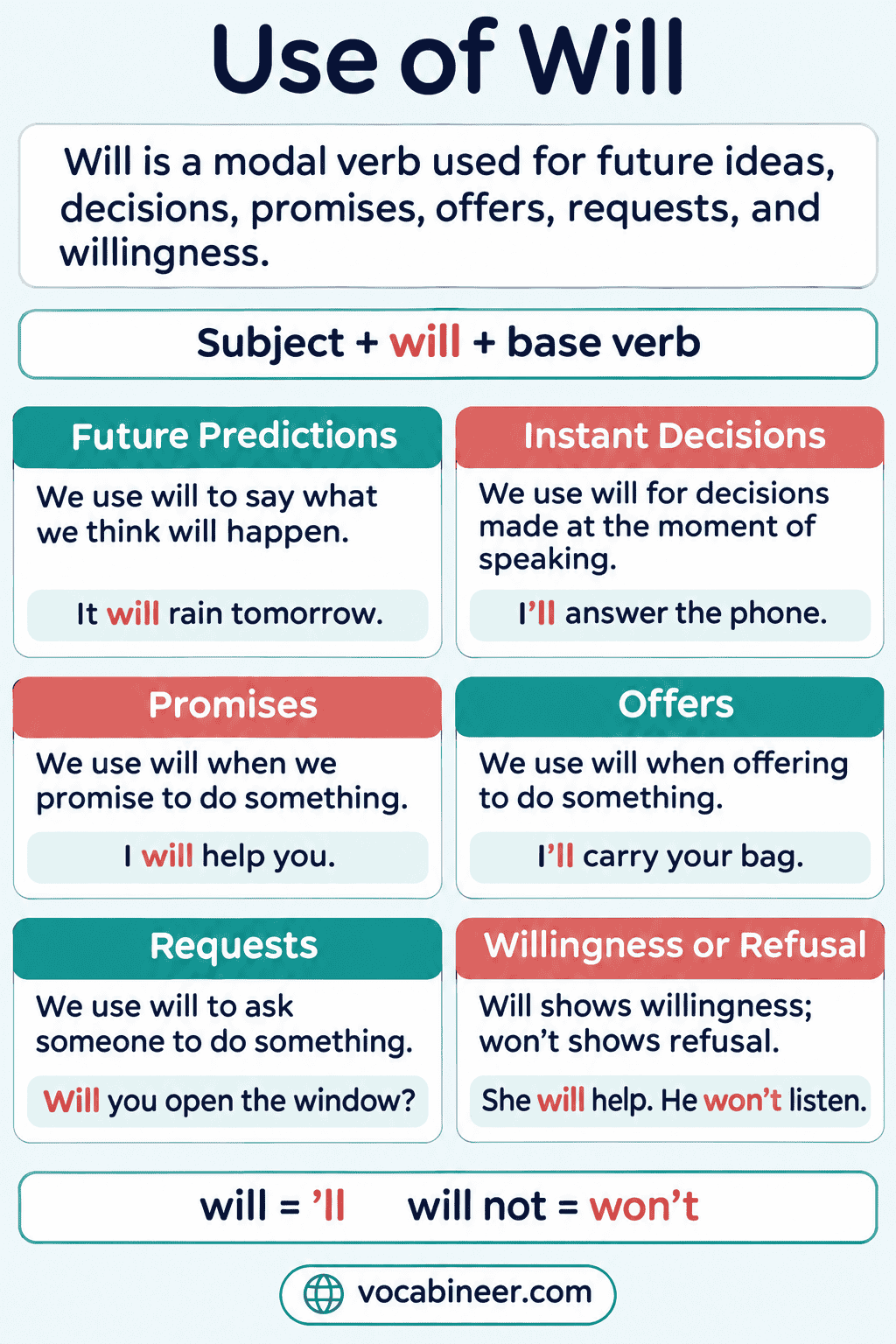
Will is one of the most frequently used modal verbs in English. Learners often connect it only with the future, but it performs many additional functions. It can express predictions, decisions, promises, offers, requests, willingness, refusal, assumptions, instructions, and characteristic behavior.
Understanding the use of will requires more than memorizing a future-tense formula. This guide explains its structures, meanings, contractions, question forms, conditional uses, passive constructions, comparisons, and common errors. It also shows when will refers to the present or past rather than the future.
In This Page
Meaning and Basic Rules of Will
Will is a modal auxiliary verb. It comes before the base form of a main verb and does not change according to the subject.
- I will call you.
- She will call you.
- They will call you.
The same form works with I, you, he, she, it, we, and they. Therefore, do not add -s, -ed, or to to the verb directly after will.
| Incorrect | Correct |
|---|---|
| He will goes. | He will go. |
| She will to call. | She will call. |
| They will arrived. | They will arrive. |
As a modal, will is defective: it does not have the full set of forms that an ordinary verb has. However, English also has a separate lexical verb will, meaning to use determination or to leave property through a legal document. In “She willed herself to continue,” willed is a main verb, not the modal auxiliary.
Sentence Structures with Will
The base verb remains unchanged in affirmative statements, negative statements, and questions.
| Sentence type | Structure | Example |
|---|---|---|
| Affirmative | Subject + will + base verb | She will arrive soon. |
| Negative | Subject + will not + base verb | She will not arrive today. |
| Yes/no question | Will + subject + base verb? | Will she arrive soon? |
| WH-question | WH-word + will + subject + base verb? | When will she arrive? |
Affirmative Sentences
Use subject + will + base verb to form an affirmative sentence.
- I will finish the report tonight.
- He will meet us at the station.
- We will discuss the problem tomorrow.
- The shop will open at nine.
Negative Sentences
Place not after will to form the negative. Will not usually contracts to won’t.
- I will not forget your kindness.
- She won’t attend the meeting.
- The machine won’t start.
- We won’t need another table.
The correct contraction is won’t, not willn’t. Its spelling does not follow the regular pattern used in wouldn’t or couldn’t.
Questions with Will
Move will before the subject to form a yes/no question.
- Will you join us?
- Will he arrive on time?
- Will the children need lunch?
- Will there be enough chairs?
Place a question word before will to form a WH-question.
- When will they return?
- Where will you stay?
- Why will she need the documents?
- How will we solve the problem?
Short Answers
| Question | Positive answer | Negative answer |
|---|---|---|
| Will you come? | Yes, I will. | No, I won’t. |
| Will she help? | Yes, she will. | No, she won’t. |
| Will they agree? | Yes, they will. | No, they won’t. |
| Will it work? | Yes, it will. | No, it won’t. |
Do not repeat the main verb in an ordinary short answer. Say “Yes, she will,” not “Yes, she will help,” unless the context requires emphasis or additional information.
Contractions and Emphasis
Contractions with will occur frequently in conversation and informal writing.
| Full form | Contraction |
|---|---|
| I will | I’ll |
| You will | You’ll |
| He will | He’ll |
| She will | She’ll |
| It will | It’ll |
| We will | We’ll |
| They will | They’ll |
| Will not | Won’t |
The contracted form is usually unstressed:
- I’ll call you later.
- She’ll understand.
- They’ll arrive before noon.
In contrast, the full form can carry stress to show determination, insistence, or correction:
- I will finish this work.
- She will keep interrupting.
- We will find a solution.
Main Uses of Will
The meaning of will depends on context. Although several uses involve future time, others describe willingness, present assumptions, natural tendencies, or repeated behavior.
Predictions Based on Opinion
Use will for a prediction based on belief, expectation, or personal judgment rather than visible present evidence.
- I think it will rain tonight.
- She will probably pass the examination.
- People will use more renewable energy in the future.
- I’m sure you will enjoy the book.
Common expressions include I think, I believe, I expect, probably, perhaps, and I’m sure.
Decisions Made at the Moment of Speaking
Use will for a decision made as someone speaks rather than a plan made earlier.
- The phone is ringing. I’ll answer it.
- I’m thirsty. I’ll get some water.
- We have no bread. I’ll buy some on my way home.
- That bag looks heavy. I’ll carry it.
Promises and Commitments
Use will to promise that an action will or will not happen.
- I will always support you.
- I’ll return the book tomorrow.
- We won’t tell anyone your secret.
- I promise I will be more careful.
Offers
Use will when volunteering to help or do something for another person.
- I’ll carry your bags.
- We’ll help you clean the room.
- I’ll make some tea.
- I’ll drive you to the station.
Requests
Use will in a question to request an action.
- Will you close the window?
- Will you wait here for a moment?
- Will you help me move this table?
- Will you please speak more slowly?
A request with will can sound neutral or direct. Would often makes the request more tentative or polite.
| Form | Typical tone |
|---|---|
| Will you open the window? | Neutral or direct |
| Will you please open the window? | Polite but firm |
| Would you open the window? | More tentative |
| Would you mind opening the window? | Indirect and polite |
Willingness
Use will to show that someone agrees or is prepared to act.
- I will help you.
- She will speak to the manager.
- They will work with us.
- Who will volunteer for the task?
Refusal and Failure to Function
Use won’t when someone refuses to act. It can also describe an object that fails to work as expected.
- He won’t apologize.
- The child won’t eat anything.
- My car won’t start.
- This drawer won’t open.
In these examples, won’t does not simply mark a negative future. It communicates refusal, resistance, or failure.
Future Facts and Expected Events
Use will for events treated as future facts or confident expectations.
- She will be twenty next month.
- The ceremony will begin at noon.
- Winter will follow autumn.
- The next train will leave from platform four.
Present Assumptions
Will can express a confident assumption about a present situation.
- That will be Sarah at the door.
- He’ll be at work now.
- You’ll know the answer, I suppose.
- This will be the package we ordered.
Here, will means “I assume” or “I expect,” not future time.
Assumptions About Completed Events
The structure will have + past participle can express an assumption about an event that is probably complete.
- They will have arrived by now.
- She’ll have received the message already.
- You will have heard the news.
This form may resemble the future perfect, but context can give it a present or past-reference meaning: the speaker assumes that something has already happened.
Characteristic or Repeated Behavior
Use will to describe typical behavior or something that happens regularly.
- Children will sometimes ask difficult questions.
- He will talk for hours about football.
- She will sit by the window and read all afternoon.
- Good friends will support each other.
When stressed, will can show annoyance about repeated behavior.
- He will leave the door open.
- She will keep interrupting me.
- They will arrive late every time.
Natural Tendencies and General Results
Will can describe the predictable behavior of people, materials, machines, or situations.
- Oil will float on water.
- Glass will break if you drop it.
- A good coat will keep you warm.
- Accidents will happen.
This use expresses a tendency or expected result rather than one particular future event.
Instructions and Formal Requirements
Will can appear in firm instructions, official notices, policies, and formal statements.
- Students will remain seated until the bell rings.
- Applicants will provide two photographs.
- Employees will follow the safety procedure.
- Payment will be made within thirty days.
In modern legal and administrative writing, must may communicate obligation more clearly because will can sometimes express only future time.
Warnings and Threats
Use will to state a consequence or communicate a threat.
- You will regret that decision.
- Touch that wire and you will get hurt.
- If you continue, I will call the manager.
- You’ll lose your place if you leave now.
Invitations
Questions with will can invite someone to participate.
- Will you join us for dinner?
- Will you come to the ceremony?
- Will you stay for coffee?
Negative questions can make an invitation sound encouraging or persuasive.
- Won’t you come inside?
- Won’t you join us?
- Won’t you stay a little longer?
Common Patterns with Will
Several patterns occur so frequently that learners should recognize them as complete structures.
There Will Be
Use there will be to state that something will exist, occur, or become available.
- There will be a meeting tomorrow.
- There won’t be enough time.
- Will there be any food?
- There will be several changes next year.
It Will Be
Use it will be for weather, time, distance, conditions, opinions, and impersonal descriptions.
- It will be cold tonight.
- It will be difficult to finish today.
- It won’t take long.
- Will it be expensive?
Adverbs with Will
Adverbs such as probably, definitely, certainly, always, and never commonly appear with will.
| Pattern | Example |
|---|---|
| will + probably | She will probably arrive early. |
| will + definitely | They will definitely support us. |
| will + certainly | He will certainly remember. |
| will + never | I will never forget this day. |
| probably + won’t | She probably won’t attend. |
| definitely + won’t | They definitely won’t agree. |
In negative sentences, “She probably won’t come” generally sounds more natural than “She won’t probably come.”
Question Tags After Imperatives
Will you? and won’t you? commonly follow imperative sentences.
- Close the door, will you?
- Help me with this box, will you?
- Don’t be late, will you?
- Take a seat, won’t you?
Tone and intonation determine whether the tag sounds friendly, persuasive, or impatient.
Will in Conditional Sentences
The first conditional commonly uses a present-tense condition and a result clause containing will.
If + present simple, will + base verb
- If it rains, we will stay home.
- You will improve if you practise regularly.
- If she calls, I will tell her.
- They will miss the train if they leave late.
Do not normally place will in an ordinary condition clause.
| Incorrect | Correct |
|---|---|
| If it will rain, we will stay home. | If it rains, we will stay home. |
| If she will call, I will answer. | If she calls, I will answer. |
| If they will hurry, they will catch the bus. | If they hurry, they will catch the bus. |
Special Uses After If
Will can appear after if when it expresses willingness, polite cooperation, insistence, or a desired result rather than an ordinary future condition.
- If you will help me, we can finish early.
- If you’ll follow me, I’ll show you the room.
- If he will keep shouting, we cannot continue.
- If it will make you happier, I’ll apologize.
These uses do not cancel the general rule. Instead, will carries its separate meaning of willingness or insistence.
Will in Time Clauses
After conjunctions such as when, before, after, until, as soon as, and once, English normally uses a present form for a future event.
| Incorrect | Correct |
|---|---|
| I will call when I will arrive. | I will call when I arrive. |
| We will eat after she will come. | We will eat after she comes. |
| Wait here until I will return. | Wait here until I return. |
| I will tell you as soon as I will know. | I will tell you as soon as I know. |
However, will is correct when when introduces an indirect question rather than a time clause.
- I wonder when she will arrive.
- Do you know when they will return?
- Please tell me when the results will be available.
Compare the two structures:
| Time clause | Indirect question |
|---|---|
| I will call when she arrives. | I wonder when she will arrive. |
| We will begin when he comes. | Do you know when he will come? |
Will in the Passive Voice
Use will be + past participle to form a future passive construction.
- The work will be completed tomorrow.
- The results will be announced soon.
- New trees will be planted here.
- The documents will be checked carefully.
The passive focuses on the action or result rather than the person performing it.
| Active | Passive |
|---|---|
| The team will complete the work. | The work will be completed. |
| The school will announce the results. | The results will be announced. |
| Workers will repair the road. | The road will be repaired. |
Will in Other Future Forms
Will also helps form the future continuous, future perfect, and future perfect continuous.
| Form | Structure | Example |
|---|---|---|
| Future simple | will + base verb | She will work tomorrow. |
| Future continuous | will be + verb-ing | She will be working tomorrow. |
| Future perfect | will have + past participle | She will have finished by noon. |
| Future perfect continuous | will have been + verb-ing | She will have been working for two hours. |
These forms express different relationships between an activity and a future time. The future continuous presents an activity in progress, while the future perfect looks back from a future deadline. The future perfect continuous emphasizes duration up to a future point.
Will in Reported Speech
When a reporting verb is in the past, will commonly changes to would to express future time from a past viewpoint.
| Direct speech | Reported speech |
|---|---|
| She said, “I will call.” | She said that she would call. |
| He said, “I will help.” | He said that he would help. |
| They said, “We will return.” | They said that they would return. |
The change to would is called backshifting. It does not always mean that the action is hypothetical; it may simply present a future event from an earlier viewpoint.
Will Compared with Other Forms
Choosing the correct future form depends on meaning, evidence, intention, and context.
Will vs Going To
| Will | Going to |
|---|---|
| Instant decision | Earlier plan or intention |
| Opinion-based prediction | Prediction based on present evidence |
| Promise or offer | Intended future action |
| I’ll make some tea. | I’m going to cook dinner tonight. |
| I think it will rain. | Look at those clouds. It’s going to rain. |
The distinction is useful, although real conversations sometimes allow either form with a slight change of emphasis.
Will vs Present Continuous
| Will | Present continuous |
|---|---|
| Prediction, promise, or instant decision | Fixed personal arrangement |
| I’ll meet her someday. | I’m meeting her at six. |
| We’ll visit them soon. | We’re visiting them on Friday. |
The present continuous usually suggests that someone has arranged a time, place, or participant.
Will vs Shall
| Will | Shall |
|---|---|
| Common with all subjects | Mainly used with I and we in modern English |
| Predictions, decisions, promises, and offers | Suggestions and offers in questions |
| I will call you. | Shall I call them? |
| They will begin soon. | Shall we begin? |
Modern English generally uses will for ordinary future meaning. Shall remains common in “Shall I…?” and “Shall we…?” and may also appear in formal or legal language.
Will vs Would
| Will | Would |
|---|---|
| Future meaning or present willingness | Politeness, hypothetical meaning, or future from a past viewpoint |
| Will you help me? | Would you help me? |
| She will call tomorrow. | She said she would call. |
| I will accept the offer. | I would accept it if the salary were higher. |
Common Mistakes with Will
Adding To After Will
The base verb follows will without to.
| Incorrect | Correct |
|---|---|
| She will to come. | She will come. |
| I will to help you. | I will help you. |
Changing the Main Verb
Do not add -s or use a past form directly after will.
| Incorrect | Correct |
|---|---|
| He will goes. | He will go. |
| She will arrives early. | She will arrive early. |
| They will arrived soon. | They will arrive soon. |
| He will went home. | He will go home. |
Forming the Negative Incorrectly
Use will not or won’t. Do not combine will with do not.
| Incorrect | Correct |
|---|---|
| I willn’t go. | I won’t go. |
| She doesn’t will come. | She won’t come. |
| They not will agree. | They will not agree. |
Using Will in an Ordinary If-Clause
Use the present simple in the condition clause unless will expresses willingness or insistence.
| Incorrect | Correct |
|---|---|
| If she will study, she will pass. | If she studies, she will pass. |
| If it will rain, we will cancel the trip. | If it rains, we will cancel the trip. |
Using Will in a Future Time Clause
Use a present form after when, before, after, until, and similar conjunctions.
| Incorrect | Correct |
|---|---|
| I’ll call when I will arrive. | I’ll call when I arrive. |
| We’ll leave after he will finish. | We’ll leave after he finishes. |
Confusing Will with Going To
Use will naturally for an immediate decision, offer, promise, or opinion-based prediction. Use going to for a prior intention or a prediction supported by present evidence.
Key Points to Remember
- Will is a modal auxiliary verb.
- It has the same form with every subject.
- The base form of the main verb follows it.
- Will not contracts to won’t.
- It expresses more than future time.
- Major uses include predictions, decisions, promises, offers, requests, willingness, refusal, assumptions, tendencies, and formal instructions.
- Stressed will can express determination or annoyance.
- Present forms normally follow if, when, until, and similar conjunctions in future-reference clauses.
- Will may appear after if when it expresses willingness or insistence.
- Will commonly changes to would in reported speech.
- The structures there will be and it will be are common in everyday English.
Conclusion
Will is strongly associated with the future, but its grammatical role is much broader. Speakers use it to predict, decide, promise, offer, request, assume, insist, invite, warn, and describe willingness or typical behavior. Its meaning depends on the situation rather than on future time alone.
To use will accurately, place a base verb after it, form the negative with will not or won’t, and move will before the subject in questions. In addition, distinguish it from going to, shall, and would, and remember the special rules for conditional and time clauses.
FAQs
Yes. Will is a modal auxiliary verb. It comes before the base form of a main verb and does not change according to the subject.
The base form follows will. For example, use “She will come,” not “She will comes” or “She will to come.”
The full negative form is will not, and its standard contraction is won’t. For example, “They will not attend” can become “They won’t attend.”
Will commonly expresses instant decisions, promises, offers, and predictions based on opinion. Going to commonly expresses earlier plans and predictions based on present evidence.
Yes. Will can express present willingness, refusal, typical behavior, natural tendencies, or a confident assumption, as in “That will be Sarah at the door.”
Read More
- Verbs in English
- Action Verbs
- Regular Verbs
- Irregular Verbs
- Transitive and Intransitive verbs
- Finite and Non-finite verbs
- Principal Parts of Verbs
- Forms of Verbs