

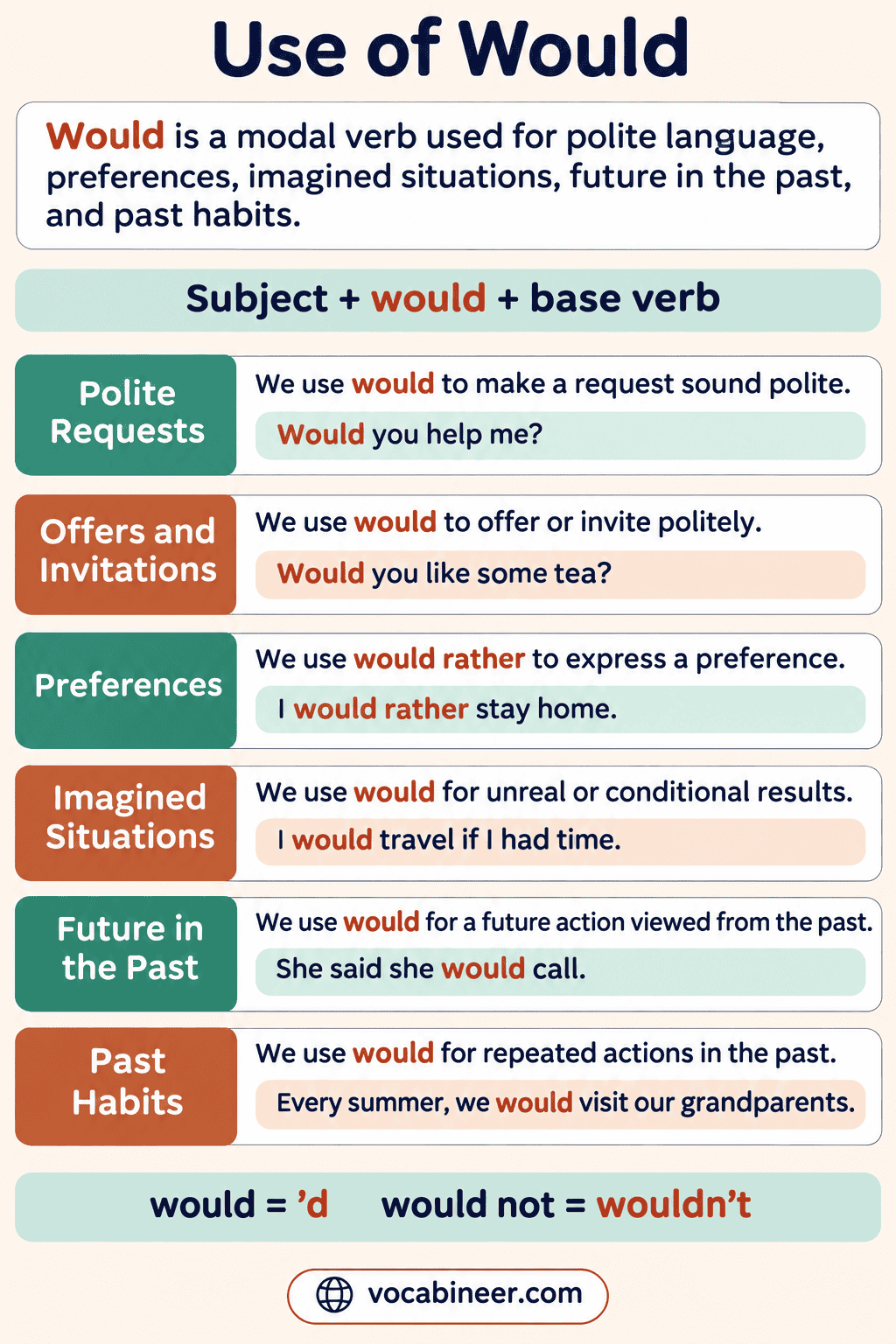
Would is a versatile modal auxiliary verb in English. It often acts as the past form of will, especially in reported speech and future events viewed from a past point. However, it also expresses hypothetical results, polite requests, preferences, repeated past actions, tentative opinions, wishes, and unreal past possibilities.
Learning the use of would requires attention to both structure and context. This guide explains affirmative, negative, and question forms; second and third conditionals; expressions such as would like and would rather; comparisons with related forms; and the mistakes learners commonly make.
In This Page
Meaning and Basic Rules of Would
Would is a modal auxiliary verb. It comes before the base form of a main verb and has the same form with every subject.
- I would help.
- She would help.
- They would help.
Do not add to, -s, -ed, or -ing directly to the main verb after would.
| Incorrect | Correct |
|---|---|
| She would goes. | She would go. |
| He would to help. | He would help. |
| They would arrived. | They would arrive. |
Like other central modal verbs, would is defective. It does not have ordinary infinitive, participle, or third-person singular forms. Instead, English uses related expressions when another form is needed, such as would be able to for hypothetical ability.
Sentence Structures with Would
The base verb remains unchanged in statements and questions.
| Sentence type | Structure | Example |
|---|---|---|
| Affirmative | Subject + would + base verb | She would help us. |
| Negative | Subject + would not + base verb | She would not help us. |
| Yes/no question | Would + subject + base verb? | Would she help us? |
| WH-question | WH-word + would + subject + base verb? | Why would she help us? |
Affirmative Sentences
Use subject + would + base verb.
- I would accept the offer.
- He would understand the problem.
- We would need more time.
- The journey would take three hours.
Negative Sentences
Place not after would. The contracted form is wouldn’t.
- I would not choose that option.
- She wouldn’t agree with the decision.
- They wouldn’t wait for us.
- The engine wouldn’t start.
Questions with Would
Place would before the subject in a yes/no question.
- Would you help me?
- Would she accept the offer?
- Would they understand?
- Would it make a difference?
Place a question word before would in a WH-question.
- What would you do?
- Where would they stay?
- Why would she refuse?
- How would we solve the problem?
Short Answers
| Question | Positive answer | Negative answer |
|---|---|---|
| Would you come? | Yes, I would. | No, I wouldn’t. |
| Would she agree? | Yes, she would. | No, she wouldn’t. |
| Would they help? | Yes, they would. | No, they wouldn’t. |
These short answers work well for hypothetical questions. Offers with would like often take more natural social responses such as “Yes, please,” “I’d love to,” or “No, thank you.”
Contractions with Would
Would commonly contracts to ’d after a pronoun or noun phrase.
| Full form | Contraction |
|---|---|
| I would | I’d |
| You would | You’d |
| He would | He’d |
| She would | She’d |
| It would | It’d |
| We would | We’d |
| They would | They’d |
| Would not | Wouldn’t |
Would or Had in ’d Contractions
The contraction ’d can mean would or had. The following verb usually reveals the meaning.
| Contraction | Full form | Explanation |
|---|---|---|
| She’d call. | She would call. | A base verb follows would. |
| She’d called. | She had called. | A past participle follows had. |
| They’d leave. | They would leave. | Leave is a base verb. |
| They’d left. | They had left. | Left is a past participle. |
The contraction would’ve means would have, never would of.
- I would’ve helped. = I would have helped.
- She would’ve called. = She would have called.
Main Uses of Would
The meaning of would depends on the surrounding clause and situation. Some uses relate to the past, while others express politeness, imagination, distance, or uncertainty.
Future Viewed from the Past
Use would for an event that was still in the future at an earlier past time.
- I knew she would return.
- He promised he would call.
- They believed the plan would work.
- We thought the journey would take two hours.
Here, would does not necessarily express an unreal situation. It presents a later event from a past viewpoint.
Would in Reported Speech
Will commonly changes to would after a past reporting verb.
| Direct speech | Reported speech |
|---|---|
| She said, “I will call.” | She said that she would call. |
| He said, “I will help.” | He said that he would help. |
| They said, “We will return.” | They said that they would return. |
However, backshifting is not automatic in every context.
- She says she will call.
- She said she would call.
- She said she will call tomorrow.
The last sentence may keep will when the speaker presents the future event as current and still valid. Viewpoint and context influence the choice.
Hypothetical Present or Future Situations
Use would to discuss imagined, unlikely, or unreal situations.
- I would travel more if I had enough money.
- She would make an excellent teacher.
- It would be wonderful to live near the sea.
- What would you do in my position?
Polite Requests
Would makes a request more tentative and less direct.
- Would you close the window?
- Would you help me with this box?
- Would you please wait here?
- Would you send me the details?
| Form | Typical tone |
|---|---|
| Open the door. | Direct command |
| Will you open the door? | Neutral or direct request |
| Would you open the door? | Polite or tentative request |
| Would you mind opening the door? | Indirect and polite request |
Polite Offers and Invitations
Use would like when offering something or inviting someone.
- Would you like some tea?
- Would you like to join us?
- Would you like me to carry that?
- Would you care for another cup?
Common responses include:
- Yes, please.
- I’d love to.
- That would be lovely.
- No, thank you.
- I’d rather not, thank you.
Advice and Personal Recommendations
Would can present advice as a personal or hypothetical choice.
- I would speak to the manager.
- I wouldn’t worry about it.
- I would wait until tomorrow.
- If I were you, I would apologize.
This form often sounds less forceful than must and more personal than should.
Softened Opinions and Suggestions
Use would to make an opinion, recommendation, or conclusion less direct.
- I would say the blue one looks better.
- I would suggest checking the figures again.
- I would recommend booking in advance.
- That would seem to be the best solution.
- It would appear that the figures are incorrect.
Tentative Assumptions and Identification
Would can express a tentative conclusion about a person or thing.
- That would be Sarah at the door.
- This would be the correct entrance.
- Those would be the documents you requested.
| Will | Would |
|---|---|
| More confident assumption | More tentative or distanced assumption |
| That will be Sarah. | That would be Sarah. |
Estimates and Approximation
Would can make an estimate sound less exact or more cautious.
- The journey would take about three hours.
- The building would be around a hundred years old.
- She would have been about twenty at the time.
- That would cost approximately fifty dollars.
Past Willingness and Refusal
Use would or wouldn’t for willingness, refusal, or failure in the past.
- She said she would help.
- He would do anything for his family.
- The child wouldn’t eat.
- My old car wouldn’t start.
- They wouldn’t listen to our advice.
Typical or Predictable Results
Use would for the expected result of an imagined circumstance.
- A mistake like that would cause serious problems.
- This material would break under pressure.
- That route would take about an hour.
- A good heater would keep the room warm.
Rhetorical and Reflective Expressions
Several common expressions use would to communicate surprise, disbelief, criticism, or reflection.
- Why would she lie?
- Why would anyone do that?
- You would think they had never met before.
- Who would have thought the plan would succeed?
- I never thought she would agree.
Would in Conditional Sentences
Would commonly appears in the result clause of second, third, and mixed conditional sentences.
Second Conditional
Use the second conditional for unreal, unlikely, or imagined present and future situations.
If + past simple, would + base verb
- If I had more time, I would learn Spanish.
- She would travel more if she earned a higher salary.
- If we lived nearby, we would visit often.
- They would buy the house if it were cheaper.
The past form in the if-clause usually expresses distance from reality, not past time.
Third Conditional
Use the third conditional for unreal past situations and their imagined results.
If + past perfect, would have + past participle
- If I had known, I would have helped.
- She would have passed if she had studied.
- If they had left earlier, they would have caught the train.
- We would have visited if we had had enough time.
Mixed Conditionals
Mixed conditionals connect different time references.
| Condition | Result | Example |
|---|---|---|
| Past condition | Present result | If I had accepted the job, I would live in London now. |
| Present condition | Past result | If she were more careful, she wouldn’t have made that mistake. |
Implied Conditions Without If
A sentence can contain would even when the condition remains unstated.
- I would help, but I have to work.
- She would come with us, but she is unwell.
- With more time, we would finish today.
- That would be impossible without additional funding.
- Otherwise, they would lose the opportunity.
For example, “I would help” implies “I would help if I were free.”
Would in an If-Clause
In an ordinary conditional, do not place would in the if-clause.
| Incorrect | Correct |
|---|---|
| If I would have time, I would help. | If I had time, I would help. |
| If she would study, she would pass. | If she studied, she would pass. |
| If they would have left earlier, they would have arrived. | If they had left earlier, they would have arrived. |
However, would may appear after if when it expresses willingness, insistence, or polite cooperation.
- If you would wait here, the manager will see you shortly.
- If he would listen, we could explain the problem.
Conditional Inversion
Formal English can omit if and invert the condition.
| Regular condition | Inverted condition |
|---|---|
| If I had known, I would have helped. | Had I known, I would have helped. |
| If she were here, she would understand. | Were she here, she would understand. |
| If you should need help, I would assist you. | Should you need help, I would assist you. |
Punctuation in Conditional Sentences
Use a comma after an introductory if-clause. Do not normally use a comma when the result clause comes first.
- If I had time, I would help.
- I would help if I had time.
Would Like, Would Love, Would Prefer, and Would Rather
These expressions communicate desires and preferences, but they follow different grammatical patterns.
Would Like
Use would like for a polite present or future desire.
- I would like some water.
- She would like to speak to the manager.
- We’d like a table for four.
- I wouldn’t like to live there.
| Like | Would like |
|---|---|
| General enjoyment or preference | Present or future desire |
| I like coffee. | I would like some coffee. |
| She likes travelling. | She would like to travel. |
Would Love
Would love expresses a strong or enthusiastic desire.
- I would love to visit Japan.
- We’d love to attend the wedding.
- She would love a new bicycle.
- I’d love to help.
Would Prefer
Common structures include:
- would prefer + noun
- would prefer + to-infinitive
- would prefer + object + to-infinitive
- would prefer to X rather than Y
Examples:
- I would prefer tea.
- She would prefer to stay home.
- I’d prefer you to call first.
- We would prefer to walk rather than wait.
Would Rather
Use would rather with the base form of a verb.
- I would rather stay home.
- She’d rather take the train.
- We would rather not discuss it.
- Would you rather eat now or later?
For another person’s present or future action, use a past form.
- I’d rather you stayed here.
- She’d rather he didn’t drive.
- We’d rather they came tomorrow.
| Would rather | Would prefer |
|---|---|
| Followed by a base verb | Often followed by a noun or to-infinitive |
| I’d rather stay. | I’d prefer to stay. |
| More conversational | Often slightly more formal |
Past Preferences
Use would rather have + past participle for the speaker’s preferred past action.
- I would rather have stayed home.
- She would rather have taken the train.
- We would rather not have discussed the issue.
For another person’s past action, use would rather + subject + past perfect.
- I’d rather you had told me earlier.
- She’d rather he hadn’t driven alone.
- We’d rather they had arrived on time.
Would You Mind
Would you mind forms a polite request or request for permission.
| Structure | Example |
|---|---|
| Would you mind + verb-ing? | Would you mind closing the window? |
| Would you mind if + past simple? | Would you mind if I opened the window? |
| I wouldn’t mind + noun | I wouldn’t mind some coffee. |
| I wouldn’t mind + verb-ing | I wouldn’t mind staying longer. |
A negative answer normally grants permission:
- “Would you mind if I sat here?”
- “No, not at all.”
The expression I wouldn’t mind generally means that something is acceptable or welcome. It does not usually express refusal.
Would for Past Habits
Use would for repeated past actions after establishing a past-time setting.
- Every summer, we would visit our grandparents.
- After dinner, my father would read the newspaper.
- She would sit by the window for hours.
- We would play outside until sunset.
Would vs Used To
| Would | Used to |
|---|---|
| Describes repeated past actions | Describes past habits and states |
| Usually needs an established past context | Can introduce the past situation |
| We would play outside. | We used to play outside. |
| Not normally used for past states | Can describe past states |
| Not: I would be shy. | I used to be shy. |
Do not normally use habitual would for past states involving be, know, own, believe, or like.
| Unnatural | Natural |
|---|---|
| I would be shy as a child. | I used to be shy as a child. |
| She would own a small shop. | She used to own a small shop. |
| We would know the answer. | We used to know the answer. |
Wishes and Complaints with Would
Use wish + would when the speaker wants a person, situation, or object to change.
- I wish you would listen.
- She wishes he would stop shouting.
- I wish it would stop raining.
- We wish the neighbors would be quieter.
This structure often communicates impatience, dissatisfaction, or a desire for changed behavior. It is not normally used for an unchangeable state or a simple regret about the past.
Would Have and Related Forms
Different combinations with would express unreal past results, continuing hypothetical actions, and missed intentions.
Would Have + Past Participle
Use would have + past participle for an unreal past result.
- I would have helped if I had known.
- She would have passed with more preparation.
- They would have caught the train if they had left earlier.
It can also describe an unfulfilled intention without a complete if-clause.
- I would have called, but I lost your number.
- She would have joined us, but she had to work.
- We would have stayed longer, but the weather changed.
Would Like to Have and Would Have Liked
These forms express an unfulfilled past wish.
| Structure | Example |
|---|---|
| would like to have + past participle | I would like to have met her. |
| would have liked to + base verb | I would have liked to meet her. |
| would have loved to + base verb | We would have loved to attend. |
| would have preferred to + base verb | She would have preferred to stay. |
Would Be + Verb-Ing
Use this structure for an imagined continuing activity or future continuous viewed from the past.
- She said she would be working late.
- He knew they would be waiting.
- I would be travelling now if the flight had not been cancelled.
Would Have Been + Verb-Ing
Use this form for an unreal or past-viewed activity continuing over a period.
- By June, she would have been working there for ten years.
- Without the interruption, they would have been travelling all night.
- He would have been waiting for hours if we had arrived late.
Hypothetical Necessity, Ability, and Permission
English uses longer expressions because two central modal verbs do not normally appear together.
| Structure | Meaning | Example |
|---|---|---|
| would have to | Hypothetical necessity | We would have to leave early. |
| would need to | Hypothetical requirement | She would need to apply again. |
| would be able to | Hypothetical ability | He would be able to help us. |
| would be allowed to | Hypothetical permission | They would be allowed to enter. |
Say “He would be able to help,” not “He would can help.”
Would in the Passive Voice
Use would be + past participle for a hypothetical or conditional passive construction.
- The work would be completed on time.
- The plan would be approved if the costs were lower.
- More trees would be planted.
- The documents would be checked carefully.
Use would have been + past participle for an unreal past passive result.
- The road would have been repaired earlier.
- She would have been promoted if the position had remained available.
- The mistake would have been discovered eventually.
Would Compared with Related Forms
Comparing would with related modal verbs helps clarify differences in certainty, ability, advice, and time viewpoint.
Would vs Will
| Will | Would |
|---|---|
| More direct or certain | More tentative, polite, or hypothetical |
| Future viewed from the present | Future viewed from the past |
| Will you help me? | Would you help me? |
| She will call tomorrow. | She said she would call. |
Would vs Was or Were Going To
| Would | Was/Were going to |
|---|---|
| Later event viewed from a past point | Earlier intention or plan |
| I knew she would succeed. | She was going to apply for the job. |
| He said he would call. | He was going to call, but he forgot. |
Was going to often suggests a previous plan that may not have happened.
Would vs Could
| Would | Could |
|---|---|
| Expected result, preference, or willingness | Ability or possibility |
| I would travel if I had money. | I could travel if I had money. |
| Focuses on the likely choice or result | Focuses on what is possible |
Would vs Might
| Would | Might |
|---|---|
| Expected hypothetical result | Possible but uncertain result |
| If we left now, we would arrive by six. | If we left now, we might arrive by six. |
| She would accept the offer. | She might accept the offer. |
Would vs Should
| Would | Should |
|---|---|
| Hypothetical result or personal choice | Advice, expectation, or duty |
| I would call her. | You should call her. |
| Describes what someone would choose | Describes what is advisable |
Modal Perfect Forms
| Form | Main meaning | Example |
|---|---|---|
| would have | Expected unreal result | I would have helped if I had known. |
| could have | Past ability or possibility | I could have helped, but nobody asked. |
| might have | Uncertain past possibility | She might have missed the train. |
| should have | Past advice or expectation | You should have called me. |
Would Rather vs Had Better
| Would rather | Had better |
|---|---|
| Expresses preference | Gives strong advice or a warning |
| I’d rather leave now. | We’d better leave now. |
| Leaving is preferred | Leaving is advisable or necessary |
Formal and Diplomatic Uses
Would often softens professional requests, recommendations, and opinions.
- I would appreciate your help.
- I would be grateful if you replied soon.
- We would welcome further information.
- I would suggest reviewing the figures.
- I would recommend booking in advance.
- I would imagine the work is difficult.
- One would assume the data had been checked.
These forms create distance and reduce the force of a statement.
Different Meanings of Wouldn’t
The negative form changes meaning according to context.
| Meaning | Example |
|---|---|
| Hypothetical negative result | I wouldn’t buy that car. |
| Past refusal | He wouldn’t apologize. |
| Past failure to function | The engine wouldn’t start. |
| Polite rejection | I wouldn’t like any coffee, thank you. |
| Negative preference | I’d rather not leave. |
Common Mistakes with Would
Adding To Directly After Would
Use a base verb directly after would.
| Incorrect | Correct |
|---|---|
| I would to help. | I would help. |
| She would to come. | She would come. |
The word to appears after phrases such as would like because it introduces an infinitive:
- I would like to leave.
- She would prefer to wait.
Changing the Main Verb
| Incorrect | Correct |
|---|---|
| He would goes. | He would go. |
| She would helped. | She would help. |
| They would arrived. | They would arrive. |
Writing Would Of
| Incorrect | Correct |
|---|---|
| I would of helped. | I would have helped. |
| She would of called. | She would have called. |
| They would of arrived. | They would have arrived. |
The contraction would’ve may sound like would of, but it always means would have.
Adding To After Would Rather
| Incorrect | Correct |
|---|---|
| I would rather to stay. | I would rather stay. |
| She would rather to leave. | She would rather leave. |
Confusing Would with Used To
Use habitual would mainly for repeated actions. Use used to for both repeated actions and past states.
Misplacing Would in Conditionals
In an ordinary conditional, use would in the result clause rather than the if-clause.
| Incorrect | Correct |
|---|---|
| If I would know, I would tell you. | If I knew, I would tell you. |
| If she would have studied, she would have passed. | If she had studied, she would have passed. |
Key Points to Remember
- Would is a modal auxiliary verb followed by a base verb.
- It has the same form with every subject.
- Its negative form is would not or wouldn’t.
- The contraction ’d can mean would or had.
- It expresses future time viewed from the past.
- It appears in second, third, and mixed conditionals.
- It makes requests, offers, invitations, opinions, and recommendations less direct.
- Expressions such as would like, would prefer, and would rather follow different structures.
- Habitual would describes repeated past actions but not normally past states.
- Would have + past participle expresses unreal past results or unfulfilled intentions.
- Would be able to expresses hypothetical ability; do not use would can.
- Would normally belongs in the result clause of a conditional sentence.
Conclusion
Would connects several important ideas in English. It can present a future event from a past viewpoint, describe a hypothetical result, make a request more polite, express a preference, soften an opinion, or describe a repeated past action. Its meaning comes from the complete structure and context rather than from the word alone.
To use would accurately, follow it with a base verb, form the negative with would not or wouldn’t, and distinguish ordinary conditional clauses from special expressions of willingness. In addition, learn the patterns used with would like, would rather, would have, and related modal forms.
FAQs
Yes. Would is a modal auxiliary verb. It comes before the base form of a main verb and does not change according to the subject.
A base verb normally follows would, as in “She would help.” In the structure would have, a past participle follows have, as in “She would have helped.”
Will is generally more direct and commonly presents the future from the present. Would can express future time from the past, hypothetical meaning, politeness, or greater tentativeness.
Both forms can describe repeated past actions. However, used to can also describe past states, while habitual would normally cannot. For example, “I used to be shy” is natural, but “I would be shy” does not normally express the same past state.
Use would have + past participle for unreal past results, missed possibilities, or unfulfilled intentions. For example, “I would have called, but I lost your number.”
Read More
- Verbs in English
- Action Verbs
- Regular Verbs
- Irregular Verbs
- Transitive and Intransitive verbs
- Finite and Non-finite verbs
- Principal Parts of Verbs
- Forms of Verbs