

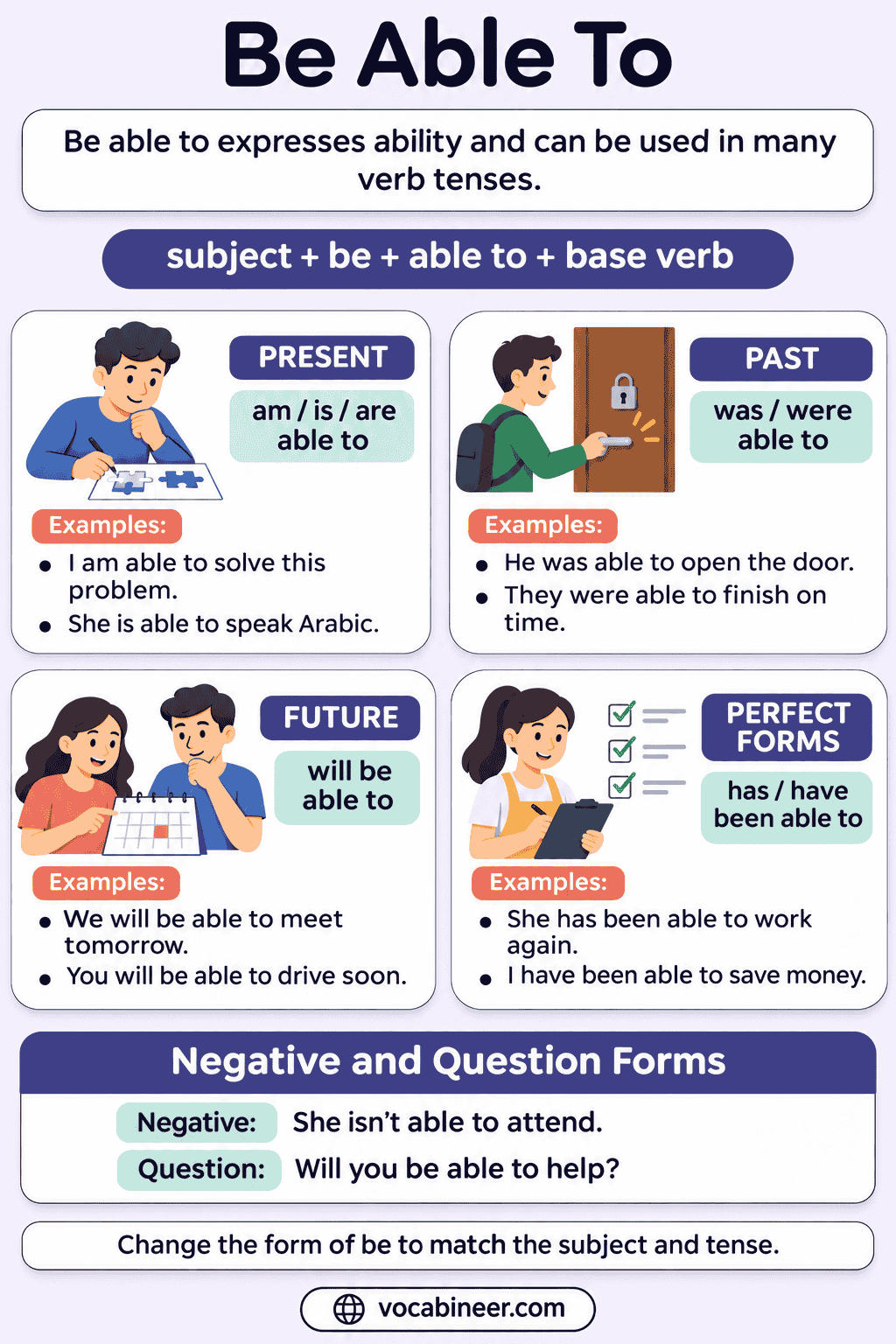
Be able to expresses the ability, capacity, opportunity, or necessary conditions to perform an action. For example, “She is able to swim” describes a present skill, while “We were able to finish” shows that a group successfully completed a past action.
The phrase is especially useful because can and could have limited grammatical forms. English uses constructions such as will be able to, have been able to, might be able to, to be able to, and being able to when can cannot fit the required structure. This guide explains these forms and shows how be able to differs from can, could, manage to, and be capable of.
In This Page
Be Able To at a Glance
| Point | Explanation |
|---|---|
| Meaning | To have the skill, capacity, opportunity, or necessary conditions to do something |
| Basic structure | Subject + form of be + able to + base verb |
| Present | am/is/are able to |
| Past | was/were able to |
| Future | will be able to |
| Present perfect | have/has been able to |
| Past perfect | had been able to |
| After another modal | may/might/should/must be able to |
| Negative | form of be + not able to |
| Question | form of be + subject + able to…? |
In this expression, able is an adjective. The verb be carries the tense and agrees with the subject, while the verb after to remains in its base form.
Basic Sentence Structures
| Sentence type | Structure | Example |
|---|---|---|
| Affirmative | Subject + be + able to + base verb | She is able to drive. |
| Negative | Subject + be + not + able to + base verb | She is not able to drive. |
| Question | Be + subject + able to + base verb? | Is she able to drive? |
| Short answer | Yes/No + subject + form of be | Yes, she is. / No, she isn’t. |
The form of be changes with the subject and time:
- I am able to attend.
- He is able to attend.
- They are able to attend.
- We were able to attend.
- She will be able to attend.
- They have been able to attend regularly.
Always use a base verb after able to: able to attend, not able to attending.
Main Uses of Be Able To
Skills and Learned Abilities
Use be able to for an ability developed through knowledge, training, or practice.
- Sara is able to speak three languages.
- He is able to repair computers.
- The child is able to read short sentences.
- Our technician is able to diagnose complex faults.
Physical Ability
The phrase can describe what a person can physically do.
- She is able to lift the box.
- After treatment, he was able to walk again.
- The athlete will be able to compete next month.
- I am not able to reach the top shelf.
Mental Ability
It can also refer to understanding, remembering, concentrating, or solving problems.
- I am able to understand the instructions.
- They were able to remember every detail.
- She has been able to concentrate better recently.
- He is able to solve difficult calculations mentally.
Opportunity and Circumstances
Sometimes the phrase describes an opportunity or favorable situation rather than a personal skill.
- We were able to visit the museum before it closed.
- I will be able to meet you after work.
- They have been able to reduce their expenses.
- Because the road reopened, the team was able to continue its journey.
Successful Completion
Was/were able to often shows that someone successfully completed a particular action.
- The firefighters were able to rescue everyone.
- I was able to find the missing file.
- She was able to complete the work on time.
- After several attempts, we were able to unlock the door.
Abilities of Things and Systems
The subject can be a machine, program, system, or organization.
- The software is able to detect errors.
- This machine is able to process large amounts of data.
- The new battery will be able to power the device for longer.
- The organization has been able to expand its services.
For a simple inherent function, can is often shorter and more natural: “This software can detect errors.”
Forms Across Different Tenses
One major advantage of be able to is its grammatical flexibility.
| Time or form | Structure | Example |
|---|---|---|
| Present simple | am/is/are able to | She is able to help. |
| Past simple | was/were able to | She was able to help. |
| Future simple | will be able to | She will be able to help. |
| Present perfect | have/has been able to | She has been able to help. |
| Past perfect | had been able to | She had been able to help. |
| Future perfect | will have been able to | She will have been able to help. |
| Infinitive | to be able to | She hopes to be able to help. |
| Gerund | being able to | She enjoys being able to help. |
| After a modal | modal + be able to | She might be able to help. |
| Conditional | would be able to | She would be able to help. |
| Perfect conditional | would have been able to | She would have been able to help. |
Continuous forms such as is being able to are generally avoided because ability normally describes a state. Use is able to for a current ability or is becoming able to when the ability is developing.
Present Ability
Both can and am/is/are able to express present ability.
| Can | Am/Is/Are Able To |
|---|---|
| More common in everyday English | More formal or emphatic |
| Natural for ordinary skills | Can emphasize capacity or successful ability |
| Short and direct | Longer and sometimes less conversational |
| Has limited grammatical forms | Can change through different forms of be |
Compare these examples:
- She can swim.
- She is able to swim.
- I can solve this problem.
- I am able to solve this problem.
Both versions are grammatical. However, can is normally the more natural choice for a simple present skill.
Ability and Permission
Can can express either ability or permission, but be able to normally concerns ability, opportunity, or circumstances.
| Sentence | Likely meaning |
|---|---|
| You can leave early. | You have permission, or circumstances allow it. |
| You are able to leave early. | You have the ability or opportunity to leave. |
Therefore, be able to does not usually replace can when can clearly means permission.
- Natural permission: You can use my phone.
- Unnatural for permission: You are able to use my phone.
Past Ability
The choice between could and was/were able to depends on whether the sentence describes a general ability or one successful action.
General Past Ability
Use could for an ability that existed over a period of time.
- When I was young, I could run quickly.
- She could read before she started school.
- They could speak French fluently.
- My grandfather could repair almost anything.
Was/were able to can also describe general past ability, although it often sounds more formal.
- She was able to read before she started school.
Specific Past Success
For a particular successful action, was/were able to is usually clearer than affirmative could.
| General past ability | Specific successful action |
|---|---|
| He could swim when he was five. | He was able to swim across the river yesterday. |
| She could solve difficult equations. | She was able to solve the final question. |
| They could climb well. | They were able to reach the summit. |
The specific examples confirm that the action was successfully completed.
Perception and Thought Verbs
Could remains natural for a specific past situation with perception and thought verbs such as see, hear, smell, feel, understand, and remember.
- From the window, I could see the mountains.
- Despite the noise, she could hear the announcement.
- I could understand what he meant.
- He could remember the address clearly.
Negative Past Ability
Both couldn’t and wasn’t/weren’t able to can describe failure on a particular occasion.
- I couldn’t open the door.
- I wasn’t able to open the door.
- They couldn’t find the address.
- They weren’t able to find the address.
Unlike affirmative could, negative couldn’t does not normally create confusion about whether a specific action succeeded.
Future Ability
Use will be able to because can cannot ordinarily follow will.
- I will be able to attend tomorrow.
- She will be able to drive after she passes the test.
- We will be able to finish the project next week.
- The new system will be able to handle more requests.
| Incorrect | Correct |
|---|---|
| I will can help. | I will be able to help. |
| She will can drive. | She will be able to drive. |
| They will can attend. | They will be able to attend. |
However, can may refer to the future when a time expression already makes the reference clear.
| Sentence | Emphasis |
|---|---|
| I can meet you tomorrow. | Availability or arrangement |
| I will be able to meet you tomorrow. | Future ability or changed circumstances |
Perfect Forms
Present Perfect
Use have/has been able to for ability or successful actions continuing or occurring up to the present.
- I have been able to improve my English.
- She has been able to work from home.
- They haven’t been able to contact him.
- We have finally been able to identify the problem.
Can has no present perfect form, so have can and have could are incorrect.
Past Perfect
Use had been able to when an ability or opportunity existed before another past event.
- She had been able to save enough money before prices increased.
- We had never been able to visit before that trip.
- He had been able to walk without support before the accident.
Future Perfect
Use will have been able to when viewing an opportunity or achievement from a future point.
- By the end of the trial, researchers will have been able to examine every sample.
- By next month, the team will have been able to test the system under several conditions.
This form is grammatical but uncommon. A simpler construction such as will have examined or will have completed is often clearer when ability is not the main point.
Be Able To After Modal Verbs
Standard English does not normally place can after another modal. Use be able to instead.
| Modal construction | Example |
|---|---|
| may be able to | We may be able to help. |
| might be able to | She might be able to attend. |
| should be able to | You should be able to finish today. |
| must be able to | Applicants must be able to communicate clearly. |
| would be able to | I would be able to travel with more time. |
| ought to be able to | The system ought to be able to handle the request. |
Avoid forms such as may can, might can, should can, must can, and would can in standard written English.
Infinitive and Gerund Forms
To Be Able To
Use the infinitive after verbs and constructions that require to.
- I hope to be able to attend.
- She wants to be able to drive.
- We expect to be able to finish soon.
- It is useful to be able to communicate clearly.
- He would like to be able to work independently.
Being Able To
Use the gerund when the phrase functions as a noun or follows a preposition.
- Being able to read is an important skill.
- She enjoys being able to work independently.
- He is proud of being able to support his family.
- Without being able to see the data, we cannot decide.
Can has no infinitive or gerund form. Therefore, to can and canning are incorrect when can expresses ability.
Conditional Ability
Would Be Able To
Use would be able to for hypothetical present or future ability.
- I would be able to help if I had more time.
- She would be able to travel if she had a passport.
- With better equipment, the team would be able to work faster.
Would Have Been Able To
Use would have been able to for an unreal past ability or opportunity.
- I would have been able to attend if you had told me earlier.
- They would have been able to win with more preparation.
- She would have been able to finish if the computer had worked.
| Form | Time reference | Example |
|---|---|---|
| would be able to | Hypothetical present or future | I would be able to help. |
| would have been able to | Unreal past | I would have been able to help. |
Negative Forms
Negate the relevant form of be or the auxiliary that comes before it.
| Time or form | Negative structure | Example |
|---|---|---|
| Present | am/is/are not able to | He is not able to attend. |
| Past | was/were not able to | We were not able to finish. |
| Future | will not be able to | She will not be able to come. |
| Present perfect | have/has not been able to | I have not been able to sleep. |
| Past perfect | had not been able to | They had not been able to agree. |
| After a modal | modal + not + be able to | He might not be able to help. |
Common contractions include:
- isn’t able to
- aren’t able to
- wasn’t able to
- weren’t able to
- won’t be able to
- haven’t been able to
- hasn’t been able to
Unable to offers a concise alternative, especially in formal writing.
- We were unable to locate the file.
- She will be unable to attend.
| Not able to | Unable to |
|---|---|
| Common in speech and general writing | Often more concise and formal |
| Works naturally with contractions | Does not use a contraction |
| We weren’t able to enter. | We were unable to enter. |
Questions and Short Answers
| Time | Question | Short answer |
|---|---|---|
| Present | Are you able to attend? | Yes, I am. / No, I’m not. |
| Past | Were they able to finish? | Yes, they were. / No, they weren’t. |
| Future | Will she be able to help? | Yes, she will. / No, she won’t. |
| Present perfect | Have you been able to contact him? | Yes, I have. / No, I haven’t. |
| After a modal | Might he be able to help? | Yes, he might. / No, he might not. |
The short answer repeats the relevant form of be, auxiliary, or modal rather than the entire expression.
Questions Used as Requests
“Are you able to…?” sometimes functions as a request, especially in professional communication.
- Are you able to send the report today?
- Would you be able to review this document?
However, Are you able to…? can sound as though the speaker is questioning someone’s capacity. For a polite request, Could you…? or Would you be able to…? is often more tactful.
| Purpose | Natural form |
|---|---|
| Ask directly about ability | Are you able to…? |
| Make an ordinary polite request | Could you…? |
| Make a careful or formal request | Would you be able to…? |
Be Able To, Can, and Could
| Form | Main use | Example |
|---|---|---|
| can | Present ability or informal possibility | She can drive. |
| could | General past ability or hypothetical possibility | She could drive at eighteen. |
| be able to | Ability across a wider range of grammatical forms | She has been able to drive for years. |
Use the following table as a practical guide.
| Intended meaning | Best choice |
|---|---|
| Ordinary present ability | Can |
| Formal or emphasized present ability | Am/is/are able to |
| General past ability | Could |
| Specific successful past action | Was/were able to |
| Negative specific past action | Couldn’t or wasn’t/weren’t able to |
| Future ability | Will be able to |
| Ability after another modal | Be able to |
| Perfect ability | Have/has/had been able to |
| Infinitive | To be able to |
| Gerund | Being able to |
| Hypothetical ability | Would be able to |
Be Able To and Manage To
| Be able to | Manage to |
|---|---|
| Focuses on ability, opportunity, or successful completion | Emphasizes difficulty and eventual success |
| Can describe general or specific ability | Usually describes success in a particular situation |
| Neutral in tone | Suggests that effort or obstacles were involved |
Compare these examples:
- We were able to finish the project.
- We managed to finish the project despite several problems.
- She was able to escape.
- She managed to escape through a small window.
Both forms can confirm success, but manage to highlights the difficulty more strongly.
Be Able To and Succeed In
Succeed in also describes successful completion, but it follows a different structure.
| Be able to | Succeed in |
|---|---|
| Followed by to + base verb | Followed by a noun or gerund |
| Can describe general ability or one success | Focuses on achieving a result |
| We were able to solve it. | We succeeded in solving it. |
Use succeed in doing, not succeed to do.
Be Able To and Be Capable Of
| Be able to | Be capable of |
|---|---|
| Followed by to + base verb | Followed by a noun or gerund |
| Common for actual ability | Can describe potential or general capacity |
| Usually neutral | Sometimes more formal |
Examples:
- She is able to solve the problem.
- She is capable of solving the problem.
- The machine is able to process the data.
- The machine is capable of processing the data.
Do not use able of doing. Use able to do or capable of doing.
Adverb Placement
Adverbs can modify the degree, time, or likelihood of an ability.
- She may eventually be able to return to work.
- We have never been able to agree.
- He is fully able to manage the project.
- They were finally able to finish.
- I will probably be able to attend.
Useful combinations include:
- fully able to
- perfectly able to
- physically able to
- mentally able to
- financially able to
- legally able to
- finally able to
Place the adverb where it clearly modifies the intended part of the verb phrase.
Active and Passive Constructions
Passive constructions after be able to can become awkward because they contain multiple forms of be.
| Awkward | Clearer |
|---|---|
| The problem was able to be solved. | We were able to solve the problem. |
| The document will be able to be downloaded. | Users will be able to download the document. |
| The door was not able to be opened. | We were not able to open the door. |
These passive structures may be grammatical, but active alternatives are generally clearer and more natural.
Be Able To in Reported Speech
When reporting a statement, change the form according to the time relationship.
| Direct speech | Reported speech |
|---|---|
| She said, “I can swim.” | She said that she could swim. |
| He said, “I will be able to attend.” | He said that he would be able to attend. |
| They said, “We have been able to finish.” | They said that they had been able to finish. |
Backshifting is not always necessary when the situation remains true, but these forms show the usual tense relationships.
Common Mistakes
Using Will Can
- Incorrect: I will can help tomorrow.
- Correct: I will be able to help tomorrow.
Combining Can and Be Able To Unnecessarily
- Awkward: She can be able to swim.
- Correct: She can swim.
- Correct: She is able to swim.
Omitting Be
- Incorrect: He able to drive.
- Correct: He is able to drive.
Omitting To
- Incorrect: She is able finish the work.
- Correct: She is able to finish the work.
Adding an -ing Form After To
- Incorrect: They are able to solving the problem.
- Correct: They are able to solve the problem.
Using Able Of
- Incorrect: She is able of solving the problem.
- Correct: She is able to solve the problem.
- Correct: She is capable of solving the problem.
Using Could for Every Specific Past Success
- Less precise: We could reach the summit yesterday.
- Better: We were able to reach the summit yesterday.
Using Continuous Forms Unnaturally
- Awkward: She is being able to work again.
- Better: She is able to work again.
- Better for gradual change: She is becoming able to work again.
Using Been Able Without an Auxiliary
- Incorrect: I been able to finish.
- Correct: I have been able to finish.
Using To Can
- Incorrect: I hope to can attend.
- Correct: I hope to be able to attend.
Using Be Able To for Permission
- Unnatural permission: You are able to borrow my car.
- Natural permission: You can borrow my car.
- Clear formal permission: You may borrow my car.
Choosing the Correct Form
| Situation | Preferred form |
|---|---|
| Present skill | Can |
| Formal or emphasized present ability | Am/is/are able to |
| General past skill | Could |
| One successful past action | Was/were able to |
| Future ability | Will be able to |
| Ability after another modal | Modal + be able to |
| Present perfect ability | Have/has been able to |
| Ability after another verb | To be able to |
| Ability functioning as a noun phrase | Being able to |
| Difficult but successful action | Manage to |
| Achievement of a result | Succeed in |
| Potential or capacity | Be capable of |
| Permission | Can or may |
Key Points to Remember
- Be able to expresses ability, capacity, opportunity, or successful completion.
- The verb be changes according to the subject and tense.
- Can is usually more natural for ordinary present ability.
- Could commonly expresses general past ability.
- Use was/were able to for a particular successful past action.
- Could remains natural with many perception and thought verbs.
- Use will be able to for future ability.
- Use be able to after another modal verb.
- Use to be able to as an infinitive.
- Use being able to as a gerund.
- Do not use will can, to can, or able of.
- Continuous forms such as is being able to are generally avoided.
- Use can or may, not be able to, when the main meaning is permission.
FAQs
Be able to means having the skill, capacity, opportunity, or necessary conditions to perform an action. It can describe both general ability and success in a particular situation.
Both forms express ability. However, can is usually more natural for ordinary present ability, while be able to works in future, perfect, infinitive, gerund, conditional, and other modal constructions.
Use could for a general ability that existed over time. Use was/were able to when someone successfully completed a particular action. However, could remains natural with perception and thought verbs and in negative sentences.
No. Two modal verbs do not normally appear together in standard English. Use will be able to instead of will can.
It can sound more formal or emphatic in the present tense. However, the choice often depends on grammar because be able to has future, perfect, infinitive, gerund, and modal forms that can lacks.
Conclusion
Be able to expresses ability, opportunity, capacity, or successful completion across a wide range of grammatical structures. The form of be changes to create constructions such as is able to, was able to, will be able to, has been able to, might be able to, to be able to, and being able to.
For ordinary present ability, can is generally the most natural choice. Use could for general past ability and was/were able to for a specific successful action. When a sentence requires a future, perfect, infinitive, gerund, conditional, or modal construction, be able to provides the form that can cannot supply.
Read More
- Verbs in English
- Action Verbs
- Regular Verbs
- Irregular Verbs
- Transitive and Intransitive verbs
- Finite and Non-finite verbs
- Principal Parts of Verbs
- Forms of Verbs