

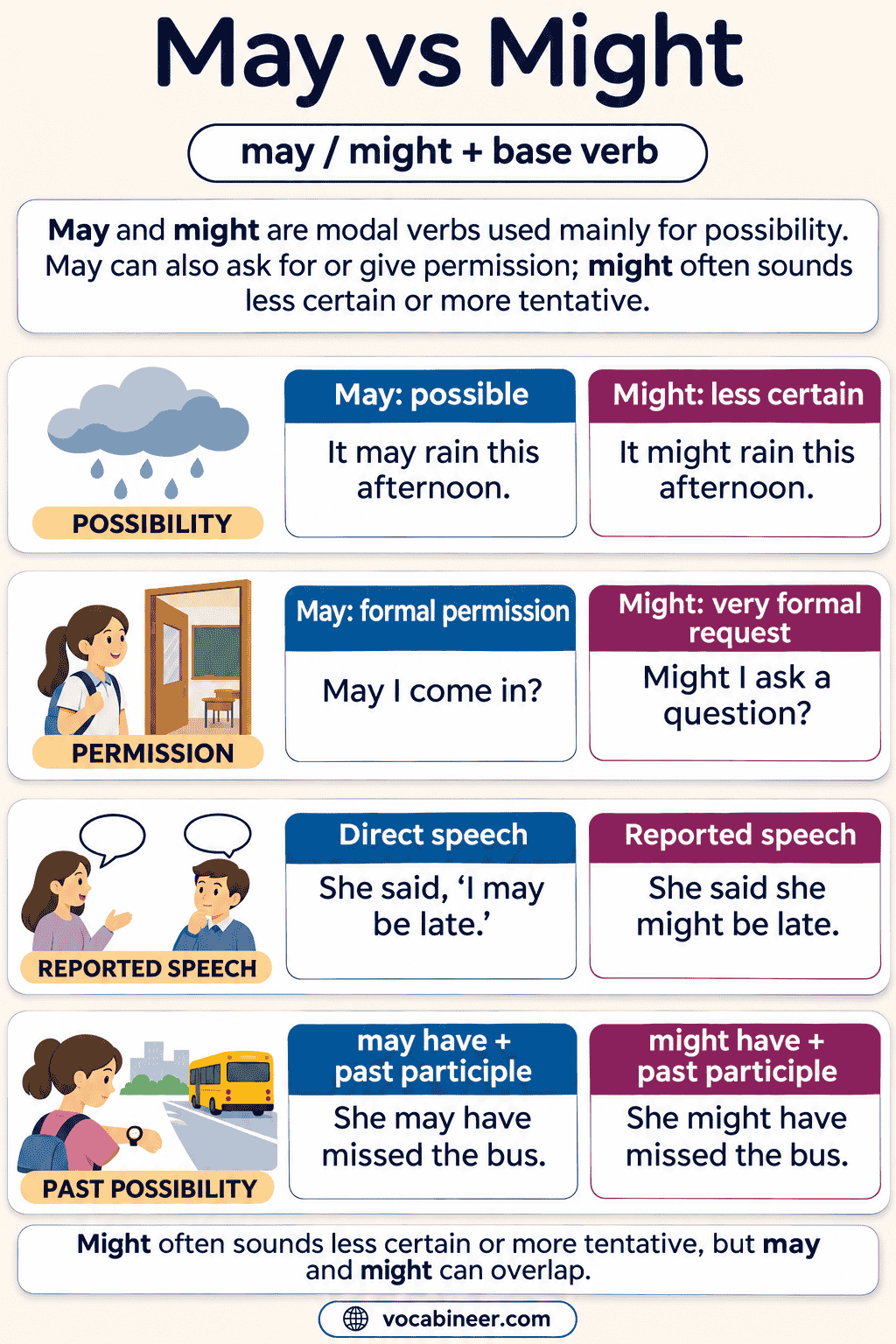
May and might are modal verbs used to discuss possibility, ask for or give permission, and express ideas carefully. They often have similar meanings, so either word may be grammatically correct in the same sentence. However, the choice can change the level of certainty, formality, or time reference.
Understanding may vs. might becomes easier when you examine the purpose of the sentence. May commonly expresses a real possibility or formal permission, while might often makes a possibility sound more uncertain, tentative, or hypothetical. This guide explains their structures, meanings, special expressions, and common errors with clear examples.
In This Page
May and Might at a Glance
The following table summarizes the main differences between may and might.
| Point | May | Might |
|---|---|---|
| Present or future possibility | Expresses a possible situation | Often makes the possibility sound more uncertain or tentative |
| Permission | Common in formal requests and permission | Used in very polite or hesitant requests, but rarely to grant permission |
| Past possibility | May have + past participle | Might have + past participle |
| Hypothetical situations | Less common | Common, especially with conditional meanings |
| Reported speech | May remain unchanged in some contexts | Often replaces may after a past reporting verb |
| Wishes and blessings | Common: “May you succeed.” | Not normally used this way |
| Formal writing | Common in rules, policies, and academic writing | Common for cautious claims and tentative suggestions |
The distinction is not always absolute. Context, tone, and the speaker’s attitude often matter more than a fixed rule.
Basic Sentence Structures
Like other modal verbs, may and might are followed by the base form of a verb. They do not change according to the subject.
| Form | Structure | Example |
|---|---|---|
| Affirmative | Subject + may/might + base verb | She may arrive early. |
| Negative | Subject + may/might + not + base verb | They might not attend. |
| Question | May/Might + subject + base verb? | May I enter? |
| Perfect | Subject + may/might + have + past participle | He may have forgotten. |
| Continuous | Subject + may/might + be + present participle | She might be working. |
| Passive | Subject + may/might + be + past participle | The meeting may be delayed. |
| Perfect passive | Subject + may/might + have been + past participle | The file might have been deleted. |
Use the same form with every subject:
- I may leave.
- She may leave.
- They may leave.
- He might leave.
Do not add -s to these modals after a third-person singular subject. Also, do not place to before the main verb.
Using May and Might for Possibility
Both modals can describe something that is possible now or in the future.
- It may rain this evening.
- It might rain this evening.
- Nadia may know the answer.
- Nadia might know the answer.
In many contexts, may suggests an open or realistic possibility, whereas might sounds more uncertain or cautious.
| Sentence | Usual impression |
|---|---|
| The team may win. | Winning is a genuine possibility. |
| The team might win. | Winning is possible, but the speaker sounds less certain. |
This is a general tendency rather than a mathematical scale. Avoid assigning fixed probability percentages to these modals because context and tone can change their strength.
Present Possibility
Use may or might when you are unsure about a present situation.
- Aisha may be at home.
- The keys might be in the drawer.
- He may need more time.
- They might have enough food for everyone.
Future Possibility
Use either modal for an event that could happen later.
- We may travel in June.
- I might call you after work.
- The shop may close early.
- Prices might increase next year.
Might is especially natural when plans are tentative:
- I might visit Lahore this weekend, but I have not decided yet.
Permission, Requests, and Authority
May is traditionally used to ask for and give formal permission.
- May I come in?
- May we use this room?
- You may begin the test now.
- Visitors may take photographs without flash.
Might can make a request extremely polite or hesitant, although it sounds formal and is less common in everyday speech.
- Might I ask a question?
- Might we suggest another approach?
The two modals do not behave identically when they express permission.
| Function | Natural choice | Example |
|---|---|---|
| Ask formal permission | May | May I leave early? |
| Make a very formal, hesitant request | Might | Might I speak with you privately? |
| Give permission | May | You may leave now. |
| Refuse permission | May not | You may not enter this area. |
Short answers to permission requests normally use may or a clearer conversational response:
- “May I sit here?” “Yes, you may.”
- “May I borrow this?” “No, you may not.”
- In everyday speech: “Yes, of course” or “No, I’m afraid not.”
Past Permission
Do not normally use might as the past form of may when discussing permission that someone actually received. Use was/were allowed to instead.
| Incorrect or unclear | Better |
|---|---|
| When I was ten, I might stay up late on Fridays. | When I was ten, I was allowed to stay up late on Fridays. |
| We might enter after showing our passes. | We were allowed to enter after showing our passes. |
Understanding May Not and Might Not
Might not usually means that something is possibly untrue or will possibly not happen.
- Sara might not come.
It is possible that Sara will not come. - The medicine might not work.
It is possible that the medicine will not work.
May not can have two meanings, so context is important.
| Sentence | Meaning |
|---|---|
| Omar may not attend the meeting. | It is possible that Omar will not attend. |
| Employees may not enter this room. | Employees are not permitted to enter. |
If the intended meaning is unclear, rewrite the sentence:
- Perhaps Omar will not attend the meeting.
- Employees are not permitted to enter this room.
Also distinguish may not have to from prohibition:
- You may not have to pay the fee.
It is possible that paying the fee will not be necessary. - You may not pay the fee here.
You are not permitted to pay it here.
May Be, Might Be, and Maybe
May be and might be are two-word verb phrases. Maybe is a one-word adverb meaning perhaps.
| Form | Function | Example |
|---|---|---|
| may be | Modal + base verb | She may be busy. |
| might be | Modal + base verb | She might be busy. |
| maybe | Adverb | Maybe she is busy. |
A useful test is to replace maybe with perhaps. If the sentence still works, use the one-word adverb.
- Maybe we should wait.
Perhaps we should wait. - The answer may be correct.
The answer perhaps correct is not grammatical.
Past Possibility with May Have and Might Have
Use may/might have + past participle to make an uncertain guess about the past.
- She may have missed the bus.
- They might have taken the wrong road.
- The message may have been sent yesterday.
- He might have been sleeping when you called.
Both forms can refer to an event that perhaps happened. Might have often sounds more tentative, but it does not automatically mean that the event did not happen.
| Sentence | Meaning |
|---|---|
| Lina may have forgotten the date. | Perhaps she forgot it. |
| Lina might have forgotten the date. | Perhaps she forgot it; the claim sounds more tentative. |
Unrealized Possibilities
In a conditional context, might have can describe an outcome that was possible but did not occur.
- If we had left earlier, we might have caught the train.
- With more practice, he might have won the match.
Here, the conditions show that the train was not caught and the match was not won. The phrase might have alone does not always carry that meaning.
Past Criticism
Might have can express mild criticism because someone failed to do something expected.
- You might have told me about the change.
- She might have offered to help.
The fixed expression I might have known shows annoyance or a feeling that the result should have been expected:
- I might have known he would arrive late.
Continuous and Passive Forms
Use may/might be + present participle for an action that is possibly in progress.
- The children may be sleeping.
- He might be driving home.
Use may/might be + past participle when the subject possibly receives an action.
- The event may be cancelled.
- Your application might be reviewed tomorrow.
Use may/might have been for past continuous or past passive meanings.
| Form | Example | Meaning |
|---|---|---|
| may have been + present participle | She may have been waiting. | Perhaps she was waiting. |
| might have been + present participle | He might have been joking. | Perhaps he was joking. |
| may have been + past participle | The door may have been locked. | Perhaps someone locked it. |
| might have been + past participle | The data might have been lost. | Perhaps someone lost the data. |
May and Might in Conditional Sentences
Might is common when a result depends on an uncertain or imaginary condition.
- If you hurry, you might catch the bus.
- If I had more free time, I might learn Italian.
- If they had checked the map, they might have avoided the delay.
May can also appear when the condition is open or realistic.
- If the weather improves, we may go for a walk.
- If you submit the form today, you may receive a reply this week.
| Conditional meaning | Common choice | Example |
|---|---|---|
| Real, open future possibility | May or might | If she calls, I may/might answer. |
| Tentative or imaginary result | Might | If I lived nearby, I might visit more often. |
| Unreal past result | Might have | If we had known, we might have helped. |
May and Might in Reported Speech
When a present statement is reported after a past-tense reporting verb, may often changes to might.
| Direct speech | Reported speech |
|---|---|
| She said, “I may arrive late.” | She said that she might arrive late. |
| He said, “It may rain.” | He said that it might rain. |
However, may can remain unchanged when the possibility is still current or when the writer does not apply backshift.
- The forecast said that it may rain tonight.
When may expresses permission, reported speech often uses could or was/were allowed to for clarity.
- The teacher said, “You may leave.”
- The teacher said that we could leave.
- The teacher said that we were allowed to leave.
Purpose Clauses
In formal English, may can introduce the intended result of an action. After a past main verb, might is possible.
- We save money so that we may travel.
- She spoke clearly so that everyone might understand.
Everyday English often uses can and could instead.
| More formal | More conversational |
|---|---|
| I am writing so that you may understand the issue. | I am writing so that you can understand the issue. |
| He repeated the instructions so that we might remember them. | He repeated the instructions so that we could remember them. |
Wishes, Hopes, and Blessings
Use may at the beginning of a sentence to express a formal wish, hope, or blessing.
- May you succeed in everything you do.
- May they live happily together.
- May the new year bring you peace.
Might does not normally replace may in this structure.
Formal, Academic, and Legal Uses
Writers use may and might to avoid making claims sound absolute.
- The results may indicate a change in consumer behavior.
- This difference might reflect a limitation in the sample.
- One might argue that the policy requires revision.
In academic writing, neither modal necessarily represents a measurable probability. Each signals caution, and the context determines the strength of the claim.
In rules, contracts, and policies, may often expresses permission, authority, or discretion rather than possibility.
- The manager may approve an extension.
- Members may access the archive during office hours.
Because legal wording can receive precise interpretations, writers should make their intended meaning explicit. For example, is authorized to expresses authority more clearly, while it is possible that clearly expresses possibility.
Common Expressions with May and Might
May Well and Might Well
May well and might well mean that something is quite possible or understandable.
- She may well be the best person for the role.
- You might well wonder why the decision took so long.
May as Well and Might as Well
These expressions suggest that an action is sensible because no better option exists.
- The café is closed, so we may as well go home.
- Since we are already here, we might as well wait.
They usually have little connection with probability.
May or Might Just
Adding just can emphasize a small but real possibility or suggest that an action may succeed.
- This plan may just work.
- We might just finish before noon.
Be That as It May
Be that as it may means “even if that is true” or “despite that.”
- The task is difficult. Be that as it may, we must complete it.
Concessive Patterns
May can acknowledge one fact before presenting a contrasting point.
- The device may be expensive, but it is reliable.
- However difficult it may be, the work must continue.
- Try as I might, I could not open the jar.
Polite Comments and Suggestions
Several established phrases make speech sound cautious or respectful.
- You might want to check the figures again.
- You may wish to keep a copy of the form.
- That approach is risky, I might add.
- If I may say so, the second design is clearer.
Depending on the tone, might want to can sound helpful, indirect, or mildly critical.
Combining May and Might with Other Ideas
English does not normally place two modal verbs together. Therefore, use an alternative construction after may or might.
| Intended idea | Correct form | Example |
|---|---|---|
| Possible necessity | may/might have to | We may have to leave early. |
| Possible ability | may/might be able to | She might be able to help. |
| Possible need | may/might need to | You may need to restart the device. |
| Possible permission | may/might be allowed to | Visitors might be allowed to enter later. |
Forms such as may can, might can, and will may are not standard in formal English. Some regional dialects use double modals such as might could, but standard written English normally uses might be able to.
May and Might Compared with Can and Could
These four modal verbs sometimes overlap, but they are not interchangeable in every situation.
| Modal | Common function | Example |
|---|---|---|
| May | Possibility or formal permission | It may rain. / May I enter? |
| Might | Tentative or hypothetical possibility | We might move next year. |
| Can | Ability, informal permission, or general possibility | She can swim. / Storms can cause damage. |
| Could | Past ability, polite request, or possible option | He could read at four. / We could take a taxi. |
For a specific uncertain event, may or might is often more natural than can.
- It may rain tomorrow. ✓
- It can rain tomorrow. ✗ when referring to a specific forecast
However, can works for a general possibility:
- It can rain heavily here in summer.
Forms That May and Might Do Not Have
Modal verbs do not have ordinary infinitive, participle, or third-person forms. Therefore, forms such as to may, maying, and mays are incorrect when may is a modal. Similarly, to might and mighting are not standard modal forms.
Use an alternative phrase when another grammatical form is required.
| Needed form | Alternative | Example |
|---|---|---|
| Infinitive for permission | to be allowed to | Everyone wants to be allowed to vote. |
| Infinitive for probability | to be likely to | The plan seems likely to succeed. |
| Future possibility | may/might + base verb | We may arrive late. |
| Past permission | was/were allowed to | They were allowed to enter. |
Common Mistakes with May and Might
Adding To After the Modal
- Incorrect: She may to arrive soon.
- Correct: She may arrive soon.
Adding -s to the Modal
- Incorrect: He mays come later.
- Correct: He may come later.
Using Do-Support
- Incorrect: Do I may leave early?
- Correct: May I leave early?
Placing Two Modals Together
- Incorrect: I will may attend.
- Correct: I may attend.
- Correct: I might be able to attend.
Using Might for Past Permission
- Incorrect: As children, we might play outside until dark, when the intended meaning is permission.
- Correct: As children, we were allowed to play outside until dark.
Writing Might Of
- Incorrect: She might of forgotten.
- Correct: She might have forgotten.
The contraction might’ve sounds similar to might of, but it always means might have.
Confusing Maybe with May Be
- Incorrect: May be he is busy.
- Correct: Maybe he is busy.
- Correct: He may be busy.
Treating Might Have as Always Unreal
- Misleading rule: Might have always means that something did not happen.
- Accurate rule: It can express an uncertain past event or, in a conditional context, an unrealized result.
Contractions and Style
Might not can contract to mightn’t, particularly in British English. The perfect negative can appear as mightn’t have.
- We mightn’t finish today.
- He mightn’t have seen the message.
May not has no common standard contraction. In formal writing, full forms are usually clearer.
Questions with might are uncommon when asking about ordinary possibility. Speakers usually ask in another way.
| Less natural in everyday English | More natural |
|---|---|
| Might it rain tomorrow? | Do you think it might rain tomorrow? |
| May she be at home? | Is it possible that she may be at home? |
Formal embedded questions can still contain may or might:
- We need to determine what may have caused the failure.
- The report examines how the error might affect users.
How to Choose Between May and Might
Use the following practical guide rather than treating the words as exact probability labels.
| Intended meaning | Preferred choice |
|---|---|
| A real present or future possibility | May or might |
| A more tentative or hypothetical possibility | Might |
| Formal permission | May |
| A very polite, hesitant request | Might |
| Permission in the past | Was/were allowed to |
| An uncertain guess about the past | May have or might have |
| An unreal past result | Might have |
| A wish or blessing | May |
| A cautious suggestion | Might want to / may wish to |
| No better available option | May as well / might as well |
When both forms are possible, choose the one that best matches the intended tone. May often sounds open, neutral, or formal; might often sounds cautious, remote, or tentative.
Key Points to Remember
- May and might are followed by the base form of a verb.
- Both can express present or future possibility.
- Might often sounds more tentative, but no fixed percentage separates the two.
- May is the usual modal for formal permission and wishes.
- May not can mean either “possibly not” or “not permitted.”
- Use may/might have + past participle for uncertain past events.
- Might have can describe an unrealized result when the context supplies a condition.
- Use was/were allowed to for past permission.
- Maybe is an adverb, whereas may be is a verb phrase.
- Use might be able to, not nonstandard double modals, in formal English.
FAQs
Both modals express possibility, but may often presents a possibility as open or realistic, while might often sounds more uncertain, remote, or tentative. May also commonly expresses formal permission.
They are interchangeable in many statements about possibility, such as “It may rain” and “It might rain.” However, they are not freely interchangeable when expressing permission, wishes, reported speech, or certain hypothetical meanings.
Use either phrase for an uncertain past event: “She may have left” and “She might have left” both mean that perhaps she left. Use might have when describing a possible result that did not occur, especially in a conditional sentence: “We might have won if we had practiced.”
No. Might often sounds less certain, but the difference is not a fixed probability. In many contexts, the two words communicate nearly the same degree of possibility.
Both are grammatical. May I? is traditional and formal when asking permission, while Can I? is normal in everyday conversation. Use the form that suits the situation and level of formality.
Conclusion
The choice between may and might depends on meaning, context, and tone. Both words express possibility, but might often makes an idea sound more tentative or hypothetical. May has additional roles in formal permission, rules, wishes, and blessings. For past uncertainty, use may have or might have; for past permission, use was/were allowed to.
Rather than memorizing an artificial probability scale, focus on what the sentence needs to communicate. Check whether you are expressing possibility, permission, an uncertain past event, a hypothetical result, or a polite suggestion. Once that purpose is clear, choosing between may and might becomes much easier.
Read More
- Verbs in English
- Action Verbs
- Regular Verbs
- Irregular Verbs
- Transitive and Intransitive verbs
- Finite and Non-finite verbs
- Principal Parts of Verbs
- Forms of Verbs