

The verb need usually describes something necessary or required. However, it can work in two different ways. As a main verb, it appears in sentences such as “She needs to rest.” As a modal verb, it appears mainly in negative statements and questions, as in “You need not worry” and “Need we wait?”
Understanding this difference helps learners form sentences correctly. Modal need takes a base verb without to, does not change with the subject, and often sounds more formal than the ordinary construction need to. This guide explains its structures, uses, past forms, passive patterns, comparisons, and common mistakes.
In This Page
Need as a Modal Verb
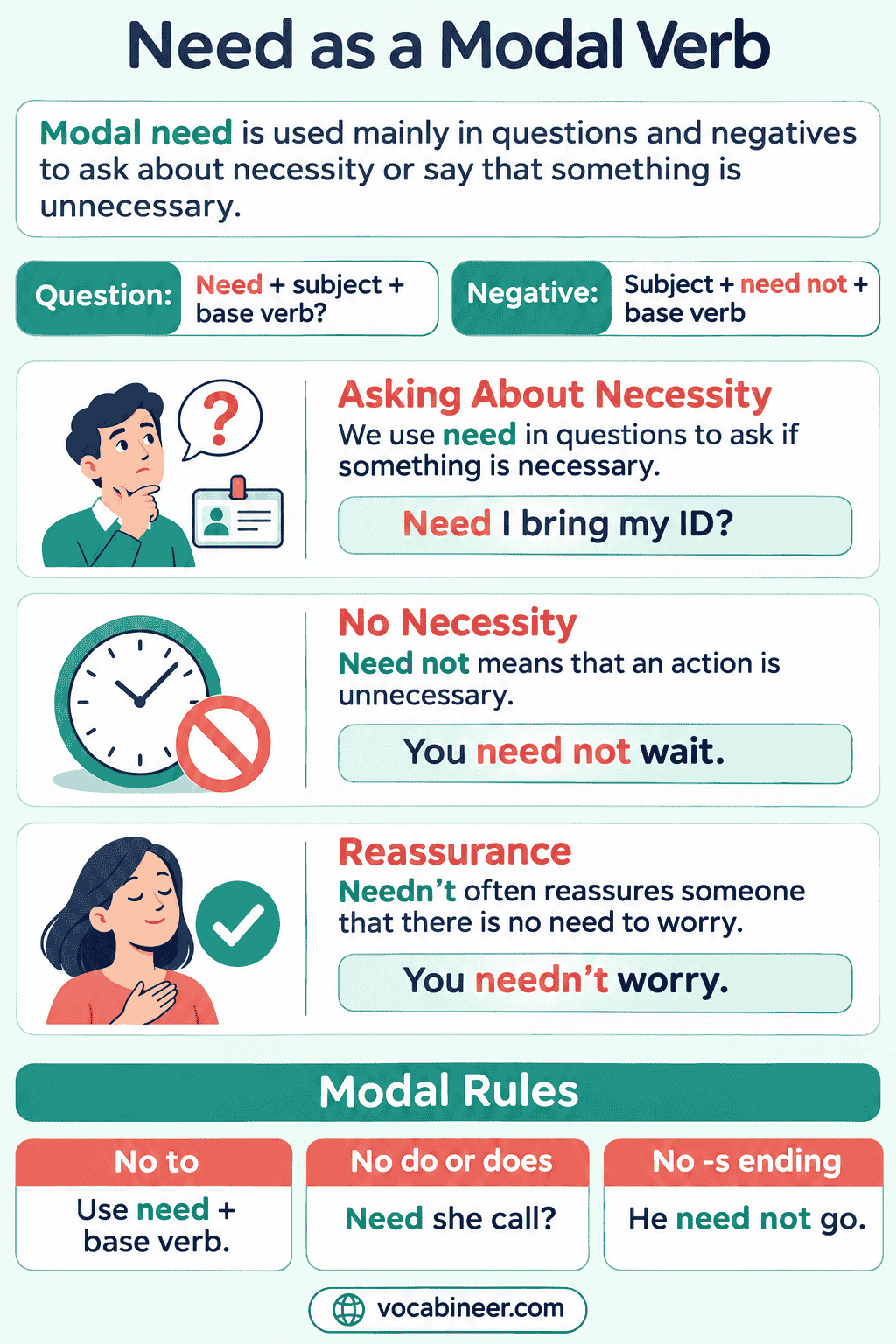
Modal need expresses necessity or, more commonly, the absence of necessity. Grammarians often call it a semi-modal or marginal modal because it shares several features with core modal verbs but has a more limited range of use.
- Need I bring my passport? asks whether bringing it is necessary.
- You need not bring your passport says that bringing it is unnecessary.
- Nobody need worry means that worrying is unnecessary for everyone.
Unlike main verb need, modal need normally appears in negative statements, questions, and other expressions with a negative or limiting meaning.
Main Features of Modal Need
Modal need follows these rules:
- It has the same form with every subject.
- It does not take -s with he, she, or it.
- It takes a base verb without to.
- It forms negatives with not.
- It forms questions by appearing before the subject.
- It does not use do, does, or did.
- It has no ordinary infinitive, participle, or past-tense form.
- It occurs mainly in non-affirmative and formal contexts.
Compare its unchanged form with different subjects:
- I need not wait.
- She need not wait.
- They need not wait.
Sentence Structures with Modal Need
| Sentence type | Structure | Example |
|---|---|---|
| Negative | Subject + need not + base verb | You need not wait. |
| Contracted negative | Subject + needn’t + base verb | She needn’t attend. |
| Question | Need + subject + base verb? | Need we continue? |
| Wh-question | Question word + need + subject + base verb? | Why need he leave? |
| Perfect negative | Subject + need not have + past participle | You need not have waited. |
| Passive | Subject + need not be + past participle | The form need not be signed. |
| Perfect passive | Subject + need not have been + past participle | It need not have been printed. |
The following verb always stays in its base form:
- Correct: She need not come.
- Incorrect: She need not comes.
- Incorrect: She need not to come.
Negative Statements with Need Not
Use need not or its contraction needn’t when an action is unnecessary. The person may still perform the action, but no rule or situation requires it.
- You need not bring any food.
- He needn’t come tomorrow.
- We need not discuss the issue again.
- Applicants need not include a photograph.
- She needn’t finish the work tonight.
The contraction needn’t requires an apostrophe. It occurs more often in British English than in everyday American English, where speakers commonly use do not need to.
Negative Subjects with Modal Need
Sometimes the subject provides the negative meaning, so the sentence does not require not.
- Nobody need know about the mistake.
- No applicant need provide a photograph.
- Neither student need repeat the test.
- Not a single member need pay the fee.
Although these sentences do not contain not after need, they belong to negative contexts.
Need Never
Need never means that an action will never be necessary.
- You need never mention this again.
- She need never worry about the payment.
- No customer need ever provide that information.
- With this pass, visitors need never wait in the regular line.
Questions with Modal Need
To form a question, place modal need before the subject. Do not add do or does.
- Need I say more?
- Need we book in advance?
- Need she attend the interview?
- Why need they know?
- How much need we bring?
These questions are correct, but they often sound formal. Everyday English usually uses need to with do or does.
| Formal modal question | Everyday alternative |
|---|---|
| Need I attend? | Do I need to attend? |
| Need we wait? | Do we need to wait? |
| Need she bring a copy? | Does she need to bring a copy? |
| Why need he leave? | Why does he need to leave? |
Rhetorical Questions
Speakers often use modal need in rhetorical questions. These questions emphasize an obvious idea rather than genuinely request information.
- Need I say more?
- Need I remind you what happened last time?
- Why need we argue about this?
- Need anyone know?
Depending on the context, such questions may express impatience, disbelief, emphasis, or confidence that the listener already understands.
Negative Questions
A negative question with needn’t often shows that the speaker expects agreement or believes the action may be necessary.
- Needn’t we tell them?
- Needn’t she complete the form?
- Needn’t he obtain permission first?
Because these forms sound formal, speakers often choose alternatives such as “Don’t we need to tell them?”
Short Answers
- Need I stay? — No, you needn’t.
- Need we pay now? — No, you need not.
- Need she bring a copy? — No, she needn’t.
Affirmative answers with modal need sound unnatural in most modern contexts. Instead, use must, should, have to, or a complete response.
- Need I bring identification? — Yes, you must.
- Need we leave now? — Yes, we should.
- Need she attend? — Yes, she has to.
Question Tags
Modal need can form its own question tags.
- We needn’t wait, need we?
- She needn’t attend, need she?
- Nobody need know, need they?
Special Patterns with Modal Need
Modal need appears in several useful formal and fixed constructions.
Need Only
Need only means that one simple action is sufficient.
- You need only ask.
- Applicants need only submit one form.
- We need only look at the evidence.
- To restart the system, you need only press this button.
Need Hardly
Need hardly means that saying or doing something is almost unnecessary because the point is already obvious.
- I need hardly explain the importance of safety.
- We need hardly mention the obvious risks.
- She need hardly worry about the result.
- It need hardly be said that honesty matters.
All You Need Do
The formal construction all you need do means that only one action is required.
- All you need do is sign here.
- All we need do is follow the instructions.
- All applicants need do is provide identification.
In everyday English, all you need to do is more common.
If Need Be
The fixed expression if need be means “if it is necessary.”
- We can extend the deadline if need be.
- If need be, I will speak to the manager.
- The meeting can continue online if need be.
- We can change the route if need be.
Need Not Necessarily
Need not necessarily shows that something is not always or automatically true.
- More expensive products need not necessarily be better.
- A long answer need not necessarily be correct.
- Change need not necessarily cause confusion.
- A quiet person need not necessarily be shy.
Need Not Have for Unnecessary Past Actions
Use need not have + past participle when someone completed an action, but the action was unnecessary.
- You need not have bought milk; we already had some.
- She needn’t have hurried because the meeting started late.
- They need not have booked a taxi; I could have driven them.
- We needn’t have prepared so much food.
This structure may express regret, criticism, surprise, or reassurance. In each example, the action happened even though the situation did not require it.
Needn’t Have vs Didn’t Need To
| Form | Meaning | Example |
|---|---|---|
| Needn’t have + past participle | The action happened, but it was unnecessary | We needn’t have taken a taxi; the station was nearby. |
| Didn’t need to + base verb | The action was unnecessary; context may indicate whether it happened | We didn’t need to take a taxi. |
Compare these sentences:
- I needn’t have called a technician; the machine was already working.
- I didn’t need to call a technician, so I repaired the machine myself.
The first sentence confirms that the speaker called. The second sentence, supported by its context, shows that the speaker did not call.
Past Necessity with Needed To
Modal need has no ordinary past-tense form. Therefore, use main verb needed to for a past action that was necessary.
| Meaning | Structure | Example |
|---|---|---|
| Past necessity | needed to + base verb | We needed to leave early. |
| Past lack of necessity | did not need to + base verb | We did not need to leave early. |
| Unnecessary completed action | needn’t have + past participle | We needn’t have left early. |
Passive and Continuous Forms
Modal need can appear in passive and continuous structures when the meaning requires them.
Passive Structures
Use need not be + past participle when an action is unnecessary and the subject receives the action.
- The form need not be signed.
- These details need not be included.
- The equipment need not be replaced.
- The decision need not be announced today.
For an unnecessary past passive action, use need not have been + past participle.
- The documents need not have been printed.
- The meeting need not have been cancelled.
- The work need not have been completed yesterday.
- The package need not have been opened.
Continuous Structures
Use need not be + -ing for an unnecessary action in progress.
- You need not be waiting outside.
- She needn’t be working today.
- They need not be worrying about us.
Use need not have been + -ing for an unnecessary past activity.
- They need not have been standing there for so long.
- You needn’t have been waiting all morning.
- He need not have been driving in such bad weather.
| Time and form | Structure | Example |
|---|---|---|
| Present negative | need not + base verb | You need not wait. |
| Present passive | need not be + past participle | It need not be signed. |
| Present continuous | need not be + -ing | You need not be waiting. |
| Past perfect | need not have + past participle | You need not have waited. |
| Past perfect passive | need not have been + past participle | It need not have been signed. |
| Past perfect continuous | need not have been + -ing | You need not have been waiting. |
Modal Need and Main Verb Need
The word need can function as either a modal verb or a main verb. Its grammar changes according to its function.
| Modal need | Main verb need |
|---|---|
| Appears mainly in negatives and questions | Appears in all sentence types |
| Takes a base verb without to | Usually takes to + base verb |
| Does not take -s | Changes to needs with he, she, and it |
| Forms questions through inversion | Forms questions with do or does |
| You need not wait. | You do not need to wait. |
| Need she leave? | Does she need to leave? |
| He need not attend. | He does not need to attend. |
Main verb need is more common in ordinary affirmative statements:
- I need to speak with you.
- She needs to rest.
- They needed to leave early.
It can also take a noun:
- I need some help.
- She needs a new laptop.
- The plants need water.
In addition, need + -ing can have a passive meaning, especially in British English:
- The room needs cleaning.
- The car needs repairing.
These sentences mean “The room needs to be cleaned” and “The car needs to be repaired.”
Need After Other Modal Verbs
Do not place modal need directly after another modal verb. Instead, use main verb need to.
| Incorrect | Correct |
|---|---|
| She may need attend. | She may need to attend. |
| You might need wait. | You might need to wait. |
| We will need leave. | We will need to leave. |
Similarly, when an infinitive or participle is required, use main verb need:
- We seem to need to wait.
- She may need to leave.
- Needing to work late, he cancelled dinner.
- They needed to replace the lock.
Modal need itself does not have infinitive, present-participle, or ordinary past forms.
Present and Future Necessity
Modal need not can refer to the present or future without changing its form.
- You need not stay now.
- You need not come tomorrow.
- We need not decide until Friday.
- She needn’t attend next week.
For affirmative future necessity, use will need to.
| Incorrect | Correct |
|---|---|
| You will need submit the form. | You will need to submit the form. |
| She will need attend tomorrow. | She will need to attend tomorrow. |
| They will need not come. | They will not need to come. |
Need Not Compared with Similar Expressions
Need Not vs Must Not
Need not removes necessity, whereas must not prohibits an action.
| Need not | Must not |
|---|---|
| The action is unnecessary or optional | The action is prohibited |
| You may perform the action if you want | You are not allowed to perform the action |
| You need not wear a tie. | You must not enter this room. |
| Visitors need not pay. | Visitors must not touch the exhibits. |
Need Not vs Do Not Need To
Both forms usually express an absence of necessity. However, they differ in structure and formality.
| Need not | Do not need to |
|---|---|
| Slightly more formal | More common in everyday speech |
| Followed directly by a base verb | Followed by to + base verb |
| Does not change with the subject | Uses do, does, or did |
| You need not attend. | You do not need to attend. |
| She need not wait. | She does not need to wait. |
Need Not vs Cannot
| Need not | Cannot |
|---|---|
| Expresses lack of necessity | Expresses inability, impossibility, or lack of permission |
| You need not finish today. | You cannot finish today because the office is closed. |
| She need not drive. | She cannot drive. |
Adverb Placement and Meaning
Adverbs commonly appear before modal need or between need and the main verb, depending on their function.
- You really need not worry.
- We probably need not wait.
- She need never know.
- You need only press the button.
- I hardly need explain the problem.
Adverb placement can also affect meaning:
| Sentence | Meaning |
|---|---|
| You need not attend. | Attendance is unnecessary. |
| You need not always attend. | Attendance is not necessary on every occasion. |
| You always need to attend. | Attendance is necessary every time. |
| You must not attend. | Attendance is prohibited. |
Modal Need in Reported Speech
Modal need may remain unchanged in reported speech when the lack of necessity still applies.
- Direct: He said, “You need not wait.”
- Reported: He said that I need not wait.
A main-verb alternative is also possible:
- He said that I did not need to wait.
For an unnecessary past action, use the perfect form:
- Direct: She said, “You need not have brought the equipment.”
- Reported: She said that we need not have brought the equipment.
The reporting context determines whether need not, did not need to, or would not need to expresses the intended time most clearly.
Formality and Regional Usage
Modal need appears frequently in formal instructions, official notices, policies, and careful written English.
- Applicants need not submit original documents.
- Customers need not create an account.
- The form need not be completed in advance.
- No payment need be made at this stage.
It also occurs more often in British English than in everyday American English. American speakers commonly prefer do not need to or does not need to. Nevertheless, both modal and main-verb constructions belong to standard English.
| More formal | More conversational |
|---|---|
| Need I reply? | Do I need to reply? |
| You need not attend. | You don’t need to attend. |
| Need we continue? | Do we need to continue? |
| She needn’t wait. | She doesn’t need to wait. |
Ellipsis with Need
Speakers can omit a repeated verb when its meaning is already clear.
- You may stay, but you needn’t.
- Need I bring a copy? — No, you needn’t.
- I can bring another chair if I need to.
Notice the distinction:
- You needn’t uses modal need.
- If I need to uses main verb need, with the following action understood from context.
Common Mistakes with Modal Need
Adding To After Modal Need
| Incorrect | Correct |
|---|---|
| You need not to wait. | You need not wait. |
| She needn’t to worry. | She needn’t worry. |
Adding -s to Modal Need
| Incorrect | Correct |
|---|---|
| He needs not attend. | He need not attend. |
| She needs not reply. | She need not reply. |
Use needs only when need functions as a main verb: “She does not need to reply” or “She needs to reply.”
Using Do with Modal Need
| Incorrect | Correct modal form | Correct main-verb form |
|---|---|---|
| Do I need explain? | Need I explain? | Do I need to explain? |
| Does she need attend? | Need she attend? | Does she need to attend? |
Confusing Lack of Necessity with Prohibition
| Intended meaning | Correct sentence |
|---|---|
| Attendance is optional. | You need not attend. |
| Attendance is forbidden. | You must not attend. |
Confusing Past Forms
| Intended meaning | Correct form |
|---|---|
| The action happened but was unnecessary | You needn’t have bought it. |
| The action was unnecessary, and context shows it did not happen | You didn’t need to buy it. |
| The action was necessary in the past | You needed to buy it. |
Misspelling the Contraction
- Incorrect: neednt
- Correct: needn’t
The apostrophe replaces the omitted letter in not.
Key Points to Remember
- Modal need expresses necessity or the absence of necessity.
- It appears mainly in negative, interrogative, and limiting contexts.
- It takes a base verb without to.
- It does not change according to the subject.
- Need not means that an action is unnecessary.
- Need not have done describes an unnecessary action that happened.
- Use needed to for affirmative past necessity.
- Use will need to for affirmative future necessity.
- Must not expresses prohibition, not absence of necessity.
- Main verb need is more common in ordinary conversational English.
Conclusion
Modal need provides a concise way to ask about necessity or explain that an action is unnecessary. It takes a base verb without to, remains unchanged with every subject, and forms questions without do or does. Although it appears less often than main verb need, it remains useful in formal questions, instructions, notices, and negative statements.
The most important distinctions involve need not, must not, did not need to, and need not have. Once learners understand whether an action is optional, prohibited, necessary in the past, or completed unnecessarily, they can choose the correct structure with confidence.
FAQs
Modal need asks whether an action is necessary or states that an action is unnecessary. It appears mainly in questions and negative statements.
No. Modal need takes a base verb without to: “You need not wait.” Main verb need usually takes a to-infinitive: “You do not need to wait.”
Need not means that an action is unnecessary or optional. Must not means that the action is prohibited.
It means that someone completed an action even though it was unnecessary. For example, “You needn’t have brought food” means that you brought food, but no one required it.
It can function as either. Modal need occurs mainly in negative statements and questions, while main verb need works in affirmative, negative, and interrogative sentences and usually takes a to-infinitive.
Read More
- Verbs in English
- Action Verbs
- Regular Verbs
- Irregular Verbs
- Transitive and Intransitive verbs
- Finite and Non-finite verbs
- Principal Parts of Verbs
- Forms of Verbs