

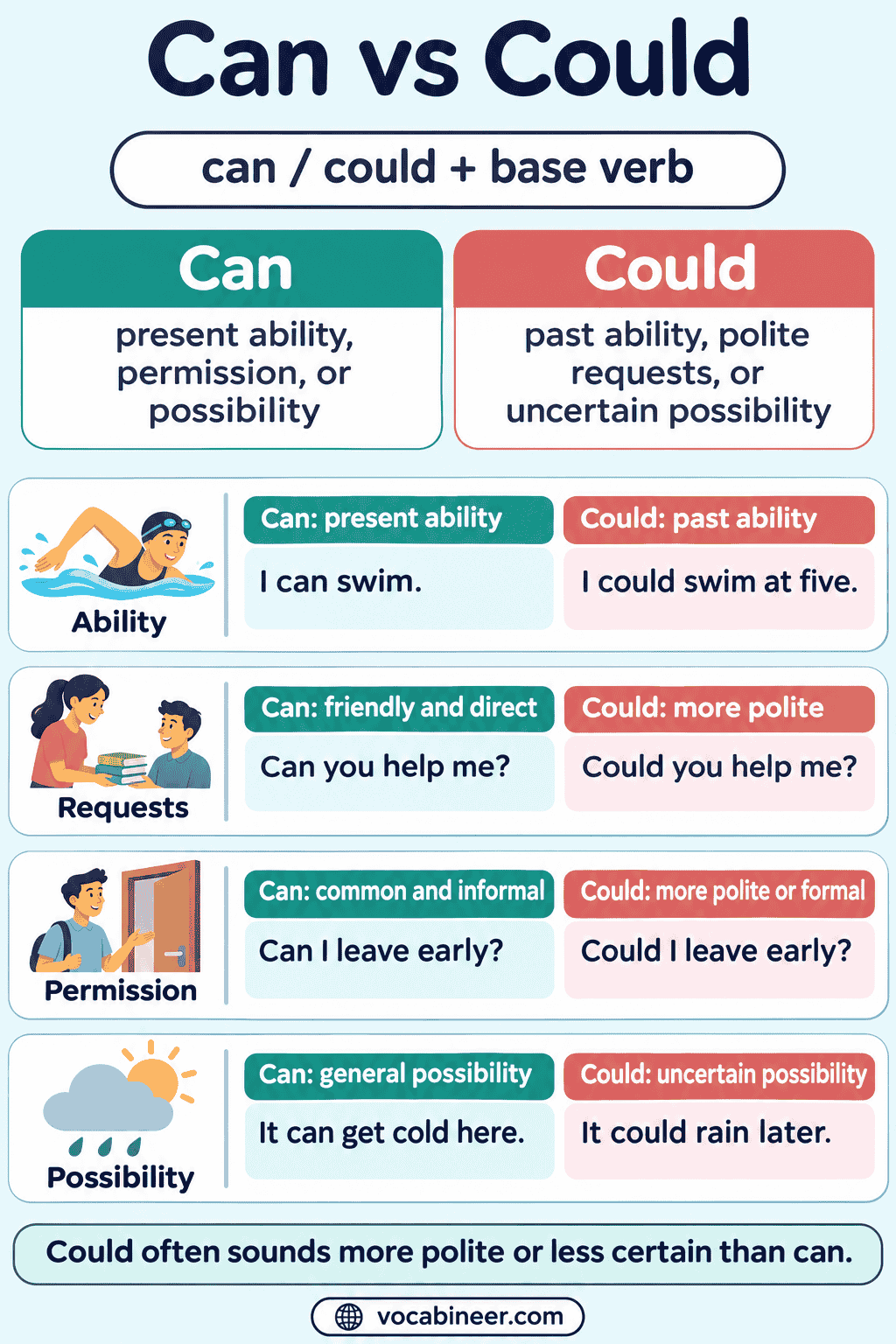
Can and could are modal verbs used to express ability, permission, requests, possibility, suggestions, and available choices. In “I can swim,” can describes a present ability. In “I could swim when I was five,” could describes an ability that existed in the past.
However, could is not simply the past form of can. It can also make a request less direct, describe an uncertain possibility, suggest an option, or express a hypothetical result. Understanding the time, certainty, and purpose of a sentence makes choosing between can and could much easier.
In This Page
Can and Could at a Glance
| Can | Could |
|---|---|
| Commonly expresses present ability | Commonly expresses general past ability |
| Asks for or gives informal permission | Asks for permission more tentatively |
| Makes direct requests | Makes less direct requests |
| Expresses general possibility | Expresses a specific or uncertain possibility |
| Presents an available option | Presents a tentative suggestion |
| Often describes real situations | Can describe hypothetical situations |
| I can swim. | I could swim at five. |
These distinctions are useful starting points, but context and tone determine the exact meaning.
Sentence Structures with Can and Could
| Sentence type | Can structure | Could structure |
|---|---|---|
| Affirmative | Subject + can + base verb | Subject + could + base verb |
| Negative | Subject + cannot/can’t + base verb | Subject + could not/couldn’t + base verb |
| Question | Can + subject + base verb? | Could + subject + base verb? |
| Short answer | Yes, subject + can. | Yes, subject + could. |
Examples:
- She can drive.
- She could drive when she was eighteen.
- He can’t attend.
- They couldn’t find the address.
- Can you help?
- Could you help?
Both modal verbs:
- Take a base verb without to.
- Have the same form with every subject.
- Do not take -s with he, she, or it.
- Form negatives by adding not.
- Form questions by appearing before the subject.
- Do not use do, does, or did.
- Have no infinitive or participle forms.
Can and Could for Ability
Present Ability with Can
Use can for an ability that exists now.
- I can speak English.
- She can solve difficult problems.
- They can swim.
- He can drive at night.
General Past Ability with Could
Use could for an ability that existed over a period in the past.
- I could read when I was four.
- She could run quickly as a child.
- We could see the mountains from our old house.
- He could speak three languages at university.
General and Specific Past Ability
Use could for general past ability. However, for many successful actions on one particular occasion, use was/were able to or managed to.
| General past ability | Specific successful action |
|---|---|
| She could swim at five. | She was able to rescue the child. |
| He could repair computers. | He managed to repair the computer yesterday. |
| We could solve basic equations. | We were able to solve the final problem. |
This is a strong tendency rather than an absolute rule. Could remains natural with perception, understanding, and some stative meanings, even when the sentence refers to one particular occasion.
- From the window, I could see the accident.
- I could hear someone outside.
- She could understand every word.
- He could smell smoke in the hallway.
In addition, couldn’t works naturally for both general inability and failure on a specific occasion.
- I couldn’t swim as a child.
- We couldn’t open the door last night.
- She couldn’t find her keys this morning.
Ability in Other Tenses
Because can has no infinitive, participle, or separate future form, use be able to when another grammatical form is required.
| Time or form | Structure | Example |
|---|---|---|
| Future ability | will be able to | She will be able to drive soon. |
| Present perfect | have been able to | I have been able to solve the problem. |
| Infinitive | to be able to | He hopes to be able to attend. |
| After another modal | may be able to | We may be able to help. |
Do not write will can or to can.
However, can can still refer to future availability or an arrangement when the context supplies the future time.
- I can meet you tomorrow.
- She can start next week.
- We can discuss it later.
- You can collect the package on Friday.
Use will be able to when the sentence emphasizes the development or existence of a future ability.
- After the course, she will be able to drive.
- Once the repairs are complete, we will be able to use the room.
Can and Could for Permission
Informal Permission with Can
Use can to ask for or give ordinary permission.
- Can I use your phone?
- Can we sit here?
- You can leave early.
- Students can use calculators.
Tentative Permission with Could
Use could to ask for permission in a less direct or more tentative way.
- Could I use your phone?
- Could we leave a little early?
- Could I ask a question?
- Could I speak to the manager?
Although could can ask for permission, speakers normally use can to grant it.
| Request for permission | Natural response |
|---|---|
| Could I leave early? | Yes, you can. |
| Could we use this room? | Yes, you can. |
| Could I borrow your pen? | Of course you can. |
General and Specific Past Permission
Use could for general permission that existed repeatedly in the past. For permission on one particular occasion, use was/were allowed to.
| Meaning | Preferred form | Example |
|---|---|---|
| General past permission | could | We could stay up late on Saturdays. |
| Permission on one occasion | was/were allowed to | We were allowed to leave early yesterday. |
Can and Could for Requests
Use can for a direct, friendly request.
- Can you open the window?
- Can you send me the file?
- Can you wait for a moment?
- Can you help me carry this box?
Use could when you want the request to sound less direct or more tentative.
- Could you open the window?
- Could you please send me the file?
- Could you wait for a moment?
- Could you help me carry this box?
In this use, could does not refer to past time. It creates distance between the speaker and the request. However, tone and context also determine politeness; could is not automatically polite if the speaker sounds impatient.
More Indirect Requests
- Could you possibly help me?
- Could I possibly speak to the manager?
- I was wondering if you could help.
- Do you think you could send the file today?
Responding to Requests
A request with could usually receives an answer with can or another natural response.
- Could you help me? — Yes, I can.
- Could you close the door? — Certainly.
- Could you wait here? — Of course.
- Could you send the report? — I’ll send it today.
Yes, I could can sound conditional or uncertain rather than a clear agreement to act now.
Ability Questions and Requests
Can you…? and Could you…? can ask about ability or make a request. Context identifies the intended meaning.
| Sentence | Ability meaning | Request meaning |
|---|---|---|
| Can you swim? | Are you able to swim? | Usually an ability question |
| Can you open the door? | Are you physically able to open it? | Please open it |
| Could you read at four? | Did you have that ability? | Past ability |
| Could you read this email? | Would you please read it? | Polite request |
Can I for Offers
Can I…? can ask for permission, but it can also introduce an offer.
| Permission | Offer |
|---|---|
| Can I use your phone? | Can I help you? |
| Can I leave early? | Can I carry those bags? |
| The speaker asks to act for a personal reason. | The speaker offers to do something for another person. |
Other common offers include:
- Can I get you some water?
- Can I call a taxi for you?
- Can I check that information for you?
Can and Could for Possibility
General Possibility with Can
Use can for events, behaviors, or conditions that are generally possible.
- Winter roads can be dangerous.
- Learning a language can take time.
- Children can become tired quickly.
- Mistakes can happen.
- City traffic can be stressful.
Specific Possibility with Could
Use could when something is possible in a particular situation but remains uncertain.
- It could rain later.
- The keys could be in the car.
- She could arrive before noon.
- This plan could work.
- That noise could be an animal.
Can Be vs Could Be
| Can be | Could be |
|---|---|
| Expresses general or characteristic possibility | Expresses a specific or uncertain possibility |
| City traffic can be stressful. | The traffic could be heavy tonight. |
| Dogs can be noisy. | That noise could be a dog. |
| The road can be dangerous in winter. | The road could be dangerous tonight. |
The could sentence is not necessarily less likely. Often, it simply refers to a specific situation rather than a general possibility.
Negative Possibility and Impossibility
Can’t often expresses strong disbelief or impossibility.
- That can’t be true.
- She can’t be at home; her car is gone.
- This can’t be the correct address.
Couldn’t may express past inability, past impossibility, or present disbelief, depending on the context.
- I couldn’t find the address.
- She couldn’t be at the office yesterday.
- That couldn’t be true.
Can and Could for Suggestions
Use can when an option is practical and currently available.
- We can take the train.
- You can call me tonight.
- We can meet after lunch.
- You can try restarting the computer.
Use could to present an idea without making it sound compulsory.
- We could take the train.
- You could speak to your teacher.
- They could try a different method.
- We could meet tomorrow.
| Can | Could |
|---|---|
| Presents an available or practical choice | Presents a possible suggestion |
| We can eat outside. | We could eat outside. |
| Sounds more definite | Sounds more tentative |
| Focuses on what is available | Focuses on one possible option |
Offers with Can and Could
Use can for a direct offer of available help.
- I can help you with the report.
- We can drive you home.
- I can carry those bags.
Use could for a more tentative or conditional offer.
- I could help if you need me.
- We could drive you home if your car is unavailable.
- I could check the figures for you.
Could for Hypothetical Situations
Use could for an ability or possibility that depends on an imagined or unreal condition.
- I could travel more if I had enough money.
- She could win if she practised harder.
- We could buy the house if the price were lower.
- He could help if he were here.
| Real situation | Hypothetical situation |
|---|---|
| I can travel this month. | I could travel if I had more money. |
| She can help us today. | She could help if she were here. |
| We can buy this car. | We could buy it if the price were lower. |
Can and Could in Conditional Sentences
| Condition | Modal | Example |
|---|---|---|
| Real present or future condition | can | If you finish early, you can leave. |
| Hypothetical condition | could | If you finished early, you could leave. |
| Unreal past condition | could have | If you had called, I could have helped. |
Could for Tentative Opinions
Could can soften an opinion or prevent it from sounding completely certain.
- I could be wrong, but this answer seems incomplete.
- This could indicate a larger problem.
- You could say that the project was successful.
- One could argue that the rule is outdated.
This use appears frequently in academic, analytical, and professional writing.
Could for Mild Criticism
Could can criticize present behavior or suggest that someone should make more effort.
- You could be more careful.
- He could at least apologize.
- They could try to arrive on time.
Use could have to criticize a past failure.
- You could have told me earlier.
- He could have helped us.
- They could have apologized.
| Present criticism | Past criticism |
|---|---|
| You could be more patient. | You could have been more patient. |
| He could help us. | He could have helped us. |
Negative Questions and Tone
Negative questions with can and could may express surprise, impatience, criticism, or a suggestion.
- Can’t you hear the alarm?
- Can’t you wait a moment?
- Couldn’t you ask someone for help?
- Couldn’t we try another method?
- Couldn’t you have called me?
These questions are not always neutral. Their meaning depends heavily on context and intonation.
Can and Could with Perception Verbs
Can and could commonly appear with verbs such as see, hear, smell, feel, and understand.
- I can see the mountains.
- We can hear music outside.
- I can smell smoke.
- She could understand every word.
- We could hear someone speaking.
These constructions often describe perception as a state rather than a deliberate action. As a result, could can describe perception on a specific past occasion even when was able to would normally be preferred for another successful action.
Passive and Continuous Forms
Both modals can appear in passive and continuous structures.
| Structure | Meaning | Example |
|---|---|---|
| can be + past participle | Present ability or possibility | The form can be completed online. |
| could be + past participle | Tentative or hypothetical possibility | The meeting could be postponed. |
| can be + -ing | Possible ongoing behavior | He can be working late at times. |
| could be + -ing | Specific uncertain activity | She could be working from home. |
| could have been + past participle | Past possibility or unreal result | The accident could have been prevented. |
| could have been + -ing | Possible past activity in progress | She could have been studying. |
Other examples include:
- They could be waiting outside.
- He can’t be sleeping already.
- They can’t have been waiting all day.
- The package could have been delivered yesterday.
Could Have for Past Situations
The structure is:
Subject + could have + past participle
Unused Past Opportunity
Use could have when an action was possible but did not happen.
- I could have called you.
- She could have applied for the job.
- We could have taken the train.
- They could have stayed longer.
Past Possibility
Use could have when a past explanation or event is possible but uncertain.
- He could have missed the bus.
- The letter could have gone to the wrong address.
- She could have misunderstood the instructions.
- They could have taken another route.
Past Criticism
Use could have to criticize someone for failing to take an available action.
- You could have told me earlier.
- He could have helped us.
- They could have apologized.
- She could have checked the information.
Context and tone determine whether the structure expresses possibility, an unused opportunity, or criticism.
Couldn’t Have for Past Impossibility
Use couldn’t have + past participle when a past action was impossible or someone lacked the ability to perform it.
- She couldn’t have written the message; she was abroad.
- They couldn’t have finished so quickly.
- I couldn’t have completed the work without your help.
- He couldn’t have known the answer.
Can’t Have for Strong Past Deduction
Use can’t have + past participle when the speaker strongly concludes that something did not happen.
- She can’t have forgotten the meeting.
- They can’t have arrived already.
- He can’t have seen us.
- You can’t have read the entire report.
Can’t Have vs Couldn’t Have
| Can’t have | Couldn’t have |
|---|---|
| Often presents the speaker’s current conclusion about a past event | Often emphasizes past impossibility or inability |
| She can’t have left yet. | She couldn’t have left because the door was locked. |
| Rejects a past possibility | Highlights circumstances that made an action impossible |
The meanings can overlap, so context and emphasis matter more than a rigid rule.
Can Have in Different Structures
Can have is common when have is the main verb followed by a noun.
- Exercise can have benefits.
- The decision can have serious consequences.
- Small changes can have a large effect.
By contrast, affirmative can have + past participle is uncommon. The modal-perfect pattern appears mainly in questions and negative deductions.
- Where can she have gone?
- Who can have taken the keys?
- Can he have forgotten?
- She can’t have taken them.
Everyday English often prefers could in questions:
- Where could she have gone?
- Could he have forgotten?
Can and Could for Deductions
Can is generally uncommon in affirmative deductions about one specific present situation. Use could, may, or might instead.
| Unnatural for a specific deduction | Natural |
|---|---|
| She can be at home now. | She could be at home now. |
| He can know the answer. | He may know the answer. |
| They can be waiting outside. | They might be waiting outside. |
However, can works naturally for general possibilities:
- She can be difficult at times.
- The road can be busy in the morning.
- This machine can be unreliable.
Can and Could in Reported Speech
Can often changes to could when speech is reported from a past viewpoint.
- Direct: She said, “I can swim.”
- Reported: She said that she could swim.
- Direct: He said, “I can help.”
- Reported: He said that he could help.
However, can may remain when the ability or situation is still true or when the reporting verb is present.
- She says that she can swim.
- He told me that the museum can be crowded.
Could normally remains unchanged:
- Direct: She said, “I could help.”
- Reported: She said that she could help.
Reporting Requests
- Direct: She said, “Could you help me?”
- Reported request: She asked me to help her.
- Reported ability or willingness: She asked whether I could help her.
Use asked someone to when reporting the requested action. Use asked whether someone could when ability or willingness remains important.
Can Compared with May
| Can | May |
|---|---|
| Common in everyday permission | More formal or traditional for permission |
| Can I leave early? | May I leave early? |
| Also expresses ability | Does not normally express ability |
Both forms are standard for asking permission, but can is more common in ordinary conversation.
Could Compared with Might
| Could | Might |
|---|---|
| Expresses a possible result, option, or explanation | Expresses uncertainty about what may happen or be true |
| This plan could work. | This plan might work. |
| Often highlights one possible outcome | Often emphasizes uncertainty |
Their meanings overlap in many contexts.
Can, Could, and Be Able To
| Can | Could | Be able to |
|---|---|---|
| Commonly expresses present ability | Expresses general past or hypothetical ability | Works in tenses and forms unavailable to can |
| I can swim. | I could swim at five. | I will be able to swim soon. |
| Concise and common | Also expresses politeness and uncertainty | More grammatically flexible |
Cannot and Can Not
The standard negative spelling is usually cannot, written as one word.
- She cannot attend.
- I cannot understand the question.
The two-word form can not appears when not belongs to a following construction such as not only.
- She can not only sing but also dance.
- This tool can not only cut metal but also polish it.
The contraction is can’t.
Ellipsis and Short Answers
The main verb can be omitted when the context makes its meaning clear.
- I can swim, but she can’t.
- He said he could help, and he could.
- Can you attend? — Yes, I can.
- I couldn’t finish, but Maya was able to.
Common Expressions with Can and Could
I can’t help it means that the speaker cannot control a reaction or situation.
- I can’t help it; the noise makes me nervous.
Can’t help + -ing means being unable to stop oneself from doing something.
- I can’t help laughing.
I couldn’t agree more means complete agreement.
- “The policy needs revision.” “I couldn’t agree more.”
Things couldn’t be better means that the situation is extremely good.
You can’t be too careful means that great care is necessary.
I could do with… means that the speaker would like or need something.
- I could do with some help.
Common Mistakes with Can and Could
Adding To After the Modal
| Incorrect | Correct |
|---|---|
| She can to swim. | She can swim. |
| He could to help. | He could help. |
Adding -s to the Modal
| Incorrect | Correct |
|---|---|
| She cans drive. | She can drive. |
| He coulds help. | He could help. |
Using Do or Did in Questions
| Incorrect | Correct |
|---|---|
| Do you can drive? | Can you drive? |
| Did she could attend? | Could she attend? |
Using the Wrong Main-Verb Form
| Incorrect | Correct |
|---|---|
| She could solved it. | She could solve it. |
| He can drives. | He can drive. |
Using Will Can
| Incorrect | Correct |
|---|---|
| I will can help. | I will be able to help. |
| She will can drive soon. | She will be able to drive soon. |
Could Have, Not Could Of
The contraction could’ve sounds similar to could of, but the correct written form is always could have.
- Correct: She could have won.
- Correct contraction: She could’ve won.
- Incorrect: She could of won.
Overusing Could for Specific Past Success
Use could for general past ability, but use was/were able to or managed to for many specific successful actions.
- General ability: She could read at four.
- Specific success: She managed to read the damaged note.
- Specific success: We were able to open the locked door.
Remember that perception, understanding, negative sentences, and some stative meanings allow could naturally in specific situations.
Key Points to Remember
- Can commonly expresses present ability, informal permission, direct requests, and general possibility.
- Could can express general past ability, tentative requests, uncertainty, suggestions, and hypothetical situations.
- Both take a base verb without to.
- Neither modal changes according to the subject.
- Could is not always the past form of can.
- Use was/were able to for many specific successful past actions.
- Use could have for past possibilities, unused opportunities, or criticism.
- Use can’t have for strong negative deductions about the past.
- Use be able to when another tense or non-finite form is required.
- Context and tone determine whether a question expresses ability, permission, a request, surprise, or criticism.
Conclusion
Can and could share several meanings, but they differ in time, certainty, directness, and distance. Can usually describes present ability, ordinary permission, available options, and general possibility. In contrast, could often describes general past ability, tentative suggestions, less direct requests, uncertain possibilities, and hypothetical situations.
Before choosing between them, consider whether the situation is present or past, real or hypothetical, general or specific, and direct or tentative. This approach makes the difference between can and could easier to understand and apply naturally.
FAQs
Can usually expresses present ability, direct permission, or general possibility. Could often expresses past ability, tentative requests, uncertainty, suggestions, or hypothetical meaning.
No. Could can describe past ability, but it also expresses less direct requests, uncertain possibilities, suggestions, and hypothetical situations.
Both are correct. Could generally sounds more tentative or less direct, while can sounds more immediate. Tone, wording, and the relationship between speakers also affect politeness.
Use could for a general ability in the past. Use was/were able to for many successful actions on one particular occasion. However, could remains natural with perception verbs, understanding, negative sentences, and some states.
Could have + past participle can express a past possibility, an unused opportunity, or criticism about an action that did not happen. The surrounding context identifies the intended meaning.
Read More
- Verbs in English
- Action Verbs
- Regular Verbs
- Irregular Verbs
- Transitive and Intransitive verbs
- Finite and Non-finite verbs
- Principal Parts of Verbs
- Forms of Verbs