

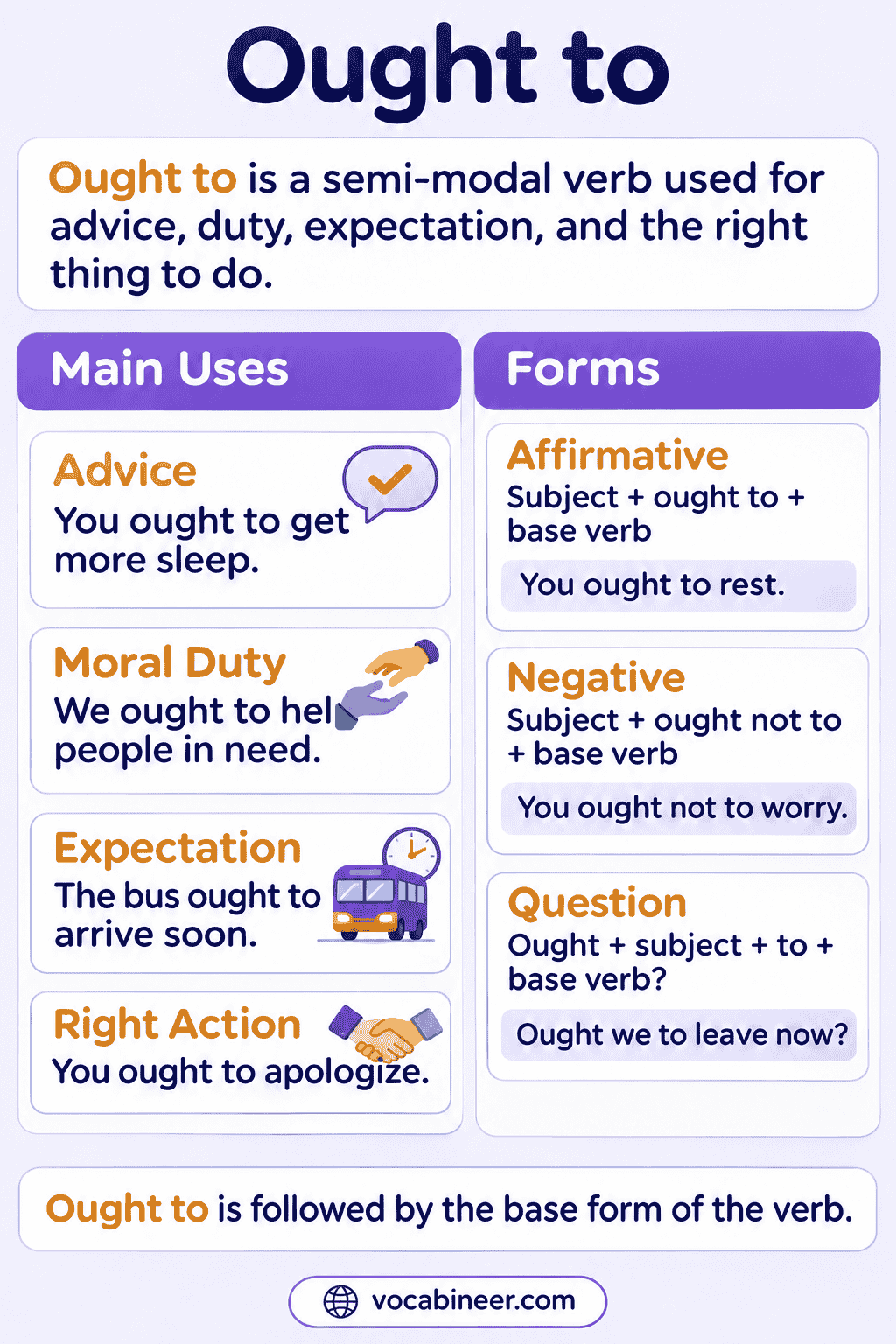
Ought to is a modal expression used to give advice, describe duty, recommend the right action, or say what is reasonably expected. In “You ought to rest,” it suggests a sensible action. In “The parcel ought to arrive tomorrow,” it expresses an expectation based on the available information.
Although ought to is close in meaning to should, it has its own grammatical patterns and shades of meaning. This guide explains how to form affirmative, negative, interrogative, perfect, continuous, and passive structures with ought to, how it compares with similar expressions, and how to avoid common mistakes.
In This Page
What Does Ought To Mean?
Ought to is a semi-modal or marginal modal expression. It behaves like a modal auxiliary in several ways, but unlike core modal verbs such as can, may, and must, it is followed by to.
Its main meanings are:
- Advice or recommendation: You ought to drink more water.
- Moral duty or responsibility: People ought to respect one another.
- Expectation or probability: The results ought to be ready soon.
- Past criticism or regret: You ought to have called me.
The strength of ought to depends on the context. It can sound like gentle advice in one sentence and a strong statement of responsibility in another.
Sentence Structures with Ought To
Ought to does not change according to the subject. It is used with I, you, he, she, it, we, and they in the same form.
| Sentence type | Structure | Example |
|---|---|---|
| Affirmative | Subject + ought to + base verb | She ought to apologize. |
| Negative | Subject + ought not to + base verb | She ought not to worry. |
| Question | Ought + subject + to + base verb? | Ought we to leave now? |
| Short answer | Yes, subject + ought to. | Yes, we ought to. |
| Negative short answer | No, subject + ought not. | No, we ought not. |
The verb after ought to remains in its base form:
- I ought to go.
- He ought to go.
- They ought to go.
Do not add -s, -ed, or -ing directly to the main verb after ought to.
Using Ought To for Advice
Use ought to when you believe an action is sensible, helpful, or appropriate.
- You ought to check the figures again.
- Maya ought to speak with her teacher.
- We ought to book the tickets in advance.
- They ought to take a map with them.
This use is close to should. In everyday conversation, should is usually more common, while ought to may sound slightly more formal or deliberate.
Negative advice uses ought not to:
- You ought not to skip breakfast.
- He ought not to decide while he is angry.
- We ought not to ignore the warning signs.
The contraction oughtn’t to is grammatically correct, particularly in British English, but it is less common than the full form:
- You oughtn’t to drive so fast.
Using Ought To for Duty and Responsibility
Ought to can express what is morally right, socially responsible, or expected according to a principle.
- We ought to keep our promises.
- Employers ought to provide a safe workplace.
- Everyone ought to be treated fairly.
- Governments ought to protect vulnerable communities.
In this use, ought to can sound stronger than ordinary advice because the speaker is making a judgment about the right action. However, it normally does not express the same unavoidable necessity as must.
Using Ought To for Expectation
Use ought to when something is likely or reasonably expected to happen.
- The bus ought to arrive in ten minutes.
- This key ought to open the back door.
- The weather ought to improve by afternoon.
- With enough practice, she ought to pass the test.
This meaning is based on evidence, normal circumstances, or logical expectation. It does not guarantee the result.
Negative expectation has a different meaning from negative advice:
| Meaning | Example | Explanation |
|---|---|---|
| Negative advice | You ought not to call him now. | Calling him now would be unwise. |
| Negative expectation | The repair ought not to take long. | The repair is not expected to take long. |
Context usually makes the intended meaning clear.
Common Patterns with Ought To
Several patterns with ought to appear frequently in natural English.
There Ought to Be
Use there ought to be to say that something should exist, happen, or be available.
- There ought to be a safer crossing here.
- There ought to be enough food for everyone.
- There ought to be a rule against that practice.
- There ought to be more buses during rush hour.
It Ought to Be
Use it ought to be to describe an expected condition, result, or degree of difficulty.
- It ought to be easy to find.
- It ought to be ready by Friday.
- It ought to be possible to repair the screen.
- It ought to be warmer this afternoon.
Ought to Be Able To
Use ought to be able to for an expected ability or possibility.
- I ought to be able to finish today.
- The technician ought to be able to recover the files.
- You ought to be able to see the mountains from here.
Ought to Know Better
Ought to know better is a common expression used when someone is expected to understand that an action is wrong or unwise.
- You ought to know better than to share your password.
- He ought to know better at his age.
- Experienced drivers ought to know better than to ignore that sign.
Ought To with Stative Verbs
Ought to can be used with stative verbs such as know, understand, remember, and believe.
- She ought to know the answer.
- They ought to understand the procedure.
- I ought to remember his name.
- He ought to believe the evidence after seeing it himself.
Adverb Placement with Ought To
Adverbs such as really, certainly, probably, and definitely usually appear after the subject and before ought to.
- You really ought to see a doctor.
- We probably ought to leave now.
- They definitely ought to revise the policy.
- She certainly ought to receive an explanation.
An adverb can strengthen advice, duty, or expectation. Really ought to is especially common when the speaker wants to emphasize that an action is important.
Ought To Have for Past Actions
Ought to has no ordinary past-tense form. To discuss an action that was advisable, expected, or morally right in the past, use:
Subject + ought to have + past participle
Past Advice, Criticism, or Regret
Use ought to have when the preferred action did not happen.
- You ought to have told me earlier.
- I ought to have checked the address.
- They ought to have followed the instructions.
- We ought to have left before the storm began.
The negative form, ought not to have, criticizes an action that did happen:
- You ought not to have opened the letter.
- She ought not to have spoken to him so harshly.
- They ought not to have entered the building.
Past Expectation
The same structure can describe something that was expected to have happened already.
- The train ought to have arrived by now.
- The payment ought to have reached your account yesterday.
- He ought to have finished the report by this time.
If the expected event did not occur, the sentence can imply surprise or a failed expectation:
- The package ought to have arrived, but it is still missing.
Continuous and Passive Forms
Ought to can be followed by continuous and passive structures when the meaning requires them.
Continuous Forms
Use ought to be + -ing for an action that should be or is expected to be in progress.
- You ought to be studying now.
- The children ought to be sleeping.
- The team ought to be preparing for the final.
Use ought to have been + -ing for an action that should have been in progress in the past.
- He ought to have been wearing a helmet.
- They ought to have been watching the road.
Passive Forms
Use ought to be + past participle when the subject receives the action.
- The form ought to be signed today.
- These records ought to be kept securely.
- The problem ought to be discussed openly.
Use ought to have been + past participle for a past passive action.
- The bill ought to have been paid last week.
- The equipment ought to have been inspected before use.
- She ought to have been informed about the change.
| Meaning | Structure | Example |
|---|---|---|
| Present or future action | ought to + base verb | You ought to call. |
| Action in progress | ought to be + -ing | You ought to be working. |
| Present or future passive | ought to be + past participle | It ought to be replaced. |
| Past action | ought to have + past participle | You ought to have called. |
| Past continuous action | ought to have been + -ing | You ought to have been working. |
| Past passive action | ought to have been + past participle | It ought to have been replaced. |
Questions with Ought To
Questions with ought to are formed by placing ought before the subject.
- Ought I to apologize?
- Ought we to tell them now?
- Ought the company to issue a refund?
- What ought I to do?
These forms are grammatically correct but can sound formal in modern conversation. Everyday speakers often use should or a longer expression instead.
| Formal or less common | More conversational |
|---|---|
| Ought I to call her? | Should I call her? |
| Ought we to wait? | Do you think we ought to wait? |
| What ought he to say? | What should he say? |
Do not use do or does to form a standard question with ought to. Write Ought we to leave?, not Do we ought to leave?
Using Ought To for Future Time
Although ought to has no separate future form, it can refer to the future when a time expression or the context makes the meaning clear.
- I ought to finish the work tomorrow.
- The guests ought to arrive at eight.
- You ought to receive a reply next week.
Do not write will ought to. If will is necessary, rewrite the sentence.
| Incorrect | Correct |
|---|---|
| She will ought to call tomorrow. | She ought to call tomorrow. |
| You will ought to be careful. | You will need to be careful. |
Ought To in Conditional Sentences
Ought to can appear in conditional sentences when advice, duty, or expectation depends on a condition.
- If you want to improve, you ought to practise regularly.
- If the roads are clear, we ought to arrive before noon.
- If he made the mistake, he ought to admit it.
- If the medicine causes discomfort, you ought to contact a qualified medical professional.
The condition does not change the form of ought to.
Ought To in Reported Speech
Ought to normally remains unchanged when direct speech becomes reported speech.
- Direct: She said, “You ought to rest.”
- Reported: She said that I ought to rest.
- Direct: He said, “They ought to have arrived.”
- Reported: He said that they ought to have arrived.
Unlike some other verb forms, ought to generally does not shift to a separate past form.
Ought To Compared with Similar Expressions
Ought To vs Should
Ought to and should often express similar advice, duty, or expectation. Should is more common in everyday English, while ought to can sound slightly more formal or morally weighted.
| Ought to | Should |
|---|---|
| You ought to apologize. | You should apologize. |
| The bus ought to arrive soon. | The bus should arrive soon. |
| We ought to protect the environment. | We should protect the environment. |
The difference is often small and depends on tone and context rather than a fixed rule.
Ought To vs Must
| Ought to | Must |
|---|---|
| Expresses advice, duty, or expectation | Expresses strong necessity, obligation, or a firm conclusion |
| Often allows some personal choice | Usually sounds more forceful |
| You ought to wear a seat belt. | You must wear a seat belt. |
| She ought to be home by now. | She must be home; the lights are on. |
Must not means that an action is prohibited, while ought not to usually means that it is unwise or morally wrong.
Ought To vs Have To
| Ought to | Have to |
|---|---|
| Often expresses advice or moral responsibility | Usually expresses practical, legal, or external necessity |
| You ought to help your neighbor. | You have to show identification. |
| Does not change with the subject | Changes to has to with third-person singular subjects |
Ought To vs Had Better
| Ought to | Had better |
|---|---|
| Gives general advice or states duty | Gives stronger, situation-specific advice |
| May not imply an immediate consequence | Often implies a problem if the advice is ignored |
| You ought to save some money. | You had better pay the bill today. |
Ought To vs Be Supposed To
| Ought to | Be supposed to |
|---|---|
| Expresses advice, duty, or logical expectation | Often expresses a rule, arrangement, or what others expect |
| We ought to leave early. | We are supposed to meet at nine. |
| The plan ought to work. | The train is supposed to arrive at six. |
Formality, Pronunciation, and Regional Use
Ought to is standard English, but it is less frequent in casual speech than should. It remains useful in formal advice, ethical arguments, careful recommendations, and statements of reasonable expectation.
In connected speech, speakers may pronounce ought to quickly so that it sounds similar to “oughta.” That spelling may represent informal dialogue, but it is unsuitable for standard formal writing. Write ought to.
Usage also varies by region and speaker. Oughtn’t to and inverted questions such as Ought we to…? are more likely to appear in British English than in everyday American English, where shouldn’t and Should we…? are usually preferred.
Common Mistakes with Ought To
Omitting To
| Incorrect | Correct |
|---|---|
| You ought call her. | You ought to call her. |
| He ought apologize. | He ought to apologize. |
Adding To Twice
| Incorrect | Correct |
|---|---|
| We ought to to leave. | We ought to leave. |
Changing Ought for the Subject
| Incorrect | Correct |
|---|---|
| She oughts to wait. | She ought to wait. |
| He oughted to know. | He ought to know. |
Using the Wrong Verb Form
| Incorrect | Correct |
|---|---|
| She ought to goes. | She ought to go. |
| They ought to left. | They ought to leave. |
Forming Questions with Do
| Incorrect | Correct |
|---|---|
| Do I ought to call? | Ought I to call? |
| Does he ought to pay? | Ought he to pay? |
In conversational English, Should I call? and Should he pay? are more natural alternatives.
Confusing Present and Past Advice
| Intended time | Correct form |
|---|---|
| Advice about now or later | You ought to apologize. |
| Criticism about an earlier action | You ought to have apologized. |
Misplacing Not
Standard negative forms are ought not to + verb and ought not to have + past participle.
- You ought not to interrupt.
- She ought not to have shared the information.
Avoid nonstandard forms such as do not ought to.
Using Will Ought To
Ought to can already refer to the future, so it does not need will.
- Incorrect: The parcel will ought to arrive tomorrow.
- Correct: The parcel ought to arrive tomorrow.
Key Points to Remember
- Ought to expresses advice, duty, moral responsibility, or reasonable expectation.
- It is followed by the base form of the main verb.
- Its form does not change with the subject.
- The standard negative is ought not to.
- Questions place ought before the subject, although should is more common in conversation.
- Ought to have + past participle refers to past advice, criticism, regret, or expectation.
- Continuous and passive forms are possible when the sentence requires them.
- Ought to can refer to the future without will.
- Should is generally more common, but ought to remains correct and useful.
Conclusion
Ought to helps speakers and writers express what is advisable, morally right, or reasonably expected. Its basic form is simple—ought to + base verb—but structures such as ought to have, ought to be, and ought to have been allow it to describe present, future, and past situations with precision.
To use it naturally, match the structure to the intended time and meaning. Use ought to for present or future advice and expectations, ought to have for past situations, and remember that should is often the more conversational choice when both expressions are possible.
FAQs
Ought to expresses advice, duty, moral responsibility, or reasonable expectation. Its exact meaning depends on the context.
Use ought to + base form of the verb, as in “You ought to wait.” For a past action, use ought to have + past participle, as in “You ought to have waited.”
They are often interchangeable. Should is more common in everyday English, while ought to may sound slightly more formal or place greater emphasis on duty and what is right.
Place not after ought: “You ought not to worry.” The contraction oughtn’t to is also correct but less common.
Use ought to have + past participle for past advice, criticism, regret, or expectation: “They ought to have arrived by now.”
Read More
- Verbs in English
- Action Verbs
- Regular Verbs
- Irregular Verbs
- Transitive and Intransitive verbs
- Finite and Non-finite verbs
- Principal Parts of Verbs
- Forms of Verbs