

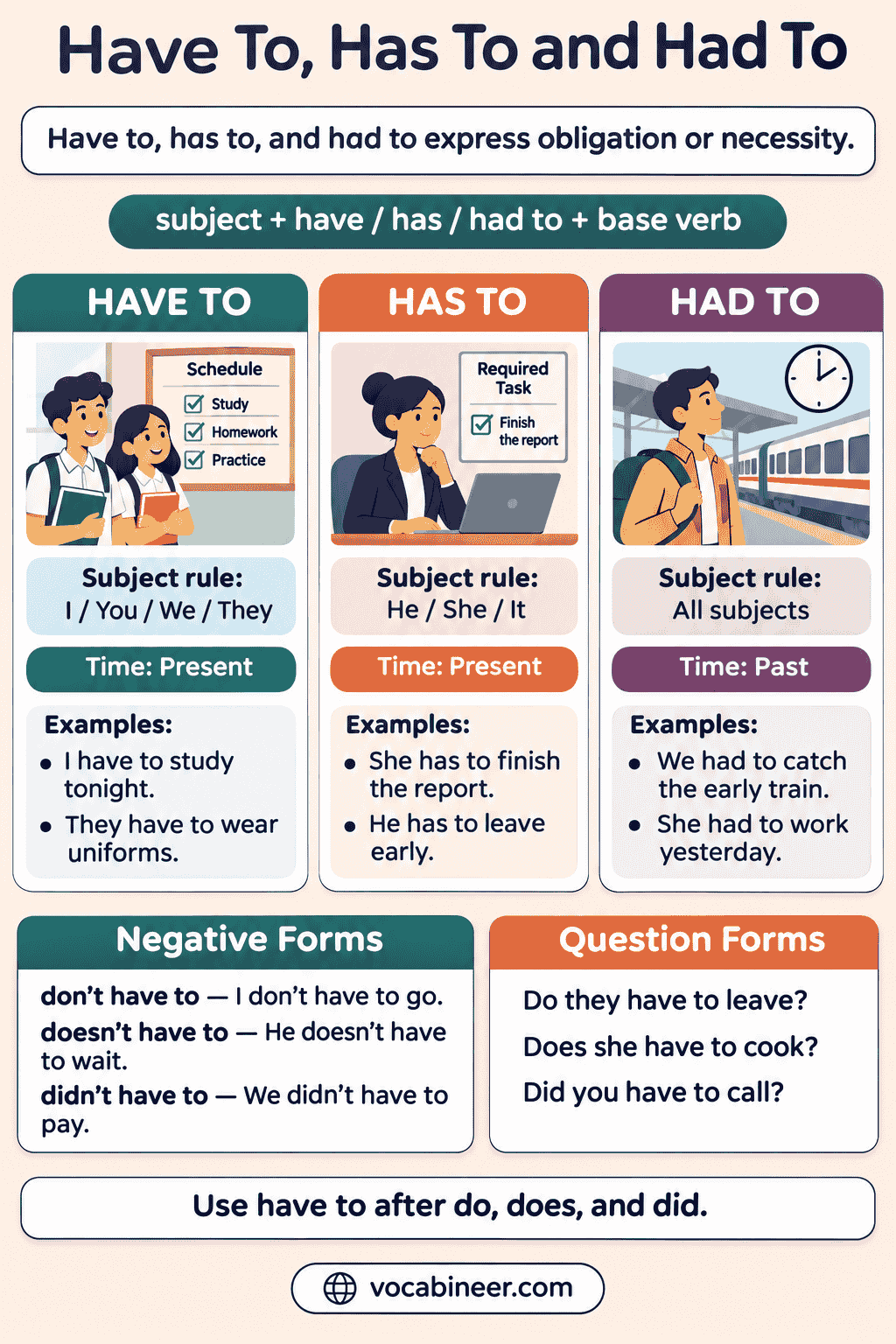
Have to, has to, and had to express obligation or necessity. They show that an action is required because of a rule, responsibility, situation, or practical need. For example, “I have to work today” describes a present obligation, while “They had to work yesterday” describes a past one.
The correct form depends on the subject and time. Use have to with I, you, we, and they; use has to with he, she, and it; and use had to with every subject for past necessity. This guide explains their structures, uses, negative forms, questions, tense forms, and common mistakes.
In This Page
Have To, Has To, and Had To at a Glance
| Form | Time | Subjects | Example |
|---|---|---|---|
| have to | Present | I, you, we, they; plural nouns | We have to leave. |
| has to | Present | He, she, it; singular nouns | She has to leave. |
| had to | Past | Every subject | They had to leave. |
All three forms are followed by the base form of a verb. Have to changes to has to with third-person singular subjects, but had to remains the same with every subject.
Basic Sentence Structures
Affirmative Forms
| Form | Structure | Example |
|---|---|---|
| have to | Subject + have to + base verb | We have to study. |
| has to | Subject + has to + base verb | He has to study. |
| had to | Subject + had to + base verb | She had to study. |
Negative and Question Forms
| Sentence type | Present | Past |
|---|---|---|
| Negative | Subject + do/does not have to + base verb | Subject + did not have to + base verb |
| Question | Do/Does + subject + have to + base verb? | Did + subject + have to + base verb? |
| Positive short answer | Yes, subject + do/does. | Yes, subject + did. |
| Negative short answer | No, subject + don’t/doesn’t. | No, subject + didn’t. |
Examples:
- We don’t have to wait.
- She doesn’t have to wait.
- They didn’t have to wait.
- Do you have to leave?
- Does he have to work?
- Did they have to pay?
After does and did, always use have to, not has to or had to.
Meaning and Uses
Rules and Regulations
Use these forms for obligations created by laws, schools, workplaces, and organizations.
- Drivers have to stop at red lights.
- Every employee has to wear an identification card.
- Visitors had to show their passes.
Duties and Responsibilities
- I have to prepare the weekly report.
- She has to take care of her younger brother.
- We had to clean the office after the event.
Circumstantial Necessity
Use these forms when a situation makes an action necessary.
- We have to take a taxi because the bus is late.
- He has to walk because his bicycle is broken.
- They had to cancel the trip because of the storm.
Regular Obligations
- I have to get up early on weekdays.
- Sara has to travel for work every month.
- Our previous manager had to attend several meetings each week.
One-Time Necessity
- I have to call the bank today.
- He has to submit the form before noon.
- We had to replace the damaged cable yesterday.
How to Use Have To
Use have to with I, you, we, they, and plural nouns.
- I have to finish this assignment.
- You have to bring your passport.
- We have to leave by six.
- They have to follow the rules.
- The students have to wear uniforms.
How to Use Has To
Use has to with he, she, it, singular names, singular nouns, and singular noun phrases.
- He has to work late.
- She has to take the train.
- It has to remain connected.
- Ali has to renew his licence.
- The new student has to complete this form.
| Subject | Correct form |
|---|---|
| I | have to |
| You | have to |
| He | has to |
| She | has to |
| It | has to |
| We | have to |
| They | have to |
| The teacher | has to |
| The teachers | have to |
How to Use Had To
Had to expresses past obligation or necessity with every subject.
- I had to wait.
- You had to wait.
- She had to wait.
- We had to wait.
- The passengers had to wait.
Unlike have to and has to, had to does not change according to the subject.
Present and Past Necessity
| Present necessity | Past necessity |
|---|---|
| I have to work today. | I had to work yesterday. |
| She has to travel this week. | She had to travel last week. |
| They have to pay now. | They had to pay earlier. |
Had to also functions as the usual past equivalent of must when must expresses obligation.
| Present obligation | Past obligation |
|---|---|
| I must leave now. | I had to leave early yesterday. |
| She must complete the form. | She had to complete the form. |
Negative Forms
The negative forms express an absence of necessity, not prohibition.
| Form | Structure | Example |
|---|---|---|
| don’t have to | I/you/we/they + don’t have to + verb | We don’t have to wait. |
| doesn’t have to | he/she/it + doesn’t have to + verb | She doesn’t have to wait. |
| didn’t have to | any subject + didn’t have to + verb | They didn’t have to wait. |
Examples:
- You don’t have to attend. Attending is optional.
- He doesn’t have to pay. Payment is unnecessary.
- We didn’t have to book. Booking was unnecessary.
After doesn’t and didn’t, use have to.
| Incorrect | Correct |
|---|---|
| She doesn’t has to go. | She doesn’t have to go. |
| They didn’t had to wait. | They didn’t have to wait. |
No Necessity and Prohibition
The difference between don’t have to and mustn’t is essential.
| Form | Meaning | Example |
|---|---|---|
| do not have to | The action is unnecessary or optional | You don’t have to come. |
| must not | The action is prohibited | You must not enter. |
Compare:
- You don’t have to wear a tie. Wearing a tie is optional.
- You must not wear outdoor shoes inside. Wearing outdoor shoes is prohibited.
Forming Questions
Questions use do, does, or did.
| Time and subject | Structure | Example |
|---|---|---|
| Present: I/you/we/they | Do + subject + have to…? | Do we have to leave? |
| Present: he/she/it | Does + subject + have to…? | Does she have to leave? |
| Past: every subject | Did + subject + have to…? | Did they have to leave? |
| Incorrect | Correct |
|---|---|
| Does she has to work? | Does she have to work? |
| Did he had to pay? | Did he have to pay? |
Does already carries the third-person singular marking, while did carries the past tense. Therefore, the main verb returns to have.
Wh-Questions
- Why do you have to leave?
- When does she have to arrive?
- How often does he have to travel?
- Why did they have to cancel?
- How long did you have to wait?
Short Answers
| Question | Positive answer | Negative answer |
|---|---|---|
| Do you have to work? | Yes, I do. | No, I don’t. |
| Does she have to travel? | Yes, she does. | No, she doesn’t. |
| Did they have to wait? | Yes, they did. | No, they didn’t. |
Short answers repeat do, does, or did, not the complete expression.
Question Tags
Question tags also use do, does, or did.
- You have to leave, don’t you?
- She has to work, doesn’t she?
- They had to pay, didn’t they?
- He doesn’t have to attend, does he?
Present, Past, and Future Forms
| Time | Structure | Example |
|---|---|---|
| Present | have/has to + base verb | She has to leave. |
| Past | had to + base verb | She had to leave. |
| Future | will have to + base verb | She will have to leave. |
Future Necessity
Use will have to for an obligation or necessity that will exist later.
- I will have to renew my passport next year.
- She will have to work tomorrow.
- We will have to make a decision soon.
- The company will have to replace the equipment.
Do not use will has to or will had to.
Perfect Forms
Present Perfect
Use have/has had to for a necessity that has occurred repeatedly or continued up to the present.
- I have had to change my schedule.
- She has had to work late all week.
- They have had to reduce their expenses.
- We haven’t had to borrow any money.
Past Perfect
Use had had to for a necessity that existed before another past event.
- We had had to revise the plan before the client approved it.
- She had had to leave before the meeting ended.
- They had never had to manage such a large project before.
The form is grammatically correct, although it can sound repetitive. A clearer rewrite may be preferable when possible.
Future Perfect
Use will have had to when looking back on a future necessity.
- By the end of the course, students will have had to complete five projects.
- By December, the company will have had to replace several machines.
This form is correct but uncommon.
Continuous Forms
Use be having to for temporary, repeated, or changing necessity.
- I am having to work from home this week.
- She is having to travel more often.
- They were having to make several changes.
- We are having to reduce our spending.
| Simple form | Continuous form |
|---|---|
| Describes a regular or general obligation | Emphasizes temporary or developing necessity |
| I have to work late on Fridays. | I am having to work late this week. |
| She has to travel for her job. | She is having to travel more this month. |
The continuous form is possible, although the simple form remains more common.
Have To After Modal Verbs
Use have to after another modal because two central modal verbs do not normally appear together.
| Construction | Example |
|---|---|
| may have to | We may have to wait. |
| might have to | She might have to travel. |
| could have to | You could have to pay extra. |
| would have to | I would have to ask permission. |
| should not have to | Employees should not have to work unpaid. |
Avoid forms such as may must, might must, and will must in standard English.
Infinitive and Gerund Forms
To Have To
Use the infinitive after verbs and constructions that require to.
- I expect to have to wait.
- She does not want to have to move.
- We may continue to have to rely on public transport.
- He seems to have to travel frequently.
Having To
Use the gerund when the expression functions as a noun or follows a preposition.
- Having to wait is frustrating.
- She dislikes having to travel alone.
- He complained about having to work late.
- We left early to avoid having to drive in heavy traffic.
Must has no equivalent infinitive or gerund form.
Have Got To
| Have to | Have got to |
|---|---|
| Neutral and common in most contexts | Informal and often emphatic |
| Works across several tenses | Mainly used for present necessity |
| I have to leave. | I’ve got to leave. |
| She has to work. | She’s got to work. |
Use had to for past necessity and will have to for future necessity.
Gotta represents highly informal pronunciation and should generally be avoided in formal writing.
Have To and Must
| Have to | Must |
|---|---|
| Often describes rules or circumstances | Often sounds personal, direct, or authoritative |
| Common in everyday conversation | Common in formal rules and strong instructions |
| Has several tense forms | Has limited grammatical forms |
| Negative means no necessity | Negative means prohibition |
Examples:
- We have to wear uniforms because it is a school rule.
- You must remain silent during the test.
The distinction between external and speaker-imposed obligation can be useful, but it is not absolute. The two forms often overlap.
Have To and Need To
| Have to | Need to |
|---|---|
| Often sounds like a firm or unavoidable requirement | Can sound more practical or less forceful |
| Commonly connected to rules and circumstances | Commonly connected to requirements or goals |
| I have to submit the form today. | I need to submit the form today. |
Their meanings frequently overlap. However, have to may sound stronger when a rule or unavoidable circumstance creates the necessity.
Didn’t Have To and Needn’t Have
| Form | Meaning | Example |
|---|---|---|
| didn’t have to do | The action was unnecessary; context shows whether it happened | I didn’t have to pay. |
| needn’t have done | The action happened, but it was unnecessary | I needn’t have paid. |
Compare:
- We didn’t have to bring food, so we left it at home.
- We needn’t have brought food because the hosts had prepared plenty.
The second sentence confirms that the speakers brought food unnecessarily.
Past Necessity and Past Deduction
| Form | Meaning | Example |
|---|---|---|
| had to + base verb | Past obligation or necessity | She had to leave early. |
| must have + past participle | Strong conclusion about a past event | She must have left early. |
Must have left is not the past form of must leave. Use had to leave for past obligation.
Passive Constructions
| Active | Passive |
|---|---|
| You have to submit the form. | The form has to be submitted. |
| They had to repair the machine. | The machine had to be repaired. |
| We will have to replace the cable. | The cable will have to be replaced. |
| Someone has to approve the request. | The request has to be approved. |
Use the passive when the required action matters more than the person performing it.
Reported Speech
| Direct speech | Reported speech |
|---|---|
| She said, “I have to leave.” | She said that she had to leave. |
| He said, “I will have to wait.” | He said that he would have to wait. |
| They said, “We had to pay.” | They said that they had had to pay. |
Backshifting is not always necessary when an obligation remains current.
- She says that she has to leave early.
- He said that employees have to wear identification cards.
Adding Emphasis
Use do, does, and did in affirmative sentences for emphasis or correction.
- I do have to leave now.
- She does have to attend the meeting.
- We did have to pay the fee.
These forms often respond to doubt or correct an incorrect assumption.
Adverb Placement
- I often have to work late.
- She sometimes has to travel.
- We always had to arrive early.
- They have recently had to reduce their expenses.
- He may occasionally have to work on weekends.
Frequency adverbs generally appear before have to in simple forms and after the first auxiliary in longer verb phrases.
Pronunciation in Natural Speech
In connected speech:
- Have to often sounds like haf to.
- Has to usually has an /s/ sound rather than a /z/ sound.
- Had to may sound like had tuh in rapid speech.
- Have got to may be reduced to gotta in highly informal speech.
These pronunciation changes do not affect standard spelling.
Common Expressions
Have To Admit
- I have to admit that you were right.
- She had to admit that the plan had failed.
Have To Say
- I have to say, the service was excellent.
- We have to say that we disagree.
Have To Do With
Have to do with means “be related to.” It does not express obligation.
| Expression | Meaning |
|---|---|
| She has to do the work. | She is required to perform the work. |
| The issue has to do with money. | The issue is related to money. |
- The problem has to do with poor communication.
- This chapter has to do with verb forms.
All You Have To Do
Use this expression for a simple instruction.
- All you have to do is press the button.
- All she has to do is sign the form.
- All we had to do was wait.
Common Mistakes
Using Has To with the Wrong Subject
- Incorrect: They has to leave.
- Correct: They have to leave.
Using Have To with a Singular Subject
- Incorrect: She have to work.
- Correct: She has to work.
Using Has After Does
- Incorrect: Does he has to go?
- Correct: Does he have to go?
Using Had After Did
- Incorrect: Did they had to wait?
- Correct: Did they have to wait?
Using Has After Doesn’t
- Incorrect: She doesn’t has to attend.
- Correct: She doesn’t have to attend.
Using Had After Didn’t
- Incorrect: We didn’t had to pay.
- Correct: We didn’t have to pay.
Omitting To
- Incorrect: I have finish the report.
- Correct: I have to finish the report.
Using an -ing Form After To
- Incorrect: She has to working late.
- Correct: She has to work late.
Confusing Have To with Possession
- I have a car expresses possession.
- I have to drive expresses necessity.
Confusing Don’t Have To with Mustn’t
- Don’t have to means that an action is optional.
- Mustn’t means that an action is prohibited.
Using Will Has To
- Incorrect: She will has to leave.
- Correct: She will have to leave.
Confusing Had To with Must Have
- Had to leave expresses past necessity.
- Must have left expresses a past deduction.
Choosing the Correct Form
| Situation | Correct form |
|---|---|
| Present necessity with I, you, we, or they | have to |
| Present necessity with he, she, or it | has to |
| Past necessity with any subject | had to |
| Future necessity | will have to |
| Present negative with I, you, we, or they | don’t have to |
| Present negative with he, she, or it | doesn’t have to |
| Past negative | didn’t have to |
| Present question | do/does + subject + have to |
| Past question | did + subject + have to |
| Present perfect necessity | have/has had to |
| Necessity after another modal | modal + have to |
| Infinitive | to have to |
| Gerund | having to |
| Informal immediate necessity | have got to |
Key Points to Remember
- Use have to with I, you, we, they, and plural nouns.
- Use has to with he, she, it, and singular nouns.
- Use had to with every subject for past necessity.
- Follow all three forms with a base verb.
- Use doesn’t have to, not doesn’t has to.
- Use didn’t have to, not didn’t had to.
- Use will have to for future necessity.
- Do not have to means that an action is unnecessary.
- Must not means that an action is prohibited.
- Had to expresses past necessity.
- Must have + past participle expresses a past deduction.
- Use have/has had to for repeated or continuing necessity up to the present.
Frequently Asked Questions
What is the difference between have to and has to?
Use have to with I, you, we, they, and plural nouns. Use has to with he, she, it, singular names, and singular nouns. Both forms express present obligation or necessity.
What is the past form of have to and has to?
Both forms change to had to in the past. Had to works with every subject: “I had to leave,” “She had to leave,” and “They had to leave.”
Why do we say does she have to instead of does she has to?
Does already carries the third-person singular grammatical marking. Therefore, the main verb returns to its base form, have: “Does she have to work?”
What is the difference between don’t have to and mustn’t?
Don’t have to means that an action is unnecessary or optional. Mustn’t means that an action is prohibited.
Can have to be used in the future?
Yes. Use will have to + base verb: “I will have to leave early” and “She will have to renew her passport.”
Conclusion
Have to and has to express present obligation or necessity, while had to expresses past necessity. Use have to with I, you, we, they, and plural nouns; use has to with he, she, it, and singular nouns; and use had to with every subject.
The negative and question forms require special attention. After do, does, and did, always use have to. In addition, remember that don’t have to means an action is unnecessary, whereas mustn’t means it is prohibited. Once these basic patterns are clear, the three forms become much easier to use correctly.
Read More