

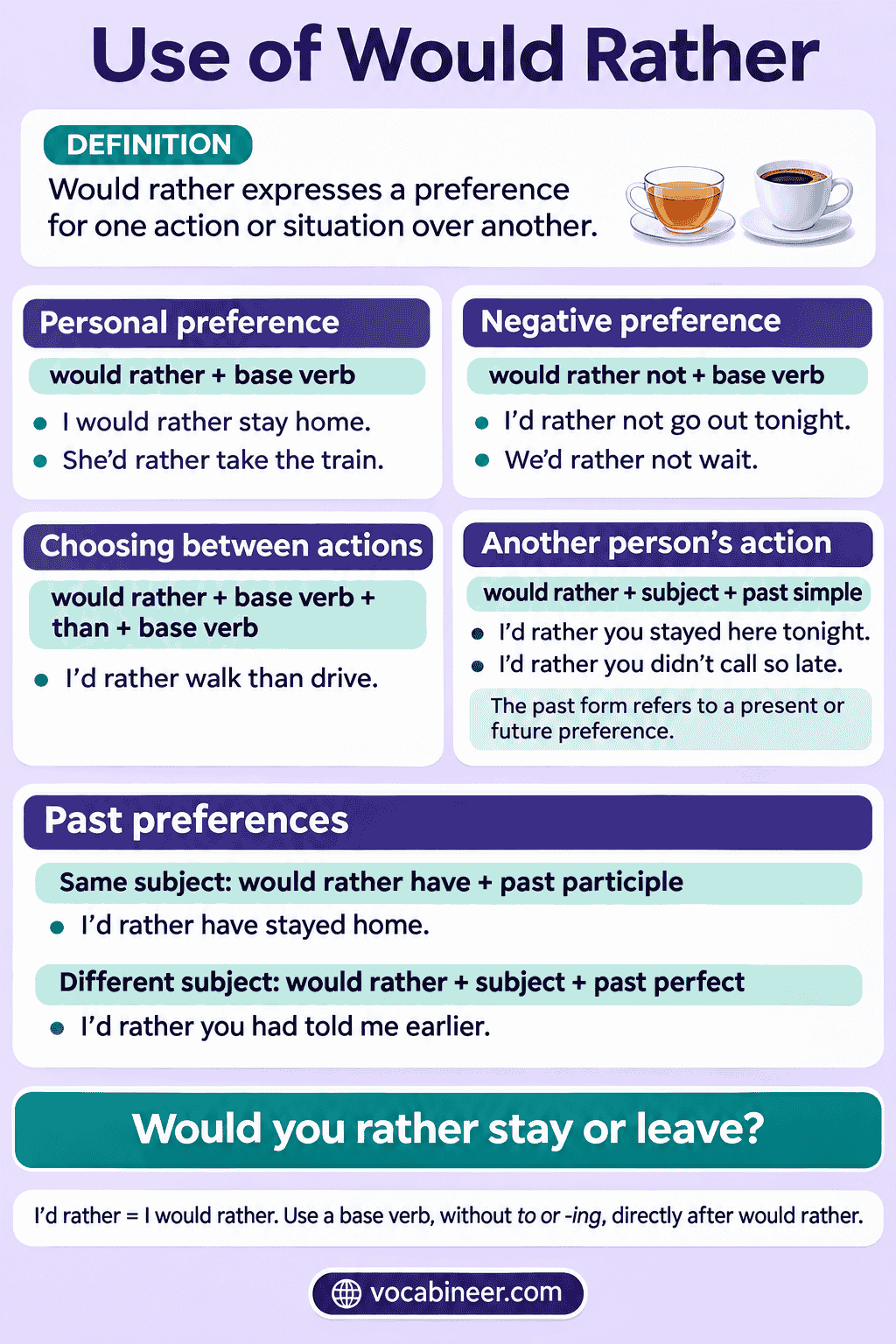
Would rather is a common modal expression used to show that someone prefers one action, choice, or situation over another. For example, I would rather stay home means that staying home is more desirable to the speaker than another available option, such as going out.
The most common pattern is would rather + base verb, but the structure changes when the preferred action has a different subject or refers to the past. Learning these patterns will help you express present choices, future preferences, past regrets, and polite requests accurately.
In This Page
Would Rather at a Glance
| Use | Structure | Example |
|---|---|---|
| Present or future preference | would rather + base verb | I would rather stay home. |
| Negative preference | would rather not + base verb | She would rather not drive. |
| Choice between actions | would rather + verb + than + verb | We would rather walk than wait. |
| Different subject | would rather + subject + past simple | I would rather you stayed. |
| Own past preference | would rather have + past participle | He would rather have left earlier. |
| Another person’s past action | would rather + subject + past perfect | I would rather you had called. |
| Question | would + subject + rather + base verb? | Would you rather stay? |
Meaning of Would Rather
Would rather means would prefer to. It expresses a preference for one action or situation instead of another.
- I would rather stay at home.
- She would rather travel by train.
- We would rather wait until tomorrow.
- They would rather discuss the matter privately.
The alternative may appear directly:
- I would rather stay home than go out.
- She would rather travel by train than fly.
However, context can also make the alternative clear:
- “Would you like to drive?” “No, I would rather walk.”
- “Shall we eat outside?” “I would rather stay indoors.”
Grammatical Features of Would Rather
Would rather follows several important grammatical rules:
- It normally takes a bare infinitive.
- Do not place to before the main verb.
- Would remains unchanged with every subject.
- The standard contraction is ’d rather.
- In ’d rather, ’d means would.
- Put not after rather.
- Use than when comparing two actions.
- Keep compared verb forms parallel.
- Use the past simple when another person performs the preferred present or future action.
- Use would rather have + past participle for the speaker’s own past preference.
- Use a past perfect clause for another person’s completed past action.
Affirmative Sentences with Would Rather
Use the following structure for the subject’s own present or future preference:
Subject + would rather + base verb
- I would rather stay home.
- You would rather know the truth.
- He would rather work alone.
- She would rather travel by train.
- We would rather wait until tomorrow.
- They would rather discuss the matter privately.
The main verb stays in its base form regardless of the subject.
| Incorrect | Correct |
|---|---|
| She would rather travels by train. | She would rather travel by train. |
| He would rather stayed home. | He would rather stay home. |
| We would rather to wait. | We would rather wait. |
Negative Sentences with Would Rather
Use this structure to express a negative preference:
Subject + would rather not + base verb
- I would rather not talk about it.
- She would rather not drive at night.
- We would rather not wait outside.
- They would rather not attend the meeting.
- He would rather not answer that question.
Place not after rather, not before it. Also, keep the main verb in its base form.
| Incorrect | Correct |
|---|---|
| I would not rather go. | I would rather not go. |
| She would rather not to wait. | She would rather not wait. |
| He would rather not answers. | He would rather not answer. |
Contracted Forms of Would Rather
In conversation and informal writing, speakers usually contract would to ’d.
| Full form | Contracted form |
|---|---|
| I would rather | I’d rather |
| You would rather | You’d rather |
| He would rather | He’d rather |
| She would rather | She’d rather |
| We would rather | We’d rather |
| They would rather | They’d rather |
Examples include:
- I ’d rather stay.
- You ’d rather know the truth.
- He ’d rather work alone.
- She ’d rather not answer.
- We ’d rather leave early.
- They ’d rather wait outside.
The contraction ’d can represent would or had. Before rather, it means would. Before better, it means had.
- I ’d rather stay. = I would rather stay.
- You ’d better stay. = You had better stay.
Questions with Would Rather
Use this structure to ask about someone’s preference:
Would + subject + rather + base verb?
- Would you rather stay home?
- Would she rather travel by train?
- Would they rather leave now?
- Would he rather work alone?
- Would you rather wait or return tomorrow?
Questions with would rather commonly present two possible choices:
- Would you rather have tea or coffee?
- Would they rather stay here or move elsewhere?
- Would she rather call or send a message?
Short Answers
Natural short answers include:
- Would you rather stay? — Yes, I would.
- Would she rather leave? — No, she wouldn’t.
- Would you rather have tea or coffee? — I’d rather have tea.
When the preferred action is not obvious, include the verb rather than answering only with I’d rather.
Comparing Two Actions
Use this structure when choosing one action instead of another:
Subject + would rather + base verb + than + base verb
- I would rather walk than wait for the bus.
- She would rather cook than order food.
- We would rather save than spend.
- They would rather leave now than stay overnight.
- He would rather listen than argue.
Keep the two compared verb forms parallel. If the first verb is a base verb, the second should also be a base verb.
| Incorrect | Correct |
|---|---|
| I would rather walk than waiting. | I would rather walk than wait. |
| She would rather cook than to order food. | She would rather cook than order food. |
| We would rather save than spending. | We would rather save than spend. |
The second verb may be understood from the context, but it is usually stated when the actions differ.
Comparing Things and Nouns
Would rather most naturally compares actions. Therefore, include a suitable verb when choosing between things.
- I would rather have tea than coffee.
- She would rather buy the blue dress than the red one.
- We would rather choose a hotel than an apartment.
- They would rather order soup than salad.
When comparing nouns directly, prefer often sounds more natural:
- I prefer tea to coffee.
- She prefers the blue dress to the red one.
- We prefer hotels to apartments.
Avoid incomplete forms such as I would rather tea in careful standard English. Say I would rather have tea or I would prefer tea.
Would Rather with a Different Subject
When someone prefers another person to do something, use:
Subject + would rather + different subject + past simple
- I would rather you stayed here.
- She would rather he called tomorrow.
- We would rather they arrived early.
- He would rather his children studied at home.
- They would rather I spoke to the manager.
The word that may appear, but speakers usually omit it:
- I would rather that you stayed.
- I would rather you stayed.
Although the subordinate clause uses the past simple, it normally describes a present or future preference. The past form creates grammatical distance and presents the situation as desired rather than factual. Grammarians often call this use the unreal past.
For example, I would rather you came tomorrow refers to tomorrow, not to a completed past visit.
Negative Clauses with a Different Subject
Use this structure when you prefer another person not to do something:
Subject + would rather + different subject + did not + base verb
- I would rather you did not mention this.
- She would rather he did not drive at night.
- We would rather they did not bring extra guests.
- They would rather I did not leave early.
The contraction didn’t is common in speech and informal writing:
- I’d rather you didn’t tell anyone.
- She’d rather he didn’t smoke indoors.
- We’d rather they didn’t park here.
These sentences can function as indirect requests. However, they may still sound firm, so tone and context matter.
Own Past Preferences with Would Rather Have
Use this structure when the speaker prefers a different action in the past:
Subject + would rather have + past participle
- I would rather have stayed home.
- She would rather have taken the train.
- We would rather have waited until morning.
- They would rather have booked another hotel.
- He would rather have spoken privately.
The preferred action usually did not happen. Therefore, the structure often expresses regret or dissatisfaction with a completed choice.
For example, I would rather have stayed home normally means that the speaker went somewhere but now believes staying home would have been better.
Negative Past Preferences
Use this structure when the speaker wishes an action had not happened:
Subject + would rather not have + past participle
- I would rather not have attended the meeting.
- She would rather not have mentioned the problem.
- We would rather not have waited so long.
- They would rather not have spent so much money.
Past Preferences with a Different Subject
Use a past perfect clause when the preference concerns another person’s completed past action:
Subject + would rather + different subject + had + past participle
- I would rather you had called first.
- She would rather he had told the truth.
- We would rather they had arrived earlier.
- He would rather his team had waited.
- They would rather I had asked for permission.
This structure often communicates disappointment or criticism because the completed action cannot now be changed.
Negative Past Clauses
Use had not + past participle when the speaker wishes another person had avoided an action.
- I would rather you had not told anyone.
- She would rather he had not driven in the storm.
- We would rather they had not cancelled the meeting.
- They would rather I had not mentioned the argument.
Same-Subject and Different-Subject Patterns
The verb pattern depends on who performs the preferred action.
| Same subject | Different subject |
|---|---|
| I’d rather stay. | I’d rather you stayed. |
| She’d rather leave. | She’d rather he left. |
| We’d rather wait. | We’d rather they waited. |
For past preferences, compare the perfect structures:
| Own past preference | Another person’s past action |
|---|---|
| I’d rather have stayed. | I’d rather you had stayed. |
| She’d rather have called. | She’d rather he had called. |
| We’d rather have waited. | We’d rather they had waited. |
Present and Future Preferences
Use would rather + base verb for the subject’s own present or future preference.
| Time reference | Example |
|---|---|
| Present choice | I would rather stay here. |
| Near future | We would rather leave tonight. |
| Future plan | She would rather travel next week. |
When another person performs the preferred action, use the past-simple pattern:
- I would rather you came tomorrow.
- She would rather he called next week.
- We would rather they arrived before noon.
Although came, called, and arrived have past forms, these sentences refer to future actions.
Continuous Forms
Would Rather Be Doing
Use would rather be + present participle for a preferred activity in progress.
- I would rather be reading.
- She would rather be working from home.
- We would rather be sitting outside.
- They would rather be travelling right now.
This form emphasizes what the subject would prefer to be doing at the present time.
Would Rather Have Been Doing
Use would rather have been + present participle for a preferred continuing activity in the past.
- I would rather have been sleeping.
- She would rather have been working with her team.
- We would rather have been travelling during the summer.
These advanced forms focus on an ongoing activity rather than a single completed event.
Passive Forms
Use would rather be + past participle when the subject prefers to receive an action.
- I would rather be told the truth.
- She would rather be contacted by email.
- We would rather be given more time.
- They would rather be invited directly.
Use would rather have been + past participle for a past passive preference:
- I would rather have been informed earlier.
- She would rather have been contacted directly.
- They would rather have been invited in person.
Would Rather and Prefer
Both expressions describe preference, but their grammar and typical uses differ.
| Would rather | Prefer |
|---|---|
| Usually takes a bare infinitive | Can take a noun, gerund, or to-infinitive |
| Often describes a specific choice | Can describe general preferences |
| I would rather walk. | I prefer walking. |
| I’d rather walk than drive. | I prefer walking to driving. |
Common patterns with prefer include:
- prefer + noun + to + noun: I prefer tea to coffee.
- prefer + gerund + to + gerund: I prefer walking to driving.
- prefer + to-infinitive: I prefer to work alone.
Use prefer for general likes, habits, and direct comparisons between nouns. Use would rather for a particular choice in a specific situation.
Would Rather and Would Prefer
Both expressions can describe a specific preference, but they take different complements.
| Would rather | Would prefer |
|---|---|
| Followed by a bare infinitive | Usually followed by a to-infinitive |
| Common in conversation | Can sound slightly more formal or neutral |
| I would rather stay. | I would prefer to stay. |
| I’d rather walk than drive. | I’d prefer to walk rather than drive. |
Do not mix their structures.
| Incorrect | Correct |
|---|---|
| I would rather to stay. | I would rather stay. |
| I would prefer stay. | I would prefer to stay. |
Would Rather and Had Better
These expressions share the contraction ’d, but their meanings differ completely.
| Would rather | Had better |
|---|---|
| Expresses preference | Gives strong advice or a warning |
| ’d means would | ’d means had |
| I’d rather stay. | You’d better stay. |
Compare:
- I ’d rather leave. — Leaving is my preference.
- You ’d better leave. — Leaving is the advisable action.
Would Rather and Rather Than
Would rather expresses personal preference, while rather than connects alternatives in a wider range of sentence structures.
- I would rather walk than drive.
- She chose to walk rather than drive.
- We selected the train rather than the bus.
- He stayed silent rather than argue.
Keep the compared words, phrases, or clauses grammatically parallel whenever possible.
Would Rather and Would Sooner
Would sooner has almost the same meaning as would rather, although it occurs less frequently.
- I would sooner stay home.
- She would sooner resign than accept those conditions.
- We would sooner wait than make a careless decision.
For most learners and everyday situations, would rather is the more useful choice.
Tone and Politeness
Sentences with a different subject can express requests, criticism, or control.
- I’d rather you stayed.
- I’d rather you didn’t smoke here.
- We’d rather you arrived on time.
These forms are indirect, but they may still sound firm. When greater politeness is necessary, use a softer alternative:
- I’d prefer it if you stayed.
- Would you mind not smoking here?
- It would be better if you called first.
- I’d appreciate it if you arrived early.
- I would prefer you to wait outside.
The relationship between the speakers and the situation will determine which form sounds most appropriate.
Common Mistakes with Would Rather
Adding To Before the Main Verb
Use a bare infinitive after would rather.
| Incorrect | Correct |
|---|---|
| I would rather to stay. | I would rather stay. |
Putting Not Before Rather
Place not after rather.
| Incorrect | Correct |
|---|---|
| I would not rather go. | I would rather not go. |
Using the Present Simple with a Different Subject
Use the past-simple pattern when expressing a preference about another person.
| Nonstandard learner form | Standard pattern |
|---|---|
| I’d rather you stay here. | I’d rather you stayed here. |
The base form occurs in some varieties of informal English, especially American English. However, the past-simple form remains the standard learner pattern and the safer choice in formal writing.
Using the Wrong Past Structure
Use have + past participle for the subject’s own past preference.
| Incorrect | Correct |
|---|---|
| I would rather stayed home. | I would rather have stayed home. |
| I would rather have went home. | I would rather have gone home. |
Confusing ’d Rather with ’d Better
| Preference | Advice |
|---|---|
| I’d rather leave. | You’d better leave. |
Using To Instead of Than
Use than to compare actions after would rather.
| Incorrect | Correct |
|---|---|
| I’d rather walk to drive. | I’d rather walk than drive. |
Using Nonparallel Forms
Keep the compared verbs in matching forms.
| Incorrect | Correct |
|---|---|
| She’d rather cook than ordering food. | She’d rather cook than order food. |
Placing Would Rather Directly Before a Noun
Add an appropriate verb or use prefer.
| Less suitable | Natural |
|---|---|
| I would rather tea. | I would rather have tea. |
| I would rather tea. | I would prefer tea. |
Choosing the Correct Preference Structure
Choose the pattern according to who performs the action and when it happens.
| Intended meaning | Recommended structure |
|---|---|
| Own present or future preference | would rather + base verb |
| Own negative preference | would rather not + base verb |
| Choice between actions | would rather + verb + than + verb |
| Preference about another person | would rather + subject + past simple |
| Own past preference or regret | would rather have + past participle |
| Past preference about another person | would rather + subject + past perfect |
| General preference | prefer + noun/gerund |
| More formal specific preference | would prefer + to-infinitive |
Key Points to Remember
- Would rather means would prefer to.
- Use a bare infinitive after would rather.
- Do not place to before the main verb.
- Put not after rather.
- ’d rather is the standard contraction.
- In ’d rather, ’d means would.
- Use than when comparing two actions.
- Keep compared verb forms parallel.
- Use the past simple when the preferred action has another subject.
- Use would rather have + past participle for the speaker’s own past preference.
- Use a past perfect clause for another person’s past action.
- Do not confuse would rather with had better.
FAQs
Would rather means would prefer to. It shows that someone prefers one action or situation over another. For example, I would rather stay home means that staying home is the speaker’s preferred choice.
A bare infinitive normally follows would rather. Say I would rather stay, not I would rather to stay. When another subject follows the expression, use the past simple for a present or future preference: I would rather you stayed.
Would rather normally takes a bare infinitive and often describes a specific choice: I would rather walk. Prefer can take a noun, gerund, or to-infinitive and often describes a general preference: I prefer walking or I prefer to walk.
The past form creates grammatical distance and presents the situation as desired rather than factual. Therefore, I would rather you came tomorrow refers to a future visit even though came has a past form.
Use would rather have + past participle for the speaker’s own past preference, as in I would rather have stayed home. Use would rather + subject + past perfect for another person’s completed action, as in I would rather you had called first.
Conclusion
Would rather expresses preference and normally follows the structure would rather + base verb. Use would rather not + base verb for a negative preference and would rather + verb + than + verb when comparing two actions.
The pattern changes when the preferred action has another subject or refers to the past. Use the past simple for another person’s present or future action, would rather have + past participle for the speaker’s own past preference, and a past perfect clause for another person’s completed past action. Understanding these patterns—and the differences between would rather, prefer, and had better—will help you express choices clearly and naturally.
Read More
- Verbs in English
- Action Verbs
- Regular Verbs
- Irregular Verbs
- Transitive and Intransitive verbs
- Finite and Non-finite verbs
- Principal Parts of Verbs
- Forms of Verbs