

Past modals help us discuss past possibilities, deductions, regrets, abilities, obligations, and imagined results. For example, She might have missed the bus expresses an uncertain possibility, while You should have called me describes an action that would have been better but did not happen. Although these forms refer to the past, their meanings depend on both the modal verb and the structure that follows it.
Most past-modal meanings use modal + have + past participle, but forms such as could, would, and had to can also refer to past time. This guide explains each form, compares easily confused structures, and provides clear examples so you can use past modals accurately in speech and writing.
In This Page
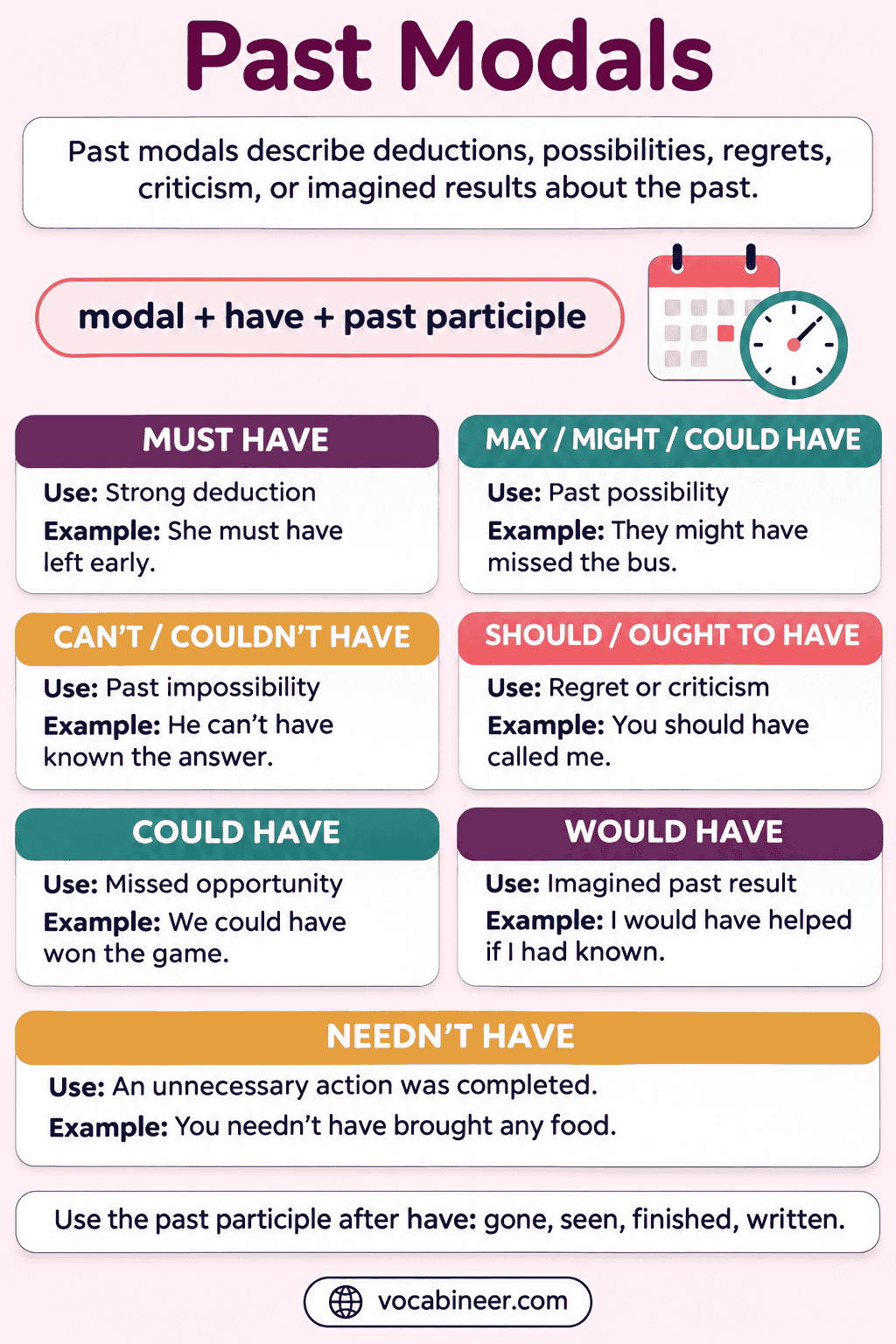
Past Modals at a Glance
| Form | Main use | Example |
|---|---|---|
| must have + past participle | Strong deduction about the past | She must have forgotten the meeting. |
| may have / might have + past participle | Uncertain past possibility | They might have taken another road. |
| could have + past participle | Possibility, missed opportunity, or criticism | I could have helped you. |
| can’t have / couldn’t have + past participle | Past impossibility | He can’t have seen us. |
| should have / ought to have + past participle | Regret, criticism, or unfulfilled expectation | You should have checked the answer. |
| needn’t have + past participle | Unnecessary action that happened | We needn’t have hurried. |
| would have + past participle | Imagined or conditional past result | I would have stayed longer. |
| could + base verb | General past ability, permission, or possibility | She could read at four. |
| had to + base verb | Past necessity or obligation | We had to leave early. |
How to Form Past Modals
The most common perfect modal structure is:
Subject + modal + have + past participle
- I may have lost the receipt.
- She must have left already.
- They should have waited for us.
- He would have accepted the offer.
Use the base form have after a modal, regardless of the subject. Do not use has or had in this structure.
| Incorrect | Correct |
|---|---|
| She might has forgotten. | She might have forgotten. |
| He should had called. | He should have called. |
| They must have went home. | They must have gone home. |
To make a negative form, place not after the modal:
- She may not have received the message.
- They could not have known the answer.
- You should not have opened the box.
Must Have for Strong Past Deductions
Use must have + past participle when available evidence makes a past conclusion seem almost certain.
- The ground is wet. It must have rained last night.
- Sara knew every detail. She must have read the report.
- The lights were off, so everyone must have gone home.
Here, must does not describe an obligation. Instead, it expresses a logical conclusion about something that probably happened.
Must Have and Had To
These forms refer to different ideas and should not be used interchangeably.
| Form | Meaning | Example |
|---|---|---|
| must have + past participle | Strong deduction | He must have left early. |
| had to + base verb | Past necessity or obligation | He had to leave early. |
In He must have left early, the speaker reaches a conclusion. In He had to leave early, circumstances made leaving necessary.
May Have and Might Have for Past Possibility
Use may have or might have + past participle when something was possible, but you do not know whether it happened.
- Ella may have taken your notebook by mistake.
- The package might have arrived while we were out.
- They may have misunderstood the instructions.
In many contexts, may have and might have have almost the same meaning. Might have can sometimes suggest greater uncertainty, but the difference is often small.
| Form | Typical meaning | Example |
|---|---|---|
| may have | Possible past event | She may have missed the train. |
| might have | Possible, sometimes less certain, past event | She might have missed the train. |
Use may not have or might not have when it is possible that an event did not happen.
- He may not have heard the announcement.
- They might not have understood the question.
- Sara may not have received our invitation.
These forms express uncertainty. They do not mean that the event was impossible.
Could Have and Its Main Meanings
Could have + past participle has several related uses. Context usually makes the intended meaning clear.
Past Possibility
Use could have when something was possible in the past.
- The noise could have come from the basement.
- Anyone could have made that mistake.
- The storm could have damaged the roof.
Missed Opportunity or Unrealized Ability
Use could have for an action that was possible but did not happen.
- We could have won, but we stopped trying.
- I could have applied for the job, but I missed the deadline.
- She could have become a professional athlete.
Criticism
Could have can also show that someone failed to do something helpful or appropriate.
- You could have warned me.
- He could have offered to help.
- They could have replied sooner.
The speaker’s tone determines whether the sentence sounds like a neutral observation, regret, or criticism.
Can’t Have and Couldn’t Have for Past Impossibility
Use can’t have or couldn’t have + past participle when you believe a past event was impossible.
- Mia can’t have written this note; she was abroad.
- They couldn’t have finished the project in ten minutes.
- He can’t have seen us because the room was dark.
Both forms reject a past possibility. Can’t have often presents a current conclusion about the past, while couldn’t have can also emphasize that an action was impossible under the circumstances.
Couldn’t and Couldn’t Have
| Form | Meaning | Example |
|---|---|---|
| couldn’t + base verb | Past inability or impossibility | I couldn’t open the door. |
| couldn’t have + past participle | Conclusion that a past event was impossible | Sam couldn’t have opened the door; he had no key. |
Must Not Have and Can’t Have
In some varieties of English, especially American English, must not have can express a strong negative deduction: She must not have seen the email. However, it may sound like a prohibition in other contexts. Can’t have is generally clearer when you mean that an event was impossible.
| Intended meaning | Clear form | Example |
|---|---|---|
| The event was impossible | can’t have | She can’t have seen the email; it went to the wrong address. |
| The event probably did not happen | must not have | She must not have seen the email because she never replied. |
Should Have for Advice, Regret, and Criticism
Use should have + past participle for an action that would have been correct, wise, or desirable but did not happen.
- I should have saved the document.
- You should have asked before borrowing the car.
- They should have left earlier.
The form may express regret when the speaker refers to their own action and criticism when it refers to someone else’s action.
Use shouldn’t have + past participle for an action that happened but was unwise, wrong, or unnecessary.
- I shouldn’t have said that.
- You shouldn’t have driven in such heavy rain.
- They shouldn’t have ignored the warning.
Should Have for an Expected Result
Should have can also describe an event that the speaker expected to be complete by now. In this use, the speaker may not know whether it actually happened.
- The train should have arrived by now.
- Your application should have reached the office yesterday.
- The technicians should have repaired the system already.
Context separates an expected result from regret or criticism.
Ought To Have
Ought to have + past participle has almost the same meanings as should have. It can express regret, criticism, duty, or an expected result.
- We ought to have checked the weather.
- You ought to have told the truth.
- The parcel ought to have arrived by Friday.
| Form | Meaning | Style |
|---|---|---|
| should have | Regret, criticism, or expectation | Very common and neutral |
| ought to have | Regret, criticism, duty, or expectation | Slightly more formal and less common |
Notice that ought must be followed by to, while should is followed directly by have.
Needn’t Have and Didn’t Need To
Use needn’t have + past participle when someone completed an action that was unnecessary.
- We needn’t have brought food; our hosts had prepared plenty.
- She needn’t have bought a ticket because admission was free.
- You needn’t have worried; everything went well.
Use didn’t need to + base verb when an action was not necessary. This structure does not always tell us whether the person performed the action.
| Form | Did the action happen? | Example |
|---|---|---|
| needn’t have done | Yes | I needn’t have printed the file; they accepted a digital copy. |
| didn’t need to do | Not necessarily; often no | I didn’t need to print the file, so I sent it electronically. |
This distinction matters. You needn’t have cooked means that you cooked, but it was unnecessary. You didn’t need to cook only states that cooking was unnecessary; context tells us whether you cooked.
Would Have for Imagined Past Results
Use would have + past participle for an unreal, imagined, or conditional result in the past. It commonly appears in third conditional sentences.
- I would have called if I had known your number.
- She would have attended the event, but she was ill.
- We would have arrived earlier if the road had been clear.
The result did not happen because the stated or implied condition was not met.
Could Have, Might Have, and Would Have in Conditionals
| Form | Meaning in the result clause | Example |
|---|---|---|
| would have | Expected imagined result | If we had left earlier, we would have caught the train. |
| could have | Possible ability or opportunity | If we had left earlier, we could have caught the train. |
| might have | Possible but uncertain result | If we had left earlier, we might have caught the train. |
Do not normally place would have in the if-clause of a standard third conditional.
| Incorrect | Correct |
|---|---|
| If I would have known, I would have helped. | If I had known, I would have helped. |
Would for Past Willingness and Refusal
Outside the perfect structure, would can describe willingness or refusal in the past.
- The neighbor would always help when we asked.
- I asked him to apologize, but he wouldn’t listen.
- The car wouldn’t start on cold mornings.
With people, wouldn’t often describes refusal. With objects or machines, it can describe a failure to function as expected.
Could for General Past Ability
Use could + base verb for a general ability that existed over a period in the past.
- She could swim before she started school.
- My grandfather could speak four languages.
- We could see the mountains from our old house.
For one successful action on a particular occasion, was/were able to or managed to is often clearer in affirmative sentences.
| Meaning | Preferred form | Example |
|---|---|---|
| General past ability | could | He could run very fast as a child. |
| Specific successful action | was able to / managed to | He managed to escape through a window. |
| Specific failure | couldn’t | He couldn’t open the locked gate. |
With verbs of perception and thought, could often sounds natural for a particular occasion:
- I could hear music outside.
- We could see smoke in the distance.
- I could understand her explanation.
Could for Past Permission
Could can describe general permission that existed in the past.
- At our old school, students could use the library after class.
- When we lived there, visitors could park outside.
- Employees could leave early on Fridays.
For permission granted on one specific occasion, was/were allowed to is generally clearer.
- After speaking to the manager, we were allowed to enter.
- Because the examination ended early, the students were allowed to leave.
Would for Repeated Past Actions
Use would + base verb for actions that happened repeatedly in the past, especially in stories and memories.
- Every summer, we would visit our grandparents.
- After dinner, Dad would read to us.
- On winter evenings, they would sit by the fire.
Do not use this form of would freely for past states. Use used to instead.
| Past meaning | Would | Used to |
|---|---|---|
| Repeated action | Yes | Yes |
| Past state | Usually no | Yes |
| Example | We would play outside. | We used to live nearby. |
Perfect Continuous Past Modals
Use modal + have been + present participle to focus on an activity that continued for a period before a past or present point.
- She must have been waiting for hours.
- They might have been sleeping when you called.
- You should have been studying instead of watching television.
- He could have been working from home.
| Structure | Focus | Example |
|---|---|---|
| modal + have + past participle | Completed event or result | She must have written the report. |
| modal + have been + -ing | Continuing activity or duration | She must have been writing the report. |
Stative verbs such as know, believe, and own do not normally take continuous forms. Say She must have known, not She must have been knowing.
Passive Forms of Past Modals
Use modal + have been + past participle when the subject received the action.
- The window must have been broken during the storm.
- The email may have been sent to the wrong address.
- The problem should have been reported earlier.
- The tickets could have been purchased online.
Do not confuse the perfect passive with the perfect continuous.
| Structure | Type | Example |
|---|---|---|
| modal + have been + past participle | Perfect passive | The road might have been closed. |
| modal + have been + -ing | Perfect continuous | They might have been closing the road. |
Past Modals in Reported Speech
Some modal verbs change when present or future statements move into reported speech.
| Direct speech | Reported speech |
|---|---|
| “I can help.” | She said that she could help. |
| “I will call.” | He said that he would call. |
| “I may be late.” | She said that she might be late. |
| “You must leave.” | He said that we had to leave. |
However, must may remain unchanged when it expresses a continuing rule or a deduction rather than a past obligation.
Common Contractions in Past Modal Forms
In speech and informal writing, modals often combine with have.
| Full form | Contraction |
|---|---|
| could have | could’ve |
| should have | should’ve |
| would have | would’ve |
| might have | might’ve |
| must have | must’ve |
Because contracted have can sound like of, learners sometimes write could of, should of, or would of. These forms are incorrect. Always write could have, should have, and would have, or use their standard contractions.
Common Mistakes with Past Modals
Using the Base Verb Instead of the Past Participle
After modal + have, use the past participle.
| Incorrect | Correct |
|---|---|
| She must have go home. | She must have gone home. |
| They may have take it. | They may have taken it. |
| He should have write sooner. | He should have written sooner. |
Using Had After a Modal
Modal verbs take have, not had, in perfect structures.
| Incorrect | Correct |
|---|---|
| I could had helped. | I could have helped. |
| She might had forgotten. | She might have forgotten. |
Confusing Must Have with Had To
Use must have for deduction and had to for necessity.
- The door is locked. They must have left. — deduction
- They had to leave before midnight. — necessity
Using Would Have in the If-Clause
Use the past perfect in a standard third-conditional if-clause.
| Incorrect | Correct |
|---|---|
| If she would have studied, she would have passed. | If she had studied, she would have passed. |
Confusing Needn’t Have with Didn’t Need To
Use needn’t have done when the action happened unnecessarily. Use didn’t need to do when the action was unnecessary, whether or not it happened.
Treating Could Have as Having Only One Meaning
Always check the context because could have can describe a possibility, missed opportunity, or criticism.
- It could have been an accident. — possibility
- We could have stayed longer. — missed opportunity
- You could have called me. — criticism
How to Choose the Correct Past Modal
First, decide what you want to communicate about the past.
| Intended meaning | Recommended form |
|---|---|
| I am almost certain it happened. | must have |
| It possibly happened. | may have / might have / could have |
| I believe it was impossible. | can’t have / couldn’t have |
| It was advisable, but it did not happen. | should have / ought to have |
| It happened, but it was unnecessary. | needn’t have |
| It was necessary. | had to |
| It was an unreal or conditional result. | would have |
| It was possible, but the opportunity was missed. | could have |
| It was a general past ability. | could |
Then confirm that the structure matches the meaning. For perfect modals, use modal + have + past participle. For past necessity, use had to + base verb. For general past ability, use could + base verb.
Key Points to Remember
- Most perfect past modals follow modal + have + past participle.
- Use must have for a strong deduction, not a past obligation.
- Use may have, might have, or could have for past possibility.
- Use can’t have or couldn’t have when a past event seems impossible.
- Use should have or ought to have for regret, criticism, or an unmet expectation.
- Use needn’t have when an unnecessary action actually happened.
- Use would have for an imagined past result.
- Use could for general past ability.
- Use managed to or was able to for many specific past successes.
- Never write could of, should of, or would of.
FAQs
Past modals are modal structures that express meanings connected with past time, including possibility, deduction, regret, ability, obligation, and unreal results. Common forms include must have done, might have done, should have done, and would have done. Forms such as could and had to also express certain past meanings.
The most common structure is subject + modal + have + past participle, as in She may have forgotten. Perfect continuous forms use modal + have been + -ing, while perfect passive forms use modal + have been + past participle.
Must have + past participle expresses a strong deduction about the past: He must have left. Had to + base verb expresses a past necessity or obligation: He had to leave.
Needn’t have done means the action happened but was unnecessary. Didn’t need to do means the action was unnecessary, but the structure alone does not always show whether it happened.
Could + base verb often describes a general past ability, permission, or possibility: She could swim at five. Could have + past participle refers to a past possibility, missed opportunity, unrealized ability, or criticism: She could have won the race.
Conclusion
Past modals let speakers look back at events and express how certain, possible, necessary, advisable, or imaginary those events were. The central structure—modal + have + past participle—covers many meanings, but the chosen modal changes the message. Must have signals a strong deduction, might have shows uncertainty, should have expresses regret or criticism, and would have presents an unreal result.
To choose the correct form, identify the intended meaning first and then build the appropriate structure. Paying special attention to contrasts such as must have versus had to, needn’t have versus didn’t need to, and could versus could have will make your English clearer and more accurate.
Read More
- Verbs in English
- Action Verbs
- Regular Verbs
- Irregular Verbs
- Transitive and Intransitive verbs
- Finite and Non-finite verbs
- Principal Parts of Verbs
- Forms of Verbs