

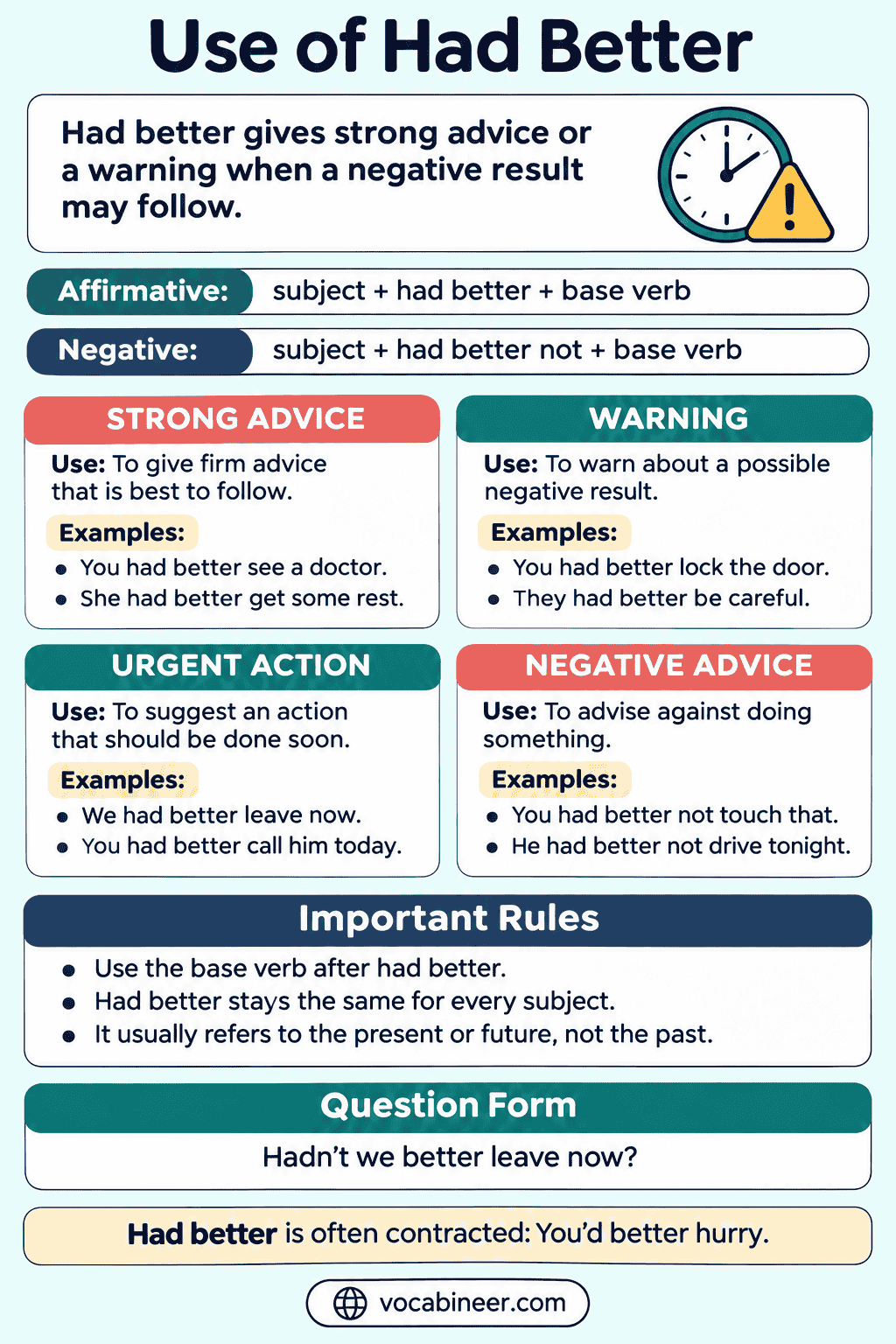
Had better is a semi-modal expression used to give strong advice, recommend an urgent action, or warn someone about a possible negative consequence. For example, You had better leave now means that leaving is the wisest action in the current situation and that staying may cause a problem.
Although the expression contains the past form had, had better normally refers to the present or future. It follows a fixed pattern: had better + base verb. Learning this structure, its negative and question forms, and its differences from should, must, and would rather will help you use it accurately and naturally.
In This Page
Had Better at a Glance
| Sentence type | Structure | Example |
|---|---|---|
| Affirmative | subject + had better + base verb | You had better leave. |
| Negative | subject + had better not + base verb | You had better not wait. |
| Contracted | subject + ’d better + base verb | She ’d better call. |
| Question | had + subject + better + base verb? | Had we better leave? |
| Perfect form | subject + had better have + past participle | You had better have finished. |
Meaning of Had Better
Use had better when you believe one action is clearly the best choice in a specific situation. The expression often implies that something unpleasant, inconvenient, or dangerous may happen if the person ignores the advice.
- You had better take an umbrella. It looks like rain.
- We had better leave before the traffic becomes heavy.
- He had better apologize, or he may lose his job.
- She had better save a copy before closing the program.
In these examples, the advice is not merely a general suggestion. Each sentence responds to a particular circumstance and often carries a sense of urgency.
Grammatical Features of Had Better
Had better behaves like a modal expression in several ways:
- Had remains unchanged with every subject.
- A bare infinitive follows had better.
- The main verb does not take to, -s, or a past-tense ending.
- The expression usually refers to the present or future.
- The standard contraction is ’d better.
- In ’d better, ’d means had, not would.
- The negative form places not after better.
- Questions are possible, although they occur less often than statements.
Because the expression is fixed, we say She had better go, not She has better go or She had better goes.
Affirmative Sentences with Had Better
Use the following structure for affirmative statements:
Subject + had better + base verb
- I had better start working.
- You had better check the address.
- He had better speak to the manager.
- She had better take a coat.
- We had better book the tickets today.
- They had better arrive on time.
The main verb always stays in its base form. Therefore, go, speak, take, and arrive do not change according to the subject.
| Incorrect | Correct |
|---|---|
| She had better goes home. | She had better go home. |
| They had better left early. | They had better leave early. |
| He had better to call. | He had better call. |
Negative Sentences with Had Better
Use this structure for negative statements:
Subject + had better not + base verb
- You had better not touch that wire.
- He had better not forget the appointment.
- She had better not drive in such heavy rain.
- We had better not be late.
- They had better not enter the building.
Place not after better, not between had and better. Moreover, keep the following verb in its base form.
| Incorrect | Correct |
|---|---|
| You had not better go. | You had better not go. |
| She had better not to wait. | She had better not wait. |
| He had better not drives. | He had better not drive. |
The negative form often gives a strong warning. For instance, You had better not touch that wire suggests that touching it may be dangerous.
Contracted Forms of Had Better
In conversation and informal writing, speakers usually contract had to ’d.
| Full form | Contracted form |
|---|---|
| I had better | I’d better |
| You had better | You’d better |
| He had better | He’d better |
| She had better | She’d better |
| We had better | We’d better |
| They had better | They’d better |
Examples include:
- I ’d better call her.
- You ’d better hurry.
- He ’d better check the figures again.
- She ’d better take a coat.
- We ’d better leave now.
- They ’d better not complain.
The contraction ’d can represent had or would in English. However, before better, it always means had. Therefore, You’d better leave means You had better leave, not You would better leave.
Questions with Had Better
Questions with had better are grammatically correct, but they appear less frequently than affirmative and negative statements.
Use this structure:
Had + subject + better + base verb?
- Had we better leave now?
- Had I better call first?
- Had they better wait outside?
- Had she better speak to the director?
Negative questions can present a strong suggestion:
- Hadn’t you better check the address?
- Hadn’t we better tell the manager?
- Hadn’t he better see a doctor?
These forms can sound formal or forceful. Consequently, everyday speakers often choose a softer alternative:
- Do you think we had better leave?
- Do you think I should call first?
- Would it be better to wait?
Main Uses of Had Better
Strong Advice
Use had better when the recommended action is important in a particular situation.
- You had better see a doctor about that pain.
- She had better save a copy of the document.
- We had better ask for directions before it gets dark.
- He had better prepare carefully for the interview.
The expression sounds stronger than a general recommendation with should.
Warnings
Use had better when ignoring the advice may lead to trouble, danger, or another undesirable result.
- You had better slow down, or you may have an accident.
- He had better not touch that cable.
- They had better follow the safety instructions.
- She had better not miss another deadline.
The negative consequence may appear directly, as in or you may have an accident, or remain implied.
Urgent Actions
Use had better when someone needs to act soon.
- We had better hurry.
- I had better call the police.
- You had better submit the form today.
- She had better leave before the storm arrives.
Time expressions such as now, soon, today, and before noon often reinforce the urgency.
Avoiding Negative Consequences
Many sentences with had better connect a recommended action with a possible result.
- He had better pay the bill before the deadline.
- You had better lock the door, or someone may enter.
- We had better leave now, or we will miss the train.
- They had better bring identification, or security may refuse entry.
This connection explains why had better can sound more serious than should.
Situation-Specific Decisions
Use had better when present circumstances make one choice especially sensible.
- We had better take a taxi because the buses have stopped.
- She had better wear formal clothes for the interview.
- I had better bring some cash in case the shop does not accept cards.
- They had better choose another route because the bridge is closed.
The advice applies to a particular situation rather than to life in general.
Present and Future Meaning
Although had usually marks past time, the complete expression had better normally refers to the present or future.
| Time reference | Example |
|---|---|
| Present situation | You had better be careful. |
| Immediate future | We had better leave now. |
| Near future | She had better call tomorrow. |
| Future deadline | You had better finish by Friday. |
Therefore, You had better call her now gives present advice, while You had better call her tomorrow gives future advice. Neither sentence describes the past.
Past Advice with Should Have
Use should have + past participle to criticize or evaluate a completed past action. Do not use ordinary had better + base verb for this purpose.
| Present or future advice | Past regret or criticism |
|---|---|
| You had better call her now. | You should have called her yesterday. |
| We had better leave early. | We should have left early. |
| He had better apologize. | He should have apologized. |
| She had better save the file. | She should have saved the file. |
The sentence You should have called her yesterday means that calling was the advisable action, but it did not happen. By contrast, You had better call her now recommends an action that can still happen.
Had Better Have with a Past Participle
The advanced structure had better have + past participle expresses a strong expectation or warning that something must already be completed by a particular future point or by the time it becomes relevant.
- You had better have finished the report by tomorrow.
- He had better have paid the bill before the deadline.
- They had better have arrived by the time the meeting starts.
- She had better have completed the training before her first shift.
Despite its perfect form, this structure does not normally express ordinary regret about a past event. Use should have + past participle when you want to say that a completed past action was advisable but did not happen.
Had Better and Should
Both expressions give advice, but their strength and typical contexts differ.
| Had better | Should |
|---|---|
| Gives strong or urgent advice | Gives general or mild advice |
| Usually relates to a specific situation | Can express broad recommendations |
| Often implies a negative consequence | Does not necessarily imply a consequence |
| Can sound forceful | Usually sounds more neutral |
| You had better leave now. | You should exercise regularly. |
Compare these sentences:
- You should take an umbrella. — a helpful suggestion
- You had better take an umbrella. — stronger advice because rain seems likely
Use should for broad health, study, or lifestyle advice. Use had better when the immediate situation creates urgency or risk.
Had Better and Ought To
Both forms can express advice, but ought to often sounds more general or connected with moral responsibility.
| Had better | Ought to |
|---|---|
| Strong and situation-specific | General advice or moral responsibility |
| Often sounds urgent | Usually sounds less urgent |
| May imply a warning | Often emphasizes what is right or advisable |
| You had better apologize now. | You ought to apologize. |
For example, You ought to help your neighbors expresses a general moral view. In contrast, You had better help them before the storm arrives responds to an immediate situation.
Had Better and Must
Had better expresses strong advice, whereas must presents an action as necessary, required, or compulsory.
| Had better | Must |
|---|---|
| Strong advice or warning | Obligation, rule, or necessity |
| The listener can technically ignore the advice | The action is presented as required |
| Often implies a possible consequence | Often expresses authority or firm necessity |
| You had better wear a coat. | You must wear a safety helmet. |
You had better wear a coat warns that the person may become cold. You must wear a safety helmet states a firm requirement.
Had Better and Would Rather
These expressions look similar because both commonly use ’d, but their meanings differ completely.
| Had better | Would rather |
|---|---|
| Expresses strong advice | Expresses preference |
| ’d means had | ’d means would |
| Followed by a bare infinitive | Followed by a bare infinitive |
| You’d better stay. | You’d rather stay. |
- You ’d better stay. — Staying is the advisable action.
- You ’d rather stay. — Staying is your preferred choice.
Never replace had with would before better. The form would better leave is incorrect in this meaning.
Had Better and Be Supposed To
Had better gives advice or a warning, while be supposed to describes an expectation, arrangement, instruction, or duty.
| Had better | Be supposed to |
|---|---|
| Gives strong advice or a warning | Describes an expectation, arrangement, or duty |
| Often depends on immediate circumstances | Often depends on a rule or plan |
| You had better arrive early. | You are supposed to arrive early. |
In the first sentence, arriving early is a wise choice. In the second, someone expects or requires an early arrival.
Had Better with Different Subjects
The form had better remains unchanged with every subject.
| Subject | Example |
|---|---|
| I | I had better go. |
| You | You had better wait. |
| He | He had better call. |
| She | She had better rest. |
| It | It had better work. |
| We | We had better hurry. |
| They | They had better listen. |
Do not use has better with he, she, or it. Likewise, do not add -s to the main verb.
Adverb Position
Adverbs usually appear before the main verb or after the complete verb phrase, depending on their meaning.
- You had better carefully check the figures.
- She had better always keep a backup.
- We had better leave immediately.
- He had better speak politely.
Avoid separating had and better with unnecessary words because they function as a fixed expression.
Tone and Politeness
Because had better sounds strong, it can appear forceful, controlling, or even threatening when directed at another person.
- You had better finish this today.
- He had better not speak to me like that again.
These sentences may be appropriate when the speaker has authority or when a genuine consequence exists. However, they may sound impolite in a casual request or when speaking to someone of equal or higher status.
Use softer alternatives when a warning is unnecessary:
- You should probably finish this today.
- It might be better to finish this today.
- I think you should finish this today.
- You may want to finish this today.
- It would be wise to finish this today.
Therefore, choose had better when urgency or risk justifies its stronger tone.
Had Better in Spoken English
The contracted form ’d better appears frequently in natural conversation.
- I’d better go.
- You’d better wait.
- She’d better call.
- We’d better hurry.
In very informal speech, some speakers omit had and say You better leave. This shortened version is common in certain varieties of spoken English, particularly American English. Nevertheless, had better or ’d better remains the safer choice in standard and formal writing.
Common Mistakes with Had Better
Adding To Before the Main Verb
Use a bare infinitive after had better.
| Incorrect | Correct |
|---|---|
| You had better to leave. | You had better leave. |
Putting Not in the Wrong Position
Place not after better.
| Incorrect | Correct |
|---|---|
| You had not better go. | You had better not go. |
Changing Had According to the Subject
The form had remains unchanged.
| Incorrect | Correct |
|---|---|
| She has better rest. | She had better rest. |
Treating Had Better as a Past-Tense Form
Use should have for past regret or criticism.
| Incorrect | Correct |
|---|---|
| Yesterday, you had better call her. | Yesterday, you should have called her. |
Confusing Had Better with Would Better
In ’d better, ’d represents had.
| Incorrect | Correct |
|---|---|
| You would better leave. | You had better leave. |
| You ’d better leave. | Correct contracted form |
Using Had Better for General Advice
Use should for broad recommendations that do not involve an immediate consequence.
| Less natural | Natural |
|---|---|
| People had better exercise regularly. | People should exercise regularly. |
Adding Will After Had Better
The base verb follows had better directly.
| Incorrect | Correct |
|---|---|
| You had better will leave now. | You had better leave now. |
Changing the Main Verb
Do not add -s or use a past form after had better.
| Incorrect | Correct |
|---|---|
| She had better goes home. | She had better go home. |
| They had better left early. | They had better leave early. |
Choosing the Right Expression
The correct expression depends on the strength, time, and purpose of the message.
| Intended meaning | Best choice |
|---|---|
| Strong advice in a specific situation | had better |
| General recommendation | should |
| Moral duty | ought to |
| Rule or firm obligation | must |
| Past regret or criticism | should have |
| Personal preference | would rather |
| Expected behavior | be supposed to |
Before choosing had better, ask whether the situation involves urgency, risk, or a likely consequence. If it does, had better may be appropriate. If the advice is general, should will usually sound more natural.
Key Points to Remember
- Had better gives strong advice or a warning.
- It often implies an undesirable consequence.
- It normally refers to the present or future.
- Use a bare infinitive after had better.
- Put not after better in negative sentences.
- Had remains unchanged with every subject.
- ’d better is the standard contraction.
- In ’d better, ’d means had.
- Questions are possible but less common than statements.
- Use should have for advice about a completed past action.
- Use should when the advice is general or less forceful.
- Use had better have + past participle for a strong expectation that something must be complete by a relevant time.
FAQs
Had better gives strong, situation-specific advice or a warning. It often suggests that an undesirable consequence may follow if the person ignores the advice. For example, You had better leave now implies that staying could cause a problem.
No. Although the expression contains had, it normally refers to present or future situations. Use should have + past participle when giving criticism or expressing regret about a completed past action.
A bare infinitive follows had better. Say You had better leave, not You had better to leave or You had better left.
Had better gives stronger, more immediate advice and often implies a negative consequence. Should usually gives milder or more general advice. For example, You should exercise regularly is a broad recommendation, while You had better see a doctor today responds to a specific concern.
Yes. Questions such as Had we better leave? and Had I better call first? are correct. However, they can sound formal, so speakers often use alternatives such as Do you think we should leave?
Conclusion
Had better expresses strong, situation-specific advice and often warns of an undesirable result. Its structure remains fixed: had better + base verb in affirmative sentences and had better not + base verb in negative sentences. Although it contains had, the expression normally refers to present or future actions.
To use had better naturally, consider both meaning and tone. Choose it when a situation involves urgency, risk, or a likely consequence. In contrast, use should for general advice, must for firm obligations, should have for past regret, and would rather for personal preference. These distinctions will make your advice clearer, more accurate, and more appropriate for the situation.
Read More