

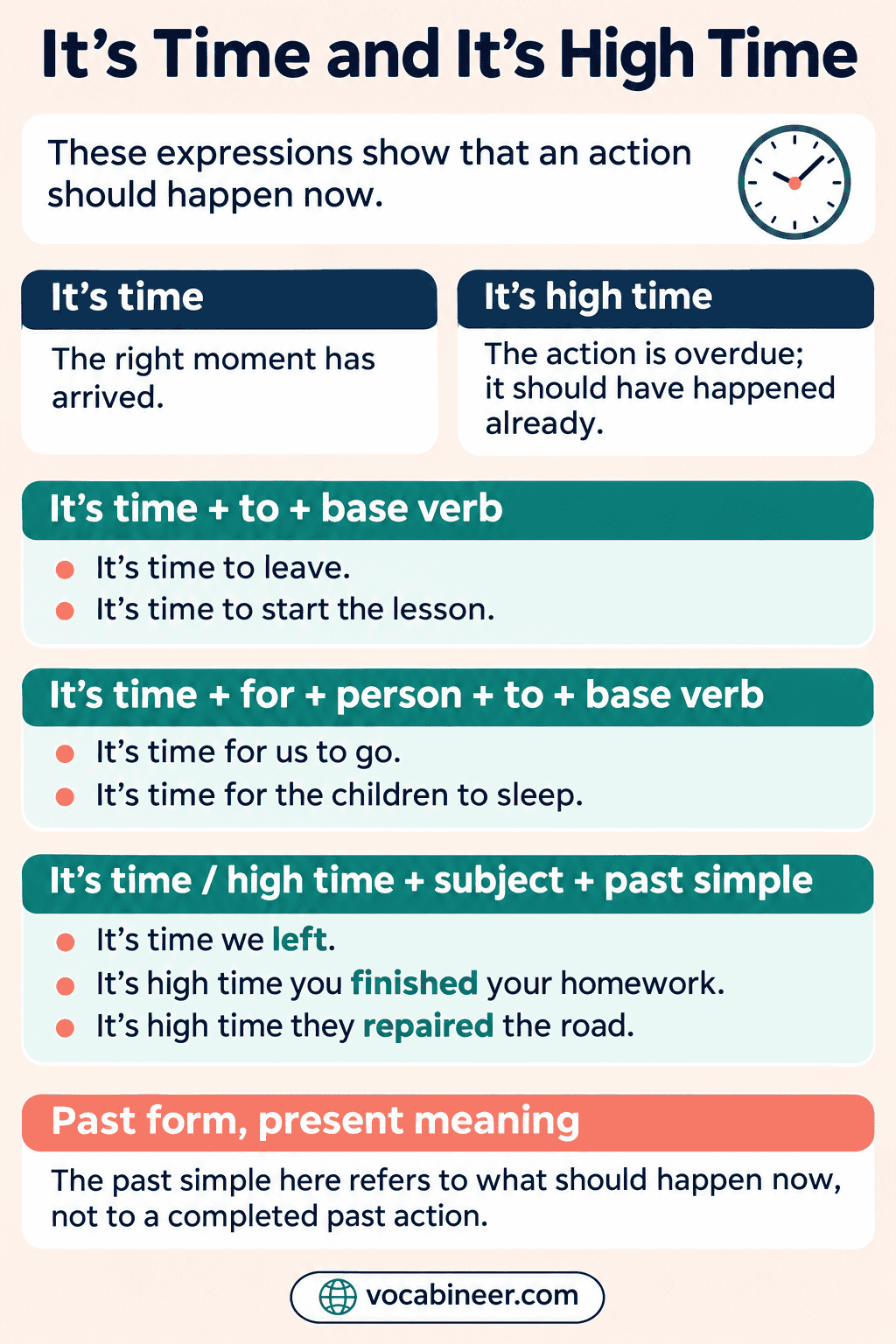
It’s time tells us that the right moment for an action or event has arrived. We use it for everyday situations: It’s time for lunch, It’s time to start the meeting, and It’s time for the children to go to bed. It’s high time sounds stronger. It suggests that someone should have acted already: It’s high time we fixed the problem.
These expressions follow several useful patterns. We can say it’s time to leave, it’s time for us to leave, or it’s time we left. The last sentence contains a past-tense verb, but it usually means that we should leave now. This guide explains the structures, their differences in tone, and the mistakes learners commonly make.
In This Page
It’s Time and It’s High Time at a Glance
| Expression | Structure | Example | Meaning |
|---|---|---|---|
| It’s time to | it’s time + to-infinitive | It’s time to leave. | The right moment has arrived. |
| It’s time for | it’s time for + noun | It’s time for lunch. | An event or activity should begin. |
| It’s time for someone to | it’s time for + object + to-infinitive | It’s time for us to leave. | Identifies who should act. |
| It’s time someone did | it’s time + subject + past simple | It’s time we left. | We should act now. |
| It’s high time someone did | it’s high time + subject + past simple | It’s high time you apologized. | The action is overdue. |
| It’s about time someone did | it’s about time + subject + past simple | It’s about time they decided. | The delay prompts impatience, criticism, or relief. |
What It’s Time Means
Use it’s time when an action, event, or activity should begin now or soon. The expression can sound neutral, practical, or gently persuasive, depending on the situation.
- It’s time to begin the lesson.
- It’s time for dinner.
- It’s time for the children to sleep.
- It’s time we went home.
The words after it’s time determine the sentence structure. A to-infinitive names an action, a noun names an event or activity, and a clause names the person who should act.
It’s Time + To-Infinitive
Use it’s time + to + base verb when the person who should act is obvious or unimportant.
- It’s time to leave.
- It’s time to start the meeting.
- It’s time to make a decision.
- It’s time to go home.
For example, if everyone at a meeting is ready, the chairperson might say, “It’s time to begin.”
It’s Time + For + Noun
Use it’s time for + noun to announce an event, meal, activity, or period.
- It’s time for lunch.
- It’s time for school.
- It’s time for a break.
- It’s time for the meeting.
Here, for lunch and for a break name activities. They do not tell us who must act.
It’s Time + For Someone + To-Infinitive
Use it’s time for + person + to + base verb when you want to identify who should act.
- It’s time for us to leave.
- It’s time for her to decide.
- It’s time for the children to sleep.
- It’s time for the team to begin.
After for, use an object pronoun such as me, him, her, us, or them:
| Correct pattern | Example |
|---|---|
| for me to | It’s time for me to go. |
| for him to | It’s time for him to decide. |
| for her to | It’s time for her to speak. |
| for us to | It’s time for us to leave. |
| for them to | It’s time for them to act. |
It’s Time + Subject + Past Simple
Use it’s time + subject + past-simple verb to say that someone should act now or soon.
- It’s time we left.
- It’s time you went to bed.
- It’s time he found a new job.
- It’s time they made a decision.
This pattern can sound firmer than a simple to-infinitive. It’s time you went to bed, for instance, addresses the listener directly and may suggest that bedtime has already arrived.
Why the Past Simple Can Mean Now
The past-simple verb after it’s time usually does not describe a completed past action. Instead, it presents an action that should happen in the present or near future.
| Sentence | Verb form | Intended meaning |
|---|---|---|
| It’s time we left. | Past simple | We should leave now. |
| It’s time she went home. | Past simple | She should go home now. |
| It’s time they started. | Past simple | They should start now. |
Grammar books often call this use the unreal past. English also uses past forms to create distance from a present situation in sentences such as I wish you were here and I’d rather you stayed. The form looks past, but the intended action lies ahead.
For learners, it’s time we left is a dependable pattern. Present-form variants such as it’s time we leave occur in some varieties of English, especially American English, but the past-simple pattern works broadly.
What It’s High Time Means
It’s high time means that an action is overdue. It often communicates urgency, impatience, criticism, or a strong desire for change.
- It’s high time you apologized.
- It’s high time we addressed the problem.
- It’s high time he took responsibility.
- It’s high time they repaired the road.
The most useful pattern is:
It’s high time + subject + past simple
The action itself belongs to the present or future. In It’s high time we addressed the problem, the speaker believes the group should address it now and may have waited too long.
It’s high time to + base verb also occurs:
- It’s high time to act.
- It’s high time to make a change.
However, the clause pattern makes it especially easy to identify the person or group whose action is overdue.
What It’s About Time Means
It’s about time also suggests that an action is due or overdue. Depending on tone and context, it can show impatience, criticism, relief, or approval.
- It’s about time we replaced this computer.
- It’s about time he admitted the truth.
- It’s about time they updated the system.
It can also stand alone when a delayed event finally happens:
“The bus is finally here.”
“It’s about time!”
In this exchange, the second speaker expresses relief or impatience about the wait.
Context matters with sentences such as It’s about time you arrived. Said to a person who has just arrived, it comments on their delayed arrival. Said before an expected arrival, a similar clause can urge someone to act. The situation tells us whether the speaker is reacting to an event or calling for one.
It’s Time, It’s High Time, and It’s About Time
These expressions share a connection to timing, but they do not always carry the same strength.
| Expression | Typical meaning | Typical tone | Example |
|---|---|---|---|
| It’s time to… | The appropriate moment has arrived | Neutral and direct | It’s time to leave. |
| It’s time someone did… | Someone should act now | Firm; sometimes mildly critical | It’s time we left. |
| It’s about time someone did… | An action has been delayed | Impatient, critical, or relieved | It’s about time we left. |
| It’s high time someone did… | An action is clearly overdue | Strong and urgent | It’s high time we left. |
These are typical differences, not absolute rules. A calm voice can soften a sentence, while a sharp tone can make even It’s time to leave sound impatient.
It’s Time to Leave and It’s Time We Left
Both sentences can tell a group to leave now. Their structures and emphasis differ.
| It’s time to leave | It’s time we left |
|---|---|
| Uses a to-infinitive | Uses a subject and past-simple verb |
| Does not name the person who should leave | Names the group directly |
| Often sounds neutral | Can sound firmer or more immediate |
| It’s time to leave. | It’s time we left. |
Use the first when a simple announcement is enough. Use the second when you want to emphasize that we should take action.
It’s Time for Us to Leave and It’s Time We Left
These sentences both identify the people who should leave, but they use different pronouns.
| It’s time for us to leave | It’s time we left |
|---|---|
| Uses for + object pronoun + to-infinitive | Uses subject pronoun + past simple |
| Us is the object of for | We is the subject of left |
| Sounds explicit and fairly neutral | Can sound a little firmer |
The same distinction applies to other pronouns:
| For + object + infinitive | Subject + past simple |
|---|---|
| It’s time for me to go. | It’s time I went. |
| It’s time for him to decide. | It’s time he decided. |
| It’s time for us to leave. | It’s time we left. |
| It’s time for them to act. | It’s time they acted. |
Optional That Before a Clause
You can put that before the subject-and-verb clause.
- It’s time that we left.
- It’s high time that he apologized.
- It’s about time that they made a decision.
However, speakers commonly leave that out:
- It’s time we left.
- It’s high time he apologized.
- It’s about time they made a decision.
Both versions are understandable. The version without that often sounds more natural in everyday speech.
Talking About a Past Moment
Change it’s to it was when the point at which an action became due lies in the past.
- It was time to leave.
- It was time for us to go.
- It was time we left.
- She realized it was high time she changed jobs.
- They felt it was about time they replaced the equipment.
In It was time we left, leaving was due at that past moment. Whether the group actually left depends on the rest of the story:
- It was time we left, so we packed our bags.
- It was time we left, but nobody wanted to move.
Expressing Negative Ideas
When you want to say that a habit or behavior should end, stop + -ing often creates the clearest sentence.
- It’s time you stopped worrying.
- It’s high time he stopped ignoring the warnings.
- It’s about time they stopped making excuses.
- It’s time we stopped arguing and found a solution.
A direct negative clause is possible in some contexts, but it often sounds less natural:
| Less natural in everyday use | More natural |
|---|---|
| It’s time you didn’t waste money. | It’s time you stopped wasting money. |
| It’s high time he didn’t ignore us. | It’s high time he stopped ignoring us. |
After an infinitive, choose the wording that expresses the intended action clearly: It’s time to stop arguing is usually smoother than It’s time not to argue.
Questions and Short Answers
For a neutral question, place is before it.
- Is it time to leave?
- Is it time for dinner?
- Is it time for us to start?
Negative questions often suggest that the speaker already believes the action should happen:
- Isn’t it time we left?
- Isn’t it time you went to bed?
- Isn’t it high time they made a decision?
- Isn’t it about time he apologized?
Short answers follow the tense of be:
- Is it time to leave? — Yes, it is.
- Is it time for lunch? — No, it isn’t.
- Was it time to start? — Yes, it was.
Choosing a Suitable Tone
It’s high time and it’s about time can sound critical when directed at someone. For example, It’s high time you found a job may suggest that the speaker disapproves of the listener’s delay.
If you want to sound gentler, try:
- Perhaps it’s time to discuss this.
- I think it may be time to make a decision.
- It might be a good time to leave.
- We should probably start soon.
Don’t you think it’s time to leave? may sound polite in one conversation but pointed in another. Consider the relationship and the listener’s situation before choosing a form.
Common Mistakes
Confusing the Infinitive and Clause Patterns
Use to + base verb without a stated subject, or use subject + past simple.
| Incorrect | Correct |
|---|---|
| It’s time we to leave. | It’s time we left. |
| It’s time leave. | It’s time to leave. |
Using the Wrong Pronoun After For
A pronoun after for takes its object form.
| Incorrect | Correct |
|---|---|
| It’s time for we to leave. | It’s time for us to leave. |
| It’s time for he to decide. | It’s time for him to decide. |
Using an Object Pronoun as the Clause Subject
The pronoun before the past-simple verb must be a subject pronoun.
| Incorrect | Correct |
|---|---|
| It’s time us left. | It’s time we left. |
| It’s time him apologized. | It’s time he apologized. |
Using a Past Participle Instead of the Past Simple
| Incorrect | Correct |
|---|---|
| It’s time we gone home. | It’s time we went home. |
| It’s high time she written to them. | It’s high time she wrote to them. |
Mistaking the Past Form for Past Meaning
It’s time we left usually means we should leave now. It does not mean that we already left. If you want to report a completed departure, say We left or We have left, depending on the context.
Using High Time for an Ordinary Schedule
It’s time suits routine announcements. It’s high time usually implies a significant delay.
| Routine announcement | Overdue action |
|---|---|
| It’s time for lunch. | It’s high time we fixed the broken door. |
Confusing It’s and Its
| Form | Meaning | Example |
|---|---|---|
| it’s | it is | It’s time to leave. |
| its | Possessive form | The clock lost its hands. |
Choosing the Correct Structure
| Intended meaning | Recommended structure | Example |
|---|---|---|
| Announce an event | It’s time for + noun | It’s time for lunch. |
| Say an action should begin | It’s time to + base verb | It’s time to go. |
| Identify who should act | It’s time for + object + to-infinitive | It’s time for us to go. |
| Express a firm present expectation | It’s time + subject + past simple | It’s time we went. |
| Emphasize an overdue action | It’s high time + subject + past simple | It’s high time we acted. |
| React to delay with impatience or relief | It’s about time + subject + past simple | It’s about time they arrived. |
| Refer to a past point | It was time… | It was time to leave. |
Key Points to Remember
- It’s time means that the appropriate moment has arrived.
- It’s high time emphasizes that an action is overdue.
- It’s about time can express impatience, criticism, or relief.
- Use it’s time to + base verb when the person who should act is understood.
- Use it’s time for + object + to-infinitive to name that person.
- Use it’s time + subject + past simple for a firm expectation about now or soon.
- The past-simple verb in that pattern usually does not describe a completed past action.
- Use it was time when the relevant moment itself lies in the past.
- Choose the expression with its tone in mind.
FAQs
It’s time means that the appropriate or expected moment for an action or event has arrived. For example, It’s time to start tells people that they should begin now.
It’s time can be a neutral announcement. It’s high time adds emphasis and usually suggests that the action should have happened sooner. Compare It’s time to discuss the issue with It’s high time we discussed the issue.
In It’s time we left, the past-simple form expresses distance from the current situation. The intended meaning is usually that we should leave now, not that we left earlier.
They can both describe an overdue action. However, it’s about time often appears in everyday speech and can express relief when something finally happens. It’s high time usually stresses urgency or criticism more strongly.
Both are correct. It’s time to leave uses a to-infinitive and sounds direct and neutral. It’s time we left names the group and can sound firmer or more urgent.
Conclusion
It’s time tells us that an action or event should begin. It’s high time adds the idea that someone has waited too long, while it’s about time can express impatience or relief about a delay. Choose to + base verb for a general action, for + object + to-infinitive to identify who should act, and subject + past simple when you want to state firmly that an action is due now.
Read More
- Verbs in English
- Action Verbs
- Regular Verbs
- Irregular Verbs
- Transitive and Intransitive verbs
- Finite and Non-finite verbs
- Principal Parts of Verbs
- Forms of Verbs