

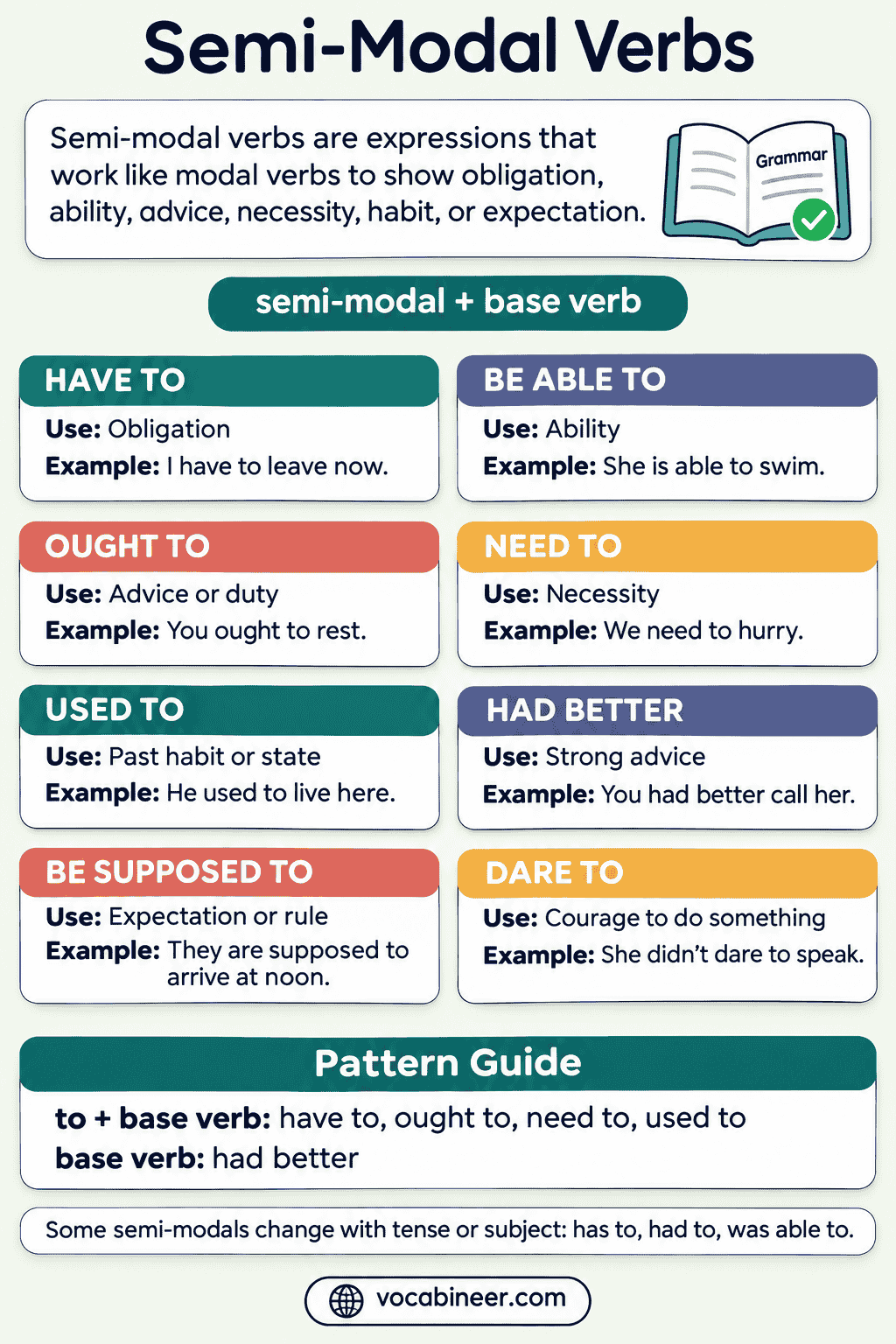
Semi-modal verbs help speakers express ability, necessity, obligation, advice, permission, probability, preference, expectation, and future intention. Familiar examples include have to, ought to, be able to, be supposed to, and used to. These forms perform many of the same jobs as central modal verbs such as can, must, and should, but their grammar often works differently.
Unlike central modals, many semi-modals change according to the subject or tense, take a to-infinitive, or require do, does, or did in questions and negatives. For example, we say She has to work, Does she have to work?, and She did not have to work. Understanding these patterns makes it easier to choose the right expression and form accurate sentences.
In This Page
Semi-Modal Verbs at a Glance
The following table introduces common semi-modal and modal-like expressions. Grammar books do not always classify every item in exactly the same way, but these forms are often taught together because they express modal meanings.
| Semi-modal or related expression | Main meaning | Example |
|---|---|---|
| have to | Necessity or obligation | I have to leave now. |
| have got to | Strong present necessity | We have got to hurry. |
| need to | Necessity | She needs to rest. |
| need | Necessity, mainly in questions and negatives | You need not wait. |
| dare | Courage or willingness | Dare he object? |
| ought to | Advice, duty, or expectation | You ought to apologize. |
| used to | Past habit or state | He used to live here. |
| be able to | Ability | She is able to swim. |
| be allowed to | Permission | We are allowed to enter. |
| be supposed to | Expectation, duty, or arrangement | You are supposed to wait. |
| be going to | Intention or evidence-based prediction | It is going to rain. |
| be about to | Immediate future | The show is about to begin. |
| had better | Strong advice or warning | You had better leave. |
| would rather | Preference | I would rather stay. |
| be likely to | Probability | They are likely to win. |
| be meant to | Intended action or purpose | This key is meant to open the door. |
Meaning of Semi-Modal Verbs
A semi-modal verb is a verb or multiword expression that communicates a meaning similar to a modal verb while retaining some features of an ordinary verb. For instance, have to expresses obligation like must, but it changes form: has to, had to, and will have to. It also forms questions with do: Do you have to leave?
The term semi-modal does not have one completely fixed list. Different grammar references may use labels such as marginal modal, quasi-modal, or semi-auxiliary for related forms. Therefore, it helps to understand the grammatical behavior instead of focusing only on the label.
| Category | Typical members | Main feature |
|---|---|---|
| Central modals | can, could, may, might, must, shall, should, will, would | Do not change for person and normally take a bare infinitive |
| Marginal modals | need, dare, ought to, used to | Share some, but not all, features of central modals |
| Semi-auxiliaries or quasi-modals | have to, be able to, be going to, be supposed to | Multiword expressions with modal-like meanings |
For practical learning, this article discusses these groups together while explaining their individual structures.
Main Features of Semi-Modals
Semi-modals differ from one another, but many share the following features:
- They express meanings such as ability, necessity, permission, advice, or probability.
- Many change according to the subject: I have to but she has to.
- Many can appear in several tenses: had to, will have to, and has had to.
- Several take a to-infinitive: ought to go, be able to swim, and need to work.
- Some form questions and negatives with do, does, or did.
- Expressions containing be form questions by inversion: Is she able to help?
- A few, such as modal need and dare, can behave more like central modals.
Semi-Modals and Central Modal Verbs
Central modals and semi-modals often express similar ideas, but their sentence patterns differ.
| Feature | Central modals | Semi-modals |
|---|---|---|
| Form after the modal | Usually a bare infinitive | Often a to-infinitive |
| Third-person -s | Not used | May appear within the expression |
| Tense flexibility | Often limited | Usually greater |
| Questions | Inversion without do | Often use do or a form of be |
| Negatives | Add not directly | May use do not or be not |
| Example | She can swim. | She is able to swim. |
Compare She can drive with She is able to drive. Both express ability. However, be able to supplies forms that can lacks, including will be able to and has been able to.
Ability with Be Able To
Use be able to + base verb to express ability. Because the verb be changes form, this expression works across many tenses.
- She is able to solve difficult equations.
- He was able to escape through a window.
- We will be able to attend the meeting.
- They have been able to reduce their expenses.
Can and Be Able To
| Can | Be able to |
|---|---|
| Common for present ability | Works across a wider range of tenses |
| Often sounds more natural in everyday statements | Useful when can has no suitable form |
| She can swim. | She will be able to swim soon. |
For a successful action on one particular past occasion, was/were able to or managed to often sounds clearer than affirmative could.
- General ability: He could run quickly when he was young.
- Specific success: He was able to catch the last train.
However, could remains natural with verbs of perception and thought: I could hear music and I could understand the explanation.
Obligation with Have To
Use have to + base verb for duties, rules, and necessities created by circumstances.
- I have to wear a uniform at work.
- She has to submit the form today.
- We had to cancel the trip.
- You will have to wait outside.
Unlike must, have to changes according to the subject and tense.
| Sentence type | Structure | Example |
|---|---|---|
| Affirmative | subject + have/has to + base verb | He has to study. |
| Negative | subject + do/does not have to + base verb | He does not have to study. |
| Question | do/does + subject + have to + base verb? | Does he have to study? |
| Past | subject + had to + base verb | He had to study. |
| Future | subject + will have to + base verb | He will have to study. |
Must and Have To
Both forms can express obligation, and their meanings often overlap. Still, must commonly presents a strong instruction or a necessity emphasized by the speaker, while have to often refers to an external rule or circumstance.
| Must | Have to |
|---|---|
| Often expresses strong personal authority or emphasis | Often expresses an external duty or circumstance |
| Has limited tense forms | Changes across tenses |
| You must apologize. | I had to apologize. |
Strong Present Necessity with Have Got To
Have got to + base verb expresses strong present necessity, especially in conversation.
- I have got to finish this report.
- She has got to leave now.
- We have got to find another solution.
The contracted forms I’ve got to and she’s got to are very common in speech. However, have got to has less tense flexibility than have to and may sound too conversational in formal writing.
| Have to | Have got to |
|---|---|
| Neutral and suitable for most contexts | More conversational |
| Works across different tenses | Used mainly for present necessity |
| We had to leave. | We have got to leave. |
Necessity with Need To
Use need to + base verb when an action is necessary or important.
- You need to check the details.
- He needs to improve his attendance.
- We needed to find another route.
- They will need to book in advance.
When need functions as an ordinary verb, it changes with the subject and forms questions and negatives with do.
- She does not need to come.
- Do we need to bring identification?
- Did they need to pay a fee?
Advice and Duty with Ought To
Use ought to + base verb for advice, moral responsibility, duty, or an expected result.
- You ought to speak politely.
- We ought to help those in need.
- He ought to apologize for his behavior.
- The bus ought to arrive soon.
The negative form is ought not to, although should not is more common in everyday English.
- You ought not to ignore the warning.
Should and Ought To
| Should | Ought to |
|---|---|
| Very common in everyday English | Slightly more formal and less frequent |
| Expresses advice or expectation | Can emphasize moral duty as well as advice |
| You should rest. | You ought to rest. |
Strong Advice with Had Better
Use had better + base verb for strong advice or a warning. The form often suggests that an undesirable consequence may follow if the person ignores the advice.
- You had better take an umbrella.
- We had better leave before traffic becomes heavy.
- He had better not miss another appointment.
Although the expression contains had, it usually refers to the present or future. Moreover, it takes a bare infinitive, not a to-infinitive.
| Incorrect | Correct |
|---|---|
| You had better to leave. | You had better leave. |
| She had better not to wait. | She had better not wait. |
Should and Had Better
| Should | Had better |
|---|---|
| Gives general or mild advice | Gives stronger advice or a warning |
| Often has no implied consequence | Often suggests a negative consequence |
| You should rest. | You had better rest, or you may become ill. |
Past Habits and States with Used To
Use used to + base verb for repeated past actions or past states that are no longer true.
- I used to walk to school.
- She used to have long hair.
- They used to live nearby.
- We used to visit our grandparents every summer.
In questions and negatives with did, the standard written form is use to because did already marks the past.
- I did not use to drink coffee.
- Did you use to play tennis?
Used To and Would
| Used to | Would |
|---|---|
| Describes past habits and states | Describes repeated past actions |
| Can stand without a previously established past-time context | Usually needs a clear past context |
| I used to live there. | Every summer, we would visit the coast. |
Do not normally use habitual would for past states. Say I used to own a bicycle, not I would own a bicycle.
Permission with Be Allowed To
Use be allowed to + base verb to express permission. Since be can change form, the expression works in present, past, future, and perfect structures.
- Students are allowed to use calculators.
- We were allowed to leave early.
- Visitors will be allowed to enter at noon.
- She has been allowed to work from home.
Can, May, and Be Allowed To
| Form | Typical use | Example |
|---|---|---|
| can | Everyday permission | You can sit here. |
| may | Formal permission | You may enter now. |
| be allowed to | Permission across different tenses | We were allowed to enter. |
Expectations with Be Supposed To
Use be supposed to + base verb for expectations, duties, arrangements, or accepted rules.
- You are supposed to submit the form today.
- The train is supposed to arrive at six.
- Employees are not supposed to use this entrance.
- We were supposed to meet yesterday.
The past form was/were supposed to often describes an arrangement or duty that did not happen.
- I was supposed to call her, but I forgot.
- They were supposed to arrive at noon, but their flight was delayed.
Be Supposed To and Have To
| Be supposed to | Have to |
|---|---|
| Describes an expectation, arrangement, or rule | Describes a stronger necessity or obligation |
| You are supposed to arrive by nine. | You have to show identification. |
Plans and Predictions with Be Going To
Use be going to + base verb for a prior intention or a prediction based on present evidence.
Planned Intentions
- I am going to study tonight.
- They are going to move next month.
- She is going to apply for the position.
Evidence-Based Predictions
- Look at those clouds. It is going to rain.
- The glass is falling. It is going to break.
- Their team is far ahead. They are going to win.
Will and Be Going To
| Will | Be going to |
|---|---|
| Often expresses a spontaneous decision, promise, or neutral prediction | Often expresses a prior plan or evidence-based prediction |
| I will answer the phone. | I am going to visit my aunt tomorrow. |
Immediate Future with Be About To
Use be about to + base verb when an action will happen very soon.
- The lesson is about to start.
- The plane is about to take off.
- We were about to leave when the phone rang.
Because the expression already means “very soon,” it does not normally appear with distant or precise future expressions. Avoid sentences such as I am about to travel next year.
Preference with Would Rather
Use would rather to express preference.
| Structure | Example |
|---|---|
| would rather + base verb | I would rather stay home. |
| would rather not + base verb | She would rather not discuss it. |
| would rather + subject + past simple | I would rather you came tomorrow. |
When the subject remains the same, use a bare infinitive after would rather. When the preferred action has a different subject, use a past form even when the preference concerns the present or future.
Would Rather and Prefer
| Would rather | Prefer |
|---|---|
| Takes a bare infinitive | Often takes a noun, gerund, or to-infinitive |
| I would rather walk. | I prefer walking. |
Probability with Be Likely To
Use be likely to + base verb when an event will probably happen.
- Prices are likely to rise.
- She is likely to arrive late.
- They were likely to win.
- The road is likely to be busy.
Related forms express different levels of confidence.
| Expression | Typical strength | Example |
|---|---|---|
| be likely to | Probable | She is likely to win. |
| be certain to | Very strongly expected | She is certain to win. |
| be bound to | Considered almost inevitable | She is bound to succeed. |
Intention and Purpose with Be Meant To
Use be meant to + base verb for an intended action, expected behavior, or purpose.
- You are meant to sign this section.
- This tool is meant to cut glass.
- We were meant to meet at noon.
- The message was meant to reassure everyone.
In some contexts, be meant to resembles be supposed to. However, be meant to often emphasizes intention or purpose, while be supposed to commonly emphasizes expectation or duty.
Need and Dare as Marginal Modals
Need and dare can function as modal-like verbs or ordinary main verbs. Their grammar changes according to the pattern.
| Function | Modal-like form | Main-verb form |
|---|---|---|
| need | You need not wait. | You do not need to wait. |
| dare | Dare he object? | Does he dare to object? |
| Infinitive | Bare infinitive | Usually a to-infinitive |
| Question | Inversion | Uses do, does, or did |
| Negative | Adds not directly | Uses do not, does not, or did not |
Modal-like need and dare occur mainly in questions and negative statements, particularly in formal or British English.
- Need I say more?
- You need not worry.
- Dare he challenge the decision?
- She dare not speak.
As ordinary verbs, they follow regular verb patterns.
- Do I need to explain?
- You do not need to worry.
- He does not dare to complain.
Forms of Semi-Modal Verbs
Semi-modals do not all follow one structure. Their question and negative patterns depend on the main word in the expression.
| Pattern | Affirmative | Negative | Question |
|---|---|---|---|
| have to | She has to work. | She does not have to work. | Does she have to work? |
| need to | He needs to go. | He does not need to go. | Does he need to go? |
| be able to | They are able to help. | They are not able to help. | Are they able to help? |
| ought to | We ought to wait. | We ought not to wait. | Ought we to wait? |
| had better | You had better leave. | You had better not leave. | Questions are uncommon. |
Short answers usually follow the auxiliary used in the question.
- Do you have to leave? — Yes, I do.
- Is she able to swim? — No, she isn’t.
- Are they supposed to wait? — Yes, they are.
Semi-Modals Across Different Tenses
One major advantage of many semi-modals is their tense flexibility.
| Time | Have to | Be able to | Be allowed to |
|---|---|---|---|
| Present | I have to work. | I am able to work. | I am allowed to work. |
| Past | I had to work. | I was able to work. | I was allowed to work. |
| Future | I will have to work. | I will be able to work. | I will be allowed to work. |
| Present perfect | I have had to work. | I have been able to work. | I have been allowed to work. |
This flexibility helps speakers avoid impossible combinations such as will can or will must.
- Incorrect: She will can attend.
- Correct: She will be able to attend.
- Incorrect: We will must leave.
- Correct: We will have to leave.
Semi-Modals in Passive Sentences
Many semi-modal expressions can introduce passive structures. The general pattern is semi-modal + be + past participle, although the complete form depends on the expression.
- The work has to be completed today.
- The application needs to be signed.
- Students are supposed to be supervised.
- Visitors are allowed to use this entrance.
- The building is going to be renovated.
- The results are likely to be announced tomorrow.
Semi-Modals in Reported Speech
When a statement moves into reported speech, the verb inside a semi-modal expression often shifts to a past form.
| Direct statement | Reported statement |
|---|---|
| “I have to leave.” | She said that she had to leave. |
| “I am going to call.” | He said that he was going to call. |
| “We are supposed to wait.” | They said that they were supposed to wait. |
| “I am able to help.” | She said that she was able to help. |
The normal rules of reported speech still depend on time, viewpoint, and whether the information remains true.
Important Negative Meanings
Negative semi-modal structures can express very different meanings. Therefore, choosing the correct form matters.
| Form | Meaning | Example |
|---|---|---|
| must not / mustn’t | Prohibition | You mustn’t touch the equipment. |
| do not have to | Lack of necessity | You don’t have to attend. |
| need not / needn’t | Lack of necessity | You needn’t wait. |
| had better not | Strong advice against an action | You had better not drive. |
| be not supposed to | An action is not expected or permitted | You are not supposed to park here. |
| be not allowed to | No permission | Visitors are not allowed to enter. |
Mustn’t and Don’t Have To
| Mustn’t | Don’t have to |
|---|---|
| Means that an action is prohibited | Means that an action is unnecessary |
| You mustn’t leave. | You don’t have to leave. |
The first sentence tells the listener to stay. The second gives the listener a choice.
Needn’t Have and Didn’t Need To
| Form | Meaning | Example |
|---|---|---|
| needn’t have + past participle | The unnecessary action happened | You needn’t have brought food. |
| didn’t need to + base verb | The action was unnecessary and may not have happened | We didn’t need to buy tickets. |
In You needn’t have brought food, the person brought food. In You didn’t need to bring food, the sentence alone does not always confirm whether the action happened.
Common Mistakes with Semi-Modal Verbs
Adding To After Had Better
| Incorrect | Correct |
|---|---|
| You had better to leave. | You had better leave. |
Omitting To After Ought
| Incorrect | Correct |
|---|---|
| You ought apologize. | You ought to apologize. |
Confusing Prohibition with Lack of Necessity
| Intended meaning | Incorrect | Correct |
|---|---|---|
| Attendance is optional. | You mustn’t attend. | You don’t have to attend. |
Using Used Instead of Use After Did
| Incorrect | Correct |
|---|---|
| Did you used to play outside? | Did you use to play outside? |
Forming Questions Without the Correct Auxiliary
| Less common or unsuitable in ordinary modern usage | Standard form |
|---|---|
| Have you to leave? | Do you have to leave? |
Combining Two Modal Verbs
| Incorrect | Correct |
|---|---|
| She will can attend. | She will be able to attend. |
| We will must pay. | We will have to pay. |
Adding To After Would Rather
| Incorrect | Correct |
|---|---|
| I would rather to stay. | I would rather stay. |
Using Have Got To in Every Context
Have got to works well in informal present-time situations. However, use have to, must, or be required to when you need another tense or a more formal style.
Choosing the Correct Semi-Modal
First, identify the meaning you want to express. Then select a form that suits the tense and level of formality.
| Intended meaning | Suitable form |
|---|---|
| Ability across different tenses | be able to |
| External obligation | have to |
| Strong present necessity | have got to |
| Necessity | need to |
| Advice or moral duty | ought to |
| Strong advice or warning | had better |
| Permission | be allowed to |
| Expectation or arrangement | be supposed to |
| Past habit or state | used to |
| Future intention | be going to |
| Immediate future | be about to |
| Preference | would rather |
| Probability | be likely to |
| Intended purpose | be meant to |
Key Points to Remember
- Semi-modals express meanings similar to central modal verbs.
- No single universally accepted list of semi-modals exists.
- Many semi-modals change according to the subject and tense.
- Expressions such as have to and need to use do in questions and negatives.
- Expressions beginning with be form questions by inversion.
- Ought to takes a to-infinitive, but had better and would rather take a bare infinitive.
- Need and dare can behave as marginal modals or ordinary main verbs.
- Don’t have to expresses no necessity, whereas mustn’t expresses prohibition.
- Used to describes past actions and states, while habitual would normally describes actions.
- Semi-modals provide tense forms that central modals cannot always supply.
FAQs
A semi-modal verb is a verb or multiword expression that communicates a modal meaning while sharing some grammatical features with ordinary verbs. Examples include have to, be able to, ought to, and used to.
Central modals do not normally change form and generally take a bare infinitive. Many semi-modals change with the subject or tense, take a to-infinitive, and use ordinary auxiliary verbs in questions and negatives.
Yes. Have to expresses necessity or obligation like must, but it changes form and can appear in a wider range of tenses, including had to, will have to, and has had to.
Both can function as marginal modal verbs or ordinary main verbs. Modal-like forms take a bare infinitive and can form questions through inversion, while ordinary forms usually take a to-infinitive and use do, does, or did.
Many can. For example, have to becomes had to in the past and will have to for future necessity. Similarly, be able to can become was able to, will be able to, or has been able to.
Conclusion
Semi-modal verbs expand the English modal system by expressing ability, obligation, necessity, advice, permission, probability, preference, expectation, and future intention. Their flexible forms allow speakers to communicate meanings across tenses that central modal verbs cannot always express.
To use semi-modals accurately, pay attention to the structure of each expression. Some require a to-infinitive, while others take a bare infinitive. Likewise, some form questions with do, whereas others use a form of be or direct inversion. Once you understand these patterns and key contrasts, semi-modal verbs become practical tools for clearer and more precise English.
Read More
- Verbs in English
- Action Verbs
- Regular Verbs
- Irregular Verbs
- Transitive and Intransitive verbs
- Finite and Non-finite verbs
- Principal Parts of Verbs
- Forms of Verbs